
During the closing decades of the nineteenth century, visitors began arriving in the Llyfnant Valley carrying railway tickets, walking sticks and expectations formed by guidebooks.
They came in search of waterfalls.
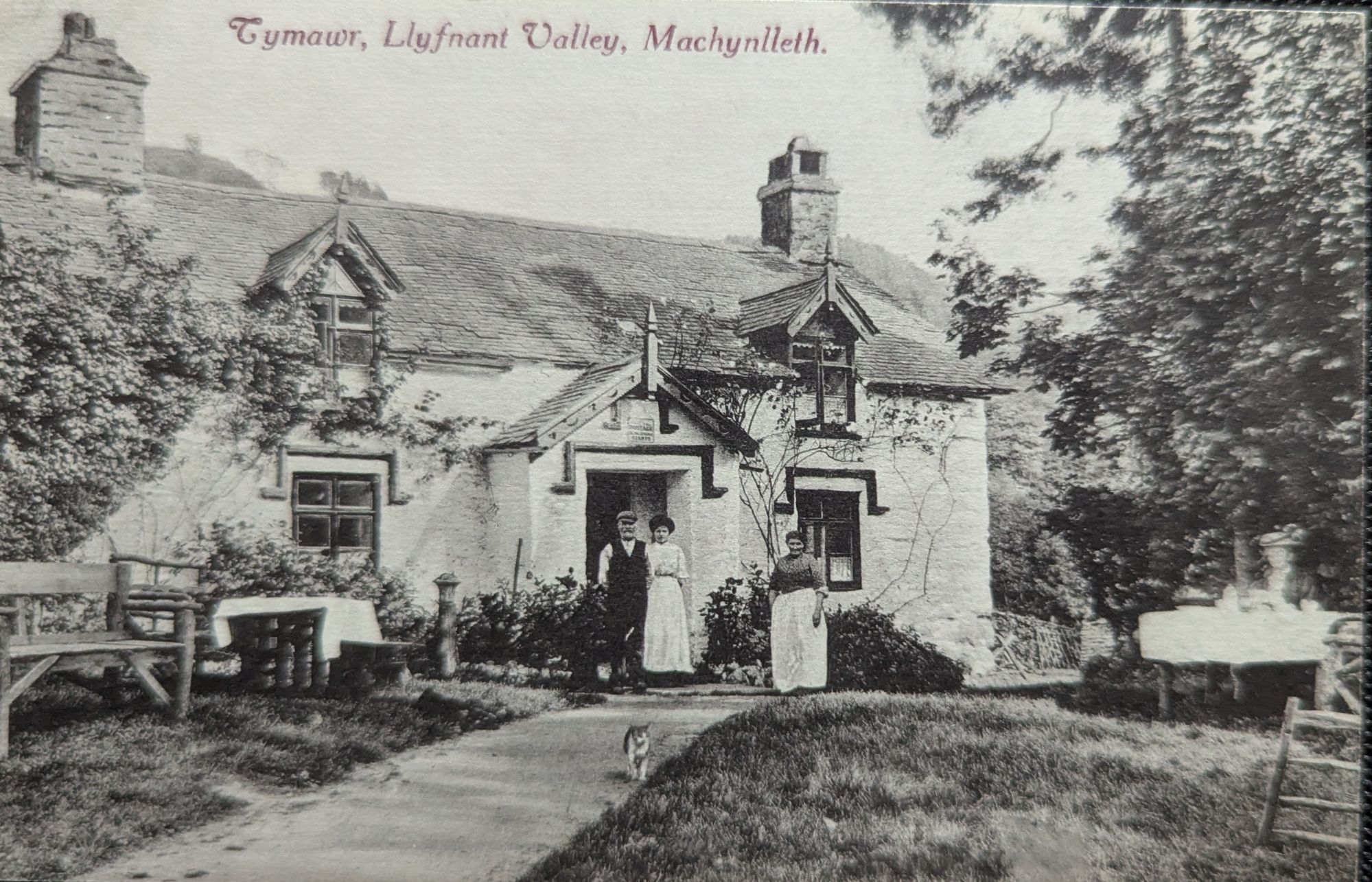
Some left the train at Glandovey, now Dovey Junction, and travelled inland through Glasbwll. They followed rough roads and increasingly uncertain paths towards the cascades and the great fall of Pistyll y Llyn. Before reaching it, they might stop at Tymawr, where John and Jane Waters offered tea, refreshments, postcards, stamps and practical advice.
For a small additional payment, John would act as a guide.
The enterprise was modest. There was no hotel, formal visitor centre or purpose-built restaurant. Tymawr remained a working tenant farm. Yet the Waters family recognised that the valley’s landscape possessed an economic value beyond sheep, woodland and agricultural rent.
Their tea room belongs to an early chapter in the history of rural tourism. It also tells a larger story about adaptation. John and Jane were not wealthy entrepreneurs arriving from outside to market an invented version of Wales. They belonged to the district’s farming society and found a way to bring the passing visitor into its economy.
For a brief period, their farmhouse stood between two worlds, the secluded life of the Llyfnant Valley and the expanding railway culture of Victorian Britain.
A daughter of Cwmrhaiadr
Jane Jenkins was born at Cwmrhaiadr on 27 August 1854.
The name means the valley, or hollow, of the waterfall. It was particularly appropriate in a landscape formed by steep slopes, fast water and dramatic changes in elevation.
Jane was the daughter of David and Jane Jenkins, part of an extensive farming family whose connections spread across Maescelyn, Cwmrhaiadr and other holdings within and around the Llyfnant Valley. She grew up in a Welsh-speaking rural society shaped by agriculture, chapel membership, kinship and the market life of Machynlleth.
Her childhood would have introduced her early to the work expected of women on an upland farm. That work extended far beyond the preparation of meals and cleaning of the house. Women participated in dairying, poultry keeping, food preservation, care of younger children and seasonal agricultural work. They also fed resident servants and labourers during the busiest points of the farming year.
These skills later made the Tymawr tea room possible. Visitors may have encountered John’s advertisements and guiding service, but the provision of food and hospitality from an isolated farmhouse would have depended substantially upon Jane.
Her contribution is difficult to trace because Victorian records generally placed commercial and agricultural activity under the husband’s name.
The tea appeared on the table under John Waters’s enterprise.
The work behind it was likely shared.
John Waters of Ystrad
John Waters was born around 1843 at Ystrad, near Llanfair Caereinion. He was the son of Jacob Waters, a farmer who lived from 1815 until 1894.
Like many farmers’ sons, John had to establish his own place within a system in which the family holding could not provide an independent livelihood for every child. By 1871 he had left Ystrad and was working as an agricultural labourer at Bryncaemisir in Forden.
This was not necessarily a permanent fall in status. Agricultural service allowed young men to develop practical experience, form connections and save money. A capable labourer could advance into positions carrying greater responsibility.
John subsequently became farm bailiff and gamekeeper at Cae Saer in the Llyfnant Valley. The property was associated with the estate of the Reverend Levi Rees Jacob.
As bailiff, John would have supervised farming activity on behalf of the owner. As gamekeeper, he occupied a more complicated position between estate authority and rural community. He was responsible for protecting game, monitoring land and discouraging poaching, an offence often rooted in poverty as well as commercial exploitation.
The appointments indicate that he was considered reliable. They also brought him into the valley where he met Jane Jenkins.
The couple married on Christmas Day 1874.
Making a home at Tymawr
By 1879, John and Jane were farming at Tymawr in Glasbwll.
The holding extended to approximately 100 acres and belonged to the Garthgwynion estate. Although modest in comparison with the great pastoral farms of the uplands, Tymawr was not a subsistence smallholding. It was a viable tenant farm requiring sustained family labour and careful management.
John and Jane appear never to have owned it.
That distinction shaped their economic position. Tenant farmers carried the immediate risks of production while remaining subject to rent, estate decisions and the terms of their tenancy. Improvements to buildings or land could benefit the holding without necessarily increasing the family’s long-term security.
In September 1906, Tymawr was sold by the Garthgwynion estate and purchased by Owen Owen. The Waters family nevertheless remained in occupation, showing that a change of ownership did not automatically displace the tenant.
Their decades at Tymawr coincided with difficult conditions in British agriculture. From the 1870s, cheaper imported grain and animal products placed pressure upon domestic prices. Welsh upland farms were less exposed to the collapse in arable income than grain-producing districts, but livestock values, wool prices and rents remained sources of anxiety.
Diversification became increasingly important.
The Waters family found opportunity in the landscape surrounding them.
The valley enters print
The Llyfnant Valley had, of course, been known to its inhabitants for generations. Its farms, tracks, river crossings and waterfalls formed part of an established working landscape.
What changed in the later nineteenth century was not the discovery of the valley itself, but its introduction to a wider reading and travelling public.
In 1879, the geologist Walter Keeping explored the district while studying the geology around Aberystwyth. Keeping was then associated with the University College of Wales, where he taught geology and natural science. He later published important work on the geology of central Wales.
He was deeply impressed by Pistyll y Llyn and drew attention to the approach from Glandovey station through Glasbwll.
It would therefore be misleading to say that Keeping “discovered” the waterfall. Local farmers and shepherds knew it perfectly well. What he did was translate a locally familiar feature into the language of scientific observation and scenic tourism.
The distinction mattered throughout Victorian Britain. Mountains, caves and waterfalls became publicly celebrated when scholars, travel writers and railway companies described them to metropolitan readers. Landscapes entered the tourist imagination through print.
Keeping’s description helped make the Llyfnant Valley legible to outsiders as a destination rather than merely agricultural country.
A railway to the edge of the valley
The arrival and expansion of the railway transformed travel through Mid Wales.
Glandovey station stood on the Cambrian route between Machynlleth and Aberystwyth. From there, visitors could leave the railway and travel towards Glasbwll and the waterfalls. During the 1890s, the Cambrian Railways actively promoted the Llyfnant Valley as an excursion.
Special ticketing arrangements allowed passengers travelling towards Aberystwyth to break their journey at Glandovey. Advertisements offered the possibility of transport into the valley during the summer season, shortening at least part of what would otherwise have been a lengthy walk.
This was a familiar railway strategy. Companies did not merely convey passengers to existing destinations. They helped create destinations through timetables, excursion fares, posters and guidebooks. Remote landscapes became commercially accessible once they could be attached to a station and advertised as a day’s experience.
The railway’s publicity sometimes described the Llyfnant Valley as being near Aberystwyth. That irritated representatives of the Machynlleth district, who believed their own town should receive the economic and geographical credit.
The disagreement reveals how tourism altered local competition. Scenic identity had commercial value. To say that a waterfall belonged to the Aberystwyth excursion market rather than the Machynlleth district affected where travellers stayed, ate and spent money.
Tymawr occupied the small but potentially profitable space between railway promotion and the physical demands of the excursion itself.
The Tymawr tea room
The earliest advertisement so far identified for refreshments at Tymawr dates from 1887.
By then, John and Jane had recognised what a journey to the waterfalls required. Visitors needed directions, food, drink and somewhere to rest. Those unfamiliar with the ground might also require a guide.
The Waterses supplied these needs from the farmhouse.
It is unlikely that Tymawr resembled a modern commercial café. The surviving evidence points instead to a domestic farmhouse enterprise, flexible enough to respond to visitors while agricultural work continued around it.
Tea was particularly suited to such a business. It required little specialised equipment beyond what already existed in the house. Bread, butter, cakes and other simple foods could be produced or prepared domestically. Milk came from the farm economy itself.
For visitors, the farmhouse added authenticity to the excursion. Refreshment was part of an encounter with rural Wales, taken in a household that belonged to the landscape rather than in an establishment constructed for tourists.
Tymawr also sold postcards and stamps. For a period in the early twentieth century, it functioned as a local postal point. This made the farmhouse useful to residents as well as visitors.
A tourist could see the waterfall, purchase an image of it and post that image from the valley. In doing so, each visitor participated in the valley’s advertisement. A postcard sent to Birmingham, Liverpool or London carried Pistyll y Llyn into another household and perhaps encouraged another journey.
The small postal transaction became part of the machinery of tourism.
John Waters, guide
John offered to guide visitors to the waterfalls for a modest fee.
This was not an unnecessary luxury. The route beyond Glasbwll could be difficult, especially in wet weather. Paths passed through working land and rough country, while a person unfamiliar with the valley could easily underestimate the distance or terrain.
John’s knowledge had practical value. He understood the farms, gates, river and safest approaches. His guiding service converted the accumulated knowledge of a rural worker into paid expertise.
The arrangement also gave visitors a point of contact with the community. John could explain the valley, identify features and provide the reassurance of local authority.
He was doing something now familiar across rural Wales, presenting a working landscape to people who came principally to consume its scenery.
Yet he did so before “heritage tourism” or “ecotourism” existed as recognised language. His enterprise was grounded in observation. Travellers were arriving, and he understood what they needed.
Civic responsibility
Tourism was only one part of John’s public life.
In April 1879, the Machynlleth Board of Guardians appointed him Overseer of the Poor for the Isygarreg district. The office required him to participate in the administration of local relief.
People in need could apply for assistance in money, food or clothing. The overseer occupied an uncomfortable position between poverty and the ratepayer. He was expected to identify genuine need while preventing expenditure upon those regarded by the system as undeserving.
It was a position of trust, but also of considerable power. A neighbour might have to disclose illness, unemployment or domestic hardship to someone who already knew the family and its reputation.
Ten years later, in 1889, John became a member of the Machynlleth Board of Guardians. The board controlled the Poor Law union’s budget and supervised the workhouse through appointed officials.
The records reveal that twenty-five meetings were held during that year and John attended eleven. His attendance was therefore limited, perhaps because of the distance from Tymawr, the demands of the farm or other commitments. He appears to have left the board in early 1890.
The detail is worth retaining because it prevents civic service from becoming ceremonial biography. John was elected, but he was not among the board’s most regular participants.
His public record was respectable rather than flawless.
Chapel, school and parish
John also served as a deacon of the Calvinistic Methodist chapel at Glasbwll.
The position placed him within the moral and administrative leadership of the local congregation. Deacons managed finance, property, discipline and relations with the wider denomination. In a small rural community, the role carried social influence far beyond Sunday worship.
Chapel participation encouraged the habits required for civic administration, reading minutes, handling subscriptions, speaking at meetings and weighing communal reputation. John’s movement from deacon to overseer, guardian and school-board member followed a recognisable pattern within rural Wales.
In December 1894 he stood for election to the new Isygarreg Parish Council. The Local Government Act of that year had created elected parish councils in rural England and Wales, transferring some authority away from older parish structures.
John lost by a single vote.
The narrow result shows that he possessed considerable local support, but not universal approval. Rural elections could be intensely personal, shaped by religion, tenancy, family loyalty and opinions about rates.
In September 1901 he was elected to the Derwenlas School Board. Here again, the farmer and chapel deacon entered an institution through which local people were acquiring greater influence over public life.
He belonged to the generation that connected voluntary chapel leadership with elected rural government.
The limits of private enterprise
The tourist economy at Tymawr depended upon access to a landscape the Waterses did not control entirely.
By 1908, criticism was growing over the condition of the route to the Glasbwll cascades and Pistyll y Llyn. The paths were narrow, muddy and potentially dangerous, particularly after rain.
On 28 August 1908, the Cambrian News argued that farmers who had benefited from visitors should have invested some of their earnings in improving access.
The criticism is revealing, but not necessarily fair.
Tenant farmers were not wealthy tourism authorities. They did not own every section of the route and may have lacked either the legal power or capital to undertake substantial improvements. A path used recreationally by visitors remained embedded within working farms whose principal business was agriculture.
The disagreement exposed a structural weakness in the valley’s tourist project. The railway could advertise the attraction, and individual households could sell refreshments, but no single organisation accepted responsibility for the whole visitor experience.
There was no coordinated system of signage, path maintenance, safety and promotion.
By 1917, the road into the valley itself was being criticised for its poor condition. The commercial future of tourism could not be secured by tea and postcards alone.
A household facing outward
John and Jane had seven children, although their family experience included early death and eventual dispersal.
Their first daughter, Jane, was born in 1875. She later married John Henry Davies, who worked first as a policeman and subsequently as a dairyman. Elizabeth, born in 1876, disappears from the presently established record after 1891.
A daughter, Margaret, died shortly after birth in 1878 and was buried in Machynlleth’s Nonconformist cemetery.
Three of the surviving children became part of the Welsh migration to London. David Jenkins Waters, born in 1879, established himself as a dairyman in Hackney. His brother John and sister Margaret Ann, known as Maggie, also worked in London and were associated with the dairy business.
Their movement followed a well-established route. Rural Welsh men and women brought agricultural knowledge into the expanding metropolis. London required reliable supplies of fresh milk, and Welsh families became notably involved in urban dairies.
These establishments could include cows kept behind the shop, early-morning milking and delivery rounds undertaken by handcart. The work was demanding, but it offered an alternative to uncertain prospects on a tenant farm.
The family’s adaptation therefore continued in another form. At Tymawr, agriculture had been combined with tourism. In Hackney, rural skills were transferred into urban food distribution.
David’s son, Ifan Richard Waters, born in 1916, later became a general practitioner in southern England. Within two generations, the family had moved from tenant farming through urban commerce into the medical profession.
Evan Richard Waters
The child most likely to succeed at Tymawr was the youngest son, Evan Richard Waters.
Born in 1883, Evan remained at home and worked under his father. He also developed a local reputation as a singer, competing successfully at eisteddfodau during the early twentieth century.
His musical ability placed him within another important element of chapel society. Eisteddfod competition gave rural men and women a public cultural life beyond occupation and class. A farmer’s son could acquire regional recognition through voice, recitation or composition.
Evan’s future appeared to lie at Tymawr. Unlike his siblings in London, he possessed the experience and presence required to continue both the farm and perhaps its visitor trade.
During the summer of 1910, however, he developed bronchitis. After an illness lasting approximately three months, he died at Tymawr on 21 September. He was twenty-seven.
His death altered the family’s future. There was no longer an obvious successor ready to continue the tenancy when John and Jane could no longer manage it.
The loss was emotional, but it was also economic. On a family farm, the death of an adult child could remove the person upon whom continuity depended.
The last years at Tymawr
John continued advertising refreshments and services for visitors until the final years of his life.
His activities extended beyond work and formal public service. According to the surviving family research, he was responsible for the first recorded fireworks displayed in the Llyfnant Valley during the New Year celebrations of 1900.
The episode fits his character. John appears repeatedly as someone willing to introduce an element of the wider world into an isolated district, whether tourism, postal services, elected governance or a night of fireworks.
He died at Tymawr on 21 November 1917, aged seventy-four. His death was attributed to Hodgkin’s disease. His personal estate was valued at £549.
The valuation was respectable but modest, and it discourages any exaggerated idea that tourism had made the family wealthy. The tea room supplemented farming. It did not transform John into a hotelier or substantial capitalist.
His death came during the First World War, when leisure travel had been heavily disrupted. Poor access and changing tourist expectations also weakened the valley’s position.
Jane, now widowed and without a child prepared to continue at Tymawr, left the farm. She moved to Birmingham House in Machynlleth, where she lived until her death from heart failure on 13 December 1941. She was eighty-seven.
Her life had extended from the remote farming world of the 1850s into the age of motor transport, radio and global war.
What the tea room represented
The Tymawr enterprise should not be described as a modern tourism business before its time without qualification.
It was small, seasonal and dependent upon infrastructure controlled by others. Its success probably fluctuated with weather, railway promotion and the condition of the paths. It did not free the family from agricultural work or establish lasting prosperity.
Its importance lies elsewhere.
John and Jane understood that rural survival required responsiveness. They did not abandon farming. They added to it. The house, food, postal service and John’s knowledge of the route became resources capable of generating additional income.
Their enterprise also complicated the relationship between host and visitor. The waterfall was not simply scenery. It existed within a landscape of farms, tenancies, labour and private rights. Visitors consumed its beauty, but local people absorbed the practical consequences of their arrival.
Tymawr became the point at which those interests met.
A valley briefly made visible
By the 1920s, the old concentration of interconnected family farms within the Llyfnant Valley was beginning to weaken. Maescelyn, Alltddu, Tymawr, Ceniarth, Cefnmaesmawr and other holdings gradually passed out of the family network.
This was not the disappearance of the valley itself. New tenants and owners continued to work the land. Describing it as entirely “lost” would erase the histories that followed.
What disappeared was a particular web of kinship.
For several decades, neighbouring farms had been connected by marriage, labour, inheritance, chapel and shared memory. Economic change and migration loosened that web. Younger people left for London and other cities. Some entered trades and professions that offered greater independence than a rented upland holding.
The movement was both loss and opportunity.
Today, the Llyfnant remains a secluded and dramatic landscape. Pistyll y Llyn still descends from the uplands into Cwm Rhaeadr, while the river passes through woodland and Glasbwll before reaching the Dyfi.
The waterfall does not require a tea room to exist. Yet without the records of John and Jane Waters, we would lose part of the human history surrounding it.
Their story reminds us that tourism was never created by railway companies and guidebook writers alone. It also depended upon the people who boiled water, prepared food, gave directions, opened gates and led strangers safely across unfamiliar ground.
For a time, Tymawr gave the Llyfnant Valley a front door.
Visitors entered through it, drank tea and carried the image of the waterfall away with them.
Related Books
Old Llyfnant Valley Farming Families
The Waters and Jenkins families, Tymawr and the wider network of Llyfnant Valley farms are explored in greater depth here.
Kindle · Paperback
From Fields to Railways: The Jenkins Family and the Making of Working-Class Britain
Jane Jenkins’s family forms part of the wider movement from rural Welsh agriculture into the industrial and railway world traced in this book.
Kindle · Paperback
Explore more: Continue with Welsh Rural History for related work on farming communities and upland life, or Family History & Genealogy for the wider reconstruction of families from archival evidence.
Sources and Further Reading
Probate records for John Waters, 1917.
Antony David Davies, Old Llyfnant Valley Farming Families, for the reconstruction of the Jenkins and Waters families, Tymawr, the early tourist enterprise and the later dispersal of the family.
Census returns for Montgomeryshire, Cardiganshire and London, 1851–1911, particularly those relating to Ystrad, Bryncaemisir, Tymawr and the Waters family’s Hackney dairy.
Civil registration certificates for Jane Jenkins, John Waters, Evan Richard Waters and other members of the family.
Cambrian News, 28 August 1908, for criticism of the condition of the paths leading through the Llyfnant Valley.
Advertisements in the Cambrian News, Cambrian Bay Visitor and other regional newspapers from 1887 onwards, relating to Tymawr refreshments, guides and the promotion of the waterfalls. These can be consulted through the National Library of Wales’s Welsh Newspapers Online.
Cambrian Railways advertisements and excursion notices from the 1890s, including arrangements allowing travellers to break their journey at Glandovey.
Walter Keeping, “Notes on the Geology of the Neighbourhood of Aberystwyth”, Geological Magazine, for the geological context in which Keeping explored the district. Cambridge University Press record.
Walter Keeping, “The Geology of Central Wales”, Quarterly Journal of the Geological Society, volume 37 (1881), pp. 141–170.
Machynlleth Board of Guardians minutes and attendance records, particularly those for 1879 and 1889–1890.
Derwenlas School Board records from 1901.
Garthgwynion estate sale material, September 1906, for the sale of Tymawr and its purchase by Owen Owen.