
History usually remembers the preacher whose sermons appeared in print, the politician whose speeches entered parliamentary record, or the benefactor whose name was carved upon a building.
John Davies of Erglodd belonged to a quieter order of influence.
He was a farmer, chapel elder, Sunday School teacher, temperance speaker and elected Poor Law guardian. He published no great theological work and held no ministerial office. Yet across the communities of Taliesin and Talybont, in northern Cardiganshire, he became known for his ability to teach children, support the vulnerable and sustain the institutions upon which rural Welsh life depended.
He was compared with Robert Owen of Nefyn, the celebrated Calvinistic Methodist minister known as Apostol y Plant, the Children’s Apostle. The comparison was a considerable tribute. It did not mean that Davies himself held Owen’s established title, but it placed this bachelor farmer from Erglodd within a distinguished Welsh tradition of religious education.
John Davies was my first cousin three times removed. His story is therefore part of my family history, but its significance reaches further. His life reveals how Welsh Nonconformity was maintained locally, not only by celebrated preachers, but by farmers, elders, teachers and organisers whose authority came from decades of dependable service.
From Esgair Hir to Cardiganshire
John Davies was born at Esgair Hir in the parish of Llanwrin, Montgomeryshire, on 19 November 1821. He was baptised at the farm on 30 November.
His parents were Thomas Davies and Mary Morgan, who had married at Llanwrin earlier that year. The family belonged to the interconnected farming society of the Dyfi uplands, where kinship, tenancy and chapel membership linked households across parish and county boundaries.
John’s early childhood was marked by movement between farms. By 1826 his father was farming at Poisnant, near Cemmaes, and by 1841 the family had moved to Caedw, near Machynlleth. During the following decade they crossed into Cardiganshire and settled at Erglodd, between Taliesin and Talybont.
The move did not take them outside the cultural world of the Dyfi. Machynlleth remained the principal market town for much of the surrounding countryside, while family, commercial and religious connections crossed the county boundary freely.
Erglodd became the family’s permanent centre. Thomas Davies was recorded there as a farmer in the 1851 census. By 1861 he occupied approximately 100 acres and employed one labourer and three boys. John, then forty and unmarried, remained within the household.
This was not a marginal subsistence holding. Erglodd was a substantial working farm by local standards, requiring hired labour and careful management. John’s religious commitments were therefore pursued alongside the continuing responsibilities of livestock, land and household economy.
His faith did not remove him from ordinary work.
It was practised through it.
The making of a chapel leader
John’s religious formation appears to have begun early.
A nineteenth-century biography of the Calvinistic Methodist preacher Dafydd Rolant preserves a glimpse of him as a young man. John was walking to a Methodist assembly at Dolgellau with Rolant and William Hughes of Pantperthog. Their conversation turned to religion, and John reportedly spoke with such confidence that Rolant remarked that the young man possessed sufficient gifts to conduct a seiat, or Methodist fellowship meeting, immediately, if only he received abundant grace.
The anecdote matters because it predates John’s later standing. It shows that his religious intelligence and ease of expression were already recognised before he became one of the established figures of the district.
The same account states that he went on to become a useful elder at Taliesin and Talybont and a prominent figure within the North Cardiganshire Monthly Meeting.
This was an important sphere of authority. Calvinistic Methodism did not depend upon ordained ministers alone. Elders supervised local causes, maintained discipline, organised meetings, supported ministers and represented congregations within the wider structures of the denomination.
John was associated with the Methodist cause at Talybont and served as an elder at Rehoboth Chapel in Taliesin. A surviving list of Rehoboth members from 1859 includes John Davies of Erglodd alongside members of his household and neighbourhood. The original membership list has been transcribed by the Llangynfelyn local history project.
The record is valuable because it places him within an identifiable worshipping community rather than treating chapel affiliation as a general family tradition.
The Sunday School in rural Wales
John’s greatest contribution was made through the Sunday School.
To modern eyes, the term may suggest a short class provided for children during a church service. In nineteenth-century Wales, the Sunday School was a much more substantial institution. It served children and adults, offered religious instruction and helped spread literacy through the reading of scripture and denominational literature.
Its purpose was explicitly Christian. Pupils learned the Bible, catechisms, hymns and doctrine. Yet its social effect extended beyond religious knowledge. In districts where formal educational provision remained uneven, the Sunday School created a local structure through which reading, recitation, questioning and public confidence could be developed.
It was also overwhelmingly Welsh in many rural communities. At a time when advancement through formal education was increasingly associated with English, the chapel demonstrated that Welsh remained capable of expressing detailed theology, moral argument and intellectual enquiry.
John Davies devoted more than thirty years to this work in Taliesin, Talybont and the surrounding district. He taught, organised and participated in the regular meetings through which different Sunday Schools compared progress and maintained common standards.
Contemporary reports praised his ability to communicate with children. He was remembered not merely for possessing biblical knowledge, but for drawing children into discussion through questioning, humour and clarity.
This was a distinctive skill. Victorian religious teaching could depend heavily upon memorisation and fear. Davies appears to have recognised that children possessed minds to be engaged rather than vessels to be filled mechanically.
John Davies and Apostol y Plant
Family and later local accounts have associated John with the title Apostol y Plant, the Children’s Apostle. The evidence requires a more careful distinction.
That epithet belonged most firmly to Robert Owen of Nefyn, a Calvinistic Methodist minister born in 1796. Owen became famous for his work among children and for the unusual effectiveness of his questioning.
A surviving recollection captures his method. Owen asked children why wool had been placed upon the sheep rather than the lion. One child answered that otherwise the lion could not be sheared. Owen used the response to make his central point, “A child has a mind, give it fair play.”
The recollection also places John Davies of Erglodd within Owen’s religious circle, but names Owen as Apostol y Plant. The Welsh-language account can be read in the recollections associated with Dafydd Rolant.
John was therefore not a second holder of Owen’s title, at least on the surviving evidence. He was compared with the Children’s Apostle because he displayed a similar gift.
That comparison is more historically meaningful than an incorrectly transferred nickname. It tells us that those who watched John teach placed him within a recognised tradition of humane and intelligent engagement with children.
He was not celebrated simply for controlling a class.
He was remembered for reaching it.
Recognition during his lifetime
John’s service did not pass unnoticed.
He served in senior positions within the district’s Sunday School organisation, including its regular inter-chapel meetings. In 1878, after decades of work, he was presented with a painted portrait and a formal address.
For a lay farmer, this was a striking honour. Portraiture carried social meaning. It preserved the appearance of a person whom a community believed worthy of remembrance. The presentation also indicated that John’s influence extended beyond his immediate family and congregation.
The honour did not celebrate wealth, military distinction or political rank. It recognised sustained work with children.
That tells us something about the values of the community presenting it. In the culture of Welsh Nonconformity, the person who taught scripture faithfully over many years could acquire a moral standing that rivalled more conventional forms of status.
Erglodd as farm and household
When Thomas Davies died at Erglodd in March 1876, John succeeded him as farmer.
The 1881 census recorded John as an unmarried farmer of 120 acres. His widowed sister, Elizabeth Jones, lived with him, together with a young farm servant and two female domestic servants.
Erglodd was therefore both a family home and an employing farm. John’s ability to devote time to religious and public work rested partly upon the labour of others, including his sister and the servants who sustained the household and agricultural business.
This deserves acknowledgement. Victorian accounts often treated public service as the achievement of an individual man while overlooking the domestic organisation that made it possible.
Elizabeth was not merely her brother’s housekeeper. She possessed a public and charitable identity of her own. During the 1870s, she served as treasurer of a local charity club through which women collected donations of money, clothing and food for poorer families during the winter.
John contributed a sheep each year so that the poor of Taliesin could have meat at Christmas.
The gift was practical and locally appropriate. A farmer gave from the resources available to him. Yet it also belonged to a paternalistic system in which relief depended partly upon the goodwill of those with property.
For the recipients, the distinction may have mattered less than the meal.
Elizabeth, Mary and the continuation of service
Elizabeth had married William Jones and had one daughter, Mary. William died when Mary was young, after which mother and daughter returned to the security of the Erglodd household.
John appears to have shared in Mary’s upbringing. In this sense, his work with children was not confined to the Sunday School. Erglodd itself contained an intergenerational family formed by widowhood and mutual dependence.
On 16 October 1876 Mary married James Thomas Morgan of Maesnewydd, near Talybont. Morgan became a substantial landowner, farmer, Justice of the Peace and Cardiganshire county councillor. He also served as a deacon and treasurer of the Methodist chapel at Talybont.
Mary and Elizabeth became known for welcoming travelling ministers to Maesnewydd. Meals provided an opportunity for hospitality, conversation and the strengthening of religious networks. This was another form of work frequently performed by women but described only indirectly in formal chapel history.
The values associated with Erglodd therefore continued at Maesnewydd. They were expressed through public office and chapel finance, but also through domestic hospitality and the practical support of ministry.
Temperance and the Good Templars
During the early 1870s, John became active in the International Order of Good Templars.
The Order was a fraternal temperance organisation committed to complete abstinence from alcohol. It organised local lodges, adopted ceremonies and offices modelled partly upon other voluntary societies, and gave members a sense of belonging to an international moral cause.
Temperance had considerable support within Welsh Nonconformity. Alcohol was associated with poverty, domestic violence, the loss of wages and spiritual disorder. Advocates therefore treated abstinence as both personal discipline and social reform.
John became a speaker for the movement in northern Cardiganshire. Newspaper reports described him as humorous and impressive before an audience.
That combination is important. Moral reformers are easily imagined as severe or joyless figures. John’s humour may have been one reason he communicated effectively with both children and adults. It allowed him to make a serious argument without reducing every audience to a collection of offenders awaiting rebuke.
The Order also gave laymen experience in public speaking, committee work and organisational procedure. Like the chapel, it formed part of the dense voluntary culture through which rural communities governed much of their own social life.
The prominence of the Good Templars in Victorian Wales is illustrated by surviving images of large temperance gatherings, including an 1880s gathering preserved by People’s Collection Wales.
Guardian of the poor
In 1882, John entered another sphere of public responsibility when he became a member of the Aberystwyth Board of Guardians.
The boards had been established under the reformed Poor Law system introduced after 1834. Guardians were elected by local ratepayers and oversaw the administration of relief within a Poor Law union. Their responsibilities included the workhouse, the appointment of officers and decisions affecting people seeking assistance.
Guardianship was both public service and social power. A guardian could help ensure that the sick, elderly and destitute received assistance. He also participated in a system deliberately designed to make public relief restrictive and, in many circumstances, humiliating.
John’s charitable reputation may have made him a conscientious guardian, but the surviving outline of his career does not tell us how he voted in individual cases. It would therefore be wrong to turn membership of the board automatically into proof of benevolent policy.
What can be said is that his neighbours trusted him sufficiently to elect him and that he continued serving until his death. The appointment moved him beyond voluntary charity into the formal administration of poverty.
The contrast is revealing. At Christmas, he could give a sheep as a personal act of generosity. At the Board of Guardians, he had to work within a statutory system of rates, regulations and institutional relief.
Victorian welfare operated through both worlds.
A life organised around service
John never married. It would be easy to describe him as solitary, but the evidence suggests the opposite.
His life was densely connected. He belonged to an extended household, a working farm, two chapel communities, a Sunday School network, a temperance lodge, a Methodist Monthly Meeting and a Poor Law union.
He also took an interest in the National schools at Taliesin and Talybont, even though those institutions belonged to a different educational tradition from the Methodist Sunday School. His concern appears to have been the education of local children rather than defence of one institution alone.
This breadth helps explain his standing. He did not restrict service to Sunday worship. Faith moved outward into teaching, public speech, charity and civic responsibility.
Nor was he a man without position. The original description of him as possessing neither wealth nor office goes too far. A 120-acre farmer employing servants occupied a position of consequence within rural society, and election to the Board of Guardians was a genuine public office.
His distinction lies not in powerlessness, but in how he used the authority he possessed.
Illness and the imagery of Job
John’s final illness lasted approximately eighteen months.
His death certificate recorded “general decay” brought about by chronic eczema. The language belongs to nineteenth-century medical practice and should not be converted too confidently into a modern diagnosis. Severe chronic skin disease could cause relentless itching, broken skin, infection, exhaustion and considerable psychological distress.
Those around John compared his suffering with that of Job.
The comparison was natural within a community formed by biblical language. Job represented undeserved affliction endured without surrendering faith. Ministers visiting Erglodd interpreted John’s illness through that scriptural pattern, finding spiritual meaning in suffering that medicine could do little to relieve.
Modern readers may be uneasy with the idea that illness ripened character. Such interpretations could console, but they could also romanticise pain.
For John’s contemporaries, however, the manner in which a person endured suffering formed part of the moral assessment of a life. His patience during illness was remembered as a final extension of the faithfulness he had shown in health.
Death and funeral
John Davies died at Erglodd on 15 June 1887. He was sixty-five.
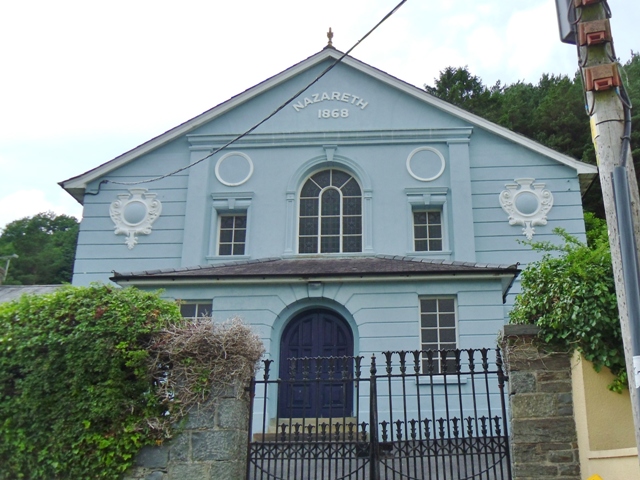
His funeral took place on Saturday 18 June. Despite the summer heat, a large company gathered to accompany his body to the Calvinistic Methodist burial ground at Talybont, associated with Nazareth Chapel, where he had asked to be buried.
Ministers and lay representatives of the denomination attended, reflecting his standing within the North Cardiganshire Monthly Meeting. Their tributes concentrated less upon formal achievement than upon the consistency of his life.
One eulogist declared that John had written his own elegy through the way he lived. Another used the agricultural image of mildew ripening the grain, applying the language of harvest to his final affliction.
The metaphor would have been immediately intelligible to a farming community. The life of the field and the language of scripture met naturally in the funeral of a farmer and elder.
Children, former pupils, neighbours and chapel members constituted the more enduring testimony. They had known him not through a printed biography, but through repeated encounters over many years.
The measure of a layman
John Davies’s importance should not be exaggerated into national celebrity. There is no evidence that he transformed Welsh education or exercised influence across the whole of Wales.
His achievement was regional, sustained and intimate.
That scale matters. Religious cultures are not maintained by famous leaders alone. They depend upon people willing to open buildings, prepare lessons, keep accounts, visit households and accept responsibility when no wider audience is watching.
John’s influence rested upon repetition. He returned to the Sunday School week after week. He attended the meetings through which chapels governed themselves. He spoke for temperance, served the Poor Law union and contributed materially to the relief of poorer neighbours.
His portrait was presented because his community had watched that service accumulate.
The surviving comparison with Robert Owen reveals the quality most valued in him. John respected the intelligence of children. He could question without humiliating, teach without merely reciting and hold attention without relying entirely upon fear.
In a religious culture sometimes caricatured as stern and oppressive, his example suggests a gentler form of authority.
The quiet architecture of Welsh Nonconformity
The history of Welsh Nonconformity is often written through revivals, great preachers and political campaigns. John Davies directs attention towards its local architecture.
That architecture was made of farms and kitchens as well as chapels. It depended upon women such as Elizabeth, who administered charity, and Mary, who welcomed travelling ministers. It depended upon hired servants whose work allowed farmers to attend public meetings. It depended upon children willing to learn and adults prepared to teach them.
John stood within this network rather than above it.
His life joined Montgomeryshire and Cardiganshire, farming and faith, private charity and public welfare. He represented the prosperous but not grand rural middle rank from which Welsh Methodism drew much of its organisational strength.
As his kinsman, I take pride in recovering his story. That pride does not require turning him into something he was not. He was not the original Apostol y Plant, nor was he a national educational reformer comparable in scale with Robert Owen of Newtown.
He was John Davies of Erglodd.
For more than thirty years, children listened when he spoke. His neighbours elected him to administer relief. His chapel trusted his judgement. His household extended protection across generations, and poorer families shared the practical fruits of his generosity.
That was the reach of his life.
It was quiet, local and profound.
Related Books
Voices from the Uplands: The Davies Family and the Soul of Rural Wales
John belongs to the wider network of upland families, chapel culture and rural communities explored in this book.
Kindle · Paperback
The Davies Caeadda Family: A Welsh Farming Dynasty, 1700–1966
This earlier family history provides the broader Davies family context from which John’s branch emerged.
Kindle · Paperback
Old Llyfnant Valley Farming Families
For the wider rural family networks and farming communities of the Llyfnant Valley connected with this story.
Kindle · Paperback
Sources and Further Reading
- Antony David Davies, The Davies Caeadda Family, for the reconstruction of the Esgair Hir and Erglodd families, census evidence, chapel work, charitable activity and later descendants.
- Cofiant Dafydd Rolant, Pennal, for the recollection of the young John Davies, his religious promise and his later standing at Taliesin, Talybont and within the North Cardiganshire Monthly Meeting.
- Rehoboth Chapel, Taliesin, membership list, 1859, recording John Davies of Erglodd within the congregation.
- Census returns for Llangynfelyn parish, 1861 and 1881. The 1881 local transcription records John as an unmarried farmer of 120 acres at Erglodd.
- Civil registration records, including John’s death certificate, which recorded his death at Erglodd on 15 June 1887 and attributed his final decline to chronic eczema.
- Contemporary reports in Welsh denominational and regional newspapers, particularly Y Goleuad, Baner ac Amserau Cymru, Y Tyst and the Cambrian News. These should be consulted through the National Library of Wales’s Welsh Newspapers Online.
- Aberystwyth Poor Law Union and Board of Guardians records, 1882–1887, held within the relevant local archive collections. Ceredigion Archives is the appropriate repository for further investigation.
- The National Archives, “Poverty and the Poor Laws”, for the responsibilities and organisation of Boards of Guardians after 1834.
- Eryn White, “Education and the Welsh Language”, in Hanes Methodistiaeth Galfinaidd Cymru: Y Twf a’r Cadarnhau, c.1814–1914, volume 3 (2011), pp. 225–270.
- People’s Collection Wales, “Temperance Gathering in Llandrindod Wells, 1880s”, for the wider presence of the International Order of Good Templars in Victorian Wales.