
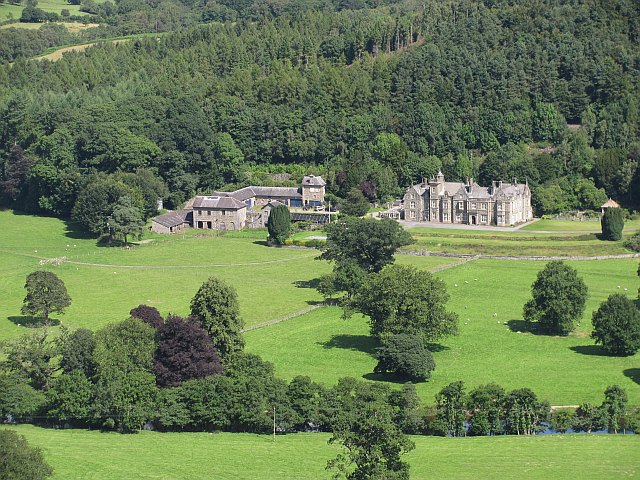
Between 1995 and 1997, when I was passing through the uncertain territory between childhood and adulthood, the Doldowlod estate became part of the landscape of my life.
My father worked there as the resident gardener. During school holidays, I was drawn into the practical routines of the place, sometimes helping outside, sometimes undertaking jobs around the house and gradually learning that an estate was not merely a large residence surrounded by attractive land. It was a working organism, dependent upon maintenance, judgement and the efforts of people whose labour was usually invisible to visitors.
Doldowlod also brought me into contact with Lord and Lady Gibson-Watt. Through them, I encountered a surviving form of country-house life that already seemed conscious of its own disappearance.
These were not years of lavish Edwardian display. There was no army of servants, no large gardening staff and no attempt to recreate a vanished golden age. The estate had adapted to the economic and social conditions of the late twentieth century.
Yet the older culture had not entirely gone. It survived in habits, expectations, conversations and attitudes towards land. It survived in the belief that ownership imposed obligations extending beyond personal enjoyment.
For a teenager already fascinated by history, Doldowlod was an education that no classroom could have provided.
A house shaped by industry
Doldowlod stands beside the upper River Wye, south of Rhayader, in a landscape of parkland, farms and wooded slopes. The present house, officially listed as Doldowlod House, developed in several stages during the nineteenth century.
Its origins as an estate residence were connected with James Watt, whose improvements to the steam engine helped drive the Industrial Revolution. Watt invested some of the wealth generated by industry in Welsh land, acquiring Doldowlod at the beginning of the nineteenth century. The estate was subsequently developed by his son and later descendants.
The house therefore embodied a familiar historical movement. Wealth created through manufacturing and technological innovation was translated into land, architecture and social permanence.
The present Jacobean-style building dates principally from the 1840s and 1870s. Its rock-faced stone, tall chimneys and picturesque arrangement gave architectural expression to the status of the family occupying it. Associated farm buildings, service ranges and estate structures made clear, however, that Doldowlod was never simply an ornamental retreat. It formed the centre of a working agricultural and forestry estate.
By the time I knew it, the world that had created such houses had largely vanished.
The country house after its age of confidence
The twentieth century had been difficult for British country houses. Agricultural depression, taxation, war service and rising maintenance costs had weakened many landed estates. Some houses were demolished. Others became schools, hotels, museums or institutional buildings. Contents and surrounding land were frequently sold to preserve what remained.
Doldowlod survived as a family home.
That distinction mattered. It was neither a heritage attraction nor a carefully staged reconstruction of an earlier period. The house was occupied, worked in and adapted. Rooms were used because they remained useful, not because a guidebook had assigned them a historical function.
There was grandeur, but also practicality. The estate could not be managed according to the staffing assumptions of the nineteenth century. Work once divided among numerous gardeners and domestic servants had to be undertaken by far fewer people.
My father’s role belonged to that changed world. He carried responsibility that, in an earlier period, would have been distributed across a much larger garden staff. Maintaining the grounds required not only horticultural knowledge but improvisation, patience and an acceptance that no estate is ever truly finished.
A fallen branch, damaged fence or neglected border could immediately reorder the day.
Lord Gibson-Watt
James David Gibson-Watt, Baron Gibson-Watt of the Wye, was in his late seventies when I knew him.
He was a tall man, around six feet four inches, whose physical presence reinforced a natural authority. Yet my memory of him is not of theatrical grandeur or deliberate intimidation. He possessed the confidence of someone accustomed to public responsibility, but he could move through the estate with an approachable, almost neighbourly manner.
Behind that ease lay an extraordinary public career.
Commissioned into the Welsh Guards in 1939, he fought in North Africa and Italy. In Tunisia, despite being wounded, he continued to command his company during the attack on Hammam-Lif. He received the Military Cross for gallantry and leadership.
At Monte Cerasola, near Monte Cassino, his conduct during a successful counterattack earned him a bar to the Military Cross. Further action in Italy brought a second bar. Such an accumulation was exceptional and reveals the wartime experience concealed beneath the quiet manner I encountered half a century later.
After the war, he entered local government and contested Brecon and Radnorshire before becoming Conservative MP for Hereford in 1956. He remained in Parliament until 1974 and served as Minister of State at the Welsh Office under Edward Heath. He entered the House of Lords in 1979.
He was also deeply involved with farming and forestry. He served as a Forestry Commissioner, chaired the Royal Welsh Agricultural Society’s council for many years and represented a tradition in which public life, agriculture and estate management were understood as connected responsibilities.
The Dictionary of Welsh Biography records that he acquired a reputation as one of the most honest and decent men in politics. That judgement corresponds with the figure I remember, authoritative, formed by institutions and certain of his values, but without any apparent need to advertise his importance.
Planting an oak
One memory has remained particularly clear.
Lord Gibson-Watt once invited me to help plant a young oak. As we worked, he spoke about the soil, the space the tree would require and the importance of thinking beyond the immediate appearance of the ground.
Planting a tree on an estate is a peculiar act of faith. The person lowering it into the soil may never see its maturity. An oak is planted for people not yet born, in a landscape that will outlive those making the decision.
As a teenager, I understood the task principally as work. Only later did I grasp what it represented.
Lord Gibson-Watt’s interest in forestry was practical rather than sentimental. Woodlands required planning, thinning and long-term management. A neglected plantation could not be restored in a season, while a badly considered decision might remain visible for generations.
The oak became a small lesson in historical time. The past was present in the mature trees around us, planted by people whose names were already fading. The future rested in the sapling at our feet.
History, I began to understand, was not confined to documents. It could be planted.
Lady Diana Gibson-Watt
It was Lady Diana Gibson-Watt whom I came to know more closely.
Born Diana Hambro, she came from a prominent banking family and married David Gibson-Watt in 1942, during the war. By the 1990s, she had spent more than half a century within the responsibilities and rhythms of Doldowlod.
She was energetic, direct and warm. She expected tasks to be completed properly, but her standards were accompanied by a genuine interest in the young people around the estate.
During the school holidays, she gave me my first paid employment.
The work consisted of the miscellaneous jobs that accumulate around any large house and garden. What mattered to me was not the grandeur of the setting, but the fact of being trusted to undertake them. Lady Gibson-Watt produced homemade timesheets on which my hours could be recorded carefully.
There was something wonderfully serious about those sheets. Each hour had to be accounted for. Work created an obligation on both sides. I was expected to perform the task properly, and she was equally determined that I should be paid correctly.
The amount itself mattered less than what it represented. These were the first wages I had earned through my own labour. They provided an early introduction to independence and to the moral relationship between work, time and payment.
I was no longer simply the gardener’s son passing through the grounds.
For those hours, I had a place within the working life of the estate.
The gardens that had gone
Lady Gibson-Watt loved the gardens and spoke about their history with affection.
She remembered a period when the grounds had been maintained by a much larger staff, with specialised gardeners responsible for different areas. There had been a head gardener, men beneath him and a structure of knowledge passed down through daily work.
That world had depended upon an abundance of relatively inexpensive labour. Its great borders, kitchen gardens, glasshouses and carefully managed lawns did not maintain themselves. The celebrated country-house garden was always a work of labour before it became an object of beauty.
By the 1990s, much of that labour structure had disappeared. One gardener might be expected to undertake work previously divided among several men. Some areas could be maintained, others simplified. Features once central to the life of the house became too costly or time-consuming to preserve in their original form.
Lady Gibson-Watt could speak of this loss with melancholy, but not with complete self-deception. The old estate system had possessed order and skill, but it had also depended upon rigid hierarchy and a large servant class.
What survived at Doldowlod was not the entire apparatus of the traditional country house. It was an adapted remnant, shaped by reduced staffing and practical compromise.
As a teenager, I had little passion for herbaceous borders. What held me were the stories. Through them, I learned to see the garden not as a static arrangement but as an accumulation of decisions, labour and memory.
A border could be an archive.
Work behind the scenery
Growing up around country houses had already taught me that visitors usually see the finished surface.
They notice the façade, lawns, mature trees and arrangement of rooms. They seldom see blocked drains, machinery that refuses to start, weeds advancing faster than they can be removed or the continuing struggle against water, weather and decay.
At Doldowlod, I saw more of the machinery behind the appearance.
The estate’s beauty depended upon repetition. Grass had to be cut again because it had grown again. Leaves returned each autumn. Gravel migrated from paths. Trees shed branches. Tools required attention. Nothing remained orderly merely because it had once been put in order.
This was another form of historical instruction. Preservation was not passive. Continuity had to be made repeatedly through work.
The same was true of the house. A country residence can appear permanent while requiring constant intervention simply to remain standing and usable.
Doldowlod was not frozen in its nineteenth-century form. Parts of the service accommodation had already been removed after the Second World War. Other buildings had acquired new purposes. Each generation altered the estate according to resources and need.
Survival was itself a form of adaptation.
Politics at the kitchen table
Lady Gibson-Watt was an unapologetic Conservative.
The mid-1990s were a particularly interesting time to encounter that political tradition. John Major’s government was struggling with internal division, electoral unpopularity and the long aftermath of Thatcherism. Tony Blair had become Labour leader in 1994 and was reshaping his party in preparation for government.
In 1995, John Redwood challenged Major for the Conservative leadership. Lady Gibson-Watt encouraged me to follow the contest and expected me to know what was happening.
Her questions were not neutral. She possessed firm opinions and was perfectly capable of making them known. Yet she did not demand that I reproduce them. She encouraged me to form a view and defend it.
For a teenager, this was significant. Politics ceased to be something conducted by remote figures on television. It became a subject upon which I might reasonably be expected to think.
One phrase remains with me. As I recall it, she would tell me, “Always thank God you’re British.”
Read without context, the remark might appear jingoistic. That is not how I understood it. It expressed her gratitude for the institutions, continuity and relative stability of the country she knew. Her patriotism was instinctive and inherited, formed by wartime experience, family service and confidence in Britain’s constitutional order.
My own political outlook would not become identical to hers. Indeed, much of intellectual development consists of examining the assumptions inherited from people one admires.
What she gave me was not a party allegiance.
It was permission to take politics seriously.
Two country houses
By the time I arrived at Doldowlod, my historical imagination had already been shaped by Stokesay Court.
Sir Philip Magnus-Allcroft had encouraged my interest in the past and helped me recognise that a country house was more than architecture. It was a concentration of family memory, social hierarchy, employment and changing power.
Doldowlod offered a different experience.
At Stokesay, my relationship with history had begun through stories, objects and the encouragement of an older mentor. At Doldowlod, history became inseparable from work. I encountered it through gardening, maintenance, estate routines and conversations held during ordinary tasks.
Both houses taught me that inherited places retain traces of the people who shaped them. Neither was simply a romantic survivor. Their beauty existed alongside labour, cost, anxiety and continual adjustment.
The country-house world had produced privilege, but it had also cultivated ideas of duty, stewardship and continuity. Those ideals were never fulfilled perfectly. They could disguise inequality or excuse authority. Yet in their best form, they insisted that possession carried responsibility.
That idea remained with me.
Social distance and human familiarity
Looking back, I am also conscious of the social structure surrounding these memories.
I was the teenage son of an employee. Lord and Lady Gibson-Watt were members of a family whose land, public standing and connections stretched across generations. No amount of warmth erased that difference.
Yet country-house relationships were rarely explained entirely by class categories. Daily proximity created forms of familiarity that coexisted with hierarchy. Employers knew about family circumstances. Workers acquired an intimate knowledge of the estate. Children moved through spaces in ways that formal visitors did not.
That familiarity could be generous, but it remained unequal. Lady Gibson-Watt could create work for me because she possessed the authority and resources to do so. My homemade timesheets were affectionate objects, but they also recorded an economic relationship.
Recognising that does not diminish the kindness involved. It makes the memory more truthful.
The Gibson-Watts did not treat me as socially invisible. They took an interest in what I thought, expected standards from me and allowed a young person to feel that his work and opinions mattered.
That combination of authority and attention made a lasting impression.
A world near its ending
Lady Gibson-Watt died in August 2000. Lord Gibson-Watt died at Doldowlod in February 2002.
By then, my teenage years on the estate had ended. The political world we had discussed had also changed. New Labour had won its landslide victory in 1997, devolution had created a National Assembly for Wales, and the constitutional settlement Lord Gibson-Watt had defended was beginning to pass into history.
The country-house culture they represented was changing too. It had not disappeared, but it could no longer assume the authority or social deference it had once possessed.
What remained was the estate, the landscape and the consequences of choices made across generations.
James Watt had acquired land in Radnorshire using wealth created through industrial innovation. His descendants had developed the house, farms and woodlands. In the 1990s, I encountered the estate not at the height of its power, but during its long adaptation to a different Britain.
That timing mattered. Had I known Doldowlod in the 1930s, I might have remembered its staff and formal hierarchy. Had I encountered it only as a historic property, I might have seen interpretation boards rather than domestic life.
Instead, I knew it as a working family home carrying the remains of an older order into the final years of the twentieth century.
An apprenticeship in historical understanding
Those summers gave me my first paid work, but their deeper influence only became clear later.
Lord Gibson-Watt taught me something about stewardship when we planted an oak whose maturity neither of us would see. Lady Gibson-Watt taught me that young people should be expected to work properly, paid fairly and invited into serious conversation.
My father’s work showed me the labour concealed beneath the apparent tranquillity of an estate. The gardens demonstrated that inherited beauty survives only through repeated effort.
Above all, Doldowlod taught me to look for history in relationships.
The past was present in the trees, the altered service buildings and the stories of vanished gardeners. It was present in Lord Gibson-Watt’s military bearing, in Lady Gibson-Watt’s patriotism and in the quiet assumptions governing daily life.
I did not become a historian simply because I read books. I became one because places such as Stokesay Court and Doldowlod taught me that history is inhabited.
It lives in buildings and landscapes, but also in gestures, habits and remembered conversations. It survives in the way a person explains how to plant a tree, in an old account of a garden staff, or in a homemade timesheet recording a teenager’s first wages.
Between 1995 and 1997, I thought I was spending my school holidays earning money and helping around an estate.
In reality, I was learning how to read a world.
Sources and Note on Memory
This essay is primarily a personal recollection. Descriptions of conversations, employment and daily life at Doldowlod are drawn from my own memories of the years between 1995 and 1997. Where exact words are given, they record the substance of phrases as I remember them rather than a contemporaneous transcript.
- Dictionary of Welsh Biography, “James David Gibson-Watt, Baron Gibson-Watt (1918–2002)”, for his military service, parliamentary career, public appointments, family and later life.
- Cadw statutory listing material for Doldowlod House and its associated estate buildings. The record describes the house’s nineteenth-century development, architectural character and surviving service ranges.
- The Radnorshire Society, “James Watt, Father and Son”, for the Watt family’s acquisition and development of Doldowlod and the wider estate.
- University of Birmingham, “Watt in the World”, for James Watt’s industrial career and acquisition of the Doldowlod estate.
- Cadw listing material for the tack room, farm range, courtyard buildings and other structures associated with the working estate.