
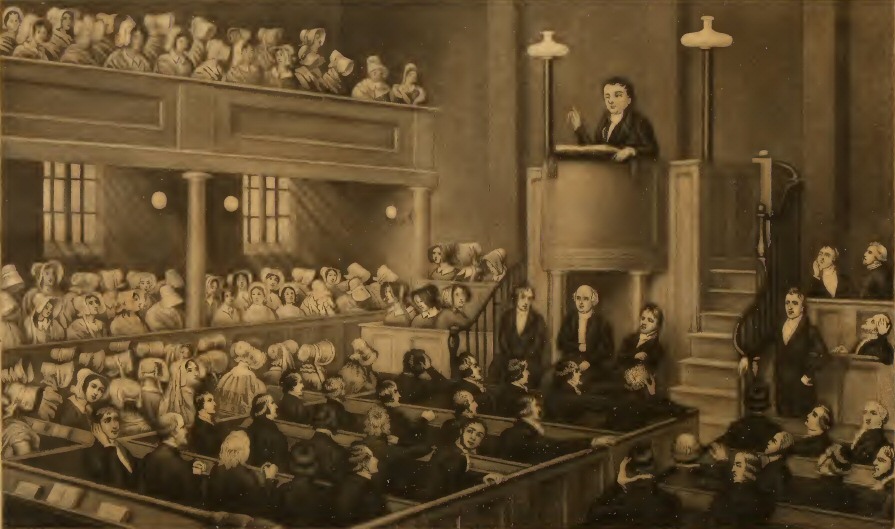
Picture a rural Welsh chapel on a Sunday evening in the later nineteenth century.
Outside, rain moves across the hills and darkness has closed around the farms. Inside, coats steam gently in the warmth. The congregation sits beneath the gallery, men and women packed closely together, waiting for the service to begin.
They have not come merely to hear notices, prayers and a respectable religious address. They have come to hear the preacher.
If he is ordinary, they will know it within minutes. If he is gifted, the silence will tighten around him. His voice will rise and fall, gathering rhythm and urgency until preacher and congregation seem to be moving together. A cry of assent will come from somewhere beneath the gallery. Another will answer it. Reserve will give way to tears, conviction or exhilaration.
By Monday morning, the sermon will be discussed in farmyards, workshops and kitchens. Its phrases will be repeated. Its weaknesses will be dissected. If it was exceptional, people may remember it for the rest of their lives.
Before broadcasting, cinema and the machinery of modern celebrity, the Welsh chapel possessed its own public figures. The greatest preachers travelled widely, drew immense congregations and acquired reputations extending far beyond their own denominations.
They held no hereditary titles and commanded no armies. Yet, for much of the nineteenth century, they exercised an authority that few politicians or landowners could match. They were the uncrowned kings of Wales.
A nation remade by religion
The power of the Victorian Welsh pulpit had been prepared by the religious transformations of the previous century.
The Methodist revival associated with Howell Harris, Daniel Rowland and William Williams of Pantycelyn brought a new emotional urgency to Welsh Protestantism. Itinerant exhorters crossed parish boundaries, preached in homes and fields, and treated personal conversion as a matter of immediate consequence.
At the same time, Griffith Jones’s circulating schools taught large numbers of adults and children to read through the medium of the Welsh Bible. The schools originated within Anglicanism, an important reminder that the relationship between Welsh literacy and Nonconformity was not as exclusive as later chapel historians sometimes suggested. Nonconformists nevertheless inherited and greatly expanded this culture of scriptural education.
By the nineteenth century, Methodists, Independents, Baptists and Wesleyans had established chapels across rural and industrial Wales. Some were small buildings serving scattered farming districts. Others were vast urban temples capable of accommodating congregations numbered in their hundreds or thousands.
The scale of that transformation can be measured more clearly than the surviving buildings alone suggest. The 1851 Census of Religious Worship recorded attendances rather than individual worshippers, so a person attending more than one service could be counted more than once. Even with that qualification, the figures are remarkable. Across Wales it recorded 256,175 attendances at Calvinistic Methodist worship, 172,463 among the Baptists and 105,351 among Wesleyan Methodists. The Church of England figure was 197,911, while a further 245,105 attendances were recorded among other religious bodies. The underlying census figures can be explored through A Vision of Britain Through Time.
These numbers should not be turned into a crude headcount of religious allegiance, but they do reveal the extraordinary institutional weight of chapel religion by the middle of the century. Nonconformity was no longer a collection of marginal dissenting communities. Across much of Wales it had become one of the principal worlds through which ordinary people worshipped, learned, associated and understood the moral life of their neighbourhood.
Their doctrinal differences mattered. Their systems of government differed, as did their attitudes towards baptism, ministry and church organisation. Yet together they created a religious culture in which preaching occupied an exceptionally prominent position. The sermon was not an addition to worship. It was its dramatic and intellectual centre.
The people’s stage
Before electronic entertainment, public speech was itself a major cultural form. Political meetings, eisteddfodau, lectures and religious gatherings offered ordinary people access to performance, argument and collective emotion. The pulpit stood at the centre of this oral culture.
A successful Welsh preacher needed more than theological knowledge. He required a commanding voice, a memory capable of holding long arguments, an instinct for rhythm and an ability to translate doctrine into images understood by farmers, quarrymen, miners and tradesmen. The greatest preachers did not merely explain a biblical text. They constructed a world around it.
Christmas Evans, one of the towering figures of the Welsh Baptist pulpit, became renowned for sermons that unfolded almost like dramas. Characters appeared, landscapes opened and abstract doctrines became visible through allegory. The Dictionary of Welsh Biography describes him as playwright and actor as well as preacher, a man whose imagination gave theological argument the force of theatre.
Evans died in 1838, before the Victorian period had fully begun, but his reputation helped establish the model inherited by later preachers. John Elias, Henry Rees, David Charles Davies and other celebrated ministers belonged to a culture in which listeners travelled long distances to judge a sermon for themselves.
The travelling preacher belonged to a national circuit of reputation. John Jones of Blaenannerch began preaching in 1833 and soon toured the country, as the Dictionary of Welsh Biography notes was customary in the period. For more than forty years he was among the most highly regarded figures at Associations and preaching festivals, his resonant voice and fiery eloquence becoming known far beyond his own district.
A generation later Thomas Charles Edwards represented another version of the same national authority. Oxford educated, a first-class classicist, biblical scholar and the first principal of the University College of Wales at Aberystwyth, he was nevertheless called repeatedly to preach throughout Wales. His biography records the endless demands made upon him as a preacher, year after year, at Associations and preaching festivals. The point is revealing. A university principal could still be urgently wanted because, above all else, Wales knew him as a preacher.
Edwards also shows how the tradition changed. The great preacher was no longer necessarily a self-taught master of oral culture. By the later nineteenth century the pulpit increasingly intersected with university scholarship. Edwards combined the zeal of the evangelist with the intellectual authority of the scholar, a newer kind of uncrowned king whose reputation rested upon learning as well as voice.
Preachers were compared with one another. Their mannerisms were imitated. Their finest passages circulated orally and in print. Denominational meetings could become national occasions, with expectations resembling those surrounding a major political speech or musical performance.
The Welsh people were not passive in this relationship. They formed an exacting audience. Congregations knew their Bibles, understood the established conventions of preaching and could distinguish borrowed eloquence from genuine command.
A minister might possess formal learning and still fail in the pulpit. Another, with little institutional education, might hold an audience through imagination, spiritual intensity and mastery of spoken Welsh. The congregation bestowed authority, but it could also withhold it.
The mystery of hwyl
No discussion of the Welsh pulpit can avoid hwyl. The word resists simple translation. It can indicate mood, enthusiasm, emotional impetus or a state of inspired animation. In preaching, it came to describe the rising cadence through which a sermon appeared to move beyond ordinary speech.
The preacher’s voice gathered rhythm. Sentences became shorter or more intensely patterned. Biblical language, repetition and tonal variation created a sense of mounting momentum. The congregation responded, sometimes with audible assent, tears or spontaneous prayer.
Yet hwyl was not simply shouting, excitement or theatrical excess. Nor was it a technique that could be reliably manufactured. A preacher who deliberately chased emotional effect risked exposing himself as artificial.
Authentic hwyl, as believers understood it, arose when argument, language, personality and spiritual conviction converged. The preacher was carried by his subject, and the congregation was carried with him.
To an outsider, the scene might appear uncontrolled. In reality, it possessed its own conventions and disciplines. The sermon normally began with exposition, developed through ordered argument and only then approached its emotional height.
There was always a tension between performance and sincerity. Great preaching required dramatic ability, but the congregation had to believe that the drama served the message rather than the preacher’s vanity.
At its most powerful, hwyl created a temporary community of feeling. People whose working lives were governed by repetition, danger and economic insecurity could experience fear, grief, hope and release collectively.
Emotional power did not always sound the same. Thomas Hughes of Trawsfynydd, known as Glan Pherath, became famous as a “tearful” preacher who could move his hearers to tears. Thomas Richard of Pembrokeshire occupied another register altogether. The Dictionary of Welsh Biography remembered the charm of his voice, but also his capacity to thunder at an audience in a manner so formidable that he became something of an autocrat in his district.
Hwyl therefore had no single sound. A preacher might console, overwhelm, frighten or release. What mattered was the ability to change the emotional temperature of a congregation, sometimes containing hundreds or thousands of people, and to persuade those listeners that the feeling arose from the truth of the message rather than from performance alone.
The preacher did not simply address the congregation. For a time, he gave it a single voice.
Pulpit, pew and sêt fawr
The architecture of the chapel expressed its social order. The pulpit dominated the interior, frequently elevated so that the minister could be seen throughout the building. Beneath or near it stood the sêt fawr, the great seat occupied by the deacons or elders. The congregation faced both.
This arrangement represented more than convenience. The pulpit embodied the authority of scripture and preaching. The sêt fawr represented the organised judgement of the chapel community.
The minister was powerful, but he was not always sovereign. In many Nonconformist traditions, the congregation selected or called its minister and contributed directly to his support. Deacons controlled finance, property, membership and much of the chapel’s daily business. A strong sêt fawr could restrain a minister as readily as it could reinforce him.
The chapel was therefore not simply a religious monarchy. It was a small governing institution, complete with meetings, accounts, elections, disputes and negotiated authority.
For men excluded from the highest levels of county administration, the chapel offered experience in chairing meetings, managing subscriptions, keeping records and addressing an audience. It trained generations in the habits of voluntary organisation.
Its democracy was incomplete. Leadership remained overwhelmingly male, even though women formed an indispensable part of chapel life. They raised funds, taught children, organised charitable work, sustained congregational networks and transmitted religious practice within the home. Their labour made the institution possible, but formal authority usually rested with men. The pulpit could challenge established privilege while reproducing another hierarchy of its own.
Kings without fortunes
There was an irony at the heart of the preacher’s authority. The men who could dominate the moral imagination of a district were not necessarily prosperous men. Many rural ministers lived on strikingly modest incomes, dependent upon voluntary contributions from congregations whose members were themselves farmers, labourers, quarrymen, miners and tradesmen.
Michael Watts’s study of Victorian Nonconformist ministry found that fifty-five Welsh Baptist ministers surveyed in 1862 received an average annual salary of only £36 6s 7d. Welsh pastors were among the worst paid in British Nonconformity. Watts’s chapter on the incomes and lives of Nonconformist pastors provides a useful corrective to any image of the famous preacher as a wealthy public figure.
This helps explain what was distinctive about the Welsh preacher. His authority was neither feudal nor financial. He might possess less money than the prosperous farmer sitting below him and infinitely less property than the local squire. His power depended instead upon reputation, intellect, religious office, command of language and the willingness of a community to accord moral weight to his judgement. An uncrowned king might return from an Association at which thousands had listened to him and spend the following week worrying about the household accounts.
A moral court
The chapel’s influence extended deeply into private conduct.
Membership was not merely a declaration of belief. It placed an individual within a disciplined moral community. Drunkenness, sexual misconduct, violence, dishonesty and disregard for the Sabbath could become matters for chapel investigation.
A member accused of wrongdoing might be visited, questioned, admonished, suspended or expelled. Repentance could bring restoration, but public knowledge of the offence could not always be contained.
In a close rural community, chapel discipline and social reputation were inseparable. The minister and deacons possessed no police force, but they did not require one. Their authority operated through belonging. To lose chapel standing could mean embarrassment before neighbours, damage to family respectability and exclusion from one of the central institutions of communal life.
This power could be protective. Chapels supported the sick, collected money for families in distress and gave ordinary people a framework of mutual obligation. They could restrain violence, encourage sobriety and insist that wealth did not excuse moral failure.
They could also be intrusive, judgemental and unforgiving. Pregnant unmarried women were likely to bear a far greater burden of shame than the men involved. Religious discipline could turn private sorrow into public humiliation. Communities that protected their respectable members could be merciless towards those judged to have failed.
The chapel offered dignity, solidarity and moral seriousness. It could also watch.
Temperance and the government of appetite
No campaign demonstrated the reach of chapel morality more clearly than temperance. Alcohol was associated with poverty, domestic violence, industrial accidents and the dissipation of wages. Ministers and deacons therefore presented abstinence not simply as personal self-control, but as protection for the household and community.
Temperance meetings adopted many of the methods of revival religion. They used testimony, public pledges, hymns, emotional appeals and collective commitment. Children joined juvenile temperance organisations, while adults publicly renounced drink.
The movement could be paternalistic and severe. It sometimes reduced complex social problems to individual moral failure. Yet it also offered working people a language through which to confront genuine harms within their communities.
Temperance helped move the preacher beyond the chapel walls. He became an advocate, lecturer and public organiser whose authority touched family expenditure, male respectability and the use of leisure.
In 1881 this moral campaign entered statute law in an unusually direct form. The Sunday Closing (Wales) Act prohibited the retail sale of intoxicating liquor throughout Sunday in Wales. It was the product of a temperance culture with particularly strong support among the Nonconformist denominations, and it demonstrated how convictions cultivated in chapel could become national legislation. The text of the 1881 Act stated plainly that licensed premises in Wales were to remain closed throughout Sunday.
The measure should not be romanticised. Its effectiveness was debated, private clubs provided ways around its restrictions, and later generations increasingly resented the paternalism it represented. Yet for the Victorian period its significance is unmistakable. A conviction repeatedly voiced from Welsh pulpits, that Sabbath observance and control of drink were matters of public morality, had acquired the force of law. The preacher possessed no legislative authority himself, but the culture he represented could shape legislation.
The salvation of the soul and the government of the household became parts of the same mission.
The chapel and the Welsh language
The chapel’s most enduring achievement may have been its contribution to Welsh literacy.
The Welsh Not, used in some nineteenth-century schools to discourage children from speaking Welsh, has acquired great symbolic importance. A surviving example from Pontgarreg School dates from 1852. A pupil heard speaking Welsh could be made to wear the object and pass it to another child caught doing the same. The pupil left holding it at the end of the session might be punished. Amgueddfa Cymru preserves both the object and an account of its use.
Its prevalence should not be exaggerated. The practice varied considerably by school and locality, and recent scholarship has challenged the idea that a single centrally directed policy explains the decline of Welsh. It nevertheless represented a wider educational culture in which English was increasingly presented as the language of advancement. The chapel offered a different linguistic world.
Here Welsh was not treated as an impediment to intelligence. It was used for prayer, theology, public debate, biblical interpretation and moral philosophy. A preacher capable of handling complex doctrine in Welsh demonstrated the intellectual capacity of the language every time he entered the pulpit.
Sunday Schools provided a vast network of popular education. Children and adults learned to read scripture, recite passages and answer questions. Lessons could be repetitive and doctrinally narrow, but they brought literacy into communities that possessed limited access to formal schooling.
The relationship between religion and literacy did not begin with Victorian Nonconformity. The translation of the Bible, Anglican circulating schools and earlier educational initiatives had already established vital foundations. Nonconformists built upon this inheritance through denominational publishing, Sunday School literature and an expanding Welsh-language press.
The pulpit also extended into print. Ministers and chapel leaders inhabited a vigorous Welsh-language world of denominational magazines, newspapers, sermons, biographies, theological books and political journalism. William Rees, better known as Gwilym Hiraethog, combined Independent ministry with writing, editing and political leadership. He founded Yr Amserau in Liverpool in 1843 and used its pages to discuss religion, politics, education and reform. His career demonstrates how naturally pulpit, press and political argument could overlap.
John Roberts, Ieuan Gwyllt, provides another example. A Calvinistic Methodist minister and musician, he edited and published, lectured across Wales and became a major figure in the development of congregational music. Print therefore did not immediately displace oral authority. It amplified it. A sermon could become a pamphlet, a minister’s argument could reappear in a periodical, and a reputation created before a chapel congregation could travel to readers who had never heard the preacher’s voice.
The chapel preserved Welsh as more than the language of home and field. It made it a language of abstraction, discipline and public authority.
The Blue Books and a wounded nation
In 1847 the British government published its reports into the state of education in Wales. Known collectively as the Blue Books, they contained valuable evidence about poverty, schooling and everyday life. They also included profoundly prejudiced judgements about Welsh language, Nonconformity and sexual morality.
The inquiry had been conducted by three monoglot English-speaking Anglican commissioners. Their findings appeared to many Welsh readers not merely as criticism of inadequate schools, but as an attack upon the character of the nation.
The response became known as Brad y Llyfrau Gleision, the Treachery of the Blue Books. The National Library of Wales describes the furore created by the reports and their lasting effect upon the Welsh mind.
The insult strengthened the claim of Nonconformist leaders to speak for Wales. Ministers defended the morality of their congregations, denounced metropolitan ignorance and presented the chapel as a guardian of national dignity.
That defence was not wholly uncomplicated. Some Welsh people internalised the assumption that social advancement required English. Others used the controversy to construct an idealised image of chapel Wales as uniformly devout and morally superior.
Nevertheless, the Blue Books helped turn religious affiliation into a question of national honour. An attack upon Nonconformity could now be understood as an attack upon Wales itself.
The radical conscience
By the later nineteenth century, Welsh Nonconformity and Liberal politics had formed a powerful, though never absolute, alliance.
The chapels opposed privileges associated with the established Church. Disputes over church rates, education, burial rights, tithes and disestablishment gave political expression to religious grievance.
Franchise reform and the secret ballot increased the power of Nonconformist voters. Ministers addressed public meetings, denominational newspapers carried political arguments and chapel networks helped mobilise communities that had previously possessed little formal influence.
Perhaps the clearest test of this influence came with the general election of 1868. Dissenting ministers increasingly treated questions involving religious privilege as questions of conscience, and opponents accused some of using spiritual or social pressure to direct the votes of chapel members. The controversy reached the House of Commons in July 1869. Defenders denied that congregations could simply be manipulated from the pulpit and pointed to an obvious contradiction: critics sometimes depicted the minister as financially dependent upon his congregation, and at other times as a despot capable of controlling it. The parliamentary debate nevertheless acknowledged that Welsh Dissenting ministers had taken an active and earnest part in the election. The debate can be read in the historic Hansard record.
The significance lies less in proving every accusation than in the fact that contemporaries found such influence plausible. Nobody needed to fear the electoral intervention of a socially irrelevant preacher. The controversy itself reveals how closely religious authority and political behaviour had become intertwined.
Burial law provided an equally personal grievance. In districts where the parish churchyard remained the traditional place of burial, a Nonconformist family could find that the final rites of a lifelong chapel member were still governed by Anglican forms. The Burial Laws Amendment Act of 1880 allowed burial in such grounds without compulsory use of the Church of England burial service. The Act placed that right on a statutory footing.
Establishment therefore followed people into the most intimate moments of life. Education, marriage, burial and death were not merely abstract constitutional questions. When a minister denounced Anglican privilege, many hearers understood the argument through the treatment of their own families.
The connection was natural but not universal. Not every minister was a Liberal, not every chapel member voted according to his minister’s wishes, and religious unity could fracture over particular policies. Industrial conflict, socialism and the growth of the labour movement would eventually expose the limits of chapel Liberalism.
Even so, the institutional training provided by Nonconformity mattered. The chapel taught ordinary people to organise committees, raise subscriptions, debate resolutions and select leaders. It gave political radicalism a moral vocabulary in which privilege could be condemned as injustice.
On Sunday, the preacher spoke of conscience and judgement. During the week, those ideas entered school-board contests, election meetings and campaigns against Anglican privilege.
The chapel did not invent Welsh radicalism, but it gave radicalism an audience, a language and an organisational base.
The making of the “land of song”
Preaching was only one of the chapel’s vocal arts. Hymn-singing created another form of collective experience. The nineteenth century saw a considerable expansion in congregational singing, choral societies and the cymanfa ganu, the mass hymn-singing festival.
The cymanfa combined disciplined rehearsal with emotional participation. Congregations learned parts, followed conductors and experienced music as something made collectively rather than passively consumed.
Helen Barlow has described this development as a democratic popular choral culture rooted in the lives of ordinary people. Her research shows how religious singing helped create the enduring image of Wales as the “land of song”. Her study is available through the Open University’s research repository.
This culture trained voices, sustained composers and gave communities a shared musical repertory. It also carried the Welsh language through melody, allowing words learned in chapel to survive long after theological arguments had faded.
The national anthem sung in a stadium and the hymn heard at a funeral both retain something of that inheritance. The setting has changed, but the instinct to express belonging through collective song remains recognisably Welsh.
Authority and its discontents
The preacher’s power was never uncontested. Some ministers became vain, authoritarian or preoccupied with reputation. Chapels quarrelled over doctrine, money, music, buildings and personalities. Congregations divided, ministers departed under clouds, and competing denominations sometimes reproduced the rivalries of small communities rather than transcending them.
The authority of the pulpit also depended upon a social world that was already beginning to change. Industrialisation created new class identities. Higher education produced different kinds of leadership. Newspapers and political organisations competed for attention. Organised labour offered loyalties not governed by the minister.
During the twentieth century, war, migration, secularisation and changing patterns of leisure weakened chapel attendance. The moral scrutiny that had once maintained order increasingly appeared intrusive. The Welsh language declined in many districts, while younger generations found other forms of association and entertainment.
Some ministers responded imaginatively. Others defended forms of authority that no longer commanded automatic respect. The uncrowned kings discovered that their crowns had always been granted by the congregation.
They could also be withdrawn.
The silence of the chapels
Across Wales, former chapels now serve as houses, workshops, community centres and storage buildings. Others stand roofless, their galleries collapsed and their inscriptions weathering above locked doors.
It is tempting to treat them only as evidence of decline. That would underestimate what occurred within them.
These buildings taught people to read, speak publicly, keep accounts, conduct meetings and organise collective action. They preserved Welsh-language print culture, supported missionary and charitable work, trained musicians and offered communities an institutional independence that neither landowner nor established Church could wholly control.
They also enforced conformity, magnified scandal and confined women largely to supporting roles. Their legacy contains liberation and restraint, democratic participation and moral surveillance.
The preachers themselves were equally complex. Some were scholars, others performers, organisers or pastors. The greatest among them could take an ancient text and make it speak directly to the anxieties of a farmer facing ruin, a quarryman entering dangerous work or a family conscious of its own grief.
The preacher’s authority must therefore be distinguished from that of the other powerful men of Victorian Wales. The landlord could control land and tenancy. The employer controlled wages and employment. The magistrate possessed the authority of law. The minister usually possessed none of these things. What he could influence was conscience, reputation and belonging.
That power was less tangible, but it could reach unusually far. A landlord might determine where a family lived. A preacher could help determine how that family understood sobriety, marriage, Sabbath observance, education, political justice, respectability and even death. It was precisely because his authority operated through values rather than statute that it could enter places conventional power could not easily reach.
Their authority did not rest upon wealth or statute. It rested upon language, memory and the willingness of a congregation to listen. That is why the preacher mattered.
He stood at the point where faith became performance, where language became public power and where a scattered people learned to understand themselves as a moral community.
The gaslights have gone. The great congregations have dispersed. The sêt fawr gathers dust or has been removed entirely.
Yet Wales still sings collectively, argues morally and invests unusual power in the spoken word. The chapels may be silent.
Their echo is not.
Related Essays
Explore more Welsh religious history
Continue with the Welsh Nonconformity guide, or browse the related essays above.
Receive new historical essays by email
For new essays on Welsh history, biography, genealogy and rural community life, subscribe on the homepage.
Sources and Further Reading
- Dictionary of Welsh Biography, “Christmas Evans (1766–1838), Baptist Minister”, for Evans’s life, dramatic preaching and place among the great figures of the Welsh pulpit.
- Dictionary of Welsh Biography, entries for John Jones of Blaenannerch (1807–1875), Thomas Charles Edwards (1837–1900), Thomas Hughes or Glan Pherath (1803–1898), and Thomas Richard (1783–1856), for the national preaching circuit, the scholar-preacher tradition and contrasting styles of pulpit authority.
- Dictionary of Welsh Biography, entries for William Rees, Gwilym Hiraethog (1802–1883), and John Roberts, Ieuan Gwyllt (1822–1877), for the relationship between ministry, Welsh-language publishing, political journalism, music and public lecturing.
- Great Britain Historical GIS, A Vision of Britain through Time, 1851 Census of Religious Worship attendance data for Wales, for the scale and denominational distribution of recorded worship attendances.
- Michael R. Watts, “Frugality and Overwork: Pastors and Preachers”, in The Dissenters, Volume III: The Crisis and Conscience of Nonconformity (Oxford University Press, 2015), especially the evidence for the incomes of Welsh Baptist ministers in 1862.
- D. Densil Morgan, The Span of the Cross: Christian Religion and Society in Wales, 1914–2000 (University of Wales Press, 1999), together with his wider scholarship on the Welsh preaching tradition.
- Eryn White, “Protestant Dissent in Wales”, in The Oxford History of Protestant Dissenting Traditions, Volume II (Oxford University Press, 2018).
- Eryn White, “Welsh Dissent and the Bible, c.1750–1850”, in Dissent and the Bible in Britain, c.1650–1950 (Oxford University Press, 2013).
- Paula Yates, “Saving Souls on a Shoestring: Welsh Circulating Schools in a Century of Change”, Studies in Church History (2019), for Griffith Jones’s circulating schools and the development of popular religious literacy.
- Amgueddfa Cymru, “Welsh Not”, object number 25.288, for the surviving example used at Pontgarreg School in 1852.
- Martin Johnes, Welsh Not: Education and the Anglicisation of Nineteenth-Century Wales (University of Wales Press, 2024), for a reassessment of the practice, its distribution and its linguistic consequences.
- National Library of Wales, “The Blue Books of 1847”, for the reports, their criticism of Welsh language and Nonconformity, and the reaction known as Brad y Llyfrau Gleision.
- House of Commons, “Elections (Wales), Resolution”, Hansard, 6 July 1869, for the parliamentary controversy surrounding alleged ministerial influence and coercion during the 1868 general election.
- Burial Laws Amendment Act 1880 (43 & 44 Vict. c. 41), for the right to burial in parish burial grounds without compulsory use of the Church of England service.
- Sunday Closing (Wales) Act 1881 (44 & 45 Vict. c. 61), for the statutory closing of licensed premises in Wales on Sundays.
- Ian Machin, “Lloyd George, Nonconformity and Radicalism, c.1890–1906”, Journal of Liberal History, for the political relationship between Welsh Nonconformity, Liberalism and opposition to Anglican privilege.
- Helen Barlow, “‘Praise the Lord! We Are a Musical Nation’: The Welsh Working Classes and Religious Singing”, Nineteenth-Century Music Review, 17, no. 3 (2020), pp. 445–472.
- Kenneth O. Morgan, Wales in British Politics, 1868–1922 (University of Wales Press), for Nonconformity, Liberalism and the development of Welsh political consciousness.
- R. Tudur Jones, Faith and the Crisis of a Nation: Wales 1890–1914, for the relationship between religion, national identity and social transformation.