
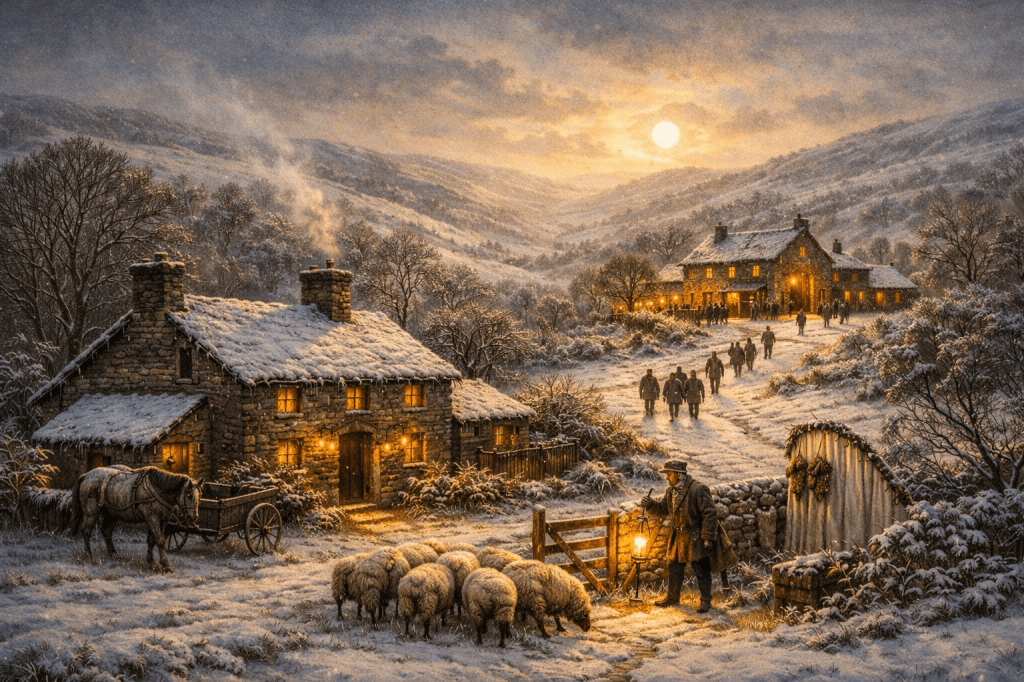
In the high country of mid and north Wales, where the hills folded into one another like great, weathered blankets and the lanes were little more than tracks worn by generations of hooves and boots, Christmas in the Victorian era arrived quietly. There was no sense of sudden abundance, no dramatic break from the rhythm of rural life. Instead, Christmas was woven gently into it, marked by restraint, reverence, and an unspoken gratitude for survival through another hard year.
By December, the upland farms lay under a pall of cold. Frost hardened the ground, and snow, when it came, lingered in drifts against stone walls and hedgebanks. The sheep were brought closer to the homestead where possible, checked daily, their welfare a constant concern. Christmas did not excuse labour. Cows still needed milking in the half-light of dawn, water had to be broken from ice, and fodder carried across yards slick with frozen mud. Yet there was a sense that these tasks were undertaken with greater care, even tenderness, as the season reminded families of their dependence on both land and providence.
Inside the farmhouse, preparations were modest but deliberate. The house was scrubbed, the hearth cleaned, and greenery gathered for decoration. In rural Wales, homes were decorated with evergreens such as holly and mistletoe in the hours before Christmas worship, and candles were prepared both for the house and for the journey to church or chapel. In a rural society of small holdings, scattered cottages, and working farmsteads, such preparation belonged to a world in which little was wasted and little was taken for granted. (source 1) (source 2) (source 3)
As Christmas approached, certain customs, quiet, local, and deeply rooted, threaded themselves through the season. On the nights leading up to Christmas, and in some places on Christmas Eve itself, families might gather for Noson Gyflaith, the toffee-pulling evening. Museum Wales records it as a traditional part of Christmas or New Year festivities in some areas of north Wales, with friends invited for supper, games, storytelling, and toffee-making. Sugar, treacle, and butter were boiled over the fire, then poured onto a greased slate or stone slab and pulled by hand until the mixture turned golden. It was one of the few moments in the year when sweetness and play briefly took centre stage. (source 2) (source 4)
Later that night, or in the small hours before dawn, the uplands stirred again for plygain. Families who had stayed awake through Noson Gyflaith or similar gatherings set out by candlelight or torchlight for the early-morning service. The service itself, held traditionally between about three and six in the morning, combined abbreviated prayer with unaccompanied carol singing by soloists and parties. In the rural dark, the sound of voices rising in chapel or church gave Christmas a solemnity that required no ornament to be profound. (source 1) (source 2) (source 5)
It is worth being precise here. Mari Lwyd certainly belonged to the Welsh Christmas season, but the strongest evidence places it chiefly in south Wales during the nineteenth century, especially in Glamorgan, Monmouthshire, and Carmarthenshire, rather than as a settled custom of the mid and north Welsh uplands. Where it appeared, it involved a decorated horse’s skull or horse-figure carried from door to door by wassailing groups who exchanged verse at the threshold in hope of entry, luck, food, and drink. It is therefore better understood as part of the wider Welsh midwinter world than as a uniformly upland Victorian practice. (source 6) (source 7)
Food, though plain by modern standards, held deep significance. Museum Wales notes that goose had long been associated with Christmas in Wales, and that in rural districts turkey did not become normal festive fare until much later. Plum pudding, toffee, and regional festive cakes also formed part of the season’s food traditions. In upland homes, whatever the table held would have been judged not by extravagance, but by care, effort, and the ability to offer warmth in the hardest part of the year. (source 4)
Religion lay at the heart of Christmas in the Welsh uplands. Church and chapel drew families together on Christmas Day and beyond, and plygain in particular gave the season its emotional core. In a society where Welsh-language worship and communal singing carried memory across generations, Christmas was not merely celebrated, it was sounded. The unaccompanied carols, the candlelit procession, and the gathering of neighbours before dawn made the season feel less like an interruption of life than a deepening of it. (source 1) (source 5)
In the days between Christmas and the New Year, families prepared calennig. Children carried decorated apples from house to house on New Year’s morning, offering blessings in exchange for gifts of food or money. Museum Wales describes the calennig as a decorated apple pierced with sticks and adorned with greenery and nuts, carried by children as bearers of good luck. The preparation itself, apples polished by firelight and decorated with care, added a gentle sense of anticipation to the quiet days after Christmas. (source 8) (source 7)
Evenings remained subdued. After supper, families gathered around the fire for candlelit reading, hymn-singing, prayer, and stories of winters past. Children might receive a small gift, but expectation was tempered by understanding. Christmas was not about novelty so much as continuity, the reaffirmation of kinship, faith, and shared endurance.
What defined a Victorian Welsh uplands Christmas most of all was its moral texture. It was a season shaped by duty, mutual reliance, and a keen awareness of fragility. Neighbours checked on one another, particularly the elderly or those weakened by illness or hardship. Charity was quiet and almost invisible, offered as food, fuel, labour, or practical help rather than through display.
In these upland homes, Christmas did not shout. It whispered. It lived in the crackle of the fire, the steady cadence of hymns, the soft pull of toffee on a winter’s night, the lantern-lit walk to plygain, and the hush of a farmstead under frost. It was not a pause from life, but a moment within it, affirming that even in cold, scarcity, and uncertainty, there was warmth enough to be shared, and faith enough to carry a family, and a community, through the long winter ahead.
Footnotes
Source 1. Museum Wales, “Christmas Traditions: ‘Plygain’ Singing”, on the early-morning Christmas service, its structure, and the role of soloists and singing parties.
Source 2. Museum Wales, “Christmas Traditions”, on rural Welsh homes being decorated with evergreens, candles being prepared, and the connection between household preparation and the journey to plygain.
Source 3. Cadw, “Small Rural Dwellings in Wales”, for the broader nineteenth-century context of scattered farms, small holdings, and rural domestic life in Wales.
Source 4. Museum Wales, “Christmas Traditions: Food”, on goose as traditional Welsh Christmas fare, the late arrival of turkey in rural Wales, plum pudding, toffee evenings, and festive cakes.
Source 5. Natural Resources Wales, “Festive Welsh winter traditions”, on plygain being held between 3am and 6am, the candlelit or torchlit procession, toffee-making, and decorating houses with holly and mistletoe beforehand.
Source 6. Museum Wales, “Christmas Traditions: The Mari Lwyd”, on the Mari Lwyd as a south Welsh custom, especially strong in the nineteenth century, involving a horse’s skull, house-visiting, verse exchanges, and gifts of food and drink.
Source 7. Wales.com, “Welsh Christmas Traditions”, on Noson Gyflaith, candlelit processions to plygain, the Mari Lwyd as a south Welsh custom, and calennig as a New Year house-to-house custom.
Source 8. Museum Wales, “New Year Traditions: Collecting Calennig”, on children carrying decorated apples door to door as bearers of good luck in exchange for food or money.
 Antony David Davies FRSA FRAS AFRHistS FIoL MCMI