
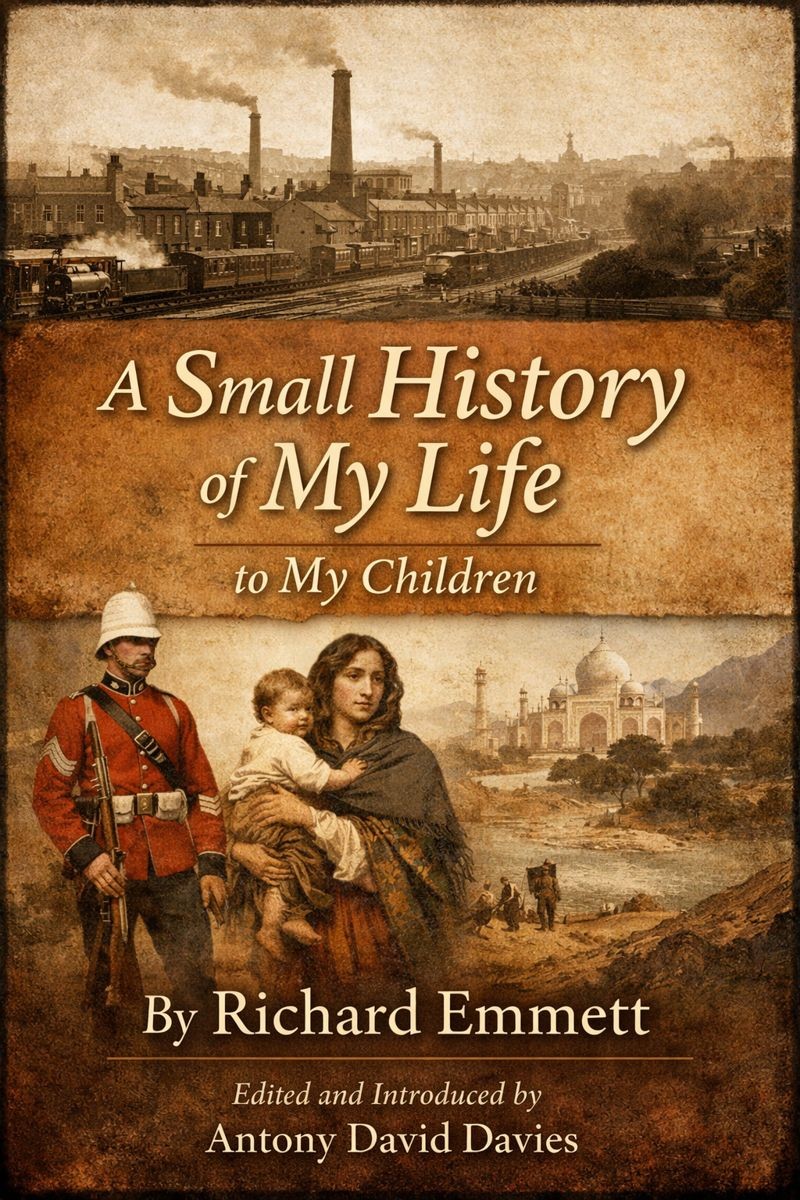
In the 1880s, a retired soldier sat down to write a short book for his children. He did not imagine an audience beyond his family, nor did he attempt to shape his life into a story of heroism or distinction. He wrote, instead, to explain himself. To account for absence. To leave behind a record that might help his children understand the choices he had made and the conditions in which he had lived.
That man was Richard Emmett, my three-times great-grandfather.
Born into a large working-class family in Salford in the early 1840s, Richard grew up amid poverty, insecurity, and limited education. He entered factory work as a boy, resented the absence of an apprenticeship, and feared the narrowing of prospects that characterised industrial life for many young men of his class. Like countless others, he left home young, initially intending to go to sea, before enlisting first in the militia and later in the Regular Army.
What followed was more than twenty years of service as a private soldier. His life was spent moving between barracks and garrison towns, across Britain and the wider empire, including long periods in Malta, Mauritius, and India. It was a life shaped by routine rather than battle, by endurance rather than glory: illness, climate, long marches, family separation, the loss of a child, and the constant calculation required to secure modest stability in later life.
Richard’s memoir, A Small History of My Life to My Children, records these experiences in plain, direct prose. There is no attempt to dramatise events or elevate them into moral lessons. Instead, the text proceeds steadily, concerned with work, pay, food, health, and family. It is precisely this lack of ornament that gives the memoir its power. What survives is not a performance, but testimony.
Why This Memoir Matters
Working-class autobiographical writing from the nineteenth century is rare. When it survives, it is often fragmentary, episodic, or heavily mediated by later editors. Sustained first-person accounts by rank-and-file soldiers are rarer still. Richard Emmett’s memoir is therefore valuable not because he was exceptional, but because he was not.
His life illuminates how institutions such as the army functioned for ordinary men: offering structure, regular pay, and the distant prospect of a pension, while demanding endurance, discipline, and submission to forces largely beyond individual control. It also reveals the often-unrecorded labour of military wives and families, without whom imperial service would have been impossible to sustain.
The memoir ends quietly, as Richard’s life did. He returned to England, completed his service, lived modestly on his pension, and died in Crewe in 1906. His death was recorded in a local inquest and he was buried in an unmarked grave. There were no medals laid out, no speeches, no public commemoration. That absence is not a failure of history. It is its truth.
The Second Edition
The Second Edition of A Small History of My Life to My Children is not a simple reprint of the earlier volume. It represents a substantial reworking of the book as a historical edition.
The original memoir text has been preserved with care, but it is now accompanied by a fuller editorial framework designed to support, rather than overshadow, Richard’s voice. This includes a new introduction setting the memoir within its social and historical context, a detailed chronology of his life and service, a glossary of military and historical terms, and a summary of surviving army service records. An appendix reproduces contemporary newspaper reporting of the inquest into his death, providing a documented ending to a life that otherwise disappears quietly from the record.
The aim has been to produce a stable, defensible edition: one that can be read by family members, local historians, students, and researchers alike, without requiring specialist knowledge, and without distorting the nature of the original text.
Why Publish It at All?
Richard Emmett did not write to be remembered beyond his family. Yet what he left behind is precisely the kind of material historians rely upon to understand how societies actually functioned. His memoir reminds us that Victorian Britain was sustained not by heroes, but by persistence, habit, and compromise.
Publishing this book is not an act of commemoration in the grand sense. It is an act of preservation. It ensures that one ordinary voice, representative of many, remains audible.
In an age drawn to spectacle and narrative climax, there is value in records that refuse both. Richard Emmett’s life does not resolve into triumph or tragedy. It simply continues, and then ends. That, too, is history.
Availability
The Second Edition of A Small History of My Life to My Children is now available in Kindle and paperback formats.
It can be purchased here:
https://amzn.eu/d/0mWhhi1
