
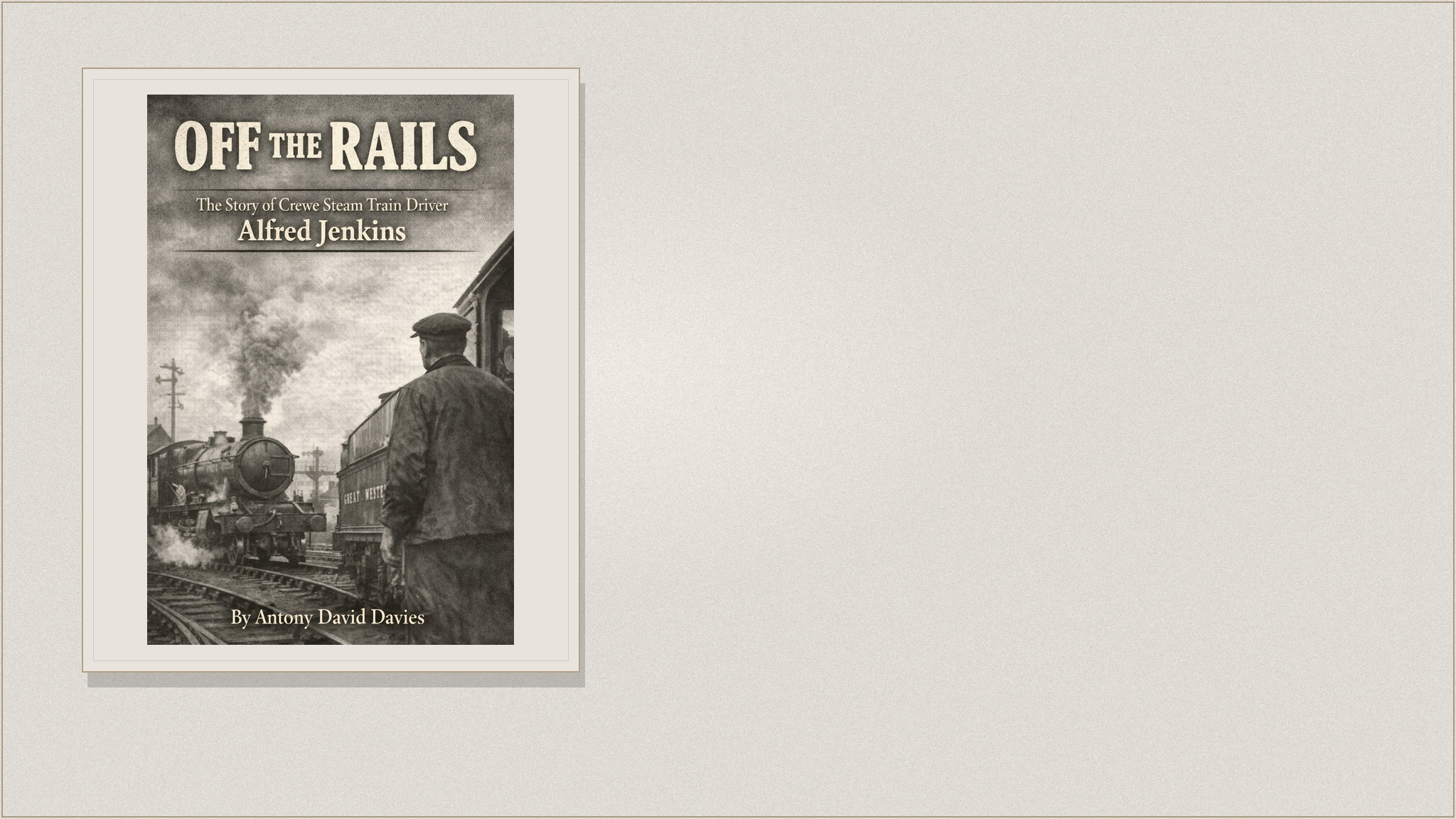
Off the Rails: The Story of Crewe Steam Train Driver Alfred Jenkins began not as a publishing project, but as an act of recovery.
Alfred Jenkins, who lived from 1882 until 1956, was my great-grandfather. He spent approximately forty-five years in railway service, beginning in a junior grade as a teenager and eventually becoming a Great Western Railway engine driver. His working life encompassed the maturity of the Victorian railway system, the Edwardian high point of steam, two world wars, industrial conflict and the profound economic pressures of the interwar years.
He was not famous. He did not design locomotives, manage a railway company or write an account of his career. His name does not appear in the familiar histories of British transport.
Yet Alfred belonged to the skilled workforce upon which the entire railway system depended.
His life deserves to be taken seriously precisely because it was not exceptional in the conventional sense. He was one of the thousands of railwaymen whose reliability allowed passengers, goods, livestock, coal and correspondence to move across Britain. Their labour connected towns and ports, supported industry and made possible the daily routines of modern economic life.
Off the Rails is my attempt to restore one of those men, and the family who sustained him, to the historical record.
A Great Western Man in an LNWR Town
There is an important historical tension at the centre of Alfred’s career.
Crewe was overwhelmingly associated with the London and North Western Railway. The town had grown around the railway after the opening of the Grand Junction Railway station in 1837. Its great locomotive works followed in 1843. By the later nineteenth century, the company’s influence reached far beyond the station and workshops. It employed thousands of people, constructed workers’ housing and supplied services upon which the expanding town depended.
The railway did not merely operate in Crewe. It helped create Crewe.
Alfred, however, was not an LNWR man. He worked for the Great Western Railway.
The Great Western reached Crewe through running powers from Nantwich. Its trains entered a town dominated by a rival company, and it maintained its own facilities at Gresty Lane, south of Crewe station on the route towards Shrewsbury.
Railway historian Ivor J. Glover described Gresty Lane engine shed and its sidings as being available for the Great Western’s exclusive use. The shed functioned as a subordinate establishment to Wellington in Shropshire, a reminder that the Great Western presence in Crewe looked south towards Nantwich, Market Drayton, Wellington and the broader Welsh border network.
This made Alfred part of a minority railway culture within the town.
The distinction mattered. Railway companies developed their own administrative practices, engineering traditions, uniforms, rules and corporate loyalties. To be a Great Western engineman in Crewe was to work within one institutional identity while living in a town shaped predominantly by another.
After the railway grouping of 1923, the LNWR became part of the London, Midland and Scottish Railway. The Great Western, unusually among the major companies, retained its identity, although it absorbed a number of smaller lines. Alfred therefore continued as a Great Western employee throughout the remainder of his career.
He retired in 1942, before railway nationalisation created British Railways in 1948. His working life belonged wholly to the company era.
From Greaser to Driver
Alfred did not enter railway employment as an engine driver. Like other footplate men, he had to advance through a hierarchy in which promotion depended upon experience, competence, conduct, medical fitness and the availability of vacancies.
He began as a greaser, a junior but necessary role within the servicing of railway machinery. Such work stood close to the locomotives without yet carrying the responsibility of operating them on the main line.
The conventional footplate progression led through engine cleaning and firing before a man could be considered for promotion to driver. The precise titles and stages varied across companies and periods, but the underlying principle remained consistent. A prospective driver learned the locomotive from below.
Cleaning and servicing provided practical familiarity with the machinery. A fireman had to maintain the fire, manage coal and water, understand the demands of the engine and work continuously with the driver. Driving required more than controlling speed. It demanded knowledge of signals, gradients, braking, locomotive behaviour, timetables and the particular characteristics of a route.
Promotion could take years.
Seniority mattered, but seniority alone was insufficient. A man had to be trusted with machinery, passengers, goods and the lives of colleagues. He also had to remain medically fit for safety-critical work.
Alfred’s progress from a teenage greaser to an engineman was therefore an extended education in skilled labour. It was conducted through work, observation, examination and accumulated experience rather than within a classroom.
The footplate was his apprenticeship.
A Life Preserved in Company Records
Alfred left no memoir. His voice does not survive in the direct form preserved by my ancestor Richard Emmett, the Victorian soldier whose recollections I edited in A Small History of My Life to My Children.
Instead, Alfred’s working life had to be recovered through records created by the railway.
His service history, promotions, medical examinations and disciplinary entries provide an institutional outline of his career. These records were not produced to help a future descendant understand him. They existed because the company needed to manage its workforce, protect its operations and assess whether an employee remained suitable for his duties.
That purpose shaped what was recorded.
The railway documented matters that affected employment. It noted grade, pay, promotion, examination, health and conduct. It was less interested in private emotion, family anxiety or the domestic consequences of irregular work.
This creates both opportunity and limitation for the historian.
A medical entry can prove that Alfred remained fit for footplate work. It cannot tell us how he felt while waiting for the result. A disciplinary notation may record an incident, but not necessarily the pressure, fatigue or misunderstanding surrounding it. A promotion date confirms advancement, but may conceal years of expectation.
The records illuminate Alfred through the eyes of his employer. The task of biography is to read them critically, setting their administrative information within the human circumstances they only partially reveal.
The Railway and the Discipline of the Body
Railway employment demanded the regulation of both conduct and physical fitness.
An engine driver needed adequate eyesight, colour perception and hearing. Signals had to be identified correctly and sometimes at distance, in poor weather or darkness. A decline in vision could remove a man from the footplate even after decades of competent work.
Alfred’s surviving medical history is therefore unusually revealing.
He continued to pass the examinations required of him into his later working years. This allowed him to remain in safety-critical employment until 1942, when he was approaching sixty.
That endurance should not be overstated as an act of heroism. Many railwaymen continued in demanding employment because income, pension and family security depended upon it. Nevertheless, maintaining the physical standards required of a steam locomotive driver into late middle age was an achievement.
Footplate work exposed men to heat, cold, vibration, noise, coal dust and irregular hours. The cab provided little protection from winter weather, while the firebox created intense heat. Shifts could begin early, finish late or continue through the night. Responsibility did not diminish because a man was tired.
The railway scrutinised the body because the consequences of failure could be severe.
Medical supervision protected passengers and the company, but it also reminded railwaymen that long service offered no unconditional security. A failed examination could remove a skilled man from the work around which he had built his identity.
Discipline and Responsibility
The steam railway depended upon rules.
Signals, timetables, braking procedures and communication systems existed because individual judgement had to operate within a coordinated network. A lapse by one employee could affect trains and workers far beyond his immediate location.
Disciplinary records must therefore be interpreted within a culture that combined safety with institutional authority. Infractions varied enormously. Some incidents resulted in warnings or fines, while more serious failures could lead to demotion, transfer or dismissal.
The existence of a disciplinary entry should not automatically be treated as evidence of bad character. It is evidence that railway work was closely monitored and that companies maintained formal mechanisms for assigning responsibility.
Alfred’s record reveals both the scrutiny under which railwaymen worked and the durability of his career. He remained within the system for nearly half a century and advanced to a position of substantial trust.
A driver’s authority was practical rather than managerial. On the footplate, however, his judgement mattered. He was responsible for the handling of the locomotive and for responding correctly to signals, gradients, weather and changing conditions.
Reliability was not a decorative virtue. It was an operational requirement.
Crewe as an Occupational Community
Crewe was more than a collection of railway facilities. It was a town in which employment, family life and social identity were closely connected.
Railway grades created their own hierarchy. Drivers, firemen, guards, fitters, signalmen, clerks and labourers occupied different positions within the company and community. Promotion brought not only additional pay but status.
A driver was a skilled worker entrusted with expensive machinery and serious responsibility. That standing extended beyond the shed. Work record, sobriety, reliability and domestic respectability could influence how a man and his household were regarded.
Crewe’s character was shaped by this culture of disciplined labour. Railway employment offered relative continuity, but it also brought supervision. Colleagues lived near one another. Families knew the grades and reputations of the men around them. News of advancement, accident or disciplinary difficulty could travel quickly.
The company was not literally a “total institution” in the strict sociological sense. Railway workers continued to possess family, religious, political and associational lives beyond their employer. Yet the railway’s influence penetrated deeply into everyday existence.
It determined hours, income, housing choices, physical routine and social standing. In Crewe, separating the occupational world from the town surrounding it was almost impossible.
Alice and the Hidden Railway Household
Alfred’s career cannot be understood without considering his wife, Alice.
The surviving records naturally place Alfred at the centre because he was the employee. Alice’s contribution appears less clearly, but the household supporting a railwayman did not organise itself.
Shift work disrupted conventional domestic time. A driver might need to sleep during the day, eat at unusual hours or leave home before the rest of the household woke. Railway timetables governed family routines as surely as they governed trains.
Domestic labour made this possible.
Food had to be prepared around irregular turns. Clothing required washing and repair in an age when both demanded considerable physical effort. Household finances had to accommodate changing wages, periods of disruption and the needs of children. Illness and exhaustion entered the home even if they originated at work.
We should not claim details of Alice’s private thoughts that the evidence does not preserve. Nor should we reduce her to the supporting character in her husband’s career. Her life possessed its own relationships, responsibilities and meaning.
What can be said is that Alfred’s ability to sustain a long railway career depended upon domestic arrangements in which Alice’s unpaid labour played an essential part.
The railway ran on coal, water and engineering knowledge. The railway workforce also depended upon meals, clean clothing, rest and household stability.
These forms of labour rarely appear together in company histories. A family biography allows them to be reunited.
War and Industrial Strain
Alfred’s career spanned both world wars, although railway service during wartime did not necessarily mean military service.
The railways were essential to the movement of troops, equipment, coal, food and civilian passengers. During the First World War, railway employees faced greater traffic demands, staff shortages and government control. The system was expected to perform under pressures for which peacetime routines had not been designed.
The war was followed by industrial unrest and the railway grouping of 1923. The interwar years brought economic uncertainty, competition from road transport and repeated attempts to reduce costs.
By the outbreak of the Second World War, Alfred was an experienced railwayman in his late fifties. Once again the network became essential to national mobilisation. Blackout conditions, additional traffic and wartime fatigue added new pressures to already demanding work.
His retirement in 1942 came after approximately forty-five years of service.
The date matters. Alfred did not remain to see nationalisation or the modernisation policies that eventually displaced steam. He retired while the railway was still engaged in war and while the Great Western remained a distinct company.
The world he left was recognisably the one he had entered, but it had been altered by technology, reorganisation and two national emergencies.
When the Family Archive Disappears
Much of the Jenkins family archive was lost following Alice’s death in 1959.
This is not unusual. Family records are particularly vulnerable at moments of bereavement and house clearance. Papers that possessed meaning within one household can appear obscure to the next generation. Photographs become detached from names. Employment documents are discarded because they look routine.
What survived of Alfred’s story did so partly by chance.
The surviving material does not reveal a life filled with dramatic incidents. It reveals something historically more valuable, structure. It shows how a working man entered an institution, advanced within it, was examined by it and remained responsible to it for most of his adult life.
Routine documents allow the historian to reconstruct routine labour.
This is precisely the kind of evidence most easily lost, because neither families nor institutions always recognise its value until the people capable of interpreting it are gone.
The Historical Importance of a Typical Life
British history naturally remembers railway pioneers, engineers, company chairmen and the designers of celebrated locomotives. Their achievements deserve study, but they do not represent the railway workforce as a whole.
The system depended upon ordinary competence repeated every day.
Alfred’s importance lies not in being unique, but in allowing us to examine the experience of a wider occupational group. His career illustrates progression through railway grades, the regulation of safety-critical labour, the importance of medical fitness, corporate identity and the relationship between employment and domestic life.
Typical lives are not simple to recover. Precisely because thousands of men followed similar paths, individual experience was often treated as unremarkable. Service records were retained for administrative purposes, not because anyone expected a biography to be written.
Once living memory has disappeared, the routine life can vanish almost completely.
Off the Rails treats Alfred not as an anecdote attached to railway history, but as historical evidence in his own right.
A Continuing Historical Concern
Readers familiar with my other work will recognise a common concern.
Whether writing about the Davies family of the Montgomeryshire uplands, Richard Emmett’s army service or Alfred Jenkins’s railway career, I am interested in the relationship between ordinary people and powerful institutions.
How was authority experienced?
How did people internalise discipline?
What forms of security did institutions offer, and what did they demand in return?
How did families absorb the pressures that employment placed upon an individual worker?
The farm, chapel, regiment and railway appear to be very different historical environments. Yet each established expectations, organised conduct and shaped identity. Individuals navigated these systems with varying degrees of freedom, resistance and accommodation.
Alfred lived within the railway system for most of his adult life. It gave him a skilled occupation, income, status and eventual security. It also claimed his time, regulated his body and subjected his conduct to continuing scrutiny.
His life cannot be reduced either to exploitation or to loyal service. It contained elements of both discipline and achievement.
That complexity is what makes it worth recovering.
An Act of Restitution
Off the Rails is not a monument to an idealised age of steam.
Steam locomotives possess beauty and mechanical fascination, but the historical railway was also dirty, dangerous and physically demanding. Nostalgia can preserve the machine while obscuring the labour required to operate it.
My purpose has been to place the people back on the footplate.
Alfred Jenkins was one railwayman among thousands. Alice was one of the many women whose domestic labour supported the railway economy without entering its service registers. Together, their lives show how a national transport system depended upon family arrangements as well as engineering.
Recovering their story does not make them famous. That is not the object.
It makes them visible.
Availability
Off the Rails: The Story of Crewe Steam Train Driver Alfred Jenkins is now available from Amazon.
About the book · Kindle · Paperback
Sources and Further Reading
- Antony David Davies, Off the Rails: The Story of Crewe Steam Train Driver Alfred Jenkins.
- Alfred Jenkins’s surviving Great Western Railway employment, medical and disciplinary records, as reproduced and discussed in the book.
- London and North Western Railway Society, Crewe, for the development of Crewe as a railway town and the scale of the LNWR works and workforce.
- Ivor J. Glover, “‘A Western on the Green’: A Glimpse of GWR and BR(W) Operations at Crewe”, Great Western Railway Journal, no. 65, winter 2008, pp. 2–24.
- Harold Gasson, Firing Days: Recollections of a Great Western Railway Engineman, Oxford Publishing Company, 1973.
- Philip S. Bagwell, The Railwaymen: The History of the National Union of Railwaymen, George Allen and Unwin, 1963.
- David Howell, Respectable Radicals: Studies in the Politics of Railway Trade Unionism, Ashgate, 1999.
- Peter W. Kingsford, Victorian Railwaymen: The Emergence and Growth of Railway Labour, 1830–1870, Frank Cass, 1970.
- Geoffrey Channon, Railways in Britain and the United States, 1830–1940, Ashgate, 2001.