
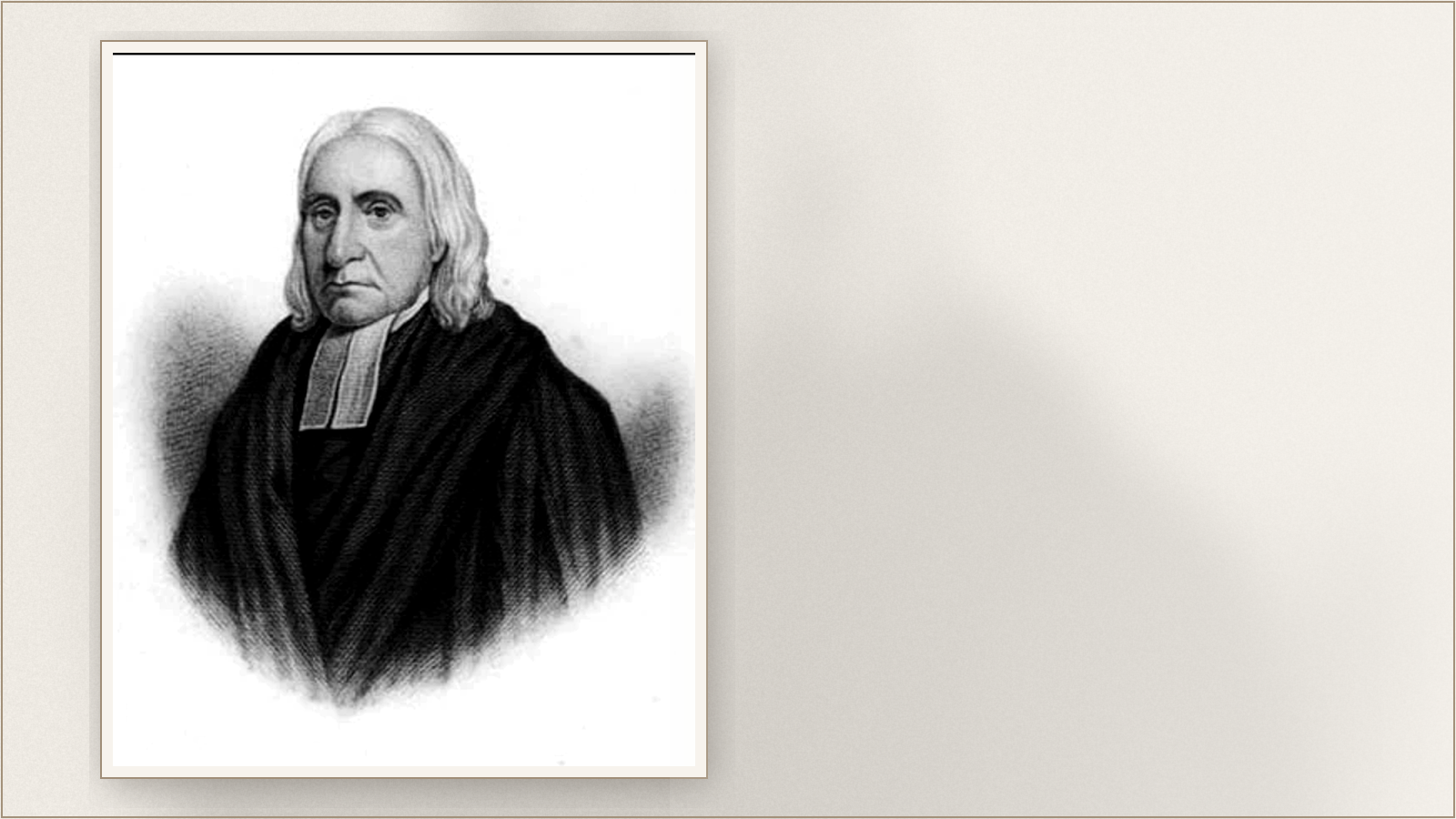
In October 1790, Daniel Rowland was buried at Llangeitho, the Cardiganshire village that his preaching had transformed into one of the great religious centres of Wales.
For decades, people had travelled there from distant counties, crossing difficult roads and sometimes walking for days to attend Communion and hear him preach. Llangeitho possessed no cathedral, university or political institution. Its importance rested upon the presence of one clergyman and the expectation that, through his ministry, an ordinary rural congregation might become the scene of an extraordinary spiritual event.
Rowland’s reputation was created above all in the pulpit. Unlike Howell Harris, he did not leave hundreds of volumes of diaries through which his inner life can be followed almost day by day. Unlike William Williams Pantycelyn, he did not leave a body of hymns that would remain in common use for generations. Yet he was neither merely an oral preacher nor a passive spiritual figure around whom others organised. He published sermons, wrote hymns, translated important evangelical works into Welsh, served at the centre of Methodist organisation and, for decades, exercised an authority that reached far beyond his own parish.
This makes him difficult, but not impossible, to recover. Later accounts frequently portray him through the language of religious veneration. Congregations become multitudes, sermons become national awakenings and the preacher himself approaches the stature of a prophet. Such evidence has to be handled with care.
Yet beneath that accumulated legend stands a historically significant figure. Rowland helped establish evangelical religion as a powerful force within Welsh-speaking society. He made Llangeitho a centre of pilgrimage and preaching, gave theological and sacramental weight to the Methodist Revival and helped create institutions that eventually outgrew the Church in which his ministry began.
He did not create modern Welsh Nonconformity by himself. He did, however, help create the conditions in which it became possible.
A clergyman’s son
Daniel Rowland was born in 1713 at Pantybeudy in the parish of Nantcwnlle, Cardiganshire. He was the son of the Reverend Daniel Rowland, incumbent of Nantcwnlle and Llangeitho, and Janet Thomas. According to tradition, he was educated at Hereford Grammar School, although the evidence for his early education is incomplete.
He did not attend university. This was not entirely unusual among Welsh clergy of the period, particularly those entering the Church through local connections and established clerical families. Rowland was ordained deacon in 1734 and priest in 1735, becoming curate to his elder brother John in the parishes previously held by their father.[1]
In 1734 he married Eleanor Davies of Caerllugest. They had a large family, traditionally described as three sons and four daughters. Later sources differ slightly in their enumeration of the children, but the surviving record makes clear that Rowland’s household was substantial and that his family remained closely connected with both Anglican and Methodist life.
This domestic background is often overlooked because later memory concentrated so heavily upon the preacher. Rowland was not a solitary prophet emerging from the mountains. He was a married Anglican clergyman, formed within a clerical household and exercising his earliest ministry through family patronage. Eleanor, meanwhile, carried much of the practical burden of domestic and farm life while her husband travelled widely to preach. Later local tradition at Llangeitho remembered her as the person who maintained the household while Rowland’s ministry repeatedly took him away.
The revival that transformed his life began within the established Church, not outside it.
Conversion and a change of voice
Around 1735, Rowland heard Griffith Jones of Llanddowror preach at Llanddewi Brefi. Jones was already known for a ministry that combined Anglican devotion, Welsh-language preaching and practical concern for religious education. His circulating schools would carry literacy and biblical instruction into communities poorly served by permanent schools.
Rowland was deeply affected by the sermon. The precise details were embroidered by later tradition, but the encounter appears to have brought him into an acute awareness of sin, judgement and personal spiritual responsibility.[2]
His preaching changed accordingly. The early Rowland became known for sermons of terrifying severity. He condemned sin, warned of judgement and pressed his hearers to confront the possibility of damnation. The language of thunder attached itself to his reputation, suggesting both the force of his delivery and the fear it could produce.
A neighbouring Independent minister, Philip Pugh of Llwynpiod, is said to have advised him to preach grace rather than dwell almost exclusively upon condemnation. Whether the change was as sudden as later biographies implied, Rowland’s mature preaching developed a stronger emphasis upon Christ, redemption and divine mercy.
This was an important theological correction. Fear might arrest attention, but fear alone could not sustain an evangelical movement centred upon the experience of salvation. Rowland learned to combine judgement with promise, and that combination became one source of his extraordinary influence.
The world in which he preached
The Wales of Rowland’s youth was formally Anglican but religiously varied. The established Church maintained its parish structure, older Dissenting congregations remained active and Griffith Jones’s schools were extending popular access to the Welsh Bible.
It would therefore be misleading to describe the country as spiritually empty before the revival. The Methodist awakening did not begin in a religious vacuum. It emerged from existing traditions of Welsh-language devotion, Puritan inheritance, Anglican renewal and Protestant literacy.
Provision, however, was uneven. Rural parishes could be extensive, travel difficult and pastoral contact limited. Some clergy were conscientious and active, while others held several livings or resided at a distance. The Church’s institutional presence did not always provide the intimate fellowship, emotional intensity and regular moral oversight that evangelical converts increasingly desired.
Rowland’s ministry answered that desire. He spoke in Welsh, within the religious language of his hearers, but with an urgency that made familiar doctrines seem immediate. Sin was personal. Grace was experiential. Salvation was not merely affirmed in a creed or inherited through parish membership. It had to be encountered and known.
This emphasis altered the relationship between preacher and congregation. The sermon was no longer simply instruction delivered by a clergyman. It became an event in which the hearer’s eternal condition was believed to be at stake.
The meeting with Howell Harris
Rowland had already begun his evangelical ministry when he met Howell Harris at Defynnog in 1737. Their partnership brought together two of the most forceful personalities in the emerging revival.
Harris was a layman whose repeated attempts to secure ordination had been refused. He travelled extensively, gathered converts into societies and connected those societies through correspondence and regular Associations. Rowland possessed clerical status, greater theological stability and the more enduring reputation as a preacher.
Their gifts were complementary, but their temperaments were not. Harris worked through continual movement. Rowland’s authority became increasingly associated with one place. Harris recorded, organised and intervened. Rowland preached, administered the sacraments and drew people towards Llangeitho.
William Williams Pantycelyn and Howel Davies joined the developing leadership. The first formal joint Welsh Calvinistic Methodist Association was held at Plas Watford, near Caerphilly, on 5 and 6 January 1743, with George Whitefield presiding. Six clergymen and twelve public exhorters were represented, and Rowland was appointed deputy moderator to Whitefield.[3]
The importance of the meeting lay not simply in bringing recognised leaders together. The Association attempted to impose order upon a movement that had grown rapidly through itinerant preaching and local societies. Approved exhorters were assigned areas of work, local societies were expected to report to the wider connexion and a framework of collective discipline began to emerge. The leaders also advised Methodists who were unhappy with local Anglican clergy to continue receiving Communion within the Established Church. The intention, at this stage, was renewal rather than separation.
When Whitefield ceased attending the Welsh Associations regularly, Rowland assumed an increasingly prominent chairing role and was remembered as presiding over the movement for much of the remainder of his life.[1] Harris remained the extraordinary organiser and early engine of Welsh Methodism, but Rowland was more institutionally important than the simple contrast between organiser and preacher sometimes suggests.
Welsh Methodism was not yet a denomination. It was a revivalist connexion, partly inside the parish system and partly operating beyond its ordinary control. That ambiguity could not continue indefinitely.
A ministry already pressing against parish boundaries
Rowland’s final break with ecclesiastical authority did not suddenly begin in the 1760s. Difficulties had appeared much earlier, as the geographical reach of his ministry increasingly exceeded the limits of ordinary parish discipline.
In 1741 he lost the opportunity to preach regularly at Ystradffin in north Carmarthenshire when a separate curacy was established there. In 1742 his licence to preach at Llanddewi Brefi was revoked. His name also appears in connection with the deeds of Soar Chapel at Cil-y-cwm in 1746, an intriguing indication of the increasingly complicated relationship between evangelical Anglicanism and older Dissenting networks.[5]
The story of Ystradffin is particularly revealing, even though some of its details survive through later revival tradition rather than contemporary documentation. A farmer’s wife is said to have travelled about twenty miles to visit her sister near Llangeitho, heard Rowland preach and returned repeatedly. Eventually she urged him to come to Ystradffin, arguing that if his preaching was true her neighbours needed to hear it. Rowland agreed, provided the local clergyman consented.[6]
Later accounts attached dramatic conversion figures to the episode, and those numbers should not be repeated uncritically. The underlying story is nevertheless valuable because it shows how revival could spread through ordinary rural mobility and kinship. A woman heard a preacher outside her own locality, carried the message home and helped draw another community into the Methodist network. The movement advanced not only through famous itinerants but through the journeys, conversations and invitations of ordinary people.
Llangeitho becomes a religious centre
Rowland’s greatest historical achievement was the creation of Llangeitho as a centre of Welsh religious life.
Thousands were reported to have travelled there on Communion Sundays. Exact numbers in later narratives must be treated cautiously, since religious biography often used large crowds as evidence of divine favour. Some accounts speak of gatherings running into many thousands and occasionally give figures as high as fourteen thousand. These claims are best understood as evidence of exceptional scale rather than exact attendance statistics.
Their significance lay in more than size. Travelling to Llangeitho required effort. Roads were poor, public transport nonexistent and journeys from distant parts of Wales could take several days. Visitors needed food, shelter and arrangements for their animals. The Communion gathering therefore became a form of pilgrimage, although its theology was emphatically Protestant.
People travelled not to venerate a shrine, but to hear preaching, receive the sacrament and participate in a community that extended beyond their own parish. Llangeitho became a meeting place for a dispersed religious people. It allowed Methodists from different localities to recognise themselves as participants in a common movement. The village acquired an importance far beyond its population or economic position.
The physical development of the Methodist site reveals how quickly charisma was becoming institution. In 1760 a meeting house was erected close to the parish church on land leased by Rowland’s brother-in-law, Peter Davies of Y Glyn, to trustees who included Rowland, William Williams Pantycelyn and William Richard. The building, known as the “New Church”, was modest, about thirty feet by eighteen feet, constructed of clom and thatch.[7]
After Rowland’s exclusion from the parish curacy, a much larger chapel was erected on the same site in 1764. It was approximately forty-five feet square, built in stone with a double slate roof and four internal stone pillars. Later descriptions preserve unusual details, including a pulpit approached from outside and a Communion table said to have been capable of being lowered on pulleys.[8]
This matters because institutional separation did not begin with a declaration of denominational independence. It emerged materially. Land was leased, trustees were appointed, walls were built and a parallel worship space developed within sight of the parish church. A revival centred upon a preacher was acquiring a durable physical form.
The Dictionary of Welsh Biography describes Llangeitho as the “Mecca of Welsh Methodists”, while later institutional memory called it the “Jerusalem of Wales”.[1][4] Both expressions reflect the same reality: Rowland’s ministry had redrawn the religious geography of the country.
The revival of the early 1760s and the “Jumpers”
The intensity of religious experience at Llangeitho became particularly visible during the revival of about 1762 to 1764. Emotional and physical manifestations, including crying out, weeping and jumping, became so closely associated with Welsh Methodists that opponents derisively called some of them the “Jumpers”. William Williams Pantycelyn entered the controversy in defence of these bodily expressions of religious joy.[9]
It is easy to treat such behaviour either as proof of religious enthusiasm or as evidence of irrationality. Both responses flatten the historical experience. For critics, the physical manifestations confirmed that Methodism was disorderly and fanatical. For participants, they could represent an overwhelming response to conviction, release and joy.
The episode reminds us that eighteenth-century Welsh Methodism was not simply Calvinistic doctrine delivered through eloquent preaching. It was often intensely embodied. People believed themselves to be undergoing spiritual transformation, and that transformation could be expressed physically as well as intellectually.
What made Rowland’s preaching powerful?
The full force of Rowland’s preaching cannot now be recreated. Printed sermons preserve words, but not cadence, gesture, timing, atmosphere or the expectations of those who heard them. Some surviving texts passed through editors or translators, placing another layer between the historical sermon and the modern reader.
Contemporaries nevertheless agreed that Rowland possessed exceptional authority. His preaching combined Calvinistic theology with emotional immediacy. Divine sovereignty, human sin, Christ’s atonement and the necessity of grace were not treated as abstract propositions. They were presented as realities bearing upon the individual hearer.
Rowland’s early severity remained part of his reputation, but his mature preaching appears to have centred increasingly upon Christ. This distinction mattered. A merely condemnatory preacher might produce fear or temporary reform. Rowland’s enduring appeal depended upon his ability to present grace as powerfully as judgement.
His clerical position also distinguished him from Harris. Rowland could preach and administer Communion, joining evangelical experience to the sacramental life of the Church. At Llangeitho, the pulpit and Communion table reinforced one another. The result was not simply popular oratory. It was a repeated communal drama in which preaching prepared the hearer for sacramental participation, and the gathering itself confirmed that the revival belonged to something larger than the individual.
One of the most important witnesses to Rowland’s impact came from the next generation. On 20 January 1773, the seventeen-year-old Thomas Charles, later one of the central figures in Welsh Calvinistic Methodism, heard Rowland preach at Llangeitho. Charles regarded the experience as decisive in his spiritual life and later spoke of Rowland with profound gratitude.[10]
The succession is historically striking. Griffith Jones helped awaken Rowland. Rowland helped awaken Thomas Charles. Charles in turn helped carry Welsh evangelical religion into the world of schools, Bible distribution and more formal nineteenth-century institutions. Influence passed across generations, not through a single unbroken organisation but through preaching, personal encounter and inherited religious culture.
The rupture with Harris
The alliance between Rowland and Harris gradually deteriorated during the 1740s. Their differences concerned leadership, doctrine and the direction of the movement. Harris had come under Moravian influence and adopted controversial expressions about the sufferings of Christ and the nature of God. His increasingly authoritarian conduct troubled colleagues, as did his intense relationship with Sidney Griffith, a married woman whom he credited with prophetic insight.
Rowland responded publicly. In 1750 he published Ymddiddan rhwng Methodist Uniawngred ac un Cyfeiliornus, a dialogue contrasting an orthodox Methodist with one led into error. By 1752 the separation was complete, and the majority associated themselves with what became known as “Rowland’s people”.[1]
The division damaged the revival, but it also revealed that the movement was becoming greater than either of its principal founders. Societies continued to meet. Williams Pantycelyn helped sustain their religious culture through itinerant ministry and hymnody. Rowland’s authority provided a measure of continuity while Harris withdrew to build his community at Trefeca.
Rowland has sometimes been presented as the calm and orthodox counterweight to Harris’s instability. There is truth in the contrast, but it should not be exaggerated. Rowland was himself a forceful leader capable of public controversy. The survival of the movement required judgement, institutional loyalty and the willingness to reject the claims of a man who had once been indispensable. Reconciliation eventually came in the early 1760s, but Harris never regained his former command.
From parish curate to Methodist leader
Rowland’s position within the established Church became increasingly difficult. After the death of his brother John in 1760, Rowland’s son, also named John, received the living of Llangeitho. For a period Rowland served as his son’s curate. By then, however, the Methodist gatherings associated with him had developed far beyond the scale of an ordinary parish ministry.
Around 1763 he was deprived of his curacy. The precise circumstances require caution. Later Methodist accounts attribute the decision to Bishop Samuel Squire of St Davids and present the central issue as Rowland’s refusal to stop itinerating and preaching beyond his parish. Some traditions preserve a dramatic scene in which the episcopal notice was delivered during worship and Rowland responded publicly. Those details belong largely to later denominational memory and should not be treated as verbatim contemporary record.
The broader conflict, however, is clear. Rowland’s evangelical ministry had long crossed parish boundaries, and by the early 1760s the institutional Church could no longer easily contain the religious network that had formed around him.
The dispute was not simply Rowland against his own parishioners. In 1767 the churchwardens and leading inhabitants of Nantcwnlle, together with the non-resident incumbent, sought his return as curate. Rowland appears to have been willing to return if episcopal approval could be obtained. It was refused.[5]
This distinction matters. Rowland’s popular legitimacy and his official ecclesiastical standing had diverged. He could be wanted by the people among whom he had ministered while remaining unacceptable to the authority responsible for regulating that ministry.
Another episode is equally revealing. In 1769 the wealthy evangelical philanthropist John Thornton offered Rowland the living of Newport in Pembrokeshire. The National Library of Wales preserves Thornton’s letter to Rowland dated 19 December 1769. Rowland declined the opportunity and remained at Llangeitho.[11]
The decision deserves more attention than it usually receives. By then Rowland was not simply an Anglican curate who had been pushed reluctantly to the margins. He was offered a respectable route back into conventional Anglican preferment and chose instead to remain with the religious community formed around Llangeitho. Later accounts say Thornton respected the decision as evidence of Rowland’s integrity.
This was a decisive change, though not yet a formal denominational separation. Rowland did not begin his ministry intending to establish a new church. Like other early Methodists, he saw revival as a means of renewing Christianity within the established order. Yet the societies had acquired their own leaders, meetings, buildings and collective identity. When ecclesiastical accommodation failed, those structures allowed the movement to continue outside ordinary parish control.
The independent denomination came later. Welsh Calvinistic Methodism did not begin ordaining its own ministers until 1811, more than twenty years after Rowland’s death. It is therefore more accurate to say that Rowland helped create a movement capable of separation than that he consciously founded modern Welsh Nonconformity.
The Welsh language and a wider evangelical world
The revival operated principally through Welsh. This was essential to both its religious success and its cultural consequences.
Welsh remained the everyday language of much of the population, particularly in rural communities. Preaching, hymns, society meetings and Association gatherings allowed people from different parts of the country to participate in a shared religious culture through their own language.
E. Wyn James has argued that Methodism helped create Welsh-language networks extending from local societies to national gatherings. It strengthened patterns of communication and belonging at a time when much political, legal and administrative power operated through English.[12]
The claim that Methodism single-handedly preserved the Welsh language would be too strong. The Bible translations, circulating schools, existing Dissenting traditions, print culture and domestic transmission all mattered. Nor was evangelicalism invariably tolerant of every aspect of popular Welsh culture.
Its contribution was nevertheless considerable. Methodism gave Welsh a powerful institutional life. It made the language a medium of theology, public oratory, collective organisation and intense emotional expression.
Rowland’s importance within that process came through both speech and print. His preaching demonstrated that Welsh could carry sustained theological argument while remaining accessible to large popular audiences. His translations, meanwhile, helped bring a wider British Protestant literature into Welsh religious culture.
Among the works associated with his translation activity were John Bunyan’s The Holy War in 1744, Aceldama in 1759, Wetherall’s Fifteen Sermons in 1762 and Thomas Boston’s The Crook in the Lot in 1769.[1] Rowland was therefore helping to naturalise a wider evangelical literature within the Welsh language. The revival was intensely local in speech and community, yet intellectually connected to Protestant currents extending far beyond Cardiganshire.
Hymns, sermons and the printed Rowland
Rowland’s reputation has always rested upon the spoken sermon, but his printed legacy was more substantial than that emphasis sometimes suggests.
The Dictionary of Welsh Biography records sermon publications in 1739, 1762, 1772 and 1775, with English translations appearing in 1774, 1775 and 1788.[1] In 1772, substantial Welsh collections were printed at Carmarthen, including Tair Pregeth a Bregethwyd yn yr Eglwys Newydd, gerllaw Llangeitho and Pum Pregeth. The latter extended to roughly 140 pages and also included hymns.[13]
An English edition, Eight Sermons, upon Practical Subjects, appeared in 1788 and ran to more than four hundred pages.[14] This transmission beyond the immediate Welsh-speaking congregation complicates the idea that Rowland survives almost entirely as an oral figure. The spoken moment remained central to his authority, but his theology also circulated in durable printed form.
He was also an important early Methodist hymn writer. Rowland contributed hymns to collections as early as 1740 and 1742. Six of his hymns appeared in 1743, nineteen in Hymnau Duwiol in 1744, and he issued a collection of his own in 1745.[1]
The National Library of Wales preserves a photographic copy of the so-called Llangeitho Manuscript, containing transcripts of hymns composed in 1743 and 1744 by Daniel Rowland, Howel Davies and Dafydd Jenkins.[15] It is a valuable reminder that Welsh Methodist hymnody was already a collaborative and developing culture before William Williams Pantycelyn came to dominate its literary memory.
Rowland was therefore not simply the voice at Llangeitho. He participated in the creation of a Welsh evangelical print culture through sermons, hymns, polemic and translation.
Revival and social discipline
The long-term social influence of Welsh Methodism arose not from preaching alone, but from the communities formed around it.
The societies encouraged prayer, testimony, self-examination and mutual oversight. Converts were expected to display the consequences of belief in their conduct. Drunkenness, sexual behaviour, Sabbath observance, speech, family responsibility and commercial honesty could all become matters of communal concern.
This discipline could be supportive, but it could also be intrusive. Chapel culture later provided fellowship, education and leadership opportunities, yet it also developed formidable powers of social judgement. The moral order associated with Welsh Nonconformity was never wholly liberating or wholly oppressive.
Its political consequences were similarly gradual. The eighteenth-century revival was not originally a democratic or nationalist campaign. Rowland did not preach a programme of Welsh political emancipation. However, the movement created habits that later acquired civic importance. It trained people to listen, speak, organise meetings, maintain voluntary institutions and recognise leaders beyond the traditional structures of landownership and the established Church.
During the nineteenth century, those habits contributed to Nonconformist campaigns over education, temperance, disestablishment and political representation. The connection was real, but it developed across generations. It should not be attributed to Rowland’s intentions alone.
The preacher and the family
Rowland’s public reputation has obscured much of the private man, but the careers of his children show how closely his family remained connected with both Anglican and Methodist worlds.
His son John, born in 1735, entered the Church, studied at Jesus College, Oxford, and became rector of Llangeitho. He later served at St Mary’s in Shrewsbury and at Clive and was a master at Shrewsbury School from 1771 until 1798.[1] Through him, the Rowland family became firmly connected with Shrewsbury’s clerical and educational life.
Another son, Nathaniel Rowland, born at Llangeitho in 1749, studied at Christ Church, Oxford, taking his BA in 1771 and MA in 1774. Although ordained in the Church of England, he remained closely involved with Methodism. In 1776 he married Margaret, daughter of Howel Davies, thereby joining two of the principal clerical families of the Welsh revival. Nathaniel later served as secretary of the Calvinistic Methodist Association and became an important Methodist figure in Pembrokeshire.[16]
The marriage is revealing. By the later eighteenth century, the leadership of the revival was becoming connected not only through societies, Associations and shared theology, but through kinship. A movement that had begun through itinerant preaching was developing its own social world.
The family’s Shrewsbury connection continued into the next generation. John Rowland’s descendants included William Gorsuch Rowland, later vicar of St Mary’s and a prebendary of Lichfield, and Daniel Rowland, antiquary and philanthropist, who endowed the Hospital of the Holy Cross in Shrewsbury at a cost of more than £4,000.[17] This lies beyond the immediate history of the Welsh revival, but it is a useful reminder that the family’s influence did not remain confined to Llangeitho.
Recovering Rowland through other people
Rowland did not leave the enormous personal archive that makes Howell Harris so unusually accessible to historians. That absence has sometimes created the impression that his life survives only through later biography. The archival footprint is, however, richer than it first appears.
The National Library of Wales holds material grouped under Daniel Rowland of Llangeitho, as well as correspondence and references within the Howell Harris and Trefeca collections. The surviving Thornton letter of December 1769 is one example. The Llangeitho hymn manuscript is another.[11][15]
Particularly valuable is the diary of John Thomas of Tre-main, a teacher in Griffith Jones’s circulating schools. His diary records his spiritual responses to around 470 sermons preached between 1756 and 1760 by Rowland, William Williams Pantycelyn, Howel Davies, Peter Williams and others.[18]
This offers an important methodological correction. If Rowland cannot always be recovered through his own private writing, he can sometimes be approached through the records of those who heard him. The preacher survives partly in the reactions of his audience.
Death, portrait and remembrance
Daniel Rowland died on 16 October 1790 and was buried at Llangeitho four days later. He was seventy-seven years old.[1]
Later accounts suggest that he remained active until close to the end of his life and was seriously ill for only a short period. Traditions also preserve the belief that he had sensed his ministry was drawing to a close. Such details come through devotional biography and should be treated cautiously, but they reflect how quickly the memory of Rowland’s final days was absorbed into Methodist tradition.
The familiar image of Rowland is itself unusually significant. The artist Robert Bowyer painted him at the request of Selina Hastings, Countess of Huntingdon, shortly before his death, and later engravings were derived from that portrait.[17] Unlike many retrospective images of eighteenth-century religious figures, it therefore rests upon a likeness produced while Rowland was still alive.
By the time of his death, Welsh Methodism was firmly established but still formally connected to the Church of England. Its societies extended across much of the country. Its Associations provided leadership. Its hymns had created a shared devotional language, and Llangeitho remained one of its principal centres.
The movement’s eventual separation from the Church was not inevitable in every detail, but the possibility was already embedded in its structure. It possessed its own buildings, leaders, disciplines, gatherings and loyalties. What had begun as revival within the Church had become a religious society capable of existing beyond it.
The physical landscape of Llangeitho continued to change after Rowland. The chapel of 1764 was eventually replaced by the much larger building erected in 1813–15, itself remodelled in 1861–63. The parish church of St Ceitho was entirely rebuilt in 1821, so the medieval and eighteenth-century church fabric known to Rowland no longer survives.[8][19]
In 1883 a white marble statue of Rowland by Edward Griffith of Chester was erected at Llangeitho.[9] Its presence belongs as much to the history of nineteenth-century Welsh Nonconformity as to the eighteenth-century preacher himself. A movement that had begun precariously at the edge of Anglican discipline now possessed founders commemorated in public monuments.
The voice at Llangeitho
Daniel Rowland should not be turned into a symbol so large that the historical person disappears.
He was not the sole father of Welsh Nonconformity, nor did he single-handedly preserve the Welsh language or create Welsh political consciousness. Such claims compress generations of complicated change into the career of one celebrated preacher.
His authentic achievement requires no exaggeration. He transformed a rural curacy into a centre known throughout Wales. He preached for more than half a century with an authority that drew people across formidable distances. He helped govern the Methodist connexion as well as preach to it. He translated evangelical literature into Welsh, contributed to early Methodist hymnody and published sermons that carried his influence beyond the spoken gathering. He helped lead the revival through partnership, division and institutional change, and his ministry shaped the religious imagination of the generation that followed him.
Most importantly, around Rowland we can watch religious charisma becoming institution. A field congregation became a chapel. Converts became societies. Societies became an Association. Oral preaching became print. A local Welsh revival joined a wider evangelical culture. Children, disciples and hearers carried the movement into another generation.
Harris supplied much of Welsh Methodism’s early organisation. Williams gave it poetry and song. Rowland gave it sustained preaching, sacramental authority and, eventually, a recognised spiritual centre.
Rowland’s Wales remained Anglican in law, hierarchical in society and without national political institutions of its own. Yet at Llangeitho, ordinary people participated in a different geography of authority. A small Cardiganshire village became important because they travelled to it, worshipped there and carried its religious language home.
That may be Rowland’s most enduring historical importance. He showed that religious authority could be created outside the ordinary centres of power, through language, preaching, voluntary association and the repeated decision of ordinary people to gather.
Related Essays
Explore more Welsh religious history
Continue with the Welsh Nonconformity guide, or browse the related essays above.
Receive new historical essays by email
For new essays on Welsh history, biography, genealogy and rural community life, subscribe on the homepage.
Sources and Further Reading
- Dictionary of Welsh Biography, “Rowland, Daniel (1713–1790), Methodist cleric”.
- Eifion Evans, Daniel Rowland and the Great Evangelical Awakening in Wales, Banner of Truth, 1985.
- Coflein, Plas Watford and the first Welsh Calvinistic Methodist Association, January 1743.
- National Library of Wales, Welsh Calvinistic Methodist Church and Calvinistic Methodist Archive.
- Thomas Charles Institute and associated documentary material relating to Rowland’s curacies, itinerancy and ecclesiastical difficulties.
- Eifion Evans and later accounts preserving the Ystradffin tradition, used here with caution as revival testimony rather than exact contemporary record.
- Llangeitho local chapel history, including the 1760 “New Church”, its trustees, dimensions and construction.
- Cadw, Llangeitho Calvinistic Methodist Chapel, listed building report.
- Teifi Faith Trail, Daniel Rowland and Llangeitho, including the revival of the early 1760s and later commemoration.
- Sources relating to Thomas Charles’s conversion experience at Llangeitho on 20 January 1773.
- National Library of Wales, letter from John Thornton to Daniel Rowland, 19 December 1769, NLW MS 14005E, f. 194.
- E. Wyn James, “‘The New Birth of a People’: Welsh Language and Identity and the Welsh Methodists, c. 1740–1820”.
- Daniel Rowland, Tair Pregeth a Bregethwyd yn yr Eglwys Newydd, gerllaw Llangeitho, Carmarthen, 1772, and related Welsh sermon collections.
- Daniel Rowland, Eight Sermons, upon Practical Subjects, English translation, 1788.
- National Library of Wales, photographic copy of the Llangeitho Manuscript, hymns by Daniel Rowland, Howel Davies and Dafydd Jenkins, composed 1743–44.
- Dictionary of Welsh Biography, “Rowland, Nathaniel (1749–1831)”, for Rowland’s son and the family connection with Howel Davies.
- Dictionary of National Biography, entries for Daniel Rowland and members of the Rowland family, used alongside modern Welsh biographical scholarship.
- National Library of Wales, diary of John Thomas of Tre-main, recording responses to approximately 470 sermons, 1756–60.
- Coflein, St Ceitho’s Church, Llangeitho, including the rebuilding of 1821.