
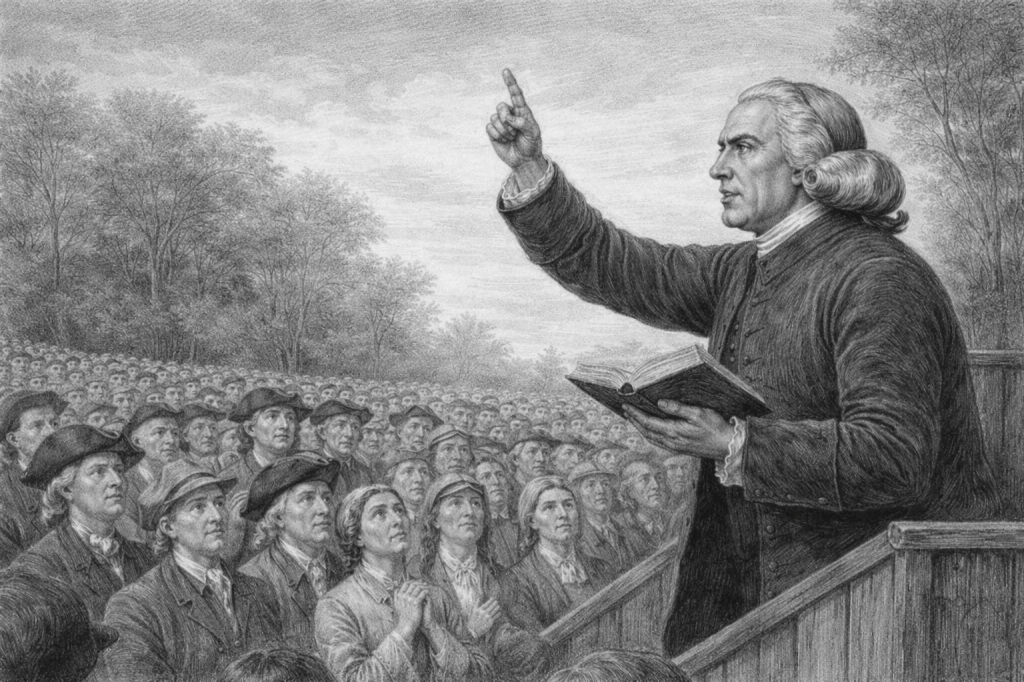
This article follows my recent study of Daniel Rowland (1713–1790), the great evangelist of the Welsh Methodist Revival and one of the defining architects of modern Welsh Nonconformity. If Rowland represents the revival at its most visible, the pulpit phenomenon, the national preacher, the man whose sermons drew thousands, then Howell Harris must be understood as the movement’s indispensable counterpart: the organiser, mobiliser, and structural founder who ensured that revival became not merely an experience, but a sustainable culture.
If Daniel Rowland can properly be described as the great evangelist of Wales, the pulpit voice that turned revival into a national experience, then Howell Harris must be understood as something different, and in some respects even more structurally consequential.
Harris was the engine.
He was the organiser, the network-builder, the restless mobiliser who ensured that the revival did not remain confined to a handful of electrifying sermons, or to the magnetism of one parish, but became a disciplined movement capable of sustaining itself across geography, time, and human weakness. Rowland’s preaching may have drawn the crowds, but Harris’s genius lay in ensuring that those crowds became societies, and that those societies became a culture.
In the long history of Welsh Nonconformity, this distinction matters. Rowland embodied the revival’s spiritual authority, Harris created its social architecture. The one supplied the flame, the other built the hearth.
1. Wales Before Harris, A Religious Nation Without Religious Infrastructure
The Wales into which Howell Harris was born in 1714 was, in formal terms, a Christian country, but in practical terms it was one of uneven provision and limited spiritual depth. The established Church of England remained the recognised religious order, but in large areas of rural Wales it struggled to offer what ordinary people needed, not merely in doctrine but in language, attention, and pastoral presence.
This was not a matter of simplistic corruption or indifference. Many parish clergy were conscientious, and Wales retained a strong underlying sense of moral seriousness. Yet the system itself was thin. Parishes were vast, travel was difficult, and the ecclesiastical structure was not designed to cultivate intense communal religion among scattered upland communities.
The result was a country ripe for an evangelical shock.
Not because it was uniquely sinful, but because it was spiritually undernourished.
This is the crucial point, and it is also where Harris enters the story with such force. He did not simply preach into a void, he preached into a landscape of hunger.
2. Trefeca and Talgarth, The Making of a Lay Apostle
Howell Harris was born at Trefeca, near Talgarth in Brecknockshire. This detail is not incidental. The revival did not begin in industrial Wales, because industrial Wales did not yet exist in the form it would later take. It began in a rural Wales of farms, tenant holdings, small market towns, and mountain roads, where communal life was tight and reputation mattered.
Harris was not an ordained minister. He did not emerge from the university system or from clerical patronage. His authority was not granted, it was seized, or rather it was experienced inwardly and then asserted outwardly.
In 1735, Harris underwent a conversion experience during a communion service at Talgarth parish church. He came to believe, with overwhelming conviction, that he had been awakened to a living knowledge of salvation, and that to remain silent would be a kind of spiritual treachery.
From that point, his life ceased to be conventional.
He began to speak, and then to preach, wherever he could.
It is difficult, from a modern perspective, to appreciate how socially disruptive this was. In eighteenth-century Wales, public authority was carefully bounded. The pulpit belonged to the ordained. Moral judgement belonged to the magistrate, the gentry, and the parish. A young layman proclaiming salvation, rebuking sin, and calling the community to repentance was not merely unusual, it was threatening.
Yet Harris did it anyway.
3. Revival as Mobilisation, Not Just Experience
One of the most common misunderstandings of the Welsh Methodist Revival is to treat it primarily as an emotional event, a wave of religious enthusiasm that swept through Wales, leaving behind chapel culture and hymnody. Emotion was certainly present, and in some places overwhelming. But Harris’s true significance lies in something more practical.
He mobilised people.
His preaching drew hearers into a new kind of religious identity, one that demanded discipline, self-examination, and communal accountability. He was not content with crowds, he wanted societies.
This is the point at which Harris differs sharply from Rowland. Rowland’s genius lay in the pulpit, in the sermon as spiritual encounter. Harris’s genius lay in the aftermath, in what happened when the sermon ended.
He asked the harder question.
What does a converted Wales look like on a Tuesday morning?
4. The Societies, The Birth of Welsh Religious Organisation
Harris’s greatest institutional legacy was the creation of religious societies, small groups of believers meeting regularly for prayer, exhortation, mutual discipline, and spiritual support.
These were not casual gatherings. They were deliberately structured, and they represented something profoundly new in Welsh religious life. In effect, Harris was creating a parallel infrastructure of religion, one that could exist within the Church of England yet was not controlled by it.
The societies did several things at once.
They created lay leadership, because meetings required speakers, organisers, and moral guides. They created routine, because religion was no longer confined to Sunday worship. They created emotional language, because testimony, confession, and prayer became normalised. They created social cohesion, because believers now belonged to a network that extended beyond the farm, the parish, and the landlord’s world.
This was an extraordinary development.
In rural Wales, Harris was helping to build what later generations would recognise as the chapel community, even before chapels existed in their nineteenth-century form.
5. Harris and Rowland, Two Leaders, One Revival, Different Gifts
The meeting of Harris and Daniel Rowland in the late 1730s is one of the defining moments of Welsh religious history. It was, in many respects, a convergence of complementary powers.
Rowland brought theological depth, pulpit authority, and a preaching gift of rare magnitude. Harris brought urgency, organisational imagination, and the ability to generate networks across Wales.
The revival required both.
Without Rowland, it may have lacked its great evangelist, the figure whose sermons became almost mythic in Welsh memory. Without Harris, it may have remained localised, a powerful religious stirring without the organisational scaffolding to sustain it.
But this partnership was never destined to remain entirely harmonious. The revival’s earliest decades were marked by intense personalities, strong convictions, and competing instincts about authority.
In other words, it was human.
6. The Cost of Charisma, Control, Conflict, and Fracture
Howell Harris was a man of immense spiritual force, but that force came with shadows.
His diaries and correspondence reveal a temperament of relentless intensity. He could be controlling. He could be suspicious. He could demand from others the same spiritual urgency that drove him, and when they did not meet it, he could interpret their weakness as moral failure.
This is not to condemn him, but to understand him.
The revival was not led by gentle men in soft agreement. It was led by individuals who believed they were participating in eternal realities, and who therefore treated time, behaviour, and conscience with extreme seriousness.
Over time, tensions between Harris and Rowland became sharper, and the movement began to fracture along lines of leadership style and personal allegiance. The rupture of 1750, when Harris effectively withdrew from the central Methodist leadership, remains one of the great turning points in the story.
And yet, even here, Harris’s importance is clear.
Because the movement did not collapse.
His structures remained.
7. Trefeca, The Community as Social Experiment
After his withdrawal from the wider revival leadership, Harris returned to Trefeca and established what became known as Teulu Trefeca, a religious community shaped by shared discipline, labour, worship, and moral accountability.
This was not a retreat into quietism. It was a social experiment, an attempt to build a model society, an evangelical community within the Welsh countryside.
In this sense, Harris’s project at Trefeca foreshadows later Welsh Nonconformist institutions, not merely chapels but schools, Sunday schools, mutual aid societies, temperance movements, and the entire infrastructure of communal respectability that came to define nineteenth-century Wales.
Harris was, in effect, trying to answer a question that would preoccupy Welsh Nonconformity for generations.
Can a people be remade through discipline?
8. The Revival and the Psychological Remaking of Wales
Perhaps Harris’s most profound legacy is not institutional but psychological.
The Welsh Methodist Revival created a new kind of Welsh interior life. It normalised self-examination, confession, moral striving, and emotional expression within religious settings. It gave ordinary men and women permission to speak publicly about the state of their souls, and to treat their daily conduct as part of a spiritual drama.
Harris, more than any other leader, drove this inwardness.
He was a man obsessed with the condition of the heart. He demanded seriousness, and he created spaces in which seriousness became communal rather than private.
This emotional and moral culture did not remain confined to the eighteenth century. It shaped the Welsh chapel world of the nineteenth century, and through that world it shaped Welsh politics, Welsh rhetoric, and Welsh cultural identity.
The revival did not merely create believers.
It created a nation trained to listen, judge, organise, and endure.
9. Reconciliation, The Return of a Founder
Harris and Rowland were eventually reconciled in the 1760s, and Harris resumed preaching more widely. This reconciliation matters, not because it makes the story neat, but because it reminds us that the revival was never simply about individual rivalry.
It was about Wales.
By the time Harris died in 1773, the Methodist movement had already become too large, too culturally embedded, and too socially useful to be undone by personal conflict. Its roots were now in the soil.
And much of that rootedness, in terms of organisation and lay discipline, was Harris’s work.
10. Howell Harris and the Making of a Nonconformist Wales
It is often said that the Welsh Methodist Revival laid the foundations for modern Welsh Nonconformity. This is true, but it can become a cliché unless one explains the mechanism.
Harris was the mechanism.
He demonstrated that religion could be organised outside formal clerical structures. He proved that lay people could lead, speak, exhort, and discipline. He created networks of meeting and mutual accountability that would later become the normal social form of Welsh chapel life.
In this sense, Harris helped Wales develop a parallel civic culture.
A culture that did not rely on the state, the gentry, or the established Church for its leadership.
This is one of the most important long-term consequences of the revival, and it cannot be understood without Harris.
Conclusion, The Man Who Built the Revival’s Machinery
If Daniel Rowland stands in Welsh memory as the great preacher, the evangelist whose sermons became a national phenomenon, Howell Harris deserves to be remembered as the man who turned revival into a system.
He did not simply inspire.
He organised.
He did not merely proclaim salvation.
He created communities capable of sustaining it.
Harris’s life was not tidy. His temperament was intense, sometimes abrasive, and at times divisive. Yet the structures he built, societies, networks, disciplined gatherings, and lay leadership, formed the foundations upon which Welsh Nonconformity would later rise.
In the making of evangelical Wales, Rowland gave the revival its voice.
Howell Harris gave it its bones.
Yet the revival’s story cannot be completed through Harris and Rowland alone. A movement requires not only preaching and organisation, but a language, a theology of the heart, and a culture capable of being carried from one generation to the next. That task fell, above all, to William Williams Pantycelyn, the great hymn-writer and spiritual poet of the revival, whose work gave Welsh evangelical religion its enduring voice. In the next instalment of this series, I will turn to Williams, and to the creation of a devotional tradition that not only transformed Wales in the eighteenth century, but shaped the emotional and literary inheritance of the nation for centuries thereafter.
