
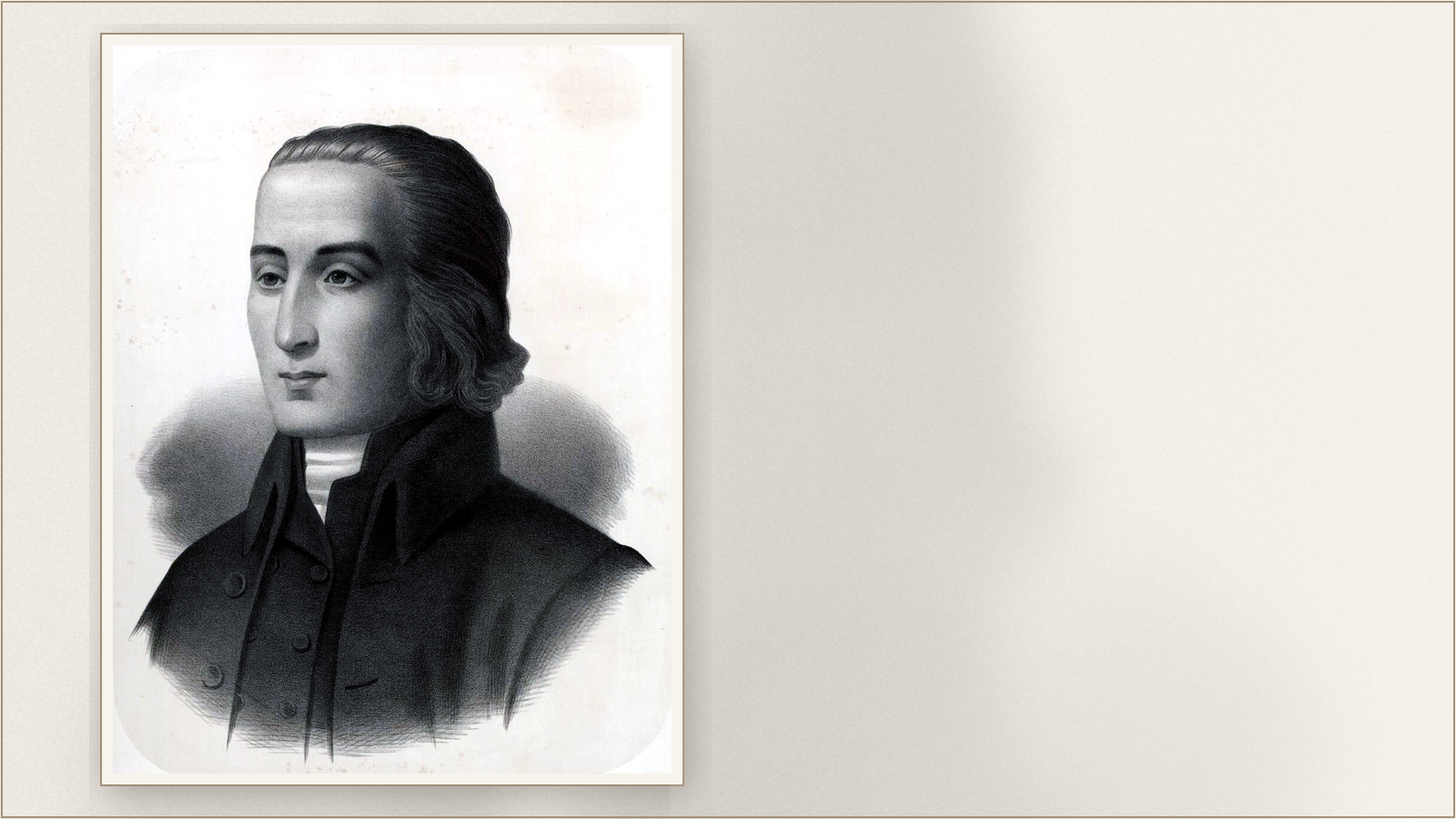
The Welsh Methodist Revival was carried by more than preaching. Daniel Rowland drew immense congregations through the force of his sermons. Howell Harris organised converts into societies and travelled across Wales with relentless urgency. Yet neither preaching nor organisation could, by itself, give the movement a language capable of surviving its founders.
That language was supplied above all by William Williams of Pantycelyn.
Williams was a preacher, theological writer, religious organiser and one of the principal leaders of early Welsh Methodism. He published almost 90 books and pamphlets, composed long poems, wrote prose works on religion and natural phenomena, and travelled extensively in support of Methodist societies. His greatest achievement, however, lay in the hundreds of hymns through which he gave poetic form to the experience of conversion, doubt, longing, spiritual struggle and dependence upon grace.
Nearly 1,000 of his hymns appeared during his lifetime. Some were written for particular occasions and have long since fallen from use. Others became so deeply embedded in Welsh religious culture that their images and phrases passed into national memory.
Williams did not single-handedly make Wales the “Land of Song”. That familiar identity arose from older Welsh musical traditions, the growth of chapel singing, nineteenth-century choral culture and the later cymanfa ganu. Nevertheless, he helped establish the form of evangelical hymnody upon which much of that culture rested.
Rowland gave the revival some of its greatest sermons. Harris gave it movement and structure. Williams gave it words that ordinary people could carry home.
Cefn-coed and the World Before Methodism
William Williams was born on 11 February 1717 at Cefn-coed, a farm in the parish of Llanfair-ar-y-bryn near Llandovery. He was the fourth child of John and Dorothy Williams.
The family belonged to the Independent tradition rather than the established Church. William’s grandfather, or near family circle, was connected with the strong Dissenting community at Cefnarthen. His religious background was therefore Nonconformist, although the denominational divisions of the eighteenth century did not yet possess precisely the institutional form they later assumed.
His father was a substantial farmer, and Williams did not emerge from poverty. He was educated locally before attending the Dissenting academy at Llwyn-llwyd near Talgarth. Such academies provided advanced education to young men excluded from Oxford and Cambridge by religious tests or family circumstance.
Williams originally intended to study medicine. This early scientific interest did not disappear completely. Decades later, he wrote Aurora Borealis, partly concerned with the northern lights, and Pantheologia, an ambitious account of religions, peoples, geography and the natural world.
His intellectual curiosity was always wider than hymnody. Before he became the “sweet singer” of Welsh Methodism, he had imagined a life concerned with the treatment of the body.
An encounter at Talgarth redirected him towards the soul.
Hearing Howell Harris
In 1737, Williams heard Howell Harris preaching in Talgarth churchyard. Harris was still a young man, but his evangelical message had already begun to disturb the settled religious life of Wales.
The sermon produced a decisive spiritual crisis in Williams. He abandoned his intended medical career and turned towards the ministry.
Conversion in early Methodism did not mean the quiet adoption of a new opinion. It was understood as an inward transformation, involving conviction of sin, fear of judgement, dependence upon Christ and the discovery of divine grace. This pattern of spiritual experience became the central subject of Williams’s writing.
His hymns would return repeatedly to the uncertainty of the believer, the apparent absence of God, the danger of self-deception and the longing for assurance. Their emotional intensity grew from the religious culture into which Harris’s preaching had drawn him.
Williams’s conversion also demonstrates the importance of the spoken word in the revival. He was changed by hearing a preacher. His own contribution would be to translate such encounters into language that could be repeated after the preacher had gone.
An Anglican Deacon
Despite his family’s Nonconformist background, Williams sought ministry within the Church of England. Welsh Methodism began as an evangelical renewal movement within the established Church, not as a separate denomination.
He was ordained deacon in 1740 and appointed curate under the Reverend Theophilus Evans. He served the upland parishes of Llanwrtyd, Llanfihangel Abergwesyn and Llanddewi Abergwesyn.
The setting was demanding. These were extensive rural parishes in central Wales, containing scattered communities separated by mountains, rivers and poor roads. Clerical work required physical endurance as well as theological conviction.
Williams’s Methodist activities quickly created difficulty. He preached beyond conventional parish boundaries, associated with the emerging revival and participated in practices regarded with suspicion by ecclesiastical authority. Complaints were made about his conduct, and when he sought ordination to the priesthood in 1743, the Bishop of St Davids refused him.
The refusal was decisive. Williams could no longer expect a conventional Anglican career. He left his curacies and committed himself to the Methodist movement.
This did not immediately make him a Nonconformist minister in the later sense. The Methodist leaders continued for many years to regard themselves as members of the established Church. Yet Williams now occupied an uncertain position, ordained as a deacon but denied advancement, ministering through societies that possessed no formal denominational status.
The exclusion gave his career its direction. Denied a parish, he made Wales his field of ministry.
The Itinerant Preacher
Williams travelled widely, preaching, visiting converts and helping to establish and supervise Methodist societies, known as seiadau. These small fellowships were essential to the survival of the revival.
A sermon might awaken an individual, but the society sustained the convert afterwards. Members met for prayer, mutual examination and discussion of spiritual experience. Leaders were expected to observe conduct, advise the uncertain and correct those believed to be drifting from Methodist discipline.
Williams was therefore more than a travelling poet. He participated in the demanding organisational life of the movement. He knew the societies for which he wrote because he visited them, listened to their members and understood the spiritual problems they described.
His journeys also gave him direct knowledge of Wales. He moved between farms, market towns, industrialising districts and remote rural communities. The physical difficulty of travel, uncertain weather and long distances entered the imaginative world of his hymns.
The believer in Williams’s work is rarely settled. He is a pilgrim, traveller or exile, crossing wilderness and water in search of a home not yet reached.
Pantycelyn
After the death of his father, Williams’s mother moved to the nearby farm of Pantycelyn. William subsequently became so closely associated with it that its name replaced a surname too common to distinguish him. In Welsh cultural memory he became simply Pantycelyn.
Around 1748 he married Mary Francis of Llansawel. They made their home at Pantycelyn and had eight children.
Mary’s contribution belongs within the history of his ministry. Williams spent long periods travelling throughout Wales. The maintenance of the farm, household and family during those absences depended substantially upon her labour and management.
The image of the solitary religious genius can therefore mislead. Williams’s public vocation rested upon a domestic structure sustained by a wife whose work rarely entered denominational accounts.
Pantycelyn itself provided more than a name. The farm gave Williams a measure of independence and a permanent centre amid continual travel. His writing emerged from the interaction between that settled household and an itinerant religious life.
He belonged neither entirely to the study nor entirely to the road.
The Publication of Aleluia
In 1744, Williams published the first part of Aleluia, his earliest collection of Welsh hymns. Five further parts followed between 1744 and 1747, and the complete sequence appeared in one volume in 1749.
This was the beginning of an extraordinary publishing career. Further collections included Hosanna i Fab Dafydd, Rhai Hymnau a Chaniadau Duwiol, Caniadau y rhai sydd ar y Môr o Wydr, Ffarwel Weledig, Groesaw Anweledig Bethau, Gloria in Excelsis and Rhai Hymnau Newyddion. He also produced English-language collections.
The number of works matters because eighteenth-century Welsh publishing operated on a comparatively small scale. Printing required money, distribution and an audience prepared to purchase or circulate the text. The continued appearance of Williams’s collections indicates the strength of demand created by the revival.
His hymns moved through both print and oral transmission. Literate members could read them privately or introduce them to congregations. Others learned them through repeated singing. A text could therefore reach considerably further than the number of printed copies might suggest.
The hymn book became one of the principal instruments through which Methodist experience travelled.
What Was New About the Welsh Hymn?
Williams did not invent Welsh religious verse. Wales already possessed a long tradition of sacred poetry, metrical psalmody and devotional writing. What changed during the revival was the scale, purpose and emotional character of hymn singing.
The metrical psalm paraphrased a biblical text. The evangelical hymn gave greater freedom to express personal religious experience. It allowed the singer to speak in the first person about sin, fear, longing, joy and the felt presence or absence of Christ.
Williams exploited this freedom with exceptional power. His hymns drew upon Scripture but rearranged its imagery within the drama of the converted soul. The wilderness journey of Israel, manna from heaven, the waters of Jordan, the bride seeking the bridegroom and the believer approaching Calvary became elements of personal devotion.
The singer did not merely recount biblical history. The singer entered it.
This helps explain Williams’s influence. He gave Welsh Methodists a language in which doctrine could become experience. Calvinistic teaching on grace, human helplessness and redemption was not left as abstract proposition. It was sung as fear, dependence and hope.
Hymnody as Theology
Williams’s hymns were not ornamental additions to Methodist worship. They were among its principal forms of theological instruction.
Many members of the early societies possessed limited formal education, although Welsh literacy was being extended by schools, religious publishing and the circulating-school movement. Hymns made complex ideas memorable without necessarily making them simple.
Through rhythm, repetition and image, singers encountered doctrines of sin, atonement, election, grace and perseverance. They also learned how Methodism expected religious life to be interpreted.
Periods of doubt did not necessarily prove that faith was absent. Spiritual longing could itself be evidence of grace. The apparent silence of God was to be endured rather than immediately explained. Christ remained the source of salvation when the believer’s own feelings became unreliable.
This was theology conducted in the first person.
Williams’s achievement lay in combining doctrinal seriousness with emotional directness. He did not merely tell the congregation what Calvinistic Methodists believed. He gave them the words with which to inhabit those beliefs.
The Society of Experience
Methodist society meetings were sometimes called seiadau profiad, meetings of experience. Participants described their spiritual condition and submitted it to communal judgement.
This culture produced both intimacy and discipline. Members were encouraged to examine their motives, fears, failures and hopes. Personal feeling mattered, but it was not regarded as self-validating. Experience had to be tested against Scripture and the accepted theology of the movement.
Williams’s hymns arose from this world. They present a searching religious psychology in which the believer repeatedly questions the condition of the soul.
Joy is present, but so are dryness, absence and apprehension. Christ may be glimpsed and then apparently lost. The believer moves between assurance and fear, longing for a clearer knowledge of grace.
The hymns did not simply release emotion. They interpreted it. They taught singers to place private feeling within a shared theological pattern.
This is one reason they possessed such communal force. A person who believed their spiritual struggle to be uniquely shameful could hear an entire congregation sing the same struggle.
Private anxiety became common language.
Pilgrimage Through the Wilderness
The journey through wilderness was one of Williams’s most enduring images. It found its fullest international expression in Arglwydd, arwain trwy’r anialwch, usually known in English as Guide Me, O Thou Great Jehovah or Guide Me, O Thou Great Redeemer.
The original Welsh hymn was published in Caniadau y rhai sydd ar y Môr o Wydr in 1762. It consisted of six stanzas and carried the heading “A Prayer for Strength to Go Through the World’s Wilderness”.
The imagery came from the Exodus. The believer is an Israelite travelling through barren country, dependent upon divine guidance, bread from heaven and living water. Jordan becomes the final boundary between earthly pilgrimage and eternal security.
These images were scriptural, but they also possessed unusual immediacy in a country where travel could be arduous. Williams and his fellow Methodists crossed mountains, rivers and difficult roads to reach scattered societies. Wilderness was not solely an imagined biblical setting. It belonged to the physical experience of itinerant ministry.
The hymn did not promise an easy journey. It asked for sufficient guidance and strength to complete it.
The English Hymn and Cwm Rhondda
The familiar English version emerged through more than one hand. Peter Williams published a translation beginning “Guide me, O thou great Jehovah” in 1771. Further English stanzas were associated with William Williams’s own adaptation.
The hymn later travelled far beyond Welsh Methodism, entering the worship of numerous Christian denominations and being translated into many languages.
Its modern identity is inseparable from the tune Cwm Rhondda, composed by John Hughes in the early twentieth century. Yet Williams never heard his words sung to it. Hughes’s tune first appeared more than a century after Pantycelyn’s death and was originally published in 1907 as a setting for words by Ann Griffiths.
The union of Williams’s text and Hughes’s music is therefore a later creation. It belongs to the mature choral culture of industrial Wales rather than directly to the eighteenth-century revival.
This distinction enhances rather than diminishes Williams’s legacy. His words proved capable of entering new musical and social worlds. A hymn born within early Methodism became associated with national ceremonies, rugby crowds, state occasions and public mourning.
Its survival depended upon adaptation.
More Than a Hymn-Writer
Williams’s reputation as a hymnist has overshadowed the range of his other work.
He wrote two substantial poems, Golwg ar Deyrnas Crist and Bywyd a Marwolaeth Theomemphus. The latter follows the spiritual life of its central figure from birth to death and demonstrates Williams’s sustained interest in religious experience as narrative.
He composed approximately 28 elegies, including works commemorating Howell Harris and Daniel Rowland. He also produced prose intended to guide and correct Methodist readers.
His Pantheologia, published in parts between 1762 and 1778, attempted to describe the religions of the world alongside geographical, historical and natural information. Aurora Borealis reflected his interest in the northern lights and combined observation with religious interpretation.
Other works addressed marriage, envy, spiritual experience and disputes within the evangelical movement. The titles alone reveal an energetic and sometimes idiosyncratic intelligence unwilling to confine itself to one literary form.
By the time of his death, he had published almost 90 books and pamphlets. The National Library of Wales’s digitised collection extends to more than 4,000 pages.
Pantycelyn was not simply an inspired singer producing hymns in moments of devotion. He was a working author who wrote, revised, published and addressed the changing needs of a religious readership over almost half a century.
The Literary Achievement
Not every hymn Williams wrote was of equal quality. The scale of his output made unevenness inevitable. His importance rests upon the finest work, in which symbolic richness, direct language and theological depth achieve an unusual unity.
His imagination was biblical without being merely derivative. He took inherited symbols and made them immediate to Welsh experience. The wilderness, the sea, the bridegroom, the banquet and the heavenly city became part of the emotional vocabulary of ordinary worshippers.
He also expanded the possibilities of Welsh religious poetry. The individual voice in his work could be intimate, uncertain, passionate and self-questioning. In this respect he contributed to the development of a more personal and experiential literary sensibility.
Gomer Morgan Roberts described him as the first Romantic poet in Wales. The term must be used carefully, since Williams wrote before the conventional age of British Romanticism. It nevertheless recognises the intensity with which he explored imagination, feeling and individual experience.
His literary significance therefore extends beyond denominational history.
Williams, Harris and Rowland
The three principal leaders of early Welsh Methodism possessed markedly different temperaments.
Howell Harris was urgent, organisationally gifted and often difficult. Daniel Rowland exercised extraordinary authority as a preacher. Williams moved between leadership, visitation, writing and hymnody.
Their relationships were not always harmonious. The revival contained disagreements over theology, authority and personal conduct. Harris’s estrangement from Rowland and the main body of Welsh Methodism during part of the 1750s exposed the movement’s fragility.
Williams cannot be understood simply as a third member of an uncomplicated triumvirate. He worked within a movement shaped by conflict as well as shared purpose. His hymns, however, could cross some of the divisions that troubled individual leaders.
Preachers and organisers remained tied to particular disputes. Hymns could pass into congregational ownership.
This may be the deepest reason his influence endured.
From Revival to Chapel Culture
Welsh Methodism remained formally connected to the Church of England during Williams’s lifetime. The Calvinistic Methodist body did not ordain its own ministers until 1811, twenty years after his death.
Nevertheless, the revival had already created the structures, devotional practices and leadership patterns from which the later denomination emerged.
Hymnody was central to that inheritance. During the nineteenth century, the chapels became major institutions of Welsh social life. They supported education, music, mutual aid, political discussion and public speaking. Congregational singing gave these communities a shared emotional register.
Williams’s work survived within this later world because it could be sung by people whose social conditions differed greatly from those of the 1740s. Farmers, quarrymen, miners, domestic servants and emigrant congregations could recognise the spiritual journey it described.
The hymn became portable Welsh culture. It travelled into industrial valleys, English cities and Welsh settlements overseas.
Did Pantycelyn Make Wales the “Land of Song”?
The claim must be approached carefully.
Wales possessed musical, poetic and communal traditions long before Williams. The eisteddfod, vernacular poetry, folk music, carol singing and metrical psalmody all pre-dated the Methodist Revival. The great choral societies and cymanfaoedd canu of the nineteenth century arose from circumstances Williams did not live to see.
He did not invent Welsh singing.
What he did was help transform congregational song into one of the principal means by which Welsh-speaking people understood themselves. His hymns strengthened a culture in which singing became religious participation, theological education and communal expression at once.
Later generations built upon that foundation. The chapel trained voices, encouraged musical literacy and created occasions on which large congregations sang together. Industrial and urban Wales then expanded this practice through choirs and festivals.
The “Land of Song” was made over generations. Pantycelyn was one of its most important early architects.
A National Writer Beyond the Chapel
Modern Wales no longer inhabits the religious world in which Williams wrote. Chapel attendance has declined, Calvinistic theology has lost much of its public authority, and many Welsh people encounter Guide Me, O Thou Great Redeemer at sporting or ceremonial events rather than worship.
Yet Pantycelyn has not become historically irrelevant.
His work helped establish Welsh as a language capable of expressing difficult theology, psychological depth and intense private feeling. It contributed to the preservation and prestige of Welsh during a period in which religious print became one of the principal means of sustaining literacy.
His continuing importance does not require modern readers to share all his beliefs. Literary history is filled with writers whose imaginative worlds differ from our own. Pantycelyn deserves to be read as a religious author because religion was the centre of his thought, not treated as an inconvenience to be removed before his cultural significance can be appreciated.
He belongs simultaneously to the history of Christianity and the literature of Wales.
Death and Continuity
William Williams died at Pantycelyn on 11 January 1791, shortly before his seventy-fourth birthday. He was buried at Llanfair-ar-y-bryn.
The Methodist movement he had served remained formally within the Anglican Church, but separation was approaching. The societies survived, the preachers continued their work and the hymn books remained in use.
Williams’s physical journeys ended, but his language continued to travel.
His hymns passed through congregations, families and generations. They accompanied Welsh emigrants overseas and entered denominations far beyond Calvinistic Methodism. Later composers supplied new tunes, translators extended their reach, and singers detached individual works from the circumstances of their creation.
That process transformed Pantycelyn from a leader of one revival into a national writer.
The Voice That Remained
William Williams Pantycelyn’s achievement cannot be contained within the phrase “hymn-writer”, even though hymnody was the source of his greatest influence.
He helped early Methodism become more than a succession of powerful sermons. He gave the movement a language in which its members could pray, question themselves, express longing and face death. His words placed complex theology within the mouths of ordinary worshippers without depriving it of mystery.
The hymns endured because they did not offer easy confidence. They understood faith as pilgrimage, marked by hunger, uncertainty and dependence. Their Christ is not a decorative figure, but the indispensable guide through a dangerous country.
Williams did not make Wales sing by himself. No single writer could have done so. He did something more precise and more enduring.
He taught generations of Welsh people what their faith might sound like when sung together.
Sources and Further Reading
- National Library of Wales, The Printed Works of William Williams, Pantycelyn.
- National Library of Wales, Williams Pantycelyn manuscripts and digital exhibition.
- E. Wyn James, “The Longing and the Legacy: Liturgy and Life in the Hymns of William Williams of Pantycelyn”.
- E. Wyn James, “The Evolution of the Welsh Hymn”, in Isabel Rivers and David L. Wykes, eds, Dissenting Praise: Religious Dissent and the Hymn in England and Wales (Oxford University Press, 2011).
- Eifion Evans, Bread of Heaven: The Life and Work of William Williams, Pantycelyn (Bryntirion Press, 2010).
- Glyn Tegai Hughes, Williams Pantycelyn (University of Wales Press, 1983).
- Gomer Morgan Roberts, Y Pêr Ganiedydd (Aberystwyth, 1949–58).
- Derec Llwyd Morgan, ed., Meddwl a Dychymyg Williams Pantycelyn (Gomer Press, 1991).
- H. A. Hodges, ed. E. Wyn James, Flame in the Mountains: Williams Pantycelyn, Ann Griffiths and the Welsh Hymn (Y Lolfa, 2017).
- The Methodist Church, the history of “Guide Me, O Thou Great Jehovah”.
- People’s Collection Wales, “William Williams, Pantycelyn, 1717–1791”