
A journey through the sacred canon of Wales
To understand Welsh identity you must first accept a simple truth: Wales is a country whose ground is saturated with sacred memory. Not sacred in the abstract, not merely in the language of church and doctrine, but sacred in the way wells are named, in the way valleys are understood, in the way the map itself still carries the fingerprints of 5th and 6th-century holy men and women.
This was the Age of Saints, the period that followed the collapse of Roman administration in Britain. As imperial order fractured and the old “civilised” structures fell away, Wales did not become a blank space. It became a crucible. In the west and uplands, in river valleys and coastal promontories, communities formed around prayer, farming, learning, and a disciplined spiritual life. Monastic settlements, clas churches, and local cults carried literacy through turbulent centuries, anchored agriculture and seasonal life, and offered moral authority in a landscape increasingly shaped by shifting kingdoms, migration, and competing spiritual loyalties.
Yet modern readers often stumble over one apparent contradiction: most Welsh saints are not canonised in the later Roman Catholic sense. They belong to an earlier Christian world, one in which sanctity was recognised by local tradition and communal memory long before the medieval Church developed formal legal procedures for canonisation. They are saints because people treated them as saints, because places remembered them as saints, because devotion became habitual, and because the landscape itself kept the record.
In Wales, the canon is not merely a list. It is a geography.
Sanctity before bureaucracy
By the time the papacy and later medieval church courts began to regulate sainthood through process and proof, Wales had been venerating its holy figures for centuries. Early Welsh Christianity, often described as “Celtic”, was not a separate religion so much as a regional expression of the wider Christian world, shaped by local politics, monastic culture, and maritime networks stretching to Ireland, Cornwall, Brittany, and beyond.
The saints of this period were not remote, ornamental figures. They were organisers, founders, mediators, teachers. They created enclosed sacred spaces, managed land, supervised cultivation, trained disciples, negotiated with rulers, and offered a moral grammar for community life. If later centuries sometimes wrapped them in legend, that does not erase their historical function. Hagiography, like all memory, is a mixture of testimony and interpretation.
The question is not whether every miracle happened exactly as told. The question is what these stories reveal about what Wales needed, valued, and remembered.
Dewi Sant, the patron of the gentle
If Wales has a spiritual heartbeat, it is Dewi Sant, Saint David. Traditionally born around the year 500, David stands at the centre of Welsh sacred imagination, not because he embodies conquest or grandeur, but because he embodies discipline and moral steadiness.
His monastic life is consistently described as austere. The tradition of David as Aquaticus, the water drinker, is not incidental. It expresses a Welsh ideal of sanctity that is suspicious of luxury and impressed by the hard, deliberate work of self-government. His monastery at Mynyw, later St Davids, sits on a coastal edge that feels almost designed for spiritual intensity, exposed, wind-scoured, stripped of softness.
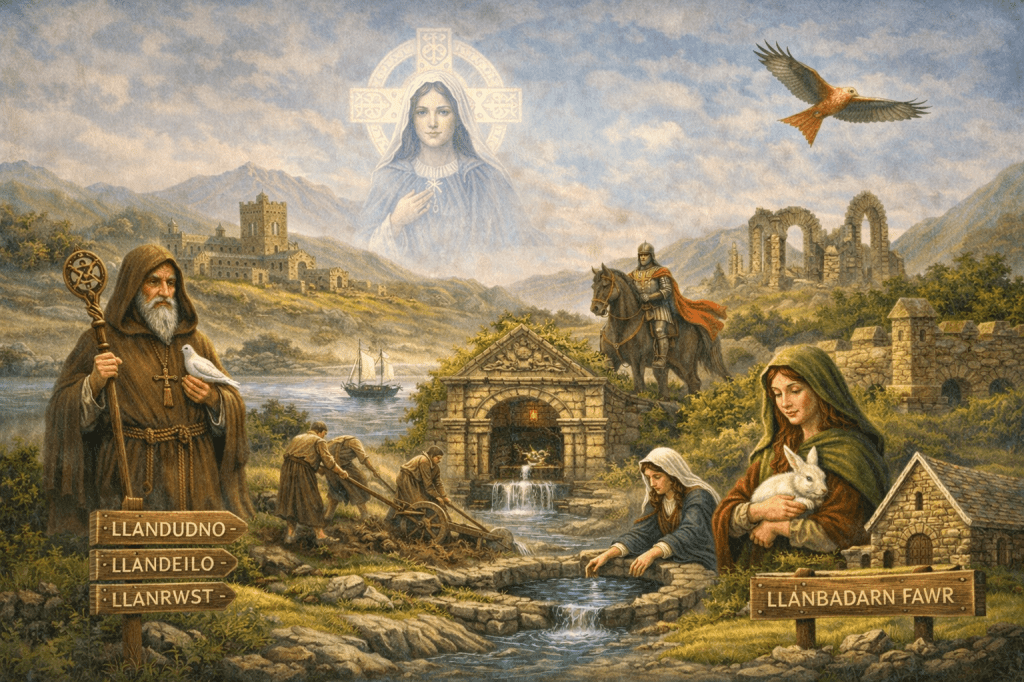
One famous detail captures the ethos. David forbade the use of oxen for ploughing, the monks themselves were to draw the plough. Whether literal or symbolic, the message is unmistakable: humility is not a sentiment, it is labour. Sanctity is not performance, it is routine. It is, in the truest sense, “the little things”.
That is why his most famous maxim endures: “Gwnewch y pethau bychain”, do the little things. Not as a slogan, but as a spiritual politics. In a world fascinated by spectacle and power, the Davidic inheritance is local, practical, stubbornly humane.
Gwenffrewi, martyr, survivor, and the stubborn holiness of a well
The story of Saint Winefride, Gwenffrewi, has always struck readers with its visceral clarity. It is a narrative of refusal, violence, restoration, and the lingering cost of trauma.
According to tradition, a local chieftain, Caradog, pursued her. She refused him in defence of her vow. He responded with rage and decapitated her. Where her head fell, a spring burst forth. Her uncle, Saint Beuno, restored her to life through prayer, but the scar remained at her neck, a bodily witness that sanctity did not erase suffering, it carried it.
What matters here is not merely the miraculous element, but the moral framing. Gwenffrewi’s power is expressed as agency. She refuses. Her sanctity is not passive. She is not celebrated because she is decorative. She is remembered because she resists.
And the place associated with her became one of Britain’s most remarkable sacred continuities. St Winefride’s Well at Holywell is the only shrine in Britain with an unbroken tradition of pilgrimage across more than a millennium, a devotion resilient enough to outlast religious upheaval and iconoclasm. In Welsh terms, the well becomes a form of historical stubbornness. A spring cannot be argued out of existence. The water keeps coming.
There is, too, a further historical twist which draws the Welsh cult of Gwenffrewi into the orbit of the English borderlands. In the late eleventh century, the monks of Shrewsbury Abbey acquired her relics, translating her remains from Holywell to Shrewsbury in a deliberate act of spiritual and institutional ambition. This was not mere piety, it was strategy. In the medieval world, relics conferred prestige, attracted pilgrims, and brought economic life into a town. The possession of a saint’s body could elevate an abbey’s standing, strengthen its claims to patronage, and anchor its identity within a crowded religious landscape. Yet the tradition of pilgrimage at Holywell endured, and the well itself remained the true heart of Gwenffrewi’s cult, a reminder that in Wales, sanctity was never only housed in stone, but flowed through the landscape.
This is the genius of Welsh sacred geography. It is harder to abolish a landscape than an institution.
Padarn, and the maritime Wales that modern maps forget
It is a mistake to imagine early medieval Wales as isolated. The western seaways were not margins, they were highways. Saints travelled, ideas travelled, books travelled, and people moved between Wales, Ireland, and Brittany as naturally as later centuries moved along roads.
Saint Padarn reminds us of this world. A contemporary of David in many traditions, associated with arrivals from Brittany and foundations in Ceredigion, Padarn is linked to Llanbadarn Fawr, one of the great early religious centres. He represents a kind of sanctity that is simultaneously spiritual and organisational, the bishop-abbot figure who blends pastoral authority with community leadership and institutional building.
Padarn’s hagiography also carries a revealing tension, the saint as moral counterweight to secular power. In some saintly lives, Arthur himself appears not as heroic ideal but as unruly ruler, requiring correction. Whether or not the historical Arthur stands behind these tales, the point is clear. The church is claiming the right to rebuke kings. Sanctity is not merely personal piety, it is public authority.
This is one reason the Age of Saints mattered. It provided legitimacy and social order in a post-Roman world where law and governance were constantly renegotiated.
The great cults, David, Teilo, Cadoc
Certain figures became more than local saints. They became ecclesiastical anchors, their cults shaping diocesan identity, political influence, and regional memory. In simplified form, you can see how different saintly reputations functioned within Welsh church culture:
| Saint | Regional stronghold | Notable motif in tradition | What the cult symbolised |
|---|---|---|---|
| David | West Wales, St Davids | The preaching at Brefi, the rising ground | Humility, discipline, moral steadiness rooted in labour |
| Teilo | South Wales, Llandaff | Wonders linked to translation and presence | Expansion, institutional consolidation, the prestige of a diocese |
| Cadoc | Glamorgan | Miracles tied to provision and learning | Education, social order, a saint as community builder and teacher |
The details vary across texts and centuries, but the pattern is consistent. Saints are not only remembered, they are used. They justify, they explain, they organise, they lend weight.
In a small country of competing kingdoms, contested boundaries, and shifting dynasties, a saint could provide the most durable form of legitimacy. Kings might rise and fall. A holy founder, tied to land, could outlast them all.
Melangell, and the holiness of refuge
If there is a saint who feels especially Welsh in the deepest sense, it is Saint Melangell, hidden in the Berwyn Mountains, associated with Pennant Melangell, a place that still carries the hush of sanctuary.
Melangell is remembered as a princess who fled an arranged marriage and chose the life of a hermit. The decisive scene in her legend is not doctrinal argument but an encounter in the wild. Prince Brochwel of Powys is hunting. A hare flees, takes refuge beneath Melangell’s protection. The hunting dogs fall silent. The prince is struck by the force of her holiness, and grants her the valley as a sanctuary.
This is a theology of restraint. Holiness here is not domination over nature, it is the protection of the vulnerable. It is a refusal to treat living things as disposable.
It is also, quietly, an early moral imagination of refuge law. In later medieval Europe, sanctuary becomes a recognised legal and ecclesiastical concept. In Melangell’s story, sanctuary is already embedded in landscape, a valley is transformed into a protected zone because a holy person declares it so, and a ruler submits to that claim.
Even now the tradition lingers in language. Hares in the area are remembered as “Melangell’s lambs”. It is a small phrase, but it carries a whole worldview. Gentleness has standing, even in the face of power.
The linguistic legacy of the “llan”
The deepest evidence of Welsh sainthood is not in illuminated manuscripts. It is on the road signs.
Originally, llan referred to an enclosed sacred space, the consecrated yard or settlement associated with a saint, a church, and a community. Over time it became the normal Welsh marker for the place where religion, daily life, and local identity met. When you drive across Wales, you are travelling through a religious history that has never entirely been overwritten.
- Llandudno, the llan of Tudno.
- Llandeilo, the llan of Teilo.
- Llanrwst, the llan of Grwst.
These names are not decorative. They record the founding logic of Welsh communities, clustered around sacred enclosures, often near springs, river crossings, sheltered valleys, and coastal landing places. Saints chose “thin places”, locations where the boundary between the material and the spiritual felt permeable, and then a village grew up around that choice.
Wales, in other words, did not merely remember its saints. It built itself around them.
The landscape as archive
The saints of Wales were not simply religious figures. They were cultural founders. They gave names to places, legitimacy to communities, moral authority to local institutions, and continuity to a society learning to survive without empire.
That is why their stories have endured, even through the upheavals of the Reformation, the collapse of the old rural world, the decline of chapel culture, and the pressures of modernity. Wales has forgotten many things, but it has not entirely forgotten its sacred map.
And there is a particular Welsh quality to this tradition. It is profoundly local, profoundly place-bound, suspicious of pomp, attracted to discipline, and intimate with landscape. The divine is not only in heaven, it is in wells, stones, boundaries, and work. It is in “the little things”.
That may be precisely why the Age of Saints speaks again in a modern world that often feels spiritually evacuated and geographically unmoored. People hunger for rootedness, for memory that is not merely nostalgic, for identity that does not depend on constant performance. The Welsh saints offer a model of belonging that is not abstract, it is lived, walked, named, and revisited.
Wales is called the Land of Saints not because it was perfect, nor because its Christianity was somehow purer than elsewhere, but because it allowed sanctity to become a landscape habit.
The map is, in its own way, a spiritual archive.
And in Wales, archives do not only sit on shelves. They rise in place names, and they run in springs.
