
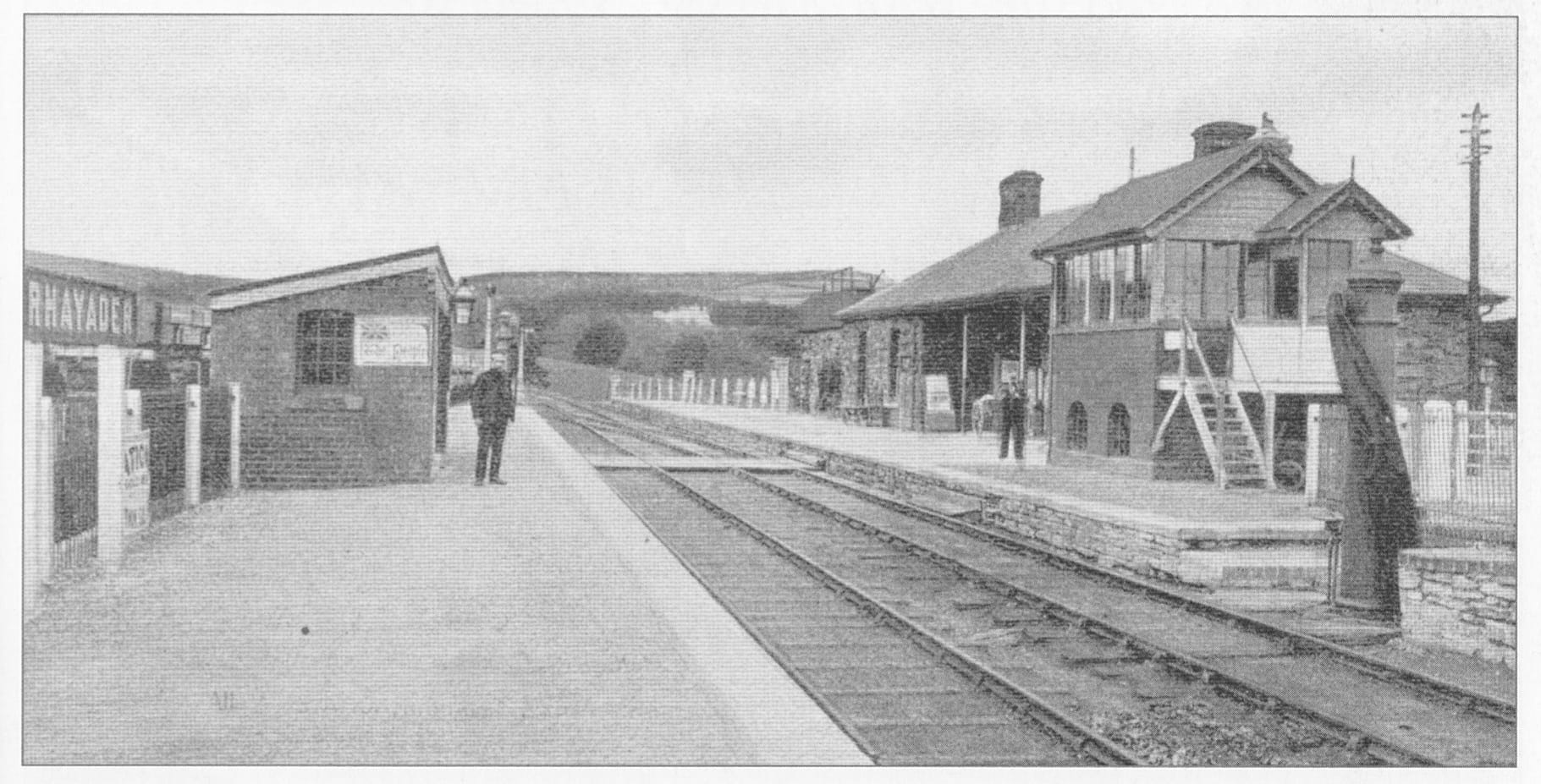
Some railway closures removed a branch from the map. The closure of the Mid-Wales Railway did something more serious. It broke one of the few direct lines of communication running through the interior of Wales.
For almost a century, trains travelled south from Llanidloes through the upper Wye country, serving Rhayader, Newbridge-on-Wye, Builth Wells, Erwood and Boughrood before reaching Three Cocks Junction and continuing towards Brecon. The railway crossed a landscape of small market towns, scattered farms and deeply cut river valleys. It was never a heavily populated corridor, nor did it possess the industrial traffic available to the railways of the south Wales coalfield. Its importance lay elsewhere.
The line gave central Wales a route through itself. That distinction matters. The railway did not merely connect isolated settlements with larger towns. Through its junctions and running powers, it formed part of a longer route between the Cambrian system in the north and the railway network of Brecon, Merthyr Tydfil and south Wales. It carried passengers, livestock, coal, timber, mail and merchandise. It brought excursionists into the countryside and allowed rural families to reach places that had previously required a long journey by road.
Its loss in December 1962 was therefore more than the disappearance of a train service. It narrowed the possibilities of life in the Welsh interior and helped to produce the fragmented transport geography with which Wales still struggles.
A Victorian Ambition
The Mid-Wales Railway emerged during the most confident period of British railway promotion. Its origins lay not in a modest proposal for a country branch, but in the much grander ambition of creating a trunk route between the industrial districts of north-western England and the ports of south-west Wales.
The company began life in 1858 under the imposing title of the Manchester, Liverpool, Swansea and Milford Haven Junction Railway. Its promoters envisaged a line running from Llanidloes by way of Newbridge-on-Wye towards Llandovery, where it would form part of a much larger north-to-south chain of communication. The proposal immediately became entangled in the intensely competitive railway politics of the period. A rival Central Wales Railway scheme sought a route from Knighton through Llandrindod Wells towards Llandovery, and both enterprises put forward lines that would have run through parts of the same country south of Builth.
Parliament did not simply approve one complete vision and reject the other. A House of Commons committee reshaped both. The Mid-Wales promoters were cut back to a Llanidloes to Newbridge-on-Wye undertaking, while the Central Wales proposal was reduced to the section between Knighton and Llandrindod. The eventual railway geography of central Wales was therefore not inevitable. It was the product of rival commercial ambitions, parliamentary compromise and competing ideas about how the Welsh interior should be connected.
The Mid-Wales Railway Act received Royal Assent on 1 August 1859, authorising the route from Llanidloes to Newbridge-on-Wye by way of Rhayader. Further powers obtained in 1860 allowed the company to extend southwards through Builth and Three Cocks to meet the Brecon and Merthyr Railway at Talyllyn. Even these powers did not exhaust the promoters’ ambitions. Surviving parliamentary papers record contemplated extensions on a remarkable scale, including a projected line towards Aberystwyth and Machynlleth and onward towards the Llŷn peninsula and Caernarfonshire. Such schemes never came close to forming the completed railway, but they demonstrate how differently the transport geography of Wales might once have developed.
The ceremonial beginning of the work was itself treated as a public event. A polished mahogany wheelbarrow and silver spade preserved by the Science Museum Group commemorate the turning of the first sod on 2 September 1859. The wheelbarrow records that it was presented to Mrs Pine, who performed the ceremony. The survival of these objects is a small but evocative reminder that railway promotion was not conducted only in committee rooms and engineers’ offices. It was also presented locally as spectacle, progress and civic promise.
The final route was therefore only part of the trans-Wales railway originally imagined. Yet even in its shortened form it remained an ambitious undertaking. From Llanidloes, the line climbed towards Pantydŵr before descending through the Marteg valley and into the upper Wye country. It passed Rhayader and followed the river south through Doldowlod and Newbridge-on-Wye. Beyond Builth, it crossed more difficult country before descending towards Boughrood, Three Cocks and the Brecon basin.
The terrain imposed steep gradients, sharp curves and considerable operating costs. Near Pantydŵr the railway reached approximately 947 feet above sea level. There were tunnels at Marteg and Rhayader, numerous river crossings and long stretches through country that could never be expected to produce urban levels of traffic.
Raising the capital proved almost as difficult as crossing the landscape. The prominent Welsh railway contractors David Davies and Thomas Savin initially agreed to undertake the work, accepting shares as a substantial part of their payment. Their involvement helped to keep the scheme alive when conventional investment proved inadequate, although their partnership broke down before the railway was completed. Other contractors followed, working under similarly precarious financial arrangements.
A ceremonial train travelled over the route on 23 August 1864. Goods traffic began on 1 September, while regular passenger services commenced later that month. A new line had been driven through the centre of Wales, but it had been achieved through compromise, financial insecurity and engineering persistence rather than effortless Victorian progress.
A Railway of Junctions
The Mid-Wales Railway is sometimes described simply as a line between Llanidloes and Brecon. That is convenient, but it conceals the feature that made the railway valuable. It was a connecting route whose importance depended upon the systems it joined.
At its northern end, the railway connected with the Llanidloes and Newtown Railway. From there, passengers and goods could travel towards Newtown, Moat Lane and the wider Cambrian network. The precise railway geography around Llanidloes was complicated by the rival Manchester and Milford scheme. The companies shared the approach to Llanidloes, while the Mid-Wales line itself diverged near Penpontbren, south of the town.
The railway then passed through Rhayader and Newbridge-on-Wye to Builth Road, where it crossed beneath the Central Wales line. The two railways possessed separate stations, later distinguished as Builth Road Low Level and Builth Road High Level, with a connecting spur between the systems. The surviving station at Builth Road belongs to the former Central Wales route, now marketed as the Heart of Wales line. It should not be confused with the vanished low-level station of the Mid-Wales Railway.
South of Builth Wells, the line continued through Aberedw, Erwood and Boughrood to Three Cocks Junction. There it met the Hereford, Hay and Brecon Railway. It then continued to Talyllyn, where trains joined the Brecon and Merthyr system for the final journey into Brecon.
At this southern end the railway inherited a transport landscape considerably older than the steam age. Part of the approach towards Brecon followed the corridor of the Hay Railway, the horse-worked tramroad opened in 1816 between the Brecon and Abergavenny Canal and Hay. The surviving tunnel at Tal-y-llyn had originally been driven for that tramroad between 1812 and 1816 and was enlarged and adapted for locomotive working in 1862. The structure is a physical record of successive transport revolutions, canal, horse tramway, steam railway and, after closure, road transport.
These junctions allowed the railway to serve purposes far beyond the local movement of passengers. When the connection through Merthyr opened in 1868, south Wales coal could be carried northwards towards Birkenhead, where Welsh steam coal was required for ships. Other through freight included slate, stone, dolomite and structural steel.
The Mid-Wales Railway was never merely a picturesque rural branch. It formed part of a contested network of routes by which industrial, commercial and agricultural Wales was being joined together.
What the Railway Meant to Rural Wales
The populations served by the railway were small. At the time of its opening, Rhayader had roughly a thousand inhabitants and Builth little more. Even Brecon, the largest town readily reached from the line, had a population of only about five thousand. Local traffic could not compare with that generated by the industrial valleys or the great English cities.
That did not make the railway unimportant. It meant that its value was spread across the ordinary life of a large rural district.
For farmers, the railway offered a dependable means of sending livestock and agricultural produce to more distant markets. Coal, animal feed, building materials, household goods and parcels could be brought into communities where road haulage remained slow and expensive. Station yards became points of exchange between the railway and the horse-drawn economy of the surrounding countryside.
The stations themselves created employment. A country station might require a stationmaster, porters, signalmen, clerks, permanent-way workers and goods staff. Railway cottages housed employees and their families, while nearby inns, shops and carriers benefited from the traffic generated by arriving trains. Even a small station drew its surrounding district into a national system of timetables, postal services and commercial exchange.
At St Harmon that general picture can be given a name. The 1901 census recorded Sarah Jones, aged fifty and born at Llandinam, as station mistress at St Harmon. Local research identifies her as Sarah Hughes before marriage and suggests that she had entered railway employment while still a teenager, later serving for many years as gatekeeper and station mistress. The parish contained a striking concentration of railway workers by 1901, including station staff and permanent-way men. In a community of modest size, the railway was therefore not simply something that passed through the valley. It was an employer, a household income and a framework around which working lives were organised.
Sarah Jones also appears, indirectly, in a more literary source. The diarist Francis Kilvert encountered the woman in charge of the little station at St Harmon in 1876, and later local research has identified her with Sarah. The episode provides a rare glimpse of the railway as contemporaries experienced it, not as a set of company accounts or engineering drawings, but as a staffed place embedded in village life.
Passenger services were never lavish. During much of the railway’s independent existence, the basic provision consisted of three trains in each direction each day, supplemented by shorter workings and connecting services. Yet regularity mattered as much as frequency. For inhabitants accustomed to journeys governed by weather, horses and the condition of the roads, a published timetable represented a profound change.
The railway enabled people to attend markets, visit relatives, conduct legal and commercial business, enter domestic service, seek employment and travel for education. It also widened the social world of rural communities. Newspapers arrived more quickly, visitors came from farther away and towns such as Rhayader and Builth became more accessible to people who did not possess their own transport.
The line did not abolish isolation, but it made distance more negotiable. It was also, of course, a working railway exposed to the risks of railway operation. On 16 September 1899 a head-on collision at Tylwch killed Maggie Rowlands and injured several passengers and railwaymen. The accident, the contemporary inquest and Lieutenant-Colonel H. A. Yorke’s subsequent Board of Trade findings are examined separately in Signal at Danger: The Tylwch Railway Disaster of 1899.
A Railway Seen Through Its Stations
The individual stations show more clearly than any timetable how the Mid-Wales Railway entered the life of the communities it served. At Rhayader, the station was a gateway not only to the town but to the upper Wye country and, increasingly, the Elan Valley. Its substantial buildings and platform survive in altered form, providing a rare physical link with a railway whose trains ceased running in 1962. The station’s history, its buildings, traffic and connections with the reservoir works, is examined in Rhayader Railway Station: The Surviving Gateway to the Upper Wye and Elan Valley.
Doldowlod presents a different picture. This was a country station serving scattered farms, an estate landscape and communities whose connection with the outside world was not easily measured by passenger numbers alone. Railway construction and operation brought employment and movement to the valley, but the buildings have not survived as those at Rhayader have. Its story is explored in Doldowlod Railway Station: A Country Station on the Mid-Wales Line, alongside the wider history of Doldowlod Hall.
At Newbridge-on-Wye the railway entered a much older economy of roads, livestock fairs, inns and rural trading. The station did not simply replace these activities. It connected them with distant markets and supplied another means by which people, animals and goods could move. The relationship between the railway and village life is considered in Newbridge-on-Wye: A Village Made by Movement. The three places are different in character, yet together they explain the importance of the line more effectively than its receipts alone.
Tylwch illustrates another side of the same railway. Its passing facilities were essential to the safe working of a predominantly single-track route, and the fatal collision of September 1899 exposed what could happen when the safeguards governing that system failed. The station was therefore part of the railway’s operating structure as well as a point of local access. The accident and its human consequences are examined in Signal at Danger: The Tylwch Railway Disaster of 1899.
Read together, these local histories reveal something which a general account of construction, finance and closure can easily obscure. The Mid-Wales Railway was a sequence of distinct working places, each linked to its surrounding countryside. At one station it carried reservoir workers and visitors, at another it served a landed estate, elsewhere it sustained the traffic of a market village or provided a vital crossing point. The loss of the line was consequently experienced not as one event alone, but as the disappearance of many everyday connections.
Rhayader and the Making of the Elan Valley
One of the railway’s most important roles arose from a development that its original promoters could not have anticipated.
During the 1890s, Birmingham Corporation began constructing the great reservoir system in the Elan and Claerwen valleys west of Rhayader. The project transformed the district. Thousands of workers, together with enormous quantities of stone, cement, machinery and other supplies, had to be transported into what was then one of the most remote parts of Wales.
A standard-gauge construction railway was built from a junction with the Mid-Wales line south of Rhayader. Work began in 1893 and the system eventually extended deep into the Elan Valley. The connection allowed materials and personnel to reach the reservoir works from the national railway network.
Some construction workers lived as far away as Llanidloes. Special workmen’s trains carried them non-stop to Rhayader early on Monday mornings and returned them on Saturday afternoons. This detail reveals the railway’s social importance particularly well. The line did not simply carry the materials from which the dams were built. It organised the working week and connected labouring households across the uplands.
The Elan Valley works lasted from 1893 until 1906 and created one of the greatest civil-engineering projects in Wales. The Mid-Wales Railway was not solely responsible for that achievement, but without its existing route through Rhayader, the movement of workers and supplies would have been considerably more difficult.
Here the railway’s wider value becomes visible. Infrastructure attracts further infrastructure. A line built under one set of Victorian ambitions became essential to an entirely different undertaking three decades later.
War, Coal and Strategic Capacity
The First World War revealed another form of railway value that ordinary passenger receipts could never measure. The Royal Navy depended upon enormous quantities of high-grade south Wales steam coal, and special trains carried it northwards for the Grand Fleet. These workings became known as the Jellicoe Specials, after Admiral Sir John Jellicoe.
The principal coal route towards the north generally followed the Marches, but when that artery was congested, traffic could be diverted by alternative lines. The Mid-Wales route formed part of that reserve capacity. Coal trains could be worked through Talyllyn, Builth Wells and Llanidloes before continuing northwards towards the Shrewsbury and Chester systems. Across the wider Jellicoe operation, thousands of special trains carried millions of tons of coal. Those totals cannot be attributed to the Mid-Wales Railway itself, but its use as a diversionary route is significant.
A railway that appeared marginal when judged solely by normal local traffic could become strategically useful because it provided another path through the network. Redundancy in transport can look wasteful in peacetime. In periods of national strain, the same spare capacity becomes resilience.
Excursions and the Discovery of Rural Wales
The railway also played a part in the emergence of rural tourism.
From 1880, summer through-carriages ran between Cardiff and Aberystwyth by way of the Rhymney Railway, Talyllyn and the Mid-Wales route. Passengers could travel from the industrial south into the river valleys and uplands of central Wales before continuing towards the coast.
Under the Great Western Railway, which absorbed the Cambrian system in 1922, cheap excursions were used to stimulate traffic. Agricultural shows at Brecon and in Radnorshire attracted special fares. Excursions carried passengers from Builth Wells to Liverpool and from Llanidloes to Barry Island. The destinations are revealing. The railway allowed the inhabitants of rural Wales to reach cities and seaside resorts, but it also allowed visitors from industrial districts to encounter the Welsh interior.
The railway continued to adapt to sparse rural settlement during the inter-war years. Glan-yr-Afon Halt opened in 1928 and Marteg Bridge Halt in 1931, modest stopping places intended to make the service more accessible to communities that could not justify substantial stations. Their creation is worth noting because it complicates any simple story of uninterrupted decline. Even as roads and motor buses became stronger competitors, the railway was still experimenting with cheaper ways of serving the countryside.
The realities of that countryside could be severe. During the bitter winter of 1947 a train between Llanidloes and Rhayader became trapped by snow, while locomotives sent to assist also became stranded near Pantydŵr. For passengers and railwaymen alike, the episode demonstrated both the vulnerability of the upland route and the extraordinary effort sometimes required to keep it open.
This traffic should not be exaggerated. The Mid-Wales Railway never became a tourist railway on the scale of the routes serving the north Wales coast or Snowdonia. Nevertheless, it formed part of the process by which the landscape of mid Wales became accessible to a wider public.
There is a striking modern irony in this. Scenic railways are now treated as valuable cultural and economic assets. The surviving Heart of Wales line is promoted for its landscapes, walking opportunities and access to rural communities. Had the route through Rhayader, the upper Wye and the Brecon countryside survived, it would today pass through precisely the kind of landscape that tourism agencies seek to market.
Its scenery, once incidental to the practical business of the railway, might have become one of the strongest arguments for its preservation.
Financial Weakness and Absorption
The railway’s social usefulness did not guarantee commercial success. The population along the route was sparse and there were few large industries generating regular freight. During the second half of 1865, the railway carried approximately 12,000 tons of goods, but freight provided only about a quarter of its gross receipts. Operating expenses were high, reflecting both the difficult route and the limited density of traffic.
Financial problems followed the company throughout its independent existence. In 1879 its debenture holders resorted to the courts after the company proved unable to meet its interest payments. Restructuring provided temporary relief, but it did not alter the fundamental weakness of a long and difficult railway serving a small population.
The Cambrian Railways assumed responsibility for working the line in 1888. The arrangement proved successful enough to lead eventually to full amalgamation, authorised by Parliament in 1904. The Mid-Wales Railway then lost its separate corporate identity.
Further changes followed. The Cambrian became part of the enlarged Great Western Railway in 1922, and the railway passed into public ownership with the nationalisation of the railways in 1948.
By then the competitive world surrounding the line had changed. Better roads, private cars and motor buses were steadily reducing passenger numbers. Road haulage removed much of the local goods traffic upon which rural stations depended. A railway designed for the transport economy of the 1860s was being judged within the very different conditions of the mid twentieth century.
The line’s operating difficulties were real. Any serious assessment must acknowledge them. It was steeply graded, circuitous in places and expensive to maintain. Its trains were relatively slow and the number of passengers was declining. The case for retention could not rest on sentiment alone.
The more difficult question is whether immediate financial performance was an adequate measure of its value to the region.
A Corridor Already in Retreat
The final closure of 1962 did not arrive without warning. Surviving Breconshire County Council papers show a railway corridor already being weakened by piecemeal proposals. There were discussions concerning the railway through Newbridge-on-Wye in 1959, proposals affecting Cilmery Halt in the same year, Trefeinon in 1960 and the withdrawal of freight facilities at Doldowlod in 1961. The pattern matters. What disappeared at the end of 1962 had already been subject to several years of retrenchment.
This process was characteristic of the period. Lightly used stations, halts and goods facilities could be removed one by one, reducing costs in the short term but also making the surviving railway less useful. Closure was therefore not simply a single decision imposed upon an otherwise intact system. It was the culmination of an erosion of services and facilities that had already altered the relationship between the railway and the communities beside it.
Closure Before Beeching
Proposals to close the railway emerged during the spring of 1962 as part of a wider plan to withdraw passenger services from the lines entering Brecon. A public inquiry into the proposed closure of the Moat Lane to Brecon route and associated lines was held from 15 to 17 May 1962. Surviving county council records preserve correspondence, objections, minutes and reports associated with the case, revealing that closure was argued over in detail rather than accepted without resistance.
The parliamentary debate that followed is particularly revealing because it exposes the very different ways in which the railway’s value was being measured. On 27 June 1962, the Minister of Transport, Ernest Marples, defended the statistical case for closing the Newport to Brecon and Brecon to Moat Lane routes. Passenger journeys made over only part of the railway were converted into equivalent journeys over the entire 107 route miles. Marples cited one train whose recorded traffic, once treated in this manner, amounted to 7.44 whole-route passengers before further adjustments. To dramatise what he regarded as the absurdity of the economics, he compared the relationship between train and passenger to a “five-ton crane lifting a bottle of beer”.
The comparison was memorable, but it also reveals the assumptions underlying the closure case. A rural railway did not exist mainly to carry people from one end of its route to the other. It served overlapping local journeys, market trips, school travel, connections and short-distance movements. Converting those journeys into whole-route equivalents made sense as one statistical device, but it could also make a dispersed rural service appear more empty than the experience of individual trains and stations suggested.
Tudor Watkins, the Labour MP for Brecon and Radnor, challenged the Minister on precisely this ground. He pointed to evidence that around 1,400 passengers a day were using the four threatened Brecon lines and accused the Ministry of relying upon an unrepresentative section of the route. He also brought the debate back to the people for whom the railway was not an abstract financial unit. What, he asked, was to happen to the rural old-age pensioner without a motor car? At the Brecon hearing, he said, it had even been suggested that some might simply “thumb a lift”.
Another contemporary objection concerned the Royal Welsh Agricultural Society. In May 1962 the House of Lords was told that the Society was establishing its permanent showground at Builth Wells only a short distance from the station threatened with closure. The apparent contradiction was striking. Railway excursions had helped agricultural shows draw visitors from a wider area, yet one of the great institutions of rural Wales was preparing a permanent home beside a railway that was about to disappear. Peers also raised the possible future importance of agricultural, coal, forestry and timber traffic.
The last ordinary services ran at the end of that year. On Sunday, 30 December 1962, a Stephenson Locomotive Society special travelled from Shrewsbury to Brecon and back, providing the final passenger journey over the route. Closure formally took effect on 31 December.
The date is historically significant. Dr Richard Beeching’s report, The Reshaping of British Railways, was not published until 27 March 1963. The Mid-Wales Railway was therefore not, in the strict sense, closed as a result of the Beeching Report.
It would be equally misleading, however, to treat its closure as unrelated to the thinking later associated with Beeching. British Railways had been closing lightly used lines for years, and Beeching had already been appointed chairman of the British Transport Commission in 1961. The closure belonged to a wider policy of concentrating railway resources upon routes considered capable of producing sufficient traffic.
The distinction matters because it places responsibility within a longer history. The contraction of rural railways was not the consequence of a single report or one individual. It arose from changing patterns of transport, government policy, railway economics and a growing belief that buses and private cars could replace local trains.
For some of the communities along the Mid-Wales route, the weakness of that belief became apparent almost immediately.
The Replacement Buses and the Winter of 1963
The closure was accompanied by the expectation that buses could provide an adequate substitute. The first winter after the trains stopped supplied an unusually harsh test. Britain experienced exceptionally severe weather, and the upland roads of Radnorshire exposed the difference between a theoretical replacement service and one that could actually reach isolated communities.
In the House of Commons on 30 April 1963, Tudor Watkins reported that the replacement buses which were supposed to begin with the railway closure had been unable for ten weeks to serve St Harmon, Pantydŵr and Tylwch because of the weather. Similar difficulties were reported at Llangorse and Trefeinon in Breconshire. The point is not that trains were immune to snow, the 1947 episode demonstrates that they were not, but that the substitute offered in place of the railway proved unable to provide the promised continuity at the very moment when isolated communities most needed dependable public transport.
The county council archive reinforces the parliamentary evidence. Files survive specifically concerning the proposed alternative bus services, the inconvenience caused during cold weather after the closure, and the timetables eventually provided for the former Moat Lane branch. These papers allow the consequences of closure to be traced beyond the final train. The transport argument did not end on 31 December 1962. It continued in complaints, timetables and attempts to make the replacement system work.
What Was Lost
It is impossible to prove that retaining the Mid-Wales Railway would have prevented depopulation, guaranteed economic development or transformed the fortunes of every town along its course. Historical honesty requires caution. Rural change had many causes, including agricultural decline, centralised services, changing employment and the increasing ownership of private cars. Nevertheless, the closure removed an important choice.
Residents without cars became dependent upon bus services, lifts from relatives or expensive journeys by taxi. Travelling between Llanidloes, Rhayader, Builth and Brecon ceased to be a single railway journey and became a matter of separate services and uncertain connections. The effect fell most heavily upon those least able to adapt, the young, the elderly and people on low incomes.
Over time, access to education, employment and healthcare became increasingly dependent upon private motoring. This became still more significant as hospitals, colleges and public services were concentrated in larger towns. A railway that had once seemed slow and old-fashioned might later have provided the basis for a more resilient public transport system.
The economic loss was less dramatic but equally persistent. A railway station places a town on a recognised route. It brings visitors into its centre and allows a journey to be planned without a car. When the station closes, the town becomes less visible. It may remain accessible by road, but it is no longer part of the mental map created by the national railway timetable.
Rhayader illustrates the contradiction. It now stands at the gateway to the Elan Valley, one of the finest landscapes in Wales, yet visitors arriving by public transport cannot reach the town by train. A railway that once helped to construct the reservoirs disappeared before their landscape became a major heritage and tourism asset.
A Nation Connected Outwards
The disappearance of the Mid-Wales Railway also raises a wider Welsh question. Much of the surviving railway network in Wales reflects the economic requirements of the nineteenth century. Lines were built to carry coal, slate and manufactured goods towards English markets and British ports. As a result, Wales possesses several important east-to-west corridors but comparatively weak connections between north and south.
The Mid-Wales Railway did not offer a perfect national solution. Its route was slow, its junctions complicated and its northern and southern connections depended upon other companies. It would be an exaggeration to describe it as a modern main line waiting to happen.
Yet it was one of the few railways that carried travellers through the Welsh interior. From the Cambrian network around Llanidloes, it ran south through Rhayader and Builth towards Brecon and the industrial valleys. Its very existence challenged the idea that travel within Wales must first turn towards the English border.
The contrast with the surviving Heart of Wales line is instructive. That railway continues to connect Swansea with Shrewsbury through Llandovery, Llanwrtyd Wells, Llandrindod Wells and Knighton. Its service is limited, but its survival means that the route can still be improved, promoted and adapted.
The modern T4 TrawsCymru bus corridor is another revealing echo. It links Newtown with Merthyr Tydfil through Llandrindod Wells, Builth Wells and Brecon, with some journeys serving Llanidloes and Rhayader. The vehicles are different and the precise route is not the same, but the underlying need is familiar. More than sixty years after the railway disappeared, public policy is still attempting to provide north-to-south movement through much of the same Welsh interior.
This does not prove that reopening the entire Mid-Wales Railway would be practical, nor is such a reopening an adopted solution to the region’s transport problems. It demonstrates something simpler and historically more important. The problem to which the railway once provided an answer has never entirely disappeared.
The Mid-Wales Railway retained no possibility of incremental improvement. Once the rails were lifted, bridges removed and sections of the formation returned to agriculture or absorbed into roads, reinstatement became vastly more expensive. Closure did not simply suspend a service. It foreclosed much of the future.
The Surviving Landscape
Traces of the railway remain. Station buildings, bridge abutments, cuttings and stretches of trackbed can still be found along the route. At Rhayader, the former station survives as a visible reminder of the town’s lost connection. Elsewhere the railway has been absorbed quietly into the landscape, its former presence recognisable mainly to those who know where to look.
These remains are not merely objects of railway nostalgia. They form part of the archaeology of rural modernisation. They show where communities once connected with national markets, where livestock was loaded, where parcels arrived and where passengers waited beneath station canopies for trains to Brecon, Llanidloes or beyond.
The railway belonged to the working landscape. Its history is inseparable from farming, tourism, reservoir construction, local employment, wartime transport and the changing fortunes of the market towns it served.
What the closure left behind
The Mid-Wales Railway was commercially weak for much of its life. It crossed difficult country, served small populations and would probably have required subsidy and modernisation had it survived. None of that removes its social value to the communities it connected.
For nearly a century it provided a continuous public route through central Wales, linking market towns, farms and communities that are now awkward to travel between without a car. Its closure was not the sole cause of later economic or demographic problems, but it removed infrastructure that might have helped the region respond to them.
The new evidence surrounding the closure makes the loss easier to understand. The line had emerged from a nineteenth-century struggle over how Wales should be connected, had supported reservoir construction, rural employment, tourism and wartime traffic, and had remained socially significant even when its finances were weak. In 1962 those different forms of value were reduced largely to the economics of railway operation. Within weeks of closure, the vulnerability of the promised replacement arrangements was already visible.
What survives today is a fragmented trackbed and a transport geography in which many journeys within mid Wales remain difficult. That is the most useful legacy against which to judge the closure. The railway should not be romanticised as a lost answer to every modern problem, but neither should it be remembered merely as an uneconomic branch that happened to disappear. It was one of the few routes that allowed the Welsh interior to function as a connected space.
Explore the surviving railway story: The Mid-Wales Railway crossed the Heart of Wales line at Builth Road. For the parallel story of how rail access transformed the Victorian spa economy farther north, see The Waters That Built a Town and the Llandrindod Wells History guide.
Related Essays
- Signal at Danger: The Tylwch Railway Disaster of 1899
- Llandrindod Wells Railway Station: William Killan and the Railway That Made a Spa Town
- The Monks’ Trod: A Medieval Road Through the Cambrian Mountains
- When an English City Drowned a Welsh Village: Llanwddyn and the Making of Lake Vyrnwy
- Newbridge-on-Wye: A Village Made by Movement
- Doldowlod Railway Station: A Country Station on the Mid-Wales Line
Explore more Welsh rural history
Continue with Welsh Rural History, or browse the related essays above.
Sources and Further Reading
- R. W. Kidner, The Mid-Wales Railway (Oakwood Press).
- Rex Christiansen and R. W. Miller, The Cambrian Railways, Volume I: 1852–1888 and Volume II: 1889–1968 (David & Charles).
- Peter E. Baughan, A Regional History of the Railways of Great Britain, Volume 11: North and Mid Wales (David & Charles).
- Cambrian Railways (Mid Wales Railway Amalgamation, etc.) Act 1904, legislation.gov.uk.
- National Library of Wales, Mid-Wales Railway records, including parliamentary papers, plans, sections and comparative estimates relating to the Mid-Wales and Central Wales schemes.
- Science Museum Group, Mid Wales Railway collection, including the ceremonial wheelbarrow and silver spade associated with the first sod, 2 September 1859.
- Cadw, listed-building record for Tal-y-llyn Tunnel and its origins in the Hay Railway.
- The Mid Wales Railway and Related Lines, Welsh Railways Research Circle.
- Mid Wales Railway, 1859–1904, Science Museum Group.
- The Railway Through Rhayader, Powys Digital History Project.
- The Elan Valley Railway, Elan Valley.
- Elan Valley: A Community Lost to Promote Progress, Royal Commission on the Ancient and Historical Monuments of Wales.
- Radnorshire’s Lost Gem: The Mid Wales Railway, Radnorshire Society.
- St Harmon Community Council, local railway history and research on Sarah Jones, Glan-yr-Afon Halt, Marteg Bridge Halt and the winter of 1947.
- The Kilvert Society, material relating to Francis Kilvert’s visit to St Harmon station.
- Board of Trade accident report, Tylwch, 16 September 1899, Railway Work, Life & Death / Railways Archive collections.
- Shropshire Remembers, research on the First World War Jellicoe Specials and alternative coal routes.
- Breconshire County Council railway files, including B/C/C/RY/2, B/C/C/RY/7 and B/C/C/RY/10, Powys Archives catalogue.
- House of Lords Debates, 2 May 1962, discussion of the proposed Brecon-area railway closures and the Royal Welsh Agricultural Show.
- House of Commons Debates, 27 June 1962, Ernest Marples and Tudor Watkins on the Brecon and Mid-Wales railway closures.
- House of Commons Debates, 30 April 1963, Tudor Watkins on replacement bus services following closure.
- British Railways Board, The Reshaping of British Railways (1963).
- TrawsCymru / Transport for Wales, current T4 Newtown–Merthyr Tydfil timetable.