
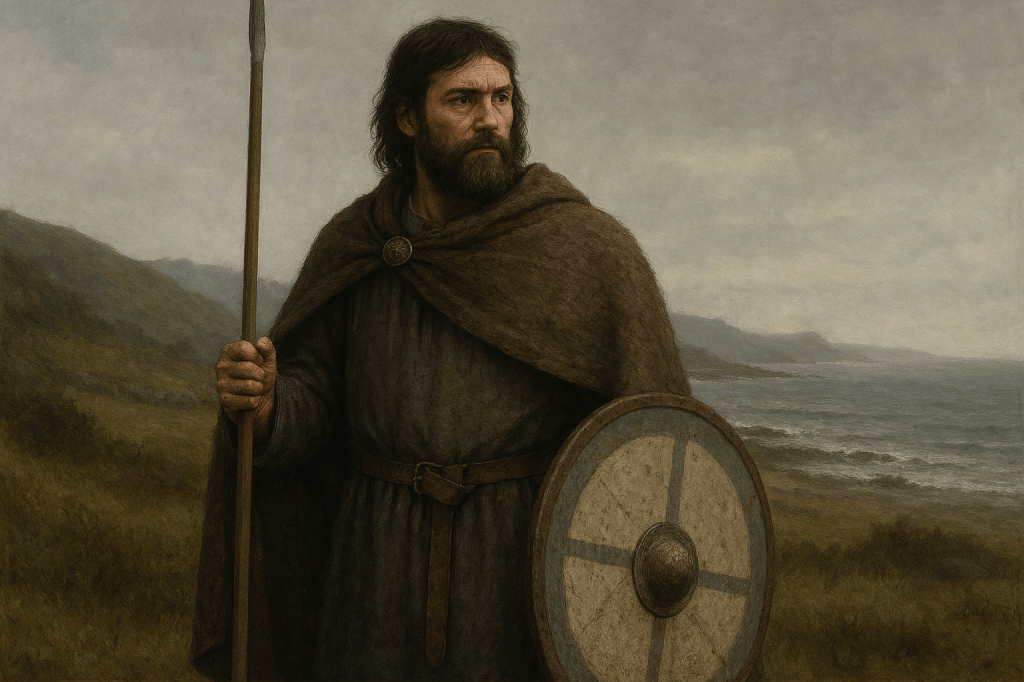
Introduction, Beyond Legend
Rhodri Mawr, who died in 878, stands at a structural turning point in Welsh history. He was neither the first king in Wales nor the ruler of a unified nation in any modern sense. Yet during his lifetime the scale at which Welsh politics operated changed perceptibly.
What had been a mosaic of rival kingdoms, bound by kinship and frequently destabilised by feud, began, however briefly, to cohere under a single dominant ruler. Rhodri did not invent Wales. He altered the possibilities of Welsh power (source 1).
To understand that shift, we must place him within the volatile world of ninth-century Britain and Ireland, a world of fragile frontiers, maritime highways, and dynasties whose legitimacy rested as much on ancestry as on arms.
The above image is a modern artistic impression of Rhodri Mawr. No contemporary likeness survives, and it should be understood as an illustrative reconstruction rather than a documentary portrait.
Fragmented Authority and a Shifting Frontier
The political landscape of Wales was composed principally of Gwynedd in the north-west, Powys in the east, and Seisyllwg in the south-west. These were not centralised states but kin-based polities. Authority derived from descent. Succession could trigger violence. Alliances were personal rather than institutional (source 2).
To the east, Mercia had long projected dominance, symbolised most dramatically by Offa’s Dyke, an earthwork that materialised Anglo-Saxon frontier power (source 3). Yet by the later ninth century the balance was shifting. The Viking Great Army destabilised English politics in the 860s and 870s, and in 874 King Burgred of Mercia was driven into exile, leaving Mercia politically weakened and dependent (source 9).
That rupture mattered. The removal of Burgred fractured the older Mercian grip on the frontier. In such conditions, rulers west of Offa’s Dyke could consolidate with less immediate interference. Rhodri’s strengthening of his hold on Powys belongs within that altered political ecology (source 2).
Across the Irish Sea, Scandinavian activity intensified. Norse bases in Dublin and elsewhere disrupted maritime networks linking Wales, Ireland, and western Britain (source 4). Raiding, settlement, opportunistic alliance, and strategic bargaining became features of the age. Rhodri’s career unfolded at precisely this moment of structural stress.
Maritime Roots, The Dynasty Before the King
Rhodri’s story does not begin in isolation. His father, Merfyn Frych, is described in the Dictionary of Welsh Biography as the son of Gwriad, probably a Manx chieftain (source 11). That detail should not be romanticised, yet it is interpretatively significant.
The Merfynion emerged from an Irish Sea world in which Wales, Man, and Ireland were connected by movement, kinship, and maritime power. Rhodri’s later defence of Anglesey was therefore not merely a reaction to Viking intrusion. It occurred within a seaborne political sphere in which his dynasty already had roots (source 4) (source 11).
The dynasty’s maritime inheritance deepens the logic of his reign. The coast was not a margin. It was a theatre.
Dynastic Consolidation, The Map Reimagined
Rhodri inherited Gwynedd through his father (source 11). Through his mother he possessed a claim to Powys, and by marriage to Angharad ferch Meurig he secured influence in Seisyllwg (source 2).
Viewed spatially, the significance is clear. Gwynedd in the north-west, Powys stretching across the eastern uplands and borderlands, Seisyllwg anchoring the south-west, these were strategic zones. Under Rhodri, they were, for the first time, held within a single dynastic grasp.
This was not bureaucratic integration. Authority remained personal and itinerant. Yet the symbolic and diplomatic implications were substantial. Wales could now be represented, however imperfectly, by a ruler whose reach extended across multiple kingdoms (source 5).
The mosaic endured, but it had been overlaid with a new architecture.
Anglesey, Gorm, and Continental Notice
Rhodri’s military reputation rests in part on a recorded victory over Scandinavian forces on Anglesey in 856 (source 1). Later tradition names the fallen Viking leader as Gorm, sometimes rendered Horm, a detail that sharpens the episode’s narrative contour (source 2).
The Irish Sea zone was not invisible to the Continent. Carolingian writers observed northern events closely, and poems by Sedulius Scottus at the court of Charles the Bald praise a figure styled “Roricus” and celebrate victory over Norsemen, material long interpreted as reflecting Rhodri’s growing reputation beyond Wales (source 10).
Whether every literary reference corresponds precisely to a single battle is less important than the broader point. Rhodri was not merely a local ruler. His successes belonged to a wider northern European struggle against Scandinavian expansion.
In a society where kingship depended upon martial credibility, such victories enhanced legitimacy at home and prestige abroad. Yet these conflicts unfolded within a fluid maritime world in which violence, diplomacy, and exchange coexisted.
Death, Memory, and “Dial Rhodri”
The Anglo-Saxon Chronicle records that Rhodri was slain by the English in 878 (source 6). His death illustrates the precariousness of early medieval kingship. Authority, however extended, remained personal. When the ruler fell, the structure trembled.
Yet memory reshaped the event. In 881, Rhodri’s sons defeated English forces at the Battle of Conwy. Welsh tradition interpreted that victory as divine retribution, “Dial Rhodri”, the vengeance of Rhodri (source 2).
The framing is revealing. His death became not only a dynastic setback but a moral narrative. Providence had vindicated the fallen king. In that transformation from event to meaning we glimpse the construction of political memory.
Division and the House of Aberffraw
Following Rhodri’s death, his territories were divided among his sons in accordance with Welsh inheritance custom (source 5). At first glance, unity dissolved.
Yet precedent endured. Rhodri’s descendants, the rulers later associated with the House of Aberffraw, invoked his name as a source of dynastic legitimacy for centuries (source 13). Descent from Rhodri became a political credential, deployed in disputes over precedence and sovereignty within Wales.
When later princes asserted primacy, they did so not in isolation but as heirs to a line that traced back to him. His achievement altered the scale at which authority could be imagined. His memory furnished the language of legitimacy.
From Rhodri to Hywel Dda
Rhodri’s grandson, Hywel Dda, would later consolidate power more durably and oversee the codification of Welsh law (source 7). If Rhodri represents the martial and dynastic phase of consolidation, Hywel represents its legal and administrative maturation.
The line between them is not romantic myth but institutional continuity. Welsh political development evolved across generations, each building upon precedents established in conditions of uncertainty.
Genealogy as Constitution
Before turning to the longer afterlife of Rhodri’s name, one principle must be stated clearly.
In the Middle Ages, genealogy was the equivalent of a constitution. Modern states point to written law or parliamentary sovereignty. Medieval dynasties pointed to bloodline. Descent did not merely explain who ruled, it justified why they should rule, what lands they could claim, and which rival claims could be dismissed as secondary (source 13).
Rhodri’s name became more than history. It became a legal and political instrument.
Legacy Table, Rhodri’s Name as Political Instrument
| Period and context | What was at stake | How Rhodri’s name functioned | Evidence |
|---|---|---|---|
| 12th century pedigree consolidation | Establishing seniority among Welsh princely lines | Pedigrees emphasised descent from Rhodri to assert Aberffraw primacy | (source 13) |
| Early 13th century Gwynedd expansion into Powys | Territorial control and overlordship | Gwynedd’s claims rested upon a long-standing precedent of multi-kingdom authority traced back to Rhodri | (source 12) |
| 1216–1240 assertion of suzerainty | From alliance to subjection in central Wales | Dynastic seniority rooted in Rhodri’s consolidation strengthened claims of leadership | (source 12) |
| Late 13th century conflicts under Llywelyn ap Gruffudd | Defence of Welsh sovereignty against England | Descent from Rhodri underpinned Aberffraw’s claim to represent Wales as a whole | (source 13) |
The table illustrates a simple point. Rhodri’s memory was curated, refined, and deployed. He became a legitimising ancestor whose name functioned as a constitutional argument.
Legacy, Possibility Rather Than Permanence
Rhodri did not create a unified Welsh state. His authority fractured after his death. External pressures persisted. Scandinavian activity did not cease. English power would rise again.
Yet he altered the political horizon.
He demonstrated that rule across multiple Welsh kingdoms was feasible. He expanded diplomatic and military scale. He left behind a dynasty that converted ancestry into constitutional logic.
In that sense, Rhodri belongs not merely to the annals of conflict but to the longer evolution of Welsh governance. His achievement was not permanence, but possibility.
And possibility, once imagined, becomes precedent.
Footnotes and Sources
(source 1) Annales Cambriae, ed. John Williams (Rolls Series, 1860).
(source 2) Thomas Charles-Edwards, Wales and the Britons 350–1064 (Oxford University Press, 2013).
(source 3) David Hill and Margaret Worthington, Offa’s Dyke: History and Guide (Tempus, 2003).
(source 4) Clare Downham, Viking Kings of Britain and Ireland (Dunedin Academic Press, 2007).
(source 5) Kari Maund, The Welsh Kings (Tempus, 2000).
(source 6) The Anglo-Saxon Chronicle, trans. Michael Swanton (Phoenix Press, 2000), entry for 878.
(source 7) Dafydd Jenkins (ed.), The Law of Hywel Dda (Gomer, 1986).
(source 9) The Anglo-Saxon Chronicle, s.a. 874, deposition of Burgred of Mercia.
(source 10) Nora Chadwick, Celtic Britain (Cambridge University Press, 1963), discussion of Sedulius Scottus and “Roricus”.
(source 11) Dictionary of Welsh Biography, “Merfyn Frych (d. 844)”.
(source 12) David Stephenson, “Re-Thinking Thirteenth-Century Powys”, Cymmrodorion.
(source 13) “The Pedigrees of the Kings of Gwynedd”, Cambridge Core publication on twelfth-century pedigree formation.
