
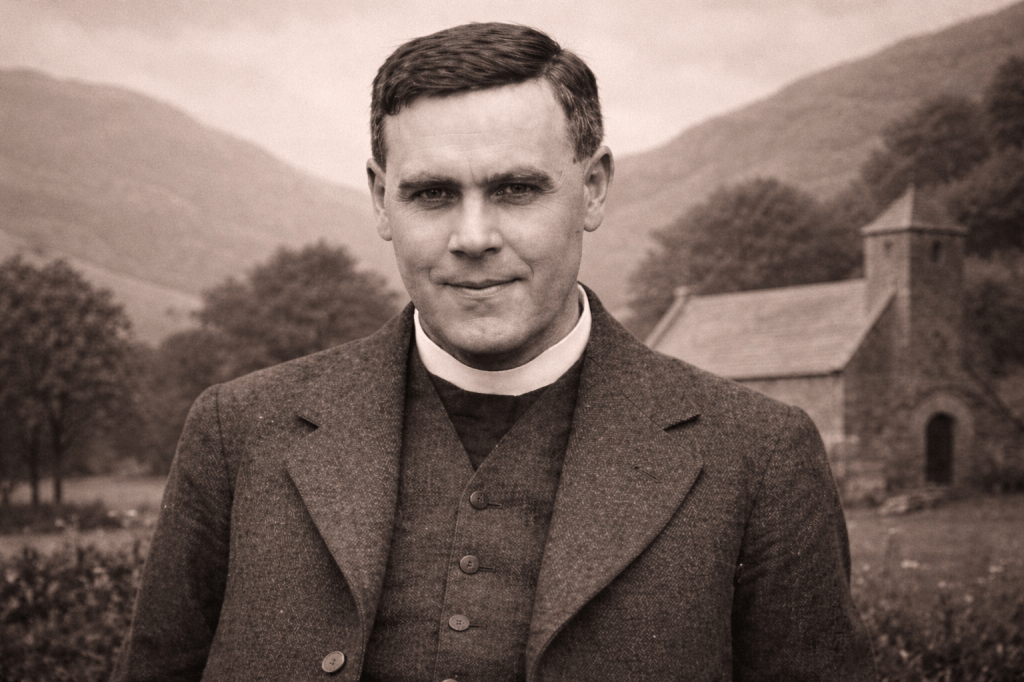
A Farm Boy at Christ Church, Oxford, A Welsh Scholar in Public Life
In 1920s Oxford, the halls of Christ Church were filled with the sons of the English landed elite. Among them sat an unlikely figure: a farm labourer from the Dyfi Valley who had traded his plough for Augustine.
Trevor Owen Davies was born at Caeadda, Llanwrin, on 20 November 1895. Raised within the farming culture of the Montgomeryshire uplands, he belonged to a world structured by seasonal labour, chapel discipline, and the stubborn seriousness of Welsh Calvinistic Methodism. By 1917 he is recorded as working as a farm labourer for his uncle David Davies. Yet within this apparently bounded landscape, he developed the rare combination of academic power, religious vocation, and public authority that would carry him from rural mid Wales to Oxford, to Trevecka, to the BBC, and to the Brecknockshire bench.
His life is best read as a case study in how Nonconformist Wales, at its height, could produce leaders who moved confidently through national institutions without surrendering cultural identity.
The Chapel and the School: A Rural Intellectual in Formation
Trevor’s early promise was visible within the highly structured world of chapel education. In April 1909 he scored 91 out of 100 in the Upper Montgomeryshire Calvinistic Methodist Sunday School examinations. By June 1914, aged eighteen, he had been put forward for training as a preacher, and in September 1915 he passed his preacher’s examination with 200 marks out of 300, receiving permission to preach and gaining the nickname “The Young Preacher”.
Between 1913 and 1917 he attended Machynlleth County School, a crucial institution in the educational modernisation of rural mid Wales. The headmaster, Hugh Harries Meyler, an Oxford graduate, praised Trevor’s “character, high aims, and serious application to his studies”. Trevor gained both Senior and Higher Certificates of Education, with special distinction in Scripture. Meyler also singled him out as a singer of “unusual merit and distinction”, and local accounts show him performing publicly in fundraising events and school productions, already comfortable before an audience.
This early evidence matters. It demonstrates that Trevor’s later public authority was not an Oxford invention. It was rooted in a Welsh rural culture that trained young men to speak, to sing, to read intensely, and to treat knowledge as moral labour.
War, Illness, and the Turn Toward Study
Trevor enlisted under the Derby Scheme in January 1916 and was called up in June 1917. His military experience was curtailed by serious ill health, including acute rheumatism and heart complications, prompting a medical recommendation for discharge in January 1918. He received a pension and a small gratuity payment, and later sought, unsuccessfully, to have the pension extended.
The illness did not, in itself, create the scholarship that followed, but it did alter the shape of his life. It ended the prospect of a conventional wartime trajectory, severed his return to full time farm labour, and placed him back into civilian life at precisely the moment when denominational education structures were looking for capable candidates.
In October 1918 he entered the University College of Wales, Aberystwyth, supported by the Owen Jones Scholarship, worth £22 per annum and awarded by Bala Theological College. The scholarship was an investment in promise, a statement that the Welsh religious world still believed learned ministry and higher education were matters of national importance.
Aberystwyth: Classics, Confidence, and the Welsh Ideal of the Learned Minister
At Aberystwyth Trevor pursued a classical education. In August 1919 he passed his first year examinations in Latin, Greek, and Philosophy, and he graduated with a degree in the Classics. He also entered fully into student life, serving on the Student Representative Council, being elected College Song Leader, and playing hockey for the university.
These details are more than decorative. They show a young man developing a public persona, not only scholarship. The Classics were the intellectual discipline, but the committees, the music, and the sport were training in leadership and confidence. Aberystwyth formed him as a Welsh civic type, the educated Nonconformist who could speak for community, not simply for self.
Christ Church, Oxford: Social Improbability and Intellectual Independence
From Aberystwyth Trevor proceeded to Oxford. He applied to both Jesus College, the traditional Welsh college, and Christ Church, one of Oxford’s most prestigious and socially aristocratic foundations. Accepted by both, he chose Christ Church.
The choice was not taken quietly. Trevor failed to inform Jesus College of his decision, leading the dean of Jesus to write a strongly worded letter to Christ Church describing him as “shabby and discourteous”. It was a small episode, but revealing. Trevor was not content to move along the expected “Welsh student” track. He chose the institution whose prestige and theological resources were greatest, and he was willing to bear the irritation that followed.
The deeper point is historical. For a Nonconformist farm boy from Llanwrin parish to study at Christ Church in the early twentieth century was extraordinarily rare. Christ Church was an Anglican stronghold, long associated with bishops, statesmen, and elite networks. His presence there illustrates not only academic merit but an ability to inhabit a world not built for him.
At Oxford he read Theology, gaining a second class honours degree in 1924. He stayed on to complete a B.Litt., awarded in June 1925 for his thesis, An Examination of the Augustinian Doctrine of Grace and Predestination, under the supervision of Leonard Hodgson of Magdalen College.
Why Augustine mattered in 1925
A word should be said about why this subject mattered. In the early twentieth century, British theology was not static. Biblical criticism, modern philosophy, and liberal theological currents were reshaping clerical education. For a Welsh Calvinistic Methodist, Augustine’s doctrine of grace, and the relationship between divine sovereignty and the human will, was not an antiquarian topic. It was the doctrinal backbone of the Reformed tradition.
Trevor’s Oxford work therefore sits at a point of pressure. It can be read as a deep engagement with the theological foundations of his own tradition at a moment when inherited certainties were being re examined, and when secularisation was beginning to test the cultural power of the chapel. His response was not retreat but scholarship, a deliberate decision to meet modern intellectual conditions with rigorous theological depth.
Ordination and Trevecka: The Scholar Preacher as Institutional Builder
Trevor was ordained in 1925. After an early phase of ministry, he was appointed to Trevecka College in 1926, a few miles outside Brecon. There he remained, committing his career to theological education within a denomination facing profound transition.
Trevecka was not simply a school. It was a symbolic institution, rooted in the legacy of the eighteenth century revival and the idea that Wales could cultivate its own learned ministry, independent in spirit and intellectually serious. By the 1920s, however, the pressures were real: fewer candidates, changing patterns of belief, and the slow drift of cultural authority away from chapel life.
Within this context Trevor rose steadily. He became Chairman of the United Colleges Board of his Connexion and was elected Moderator of the Association in the East in 1964. His crowning professional role was as the last Principal of Trevecka, serving from 1955 until the college’s closure in 1964. The closure itself, and the absorption of Trevecka’s functions into the wider University of Wales theological system, marked the end of an era, and Trevor’s principalship spans that twilight period with unusual poignancy.
He was not merely teaching doctrine. He was holding together a tradition, intellectually and institutionally, as the social world that had once sustained it weakened.
Broadcasting and the Public Face of Faith
Trevor did not confine himself to the internal life of the college. His preaching in Welsh and English was sought throughout Wales, and he served on the BBC Religious Advisory Council.
In mid twentieth century Britain, the BBC’s religious output was a major conduit of public moral speech. To advise on it was to stand at the frontier where chapel culture met mass media. Trevor’s presence in that space suggests national trust, but also a distinctive aptitude, the ability to translate theological seriousness into accessible public discourse without trivialising it.
Justice of the Peace: Moral Authority in the County
In 1950 Trevor was made a Justice of the Peace for the county of Brecknock. He also served for many years on the Breconshire Education Committee and on the standing joint committee.
These appointments are important for historical interpretation. They indicate the continued civic authority of the Welsh Nonconformist intellectual into the postwar decades. The magistracy was not simply an honour. It was an entrusting of judgement, a placing of moral responsibility into his hands on behalf of the state. The education committee role complements this, demonstrating that his influence was not restricted to ministerial training but extended into the civic shaping of local society.
He represents, therefore, a continuity between chapel leadership and county governance, a bridging of spiritual authority and public administration.
Family, Continuity, and Endings
In 1933 Trevor married Olwen Jane Phillips, daughter of the Rev. Benjamin Phillips of Merthyr Cynog, and they had one son. He died on 10 April 1966 and was buried at Siloa cemetery, Merthyr Cynog.
Influence and Legacy
Trevor Owen Davies stands as one of the most remarkable products of the Llyfnant Valley, not because he escaped his origins, but because he carried their discipline into wider arenas.
His influence can be traced in several overlapping spheres.
Educational influence. Through Trevecka he shaped ministers, guarded standards, and maintained intellectual seriousness within Welsh Presbyterian life during a period of contraction.
Theological influence. His Oxford work on Augustine was not detached scholarship but the deepening of the Reformed foundations that underpinned Welsh Calvinistic Methodism, undertaken at a moment when modern intellectual currents were testing inherited doctrine.
Cultural influence. From his early musical gifts to his later public preaching, he embodied the Welsh tradition in which eloquence and song were forms of moral leadership.
Public influence. Service on the BBC Religious Advisory Council and appointment as a Justice of the Peace placed him at the junction of faith, media, and civic authority, representing a model of public seriousness increasingly rare in late twentieth century Wales.
Above all, his life remains historically significant because it demonstrates what rural Wales once enabled. It shows a society in which a boy from an upland farm could, through chapel learning, county schooling, scholarship, and character, enter the most socially elevated spaces of English education, and return not diminished but strengthened, to serve Wales with disciplined intellect and durable influence.
Footnotes
Antony David Davies, Voices from the Uplands: The Davies Family and the Soul of Rural Wales (Kindle edition):
https://www.amazon.co.uk/Voices-Uplands-Davies-Family-Rural-ebook/dp/B0G12JVF27
Antony David Davies, Old Llyfnant Valley Farming Families (Kindle edition):
https://www.amazon.co.uk/Old-Llyfnant-Valley-Farming-Families-ebook/dp/B01GGOCUTM
Antony David Davies, The Davies Caeadda Family: A Welsh Farming Dynasty, 1700–1966 (Kindle edition):
https://www.amazon.co.uk/Davies-Caeadda-Family-farming-1700-1966-ebook/dp/B00OA7KTR8
“DAVIES, TREVOR OWEN (1895–1966), minister (Presb.),” Dictionary of Welsh Biography, National Library of Wales:
https://biography.wales/article/s2-DAVI-OWE-1895
