
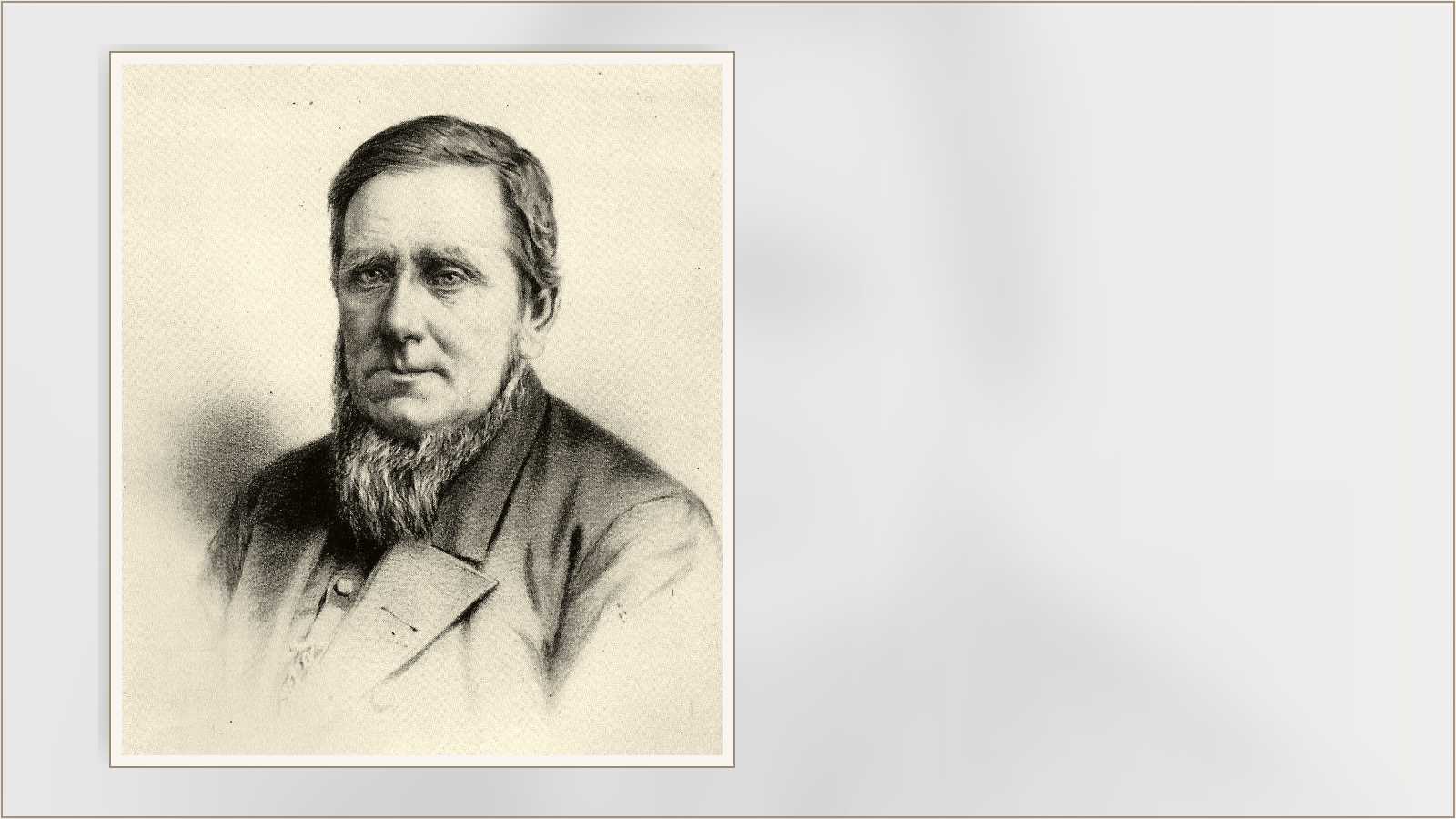
Some nineteenth-century lives are so large that they can obscure the person who lived them. David Davies of Llandinam has become one of those monumental figures, remembered as a railway contractor, coal owner, dock promoter, politician and philanthropist. His statue stands in the village where he was born, holding the plans of Barry Docks, as if the course of his life had always been directed towards that final triumph.
It was not. Davies began with little formal education, no inherited fortune and no obvious route into the commanding heights of Victorian industry. His ascent was built through physical labour, practical intelligence, an appetite for risk and an unusual ability to understand how apparently separate enterprises might be made to serve one another. He progressed from timber to bridges, from bridges to railways, from railways to coal, and from coal to the docks through which it could reach the world. At several points the outcome was far from certain, and the immense fortune of his later years can make it too easy to forget how much depended upon decisions which might equally have ended in failure.
That progression is the key to his importance. Davies did not merely accumulate interests. He learned that control over movement could be as valuable as ownership of the commodity being moved. A railway connected producer and market, a colliery produced the commodity, and a dock removed dependence upon somebody else’s route to the sea. Long before the language of vertical integration entered ordinary business usage, Davies understood the power of a connected system.
Yet he remained deeply rooted in the religious and social culture of rural Montgomeryshire. His was not the polished world of inherited aristocracy. It was the world of the farm, the sawpit, the chapel and the Welsh language, carried eventually into the boardroom, Parliament and some of the largest industrial undertakings in Wales.
Llandinam and the Making of “Top Sawyer”
David Davies was born at Llandinam on 18 December 1818, the eldest of nine children of David and Elizabeth Davies. He attended the village school until the age of eleven, after which he worked with his father in farming and in sawing timber for hire. He later recalled with pride that he had always been the “top sawyer”, the man positioned above the timber in a sawpit, guiding the long blade while his companion worked beneath. The nickname remained with him for the rest of his life and, although later generations used it affectionately, it preserved something important about the origins of a man who eventually controlled enterprises measured in millions rather than shillings.
The work was hard and practical. Timber had to be selected, moved and cut accurately, land had to be worked and the success of a job could be measured immediately in what had been produced. Davies’s later undertakings became immeasurably larger, but they retained something of this character. He was not principally a theorist of industrial development. He was interested in things which could be built, moved and made to work. Railway embankments, colliery shafts and docks were vastly more complicated than a sawpit, but all required an ability to organise labour, material, time and money towards a physical result.
The death of his father in the 1840s increased his responsibilities towards a large family, and in 1846 Davies was invited to undertake the foundations and approaches for a new bridge across the Severn at Llandinam. It was modest when compared with what followed, but it changed the direction of his career. The farmer and sawyer had demonstrated that he could organise men and materials around a substantial piece of construction. Victorian Britain was beginning to be transformed by contractors of precisely this type. Engineers designed increasingly ambitious works and investors supplied capital, but between the two stood men capable of turning drawings and finance into cuttings, bridges, embankments and permanent way.
Davies entered that world at exactly the right moment.
Railways Across a Difficult Country
In 1855 Davies began work on the first section of the Llanidloes and Newtown Railway. When the line opened in 1859 it became the first public railway in Montgomeryshire. Its beginnings were almost comically isolated. Neither terminus initially connected with another railway and the first locomotives and carriages had to be brought by road from Oswestry. Yet this apparently disconnected little railway marked the beginning of a profound change in the economic geography of mid Wales.
Towns which had depended upon turnpike roads, drovers and horse-drawn carriers were being drawn into a national transport network. Agricultural produce could travel farther, manufactured goods could arrive more cheaply and people themselves could move with a speed that would have seemed extraordinary only a generation earlier. In places such as Newtown the railway encouraged manufacturing and commerce, while farther west it would eventually transform towns whose isolation had previously constrained both tourism and trade.
Davies went on, sometimes in partnership with the more flamboyant contractor Thomas Savin, to work on the Vale of Clwyd Railway, the Oswestry and Newtown Railway, the Newtown and Machynlleth Railway, the Pembroke and Tenby Railway, the Pencader to Aberystwyth section of the optimistically named Manchester and Milford Railway, and the branch between Caersws and the Van lead mines. Benjamin Piercy was associated as engineer with several of these undertakings, and Davies accompanied him to Sardinia in 1862 when Piercy advised on railway development there.
The best-known physical monument to this phase of Davies’s career is the great cutting at Talerddig, driven through the uplands between Newtown and Machynlleth. At roughly 120 feet deep, it was regarded when completed as one of the deepest railway cuttings yet attempted. Its scale remains impressive, but its real importance lies in the obstacle it overcame. The topography of central Wales, which had for generations dictated patterns of movement and restricted economic development, could now be altered by organised labour, capital and engineering.
The achievement should not be romanticised. Railway construction was dangerous and physically punishing, dependent upon large numbers of navvies whose names rarely entered the history books. Cuttings which now appear almost natural in the landscape were created with comparatively primitive equipment and enormous quantities of human labour. Davies’s success rested not only upon vision but upon his ability to organise that labour, control costs and complete difficult contracts in terrain which could quickly turn an ambitious estimate into a financial disaster.
Nor did every railway fulfil the promises made for it. The Manchester and Milford Railway reached neither Manchester nor Milford Haven. Its imposing title eventually concealed the considerably more modest reality of a railway through western Wales. Victorian enterprise contained optimism, exaggeration and failure as well as engineering triumph.
Even so, Davies learned something from the railway business that shaped everything which followed. A productive district was only as powerful as its means of reaching a market.
From Montgomeryshire to the Rhondda
During the 1860s Davies turned towards the rapidly developing South Wales coalfield, taking mineral leases in the Upper Rhondda Fawr and beginning the long and expensive process of sinking pits at Parc and Maendy. The change in geography could scarcely have been greater. He had been formed within a thinly populated agricultural county, but he was now committing capital to one of the fastest-growing industrial regions in Britain.
It is easy, knowing what followed, to make this transition appear inevitable. It was nothing of the sort. Sinking a colliery required enormous expenditure long before the owner could know whether the investment would produce a commercially workable seam. Men had to be employed, machinery purchased, shafts sunk and water controlled while money flowed out of the enterprise and almost nothing flowed back. Family tradition surrounding Davies remembered that the early venture brought him dangerously close to exhausting his available resources before profitable coal was finally reached. The more dramatic details of that tradition are difficult to test independently, but the essential point is sound: the Ocean fortune was founded upon a gamble which could have ruined him.
The reward, when it came, was immense. The Rhondda contained valuable steam coal, a fuel particularly suited to marine engines because of its ability to generate intense heat with relatively little smoke or ash. As steam power transformed the world’s merchant and naval fleets, South Wales coal acquired a strategic and international importance far beyond the narrow valleys in which it was mined.
David Davies and Company was established in 1867 to develop the Ocean Merthyr concerns. Other collieries followed, including Dare, Eastern, Western, Garw and Lady Windsor, and in 1887 the principal interests were brought together as the Ocean Coal Company Limited. Davies acquired another name, “Davies yr Ocean”, Davies the Ocean. It was a fitting description both of the company and of the scale his ambitions had reached.
The change in his circumstances was extraordinary. The boy who had left Llandinam village school at eleven now controlled an industrial undertaking whose product powered steamships on international routes. Yet coal ownership also placed him at the head of a much harsher social system than railway contracting alone. Mines shaped entire communities. Employment, housing, family income and the prospects of children could all become tied to the fortunes of one pit or company. Underground, the wealth visible in company accounts was produced through physically demanding work undertaken amid the permanent dangers of falls, machinery, gas, fire and explosion.
Later Ocean Coal records preserve reports on output, wages, working conditions, accidents, fires, disputes and welfare provision. Although many of these records belong to the generation after the founder’s death, they remind us that Ocean Coal was never merely a balance sheet. It was an industrial system which organised the working lives of thousands of people.
Davies was not simply exporting coal. He had become one of the men helping to create the industrial society of the South Wales valleys.
The Struggle for Barry
The next development followed logically from what Davies had learned through railways. Coal could not become profit until it reached a customer. By the early 1880s Ocean Coal and other Rhondda producers were increasingly frustrated by congestion on the Taff Vale Railway and at the Bute docks in Cardiff. Their businesses depended upon transport and dock infrastructure controlled by other interests, leaving producers exposed to charges, delays and restrictions over which they had little influence.
Davies recognised the weakness. Owning highly productive collieries was not enough if somebody else controlled the route between the pithead and the sea.
The answer was audacious. Davies and other coal owners proposed a new railway and dock system at Barry, then a comparatively small settlement on the Glamorgan coast. It would allow coal to travel from the Rhondda over a purpose-built railway to a modern deep-water port without depending upon the established Cardiff system. Predictably, the proposal encountered fierce resistance from interests whose existing position it threatened.
The battle was fought before Parliament before it could be fought with picks and excavators. An initial parliamentary attempt failed in 1883, but the promoters returned and secured legislation the following year. The surviving David Davies papers at the National Library of Wales contain the legal material assembled for the Barry Dock Bills of both 1883 and 1884, a reminder that Barry was not merely a feat of civil engineering. Before construction could begin, established commercial power had to be confronted through law, lobbying and Parliament.
Construction began in November 1884. John Wolfe Barry was central to the engineering of the scheme, with Thomas Forster Brown and Henry Marc Brunel also involved, while major construction work was undertaken by T. A. Walker. The distinction matters. Davies was not the engineer responsible for every wall, lock or railway gradient. His role was commercial, financial and political. He understood why an alternative dock was necessary and possessed both the resources and determination to help force it into existence.
The first dock formally opened on 18 July 1889. For Davies it represented the culmination of a career that had begun with timber and a village bridge. Coal from the Rhondda could now travel over a new railway towards a port created specifically to overcome dependence upon the existing Cardiff system. Production, inland transport and maritime export had been brought into a connected structure.
Barry was therefore more than a dock. It represented a successful challenge to monopoly and an extraordinary transfer of commercial geography. A place which had previously occupied only a minor position on the Glamorgan coast became one of the great ports of the South Wales coal trade. By the early twentieth century millions of tons of coal were leaving Barry annually, and the town itself had expanded around the infrastructure created to serve that trade.
The lesson Davies had first encountered in mid Wales had been applied on an industrial scale. Movement was power.
Chapel, Character and Wealth
Davies’s commercial determination existed beside a deeply serious Calvinistic Methodist faith. He was a lifelong teetotaller, a strict Sabbatarian and a generous supporter of chapels, education and individuals in difficulty. The Dictionary of Welsh Biography described his speech as untutored but possessing homely eloquence and native humour, qualities which place him firmly within the Nonconformist culture from which he emerged.
Chapel life provided far more than religious instruction in nineteenth-century Wales. It created networks of trust and gave people outside the Anglican landed establishment opportunities to speak publicly, manage money, organise committees and exercise authority. Literacy, thrift, sobriety, self-discipline and collective responsibility were spiritual virtues, but they also translated readily into the world of commerce. Davies belonged to a generation of Welsh Nonconformists for whom business success and religious seriousness did not necessarily appear contradictory.
His faith should not be used to sentimentalise his capitalism. Philanthropy did not remove the inequalities on which Victorian industry rested, and generosity towards institutions cannot be allowed to erase the risks endured by miners and construction workers. Nevertheless, religion formed an important part of the moral framework through which Davies understood wealth. Money carried responsibilities. It could build chapels and schools, assist individuals and support institutions intended to improve Welsh life.
His relationship with the University College of Wales at Aberystwyth was particularly important. Davies had received little formal education himself, yet became one of the institution’s early governors and served as treasurer from 1875 until 1887. The college’s survival during its financially precarious early years depended heavily upon men and women prepared to sustain the belief that Wales required institutions of higher learning of its own.
There was an appropriateness to Davies’s involvement. Railways had reduced geographical isolation. Education offered another means of overcoming the limitations imposed by birth and circumstance.
Politics and the Limits of Liberal Unity
Davies unsuccessfully contested Cardiganshire as a Liberal in 1865 before entering Parliament in 1874 as member for the Cardigan Boroughs. He was returned unopposed again in 1880 and, following redistribution, won the Cardiganshire constituency in 1885. His political rise belonged to a broader change within Victorian Wales, as Nonconformity, commercial wealth and an expanding middle class challenged the old assumption that political representation naturally belonged to Anglican landed families.
His wealth undoubtedly strengthened his position, but money alone does not explain it. Davies had standing within the Welsh chapel world and represented a recognisable ideal of the self-made businessman whose authority had been earned through work rather than inherited through an estate. The political force of that identity should not be underestimated in nineteenth-century Wales.
He was not, however, an unquestioning Liberal. When Gladstone committed the party to Irish Home Rule in 1886, Davies broke with him and stood as a Liberal Unionist. He lost Cardiganshire to William Bowen Rowlands by only nine votes. The result exposed a division within Welsh Liberalism which is easily overlooked when the period is presented simply as a struggle between Liberal Nonconformity and Conservative landownership. Davies could be reforming, Welsh and Nonconformist while remaining deeply attached to the political Union.
His public life continued after his parliamentary defeat. In 1889 he was returned unopposed to represent Llandinam on the first Montgomeryshire County Council, created through one of the most important reforms of Victorian local government. County administration, previously dominated by unelected magistrates, was beginning to pass into representative institutions. Davies’s presence connected the new council with a lifetime which had witnessed enormous changes in the sources of local authority.
Returning Wealth to Llandinam
Davies married Margaret Jones of Llanfair Caereinion in 1851, and their only child, Edward, was born the following year. Despite the increasingly national scale of his business interests, Llandinam remained central to his identity. Industrial wealth was accumulated elsewhere, but a significant part of its social expression eventually returned to the upper Severn valley.
The history of Broneirion and Plas Dinam needs some care because later accounts do not always distinguish clearly between the houses. Davies established Broneirion as a substantial family residence, while in 1884 he also purchased nearby Plas Dinam, a large house built in 1872–73 for Captain Offley Crewe-Read. Plas Dinam subsequently became particularly associated with his son Edward and later generations of the Davies family.
The purchase carried considerable social symbolism. Plas Dinam had been created for a member of an established county family, while the Davies family belonged to the farming world from which David had emerged. Within a generation, industrial capital generated through railways, coal and docks was acquiring one of the physical symbols of the older landed order. This pattern was familiar across Victorian Britain, but in Llandinam the reversal was particularly visible. The man who had begun as a farmer’s son and sawyer could now purchase property whose scale and architecture would once have placed its occupants within a social world far removed from his own childhood.
It would be too simple to say that Davies merely wanted to become a country gentleman. He acquired estates and possessed all the wealth necessary to imitate the old landed class, yet his public identity continued to rest upon work, chapel and enterprise. His social ascent was real, but it did not require him to disguise how the fortune had been made.
Davies died at Llandinam on 20 July 1890, aged seventy-one, little more than a year after the opening of Barry Docks. Contemporary probate reporting placed the net value of his personal estate at more than £260,000, a sum which represented enormous economic power by the standards of the period. Attempts to convert Victorian fortunes directly into a modern figure are usually misleading because purchasing power, wages and control over economic resources produce very different comparisons. What matters is that a man who had begun with no inherited industrial fortune died among the wealthiest self-made businessmen in Wales.
What the Archive Reveals
The scale of Davies’s activities is reflected in the documentary record he left behind. The David Davies of Llandinam Papers at the National Library of Wales cover the period from 1836 to 1907 and occupy nearly six cubic metres, including 189 boxes and seventy-three volumes. They contain records of railway construction, the establishment and operation of Ocean Coal, documents relating to Barry Dock and Railway and the legal papers assembled during the parliamentary battle over the dock bills. Edward Davies’s letter-books also preserve the transition of the family business into the next generation.
The survival of such an archive is important because figures of Davies’s stature easily acquire a mythology in which enormous projects appear to have emerged solely from individual will. The papers reveal the organisational world behind the public achievement, agreements, correspondence, finance, legal argument, contracts and countless administrative decisions. Railways, collieries and docks were not simply imagined by one remarkable man and then produced. They required institutions capable of turning ambition into sustained activity.
The family archive is larger still. Papers preserved by later generations include source material collected for early biographies of Davies and records relating to Edward, Lord Davies, Gwendoline and Margaret Davies. The documentary inheritance therefore mirrors the financial one: the consequences of David Davies’s career extended well beyond his own lifetime.
Ocean Coal After Davies
David Davies’s death did not bring an end to the industrial system he had created. Ocean Coal remained a major force in the South Wales coalfield into the twentieth century, while subsequent generations of the family retained important connections with the industry. Later company records preserve detailed accounts of production, wages, working conditions, accidents, fires and industrial disputes, alongside the development of welfare and recreational provision.
These records are valuable because they reveal both continuity and change. The pits remained commercial enterprises whose purpose was to extract coal profitably, but the relationship between company and workforce was increasingly shaped by organised labour, industrial conflict and new expectations surrounding welfare. Records from the inter-war period refer to pithead baths, recreation grounds, welfare schemes and miners’ camps alongside strikes and disputes. The industrial world created in Davies’s generation had not remained static. It had developed its own institutions, conflicts and social expectations.
This afterlife also changes the way Davies himself should be understood. He did not simply become rich from a series of successful collieries. He helped create an industrial organisation whose decisions continued to affect communities decades after his death. The power of nineteenth-century entrepreneurship lay partly in this capacity to build structures which outlived the founder.
The Family Inheritance
The immediate responsibility for the family concerns passed to Davies’s only son, Edward, who died in 1898. The inheritance then descended to another generation and moved in directions which David Davies could only partly have anticipated.
His grandson David Davies, later the first Baron Davies, inherited something of his grandfather’s energy but applied it to a different world. He became a politician, served during the First World War and devoted substantial resources to public health and internationalist causes. His support for the campaign against tuberculosis in Wales, his involvement with the King Edward VII Welsh National Memorial Association, his endowment of the chair of international politics at Aberystwyth and his later campaign for stronger institutions to prevent international conflict turned industrial wealth towards some of the defining social and political questions of the early twentieth century.
Davies’s granddaughters Gwendoline and Margaret used the same inheritance in another way. Their collection of modern European art, much of it eventually given to the nation, transformed the holdings of what became Amgueddfa Cymru. Works bought with wealth whose origins lay partly in the South Wales coalfield became part of the cultural inheritance of Wales.
There is an unavoidable tension in that story. Coal wealth carried a human and environmental cost. The generosity of later generations cannot cancel the labour conditions, industrial dangers or inequalities through which the fortune had originally been created. Equally, it would be historically incomplete to pretend that the money simply disappeared into private consumption. A substantial portion of the Davies inheritance returned to Welsh public life through education, health, international politics and art.
Few nineteenth-century Welsh industrial fortunes had such a wide cultural afterlife.
Passing Through Llandinam
I have passed through Llandinam many times and often looked up at Davies’s statue in the village. He stands holding the plans of Barry Docks, an industrial patriarch commemorated not in Cardiff or the Rhondda but in the rural community which formed him.
There is an irony in the setting. The man who spent much of his working life building railways is remembered in a village which no longer possesses a railway station. The line through Llandinam has gone, and a form of transport that once appeared capable of transforming almost every aspect of economic life has itself become part of the historical landscape.
The same is true of coal. The Rhondda pits which generated enormous wealth and supported generations of families have largely disappeared. Barry remains, but the coal traffic which produced its extraordinary growth belongs to another age. Much of the industrial system Davies knew has vanished within little more than a century.
The landscape, however, still carries its marks. Railway cuttings remain through the hills, bridges cross valleys, settlements grew around former pits and the docks altered the coastline. Victorian infrastructure often survived its original economic purpose because it changed the physical world too profoundly to disappear entirely.
Davies understood infrastructure as a source of power.
History reminds us that the uses to which that infrastructure is put are far less permanent.
A Montgomeryshire Man in Industrial Wales
David Davies belongs among the principal makers of industrial Wales, but his importance rests upon more than the size of his fortune or the number of enterprises carrying his name. What distinguished him was the sequence of connections he understood. Railways opened markets. Coal generated wealth. Dependence upon existing transport networks limited that wealth. A new railway and dock removed the restriction.
Each stage of his career prepared the ground for the next.
That does not mean the outcome was predetermined. The early coal venture could have failed. Railway projects sometimes disappointed their promoters. Barry had to survive a formidable parliamentary struggle before construction could begin. Davies’s career involved calculation, but also risk, persistence and occasions when circumstances might easily have turned against him.
He was a product of rural Montgomeryshire who became a force in industrial Glamorgan, a Calvinistic Methodist who accumulated an immense fortune, a Liberal who eventually broke with Gladstone, and a self-made capitalist whose descendants became major patrons of Welsh national life. These were not simple contradictions. They belonged to the complexity of nineteenth-century Wales itself.
His life also joins two landscapes that are too often treated separately. One was the Wales of farms, chapels, small market towns and upland communities. The other was the Wales of pits, railway junctions, industrial valleys and docks. Davies belonged to both. The habits and values of the first accompanied him into the second, while the wealth generated in the industrial south eventually returned to Llandinam in the form of property, influence and an inheritance which shaped Welsh public life for generations.
The statue in Llandinam therefore stands in the right place.
Barry may have been his greatest industrial monument, and the Rhondda the source of his greatest wealth, but Montgomeryshire made the man who created them.
The sawyer did not merely rise within Victorian Wales.
He helped to redraw it.
Updated August 2026
This essay was substantially revised in August 2026 following further research into David Davies, his industrial enterprises and the later history of the Davies family. The revised version incorporates additional evidence from the David Davies of Llandinam Papers at the National Library of Wales, including material relating to his railway contracts, the creation of the Ocean Coal Company and the parliamentary struggle over the Barry Dock Bills of 1883 and 1884. It also develops the financial risks involved in Davies’s move into coal, clarifies the relationship between Broneirion and Plas Dinam, examines the survival of Ocean Coal after his death and gives greater attention to the working communities upon which the company’s success depended.
Sources and Further Reading
- Ivor Bulmer-Thomas, “David Davies, Llandinam (1818–1890), industrialist and Member of Parliament”, Dictionary of Welsh Biography
- National Library of Wales, David Davies of Llandinam Papers, GB 0210 LLANNAM, 1836–1907
- National Library of Wales, Lord Davies of Llandinam Papers, including later records relating to Ocean Coal and the South Wales coal industry
- National Library of Wales, Davies Family of Llandinam: Family and Personal Papers
- Ivor Bulmer-Thomas, Top Sawyer: A Biography of David Davies of Llandinam
- Leslie M. Shore, The Ocean Coal Company and ‘The Barry’
- C. P. Gasquoine, The Story of the Cambrian: A Biography of a Railway
- Historical material relating to the Barry Railway Company and Barry Docks
- Plas Dinam and local historical material relating to the Davies family, Broneirion and the Llandinam estates
- Contemporary Welsh newspaper reporting relating to Davies’s business, political career, death and estate