
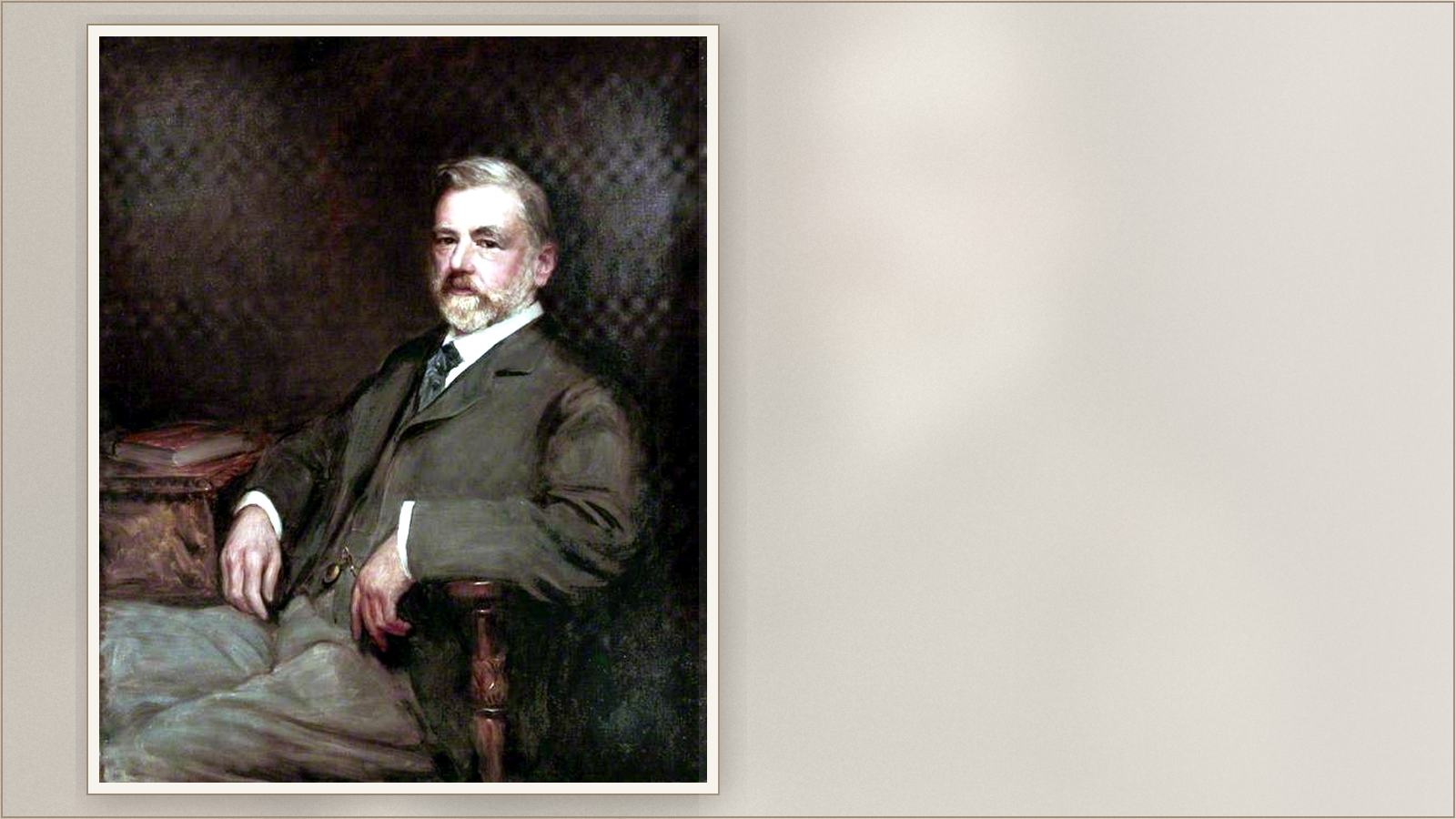
The history of nineteenth-century Wales is often told through coal, iron, slate, agriculture, Nonconformity and politics. Yet one of the most important changes of the Victorian age took place somewhere rather different, behind counters, inside warehouses and eventually within the great department stores that came to dominate British town centres.
Owen Owen, born near Machynlleth in 1847, belonged to that history. He began with borrowed money, stock supplied through family connections and the experience gained as a young draper. From those comparatively modest beginnings he built one of the most important retail businesses in northern England, became a substantial property owner and investor, developed interests in other major department-store concerns and gave his name to a company which survived for almost a century after his death.
His story is interesting not simply because he became wealthy. It tells us something about the movement of ambitious young Welsh people from rural communities into expanding industrial cities, about the importance of family and chapel networks, about the emergence of the department store, and about the way commercial success could later be converted into land, status and a renewed connection with home. There is also a particularly satisfying circularity to Owen’s life. The family had lost its ancestral Montgomeryshire farm before he was born. Nearly seventy years later, he bought it back.
A Family Displaced
Owen Owen was born on 13 October 1847 at Cwmrhaeadr, in the hills south of Machynlleth. The country into which he was born remained overwhelmingly rural, but the circumstances of his family had already been shaped by an earlier agricultural crisis. For generations the Owens had occupied Bwlch, a hill farm in the Llyfnant valley. Welsh agriculture had prospered during the wars with revolutionary and Napoleonic France, when disruption to imports helped maintain high food prices, but peace brought a sharp reversal. Prices fell, rural employment contracted and many farming families found themselves burdened by commitments entered into during more prosperous years.
In 1838 Bwlch was mortgaged for £1,200. The family was unable to meet the interest and the farm was sold the following year. Owen’s father, also named Owen Owen, moved with his first wife to Cwmrhaeadr as a tenant. Widowed in 1843, he married Esther Elizabeth Evans on the last day of 1846, and their son Owen was born a little over nine months later. The distinction matters. Owen himself did not remember the loss of Bwlch, because it had occurred before his birth, but he was born into its consequences. His father possessed agricultural experience but no longer enjoyed the security of an inherited holding, and the family moved between tenancies, first to Gartheiniog near Aberangell and later to Dyffrynglyncul, between Aberdyfi and Tywyn.
Owen’s mother died in 1855, only days after giving birth to her sixth child. He was seven years old. That bereavement altered the course of his life because his mother’s family could offer a route into a very different world. Esther Elizabeth Evans came from a notably Methodist family. Her father, the Rev. William Evans, was an important figure in Welsh Wesleyan Methodism, active in north Wales and remembered as a religious writer as well as a minister. Later Methodist biographical tradition recalled that Esther instilled strict Methodist principles in her sons. Owen therefore grew up with something more substantial than a general Nonconformist background. His maternal family belonged to an organised religious culture that valued discipline, literacy, self-improvement and close networks of mutual assistance, all qualities that would matter profoundly in his later career.
Bath and the Drapery Trade
Esther’s brother, Samuel Evans, owned a linen drapery business in Bath. He needed assistance and offered his nephews both employment and a home. Owen followed his elder half-brother Thomas to Bath, where he received further education before entering his uncle’s business as an apprentice in 1860. Thomas had already followed the same route, entering Samuel Evans’s business in 1853 and becoming a partner in 1863. His later career was substantial in its own right. He and Evans moved beyond drapery into paper manufacture, acquiring the Ely Paper Works at Cardiff in 1877, and Thomas later became chairman of Evans & Owen Ltd and Liberal MP for Launceston from 1892 until his accidental death at Cwmrhaeadr in 1898. The £375 which Thomas later advanced to Owen should therefore be understood within a family network that had already accumulated commercial experience, capital and influence.
The arrangement reveals the importance of kinship within nineteenth-century advancement. Owen did not rise in isolation. His opportunity came through a family network able to provide accommodation, training, credit and entry into a skilled occupation. What distinguished him was what he subsequently made of that opportunity.
Drapery was one of the most demanding branches of Victorian retail. A successful draper needed to understand purchasing, presentation, credit, stock turnover, fashion and the careful calculation of narrow margins. Young assistants worked long hours and often lived in accommodation controlled by their employers, creating a disciplined environment in which work, training and private life overlapped. Such businesses became informal commercial schools, producing generations of retailers who understood systems, accounting, presentation and the importance of routine.
Owen absorbed those lessons thoroughly. The surviving account books and ledgers preserved at the National Library of Wales record receipts, expenditure, balance sheets and rents from properties in Montgomeryshire, Caernarfonshire, Liverpool and London. They reveal a man for whom order was not merely something imposed upon a shop floor, but a principle applied across the whole of his commercial life. As his career developed, retailing became only one part of a much wider portfolio of property, investments and business interests.
Liverpool, 1868
On 2 May 1868, at the age of twenty, Owen opened his Liverpool business. The exact date survives in the business ledger, whose stocktaking balance sheets begin with the commencement of business on that day. Supported by his half-brother Thomas and his uncle Samuel, he established the drapery shop at 121 London Road with the benefit of family confidence, commercial training and considerable personal ambition.
Liverpool offered opportunities on a scale that rural Montgomeryshire or genteel Bath could not. Its docks connected British consumers with the products of an international trading system, while its rapidly expanding population created a large market for clothing, household textiles and respectable domestic goods. London Road was not the grandest part of the city, but it was busy, accessible and commercially promising. Owen may also have known that another uncle, Robert Owen, had previously prospered as a draper at number 93 on the same street.
Growth was remarkably rapid. By 1873, only five years after opening, Owen employed more than 120 people and occupied approximately a quarter of an acre of floor space. Significantly, the National Library of Wales records that most of his employees were themselves Welsh.
This makes the business more interesting than the story of one successful migrant. Owen Owen became part of the machinery of Welsh migration into Liverpool. Young men and women leaving rural communities could enter an urban commercial world through familiar family, linguistic and cultural networks. Migration did not necessarily mean an abrupt severing of older identities. Welsh-speaking communities, chapels, societies and employers created spaces in which people could move into city life while retaining connections with home. Owen’s own religious life nevertheless changed in Liverpool. He initially worshipped at Brunswick Wesleyan Methodist Chapel, a natural continuation of his maternal inheritance, but was later drawn towards Unitarianism and became a member of the Hope Street congregation. His career therefore combined a strong Welsh Methodist formation with exposure to the broader religious and intellectual culture of a Victorian commercial city.
Owen’s success was therefore individual, but it also helped carry others with him.
Employer and Paternalist
Owen’s concern for his workforce became one of the more notable features of his management. He provided accommodation for employees and encouraged organised recreation, including cricket and tennis. He was also remembered as an early large employer in Liverpool to introduce a weekly half-day holiday for staff, a genuine improvement in an industry where shop assistants often endured long hours and exhausting conditions. The scale of the accommodation is visible in the 1911 census evidence for the Owen Owen Hostel at 1–15 Stafford Street, close to the London Road store, where about ninety employee boarders were living. Although this evidence falls just after Owen’s death, it shows that staff housing had developed into a substantial institutional part of the business rather than a token provision.
On 15 January 1900 Owen established the trust which survives today as the Owen Owen Trust Fund. Its purpose remains strikingly close to that originally intended, providing assistance to former employees of the Owen Owen Group and to their spouses and dependants.
That survival is unusual. Buildings can be demolished, company names disappear and corporate structures be dissolved, but the trust remains a direct institutional link with Owen’s own ideas about responsibility towards employees.
It would be misleading to present this in wholly modern terms. Victorian welfare provision was usually paternal rather than egalitarian. Employers expected loyalty, discipline and good conduct in return, and housing workers or organising their recreation could reinforce authority as readily as it improved their lives. Yet the distinction should not obscure the practical effect. A regular half-day away from the counter mattered. Assistance in old age mattered. The trust recognised that decades of respectable service did not necessarily protect an employee from poverty.
Owen’s approach combined benevolence with commercial intelligence. A large store depended upon a stable and trusted workforce. Better conditions encouraged loyalty and reduced the disruption caused by continual staff turnover.
The Department Store and the New High Street
Owen entered retail at precisely the moment when the relationship between shopkeeper and customer was changing.
Traditional shopping could be highly personal. Prices were not always displayed, haggling remained common and purchases were often recorded on credit accounts. Such arrangements worked well for customers who already possessed status, confidence and a recognised place within the local community.
The expanding drapery emporium and department store offered something different. Goods could be arranged systematically, displayed attractively and divided into recognisable departments. Customers could enter a substantial public interior, compare products and encounter a range of commodities far beyond anything available in a small shop.
Owen was remembered as a retailer with a close eye for presentation, fair prices and a willingness to accept modest margins in order to secure a sale. Those qualities mattered. The success of the department store depended upon confidence. Customers needed to believe that goods, prices and procedures were reliable, and that the name above the door represented something stable.
The department store did not abolish class distinctions. In many respects it traded upon aspiration, and its architecture, displays and advertising were designed to make customers feel they were entering a more refined world. Yet it did broaden access to forms of consumption previously associated with narrower social groups. Respectability could increasingly be purchased across a counter rather than inherited through birth. Owen did not invent that transformation, but he understood it and prospered within it.
A Training Ground for Other Retailers
The influence of Owen’s business extended beyond the stores carrying his own name. Thomas John Hughes, who later founded the well-known Liverpool department-store business T. J. Hughes, had worked as an apprentice with Owen Owen.
That connection is worth noting because nineteenth-century drapery businesses frequently acted as commercial academies. Young men learned stock control, buying, selling, accounting and presentation inside established firms before going on to create businesses of their own. In that sense Owen’s influence extended through the people he trained as well as through the shops he owned.
When the Owen Owen company later moved from London Road to Clayton Square in 1925, T. J. Hughes took over the old London Road premises, and the two retail histories subsequently became intertwined again when T. J. Hughes entered the wider Owen Owen group.
The relationship illustrates the dense networks through which British retail developed. Competitors were often former employees, family members or associates, and one successful drapery business could become the training ground for several others.
London, Property and Welsh Public Life
Owen married Ellen Maria Richards in December 1891, when he was forty-four. They had two sons and two daughters. Following the marriage, the family moved to London, although Owen continued to supervise the Liverpool business. By the beginning of the twentieth century it had become one of the largest stores of its kind in northern England.
The railway made such a life possible. Owen travelled regularly between London and Liverpool and, by 1900, held a first-class season ticket between the two cities. The detail is revealing because his working life belonged to a new commercial Britain in which management, property and investment could operate across considerable distances.
His interests had already extended far beyond the original store. During the 1880s he invested in other concerns, including North American railways. In 1889 he became a director of Evans & Owen Ltd in Bath, the business in which he had served his apprenticeship. He was subsequently involved with London retail property and became a director of both Bon Marché and John Barnes & Co.
The surviving ledgers show just how diversified his affairs had become. One records stocktaking balance sheets from the opening of the business in 1868, fixture accounts, Owen’s own capital accounts, a separate capital account for Jabez D. Owen, and, from 1885, a formal record of properties and securities. Other volumes record rental income alongside shares, bonds and dividends, while later accounts identify interests connected with Penmaenmawr, Tan-y-Foel and Garthgwynion. By the closing decades of his life Owen was therefore no longer simply a successful retailer. He had become a diversified investor and property owner whose wealth rested upon several different forms of capital.
Wealth did not sever his Welsh connections. He supported Welsh causes, particularly education and the arts, and exercised influence within Welsh societies in Liverpool and London. In 1886 he became a member of the Honourable Society of Cymmrodorion. This was another characteristic feature of successful Welsh migration. Advancement outside Wales could strengthen rather than weaken cultural affiliation. Owen moved confidently within British commercial society while continuing to support Welsh institutions and networks.
Land and the Recovery of Bwlch
Like many commercially successful Victorians, Owen invested part of his wealth in land. In 1896 he purchased Plas Mariandir at Penmaenmawr, added the Tan-y-Foel estate in 1902 and, in September 1906, acquired Garthgwynion near Machynlleth. Garthgwynion included Bwlch, the ancestral hill farm lost by the family in 1839.
It is tempting to regard the purchase solely as sentiment, the successful merchant returning triumphantly to recover the farm his family had lost before his birth. There was almost certainly an emotional element, but the acquisition also reflected the enduring status of land in Victorian and Edwardian society. Commercial wealth provided influence and comfort, but an estate offered permanence, ancestry and a recognised position within the county order.
Owen’s life therefore did not follow a simple course from an old rural world into an entirely modern urban one. His success in Liverpool and London ultimately allowed him to restore his family’s territorial connection with Montgomeryshire. Commerce recovered what agriculture had been unable to retain. That is perhaps one of the most revealing episodes in his life.
Death and Succession
Owen Owen died at Hampstead on Easter Sunday, 27 March 1910, following an operation for cancer. He was sixty-two. His ashes were scattered on the family grave at Machynlleth, where his memorial bears the words:
He most lives who thinks most, feels the noblest, acts the best.
His estate was valued at approximately £463,568, an immense fortune in Edwardian Britain. The figure demonstrates the scale of wealth that retail, property and investment could generate by the opening of the twentieth century.
His surviving papers do not leave us with an especially intimate portrait. The ledgers record transactions with precision but reveal little emotion. What emerges instead is a recognisable character, methodical, commercially alert, attentive to presentation and deeply conscious of family and institutional loyalty.
The company he created, however, had only begun its longer history.
The Company After Its Founder
The national department-store group remembered by later generations largely belonged to the period after Owen’s death.
Family influence remained remarkably durable. Through Owen’s daughter and her marriage into the Norman family, Duncan Norman and later his son John Norman became leading figures in the business. Effective family control continued into the twentieth century for far longer than might be expected, linking the company closely with its founder’s descendants for much of the century after the original Liverpool shop opened. Another daughter, Muriel Gwendolin Owen, married Elias Wynne Cemlyn-Jones in 1914. He later became a prominent Welsh public figure and was knighted in 1941, illustrating how the next generation of Owen’s family moved comfortably within the commercial, professional and civic elite of twentieth-century Wales.
In 1925 the Liverpool business left London Road and moved to a much larger store in Clayton Square. The move represented far more than a change of address. The new building was associated with W. Aubrey Thomas, architect of the Royal Liver Building, with interior input from Stewart McLauchlan. It was equipped with six customer lifts, automatic sprinklers and even refrigerated storage in which customers could leave fur garments during the summer. The company founded with £375 of borrowed money had become a thoroughly modern inter-war department store.
The contrast with the original London Road shop could scarcely have been greater. Owen had begun within the traditional world of Victorian drapery, but his successors now operated a retail institution dependent upon architecture, technology, scale and spectacle.
Coventry, War and Destruction
Expansion also exposed the company to events far removed from ordinary retailing. Owen Owen opened a store in Coventry in 1937, only two years before the outbreak of the Second World War.
In August 1939 the area around the store became caught up in the IRA’s S-Plan bombing campaign. On 25 August an explosion nearby killed five people and injured around seventy. The event was one of the most serious attacks in Britain during that campaign and brought violence directly into the centre of a busy shopping district.
The Coventry store then suffered again during the war itself. In November 1940 it was destroyed during the Coventry Blitz, along with much of the city centre. A replacement store was eventually rebuilt after the war.
The episode provides a reminder that the twentieth-century history of a retail company cannot be separated from the wider events through which it survived. Expansion created opportunities, but it also exposed the business, its employees and customers to political violence and wartime destruction.
Expansion and the High-Water Mark
During the post-war decades Owen Owen continued to expand through new stores and the acquisition of established local businesses. The company’s strength rested partly upon its willingness to preserve the names of acquired stores rather than immediately impose one national identity. This allowed local loyalties to survive within a larger corporate structure.
By the late 1970s the group controlled more than twenty stores in Britain together with substantial Canadian interests, including G. W. Robinson. It also controlled T. J. Hughes stores. What had begun as one Liverpool drapery shop had developed into an international retail group.
The Shrewsbury branch entered the group in 1976. It had previously traded as R. Maddox & Co and occupied a prominent collection of historic buildings at the meeting of Pride Hill and the High Street. The store closed in 1990.
For those who remember it, including me, Owen Owen was not simply a corporate name. The Shrewsbury store belonged to an older town-centre culture in which department stores acted as landmarks, meeting places and symbols of local consequence. They offered several kinds of shopping beneath one roof, but they also created a recognisable civic interior, particularly at Christmas and during seasonal sales. Their importance was partly commercial and partly social.
This is increasingly difficult to appreciate now because so many of the institutions which once anchored British town centres have disappeared. A department store could become part of the mental geography of a town. People arranged to meet there, generations bought school clothes or Christmas presents there, and the building became associated with routines extending far beyond the transaction at the till.
Decline and the End of the Company
The later history of the Owen Owen group was complicated by family divestment, changes of ownership, store sales and the wider consolidation of British retail. The economic model which had supported regional department stores became increasingly difficult as competition intensified, shopping patterns changed and large national chains gained greater purchasing power.
The original Liverpool flagship closed in 1996. By then the Owen Owen name had already disappeared from many shopfronts, even though the company itself survived behind other trading names.
Owen Owen Ltd finally entered administration on 28 February 2007. At that point the company was operating stores under the Lewis’s name in Liverpool, Esslemont & Macintosh in Aberdeen, Robbs in Hexham and Joplings in Sunderland. Difficult retail conditions and cash-flow pressures were among the reasons given for the failure. Esslemont & Macintosh subsequently closed, while Lewis’s, Robbs and Joplings were acquired by Vergo Retail in May.
The ending was therefore not the sudden extinction of the founder’s original enterprise. It was the final administrative stage in a much longer process of restructuring and retreat. The Owen Owen name had largely vanished from the high street before the legal company itself disappeared.
Even the old Clayton Square flagship outlived the business that had once occupied it. The building survived and was later adapted for other uses, another example of the way the physical remains of the department-store age have been forced to find new purposes after the retail culture which created them disappeared.
A Montgomeryshire Life of Wider Significance
Owen Owen’s life resists a simple description. He was neither an industrialist in the conventional Welsh mould nor a social reformer comparable with Robert Owen of Newtown. He left no developed political philosophy and sought no parliamentary career. His influence was exercised through institutions, the shop, the workforce, the trust, the property portfolio and the family business.
From a childhood marked by bereavement and insecure tenancy, he entered the commercial world through the assistance of relatives. He then built upon that opportunity with unusual energy and discipline. He employed large numbers of Welsh people in Liverpool, supported Welsh culture in England, accumulated property and investments across Britain and eventually used metropolitan wealth to recover the Montgomeryshire land his family had lost.
His story is therefore not one of simple escape from rural Wales. It is a story of movement between country and city, family and commerce, memory and modernity.
That movement matters because the Welsh diaspora of the nineteenth century was not merely a story of people leaving. Many continued to send money, influence, employment and institutional support back through the networks from which they had emerged. Owen’s purchase of Bwlch was the most visible expression of that process, but it was not the only one.
What Survives
The department stores carrying Owen Owen’s name have disappeared, as have many of the institutions which once gave British town centres their sense of permanence. Yet parts of his legacy survive in less obvious forms.
The Owen Owen Trust still assists former employees and their dependants. The National Library of Wales preserves the ledgers through which his financial world can still be reconstructed. Bwlch survives as a physical link with the family history that shaped his early life. The Liverpool buildings associated with the company remain part of the city’s architectural history, even though the retail culture they represented has largely gone.
These survivals are more revealing than any simple claim that Owen created a retail empire.
He understood that durable institutions depended upon structure, trust, reputation and loyalty. His own company eventually succumbed to economic forces he could never have imagined, but the organisation he created survived him by generations.
For a man born into a tenant-farming family in the hills near Machynlleth, that was no small achievement.
Related Essays
- David Davies, 1st Baron Davies of Llandinam (1880–1944): Wealth, Duty and the Search for an Enforceable Peace
- Arthur Charles Humphreys-Owen (1836–1905): Land, Liberalism and Public Duty in Victorian Montgomeryshire
- Clement Davies (1884–1962): Liberal Leader and MP for Montgomeryshire
- Robert Owen of Newtown (1771–1858): Industry, Character and the New Moral World
Explore more Welsh history
Browse more research in Essays and Notable People of Mid Wales.
Sources and Further Reading
- National Library of Wales, Owen Owen, Liverpool, Manuscripts, including NLW MS 23808E and related account books
- David Wyn Davies, Owen Owen: Victorian Draper, Aberystwyth, 1984
- A Dictionary of Methodism in Britain and Ireland, entry on Thomas and Owen Owen
- Dictionary of Welsh Biography, entry for Sir Elias Wynne Cemlyn-Jones
- Charity Commission for England and Wales, records of the Owen Owen Trust Fund, charity no. 233264
- 1911 census evidence and Liverpool Pals material relating to the Owen Owen Hostel, Stafford Street, Liverpool
- Archives Hub, records relating to Owen Owen and the Liverpool business
- Contemporary Liverpool and Welsh newspaper reports relating to Owen Owen, his family and the company
- SAVE Britain’s Heritage and architectural material relating to the Clayton Square department store
- Records and published histories relating to T. J. Hughes and the Owen Owen group
- Contemporary reporting on the Coventry bombing of 1939 and the destruction of the store during the Coventry Blitz
- Retail trade reporting relating to the administration of Owen Owen Ltd in 2007
- Heritage Gateway and architectural records relating to former Owen Owen stores, including Shrewsbury