
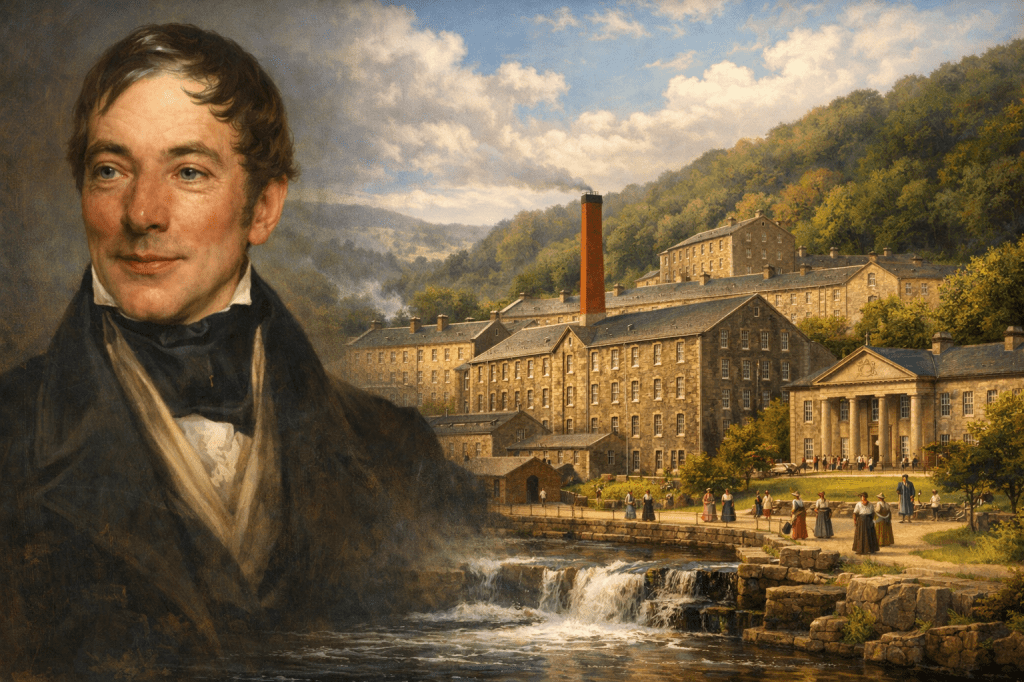
Industry, Community, and the Moral Reconstruction of Society
Few individuals produced by rural Wales exercised an influence so disproportionate to their origins as Robert Owen (1771–1858) of Newtown. Born in a modest Montgomeryshire market town at the edge of upland Wales, Owen became one of the most consequential social thinkers of the Industrial Revolution, a manufacturer who attempted nothing less than the moral reorganisation of industrial society itself. His life forms an essential bridge between Welsh provincial culture and the emerging modern world of factories, mass labour, and social reform (source 4).
Owen was not merely a theorist. He was, first and fundamentally, a practical industrialist who used commercial success as the laboratory for social experiment.
Newtown Origins and the Welsh Intellectual Tradition
Robert Owen was born on 14 May 1771 in Newtown, then a small but commercially active Montgomeryshire town sustained by agricultural exchange and domestic textile production (source 1). His father combined several occupations, saddler, ironmonger, and postmaster, representing the adaptable artisan-commercial class characteristic of eighteenth-century Welsh market society (source 4).
His formal education ended early, yet Owen belonged unmistakably to a Welsh tradition of self-improvement through reading and discipline. Like many ambitious Welsh youths of the period, he left home young, entering apprenticeship in Stamford and later Manchester, carrying with him habits of industry and intellectual curiosity formed in provincial society rather than elite institutions (source 1).
This migration from rural Wales to industrial England mirrored a wider historical pattern. Welsh talent increasingly powered Britain’s industrial expansion, even as its intellectual roots remained shaped by small communities built upon cooperation and mutual dependence.
Manchester and the Industrial Awakening
Manchester in the 1790s exposed Owen to the transformative and often brutal realities of mechanised industry. Textile manufacture generated unprecedented productivity, yet also overcrowding, child labour, and profound social instability (source 4).
Where many contemporaries viewed poverty as moral failure, Owen reached a different conclusion. Human character, he argued, was formed primarily by environment. Improve conditions, education, and security, and behaviour itself would change. This was not sentimental optimism, it was an attempt to give industrial society a workable moral logic, grounded in experience rather than sermonising (source 4).
This insight became the organising principle of his career and distinguished him sharply from both laissez-faire industrialists and traditional philanthropists.
New Lanark, Industry as Social Experiment
In 1799 Owen and his business partners purchased the cotton mills at New Lanark in Scotland, where he assumed managerial control in 1800 (source 1). The settlement contained roughly 2,000 inhabitants, including large numbers of pauper children employed under harsh industrial conditions inherited from previous ownership (source 4).
Owen transformed the community into one of the most striking social experiments of the Industrial Revolution.
Rather than maximising profit through coercion, he introduced reforms that were unusual in British industry at the time:
- Reduced working hours
- Improved housing and sanitation
- Abolition of severe disciplinary practices
- Regulated child employment
- Access to affordable provisions
- Comprehensive education for workers and their families
Crucially, New Lanark remained profitable. Owen demonstrated that humane labour management and commercial success were compatible, challenging prevailing assumptions about industrial discipline (source 4). Statesmen, reformers, and foreign visitors travelled to observe what appeared to be an industrial settlement functioning without the degradation typical of early factory towns. New Lanark became both symbol and proof: industry need not produce social misery (source 3, source 5).
Education and the Formation of Character
Education lay at the heart of Owen’s philosophy. In 1816 he established the Institute for the Formation of Character, alongside what is widely recognised as one of the world’s first infant schools (source 2).
Instruction rejected punishment and rote learning. Music, recreation, moral development, and cooperative activity replaced fear-based discipline. Owen believed social reform must begin in childhood, arguing that society reproduced inequality through environment rather than heredity (source 2).
This represented a conceptual shift. Education was not preparation merely for labour, but for citizenship and human fulfilment. Modern early-years education, workplace welfare thinking, and social pedagogy owe significant intellectual debt to these innovations (source 2).
Religion, Radicalism, and the Loss of Political Capital
Owen’s reforming ambitions expanded beyond industrial management into moral philosophy itself. By the second decade of the nineteenth century he concluded that social division arose not only from economic inequality but from religious and ideological fragmentation.
This position culminated in controversial public statements in 1817, in which he argued that organised religion perpetuated error and social conflict rather than human improvement (source 4). In early nineteenth-century Britain, where political legitimacy remained tightly bound to Christianity, such views proved politically ruinous.
Until this point Owen had enjoyed cautious sympathy from influential figures who viewed New Lanark as a stabilising model, a way to soften industrial antagonism without inviting revolution. His rejection of established religion marked a turning point. Support within government and elite reform circles evaporated, and proposals for wider national reconstruction encountered entrenched resistance (source 7).
His intellectual consistency thus weakened his practical influence. Owen ceased to be regarded as a reformer within society and instead appeared a visionary seeking to reconstruct it entirely.
Cooperation, Social Reform, and International Experiment
Owen’s ideas nevertheless travelled widely. He advocated factory legislation and helped push labour conditions into the sphere of legitimate political responsibility (source 7).
More enduring still was his role in inspiring the modern co-operative movement. Owen proposed self-governing communities founded upon shared ownership, education, and mutual welfare, positioned as an alternative both to unregulated capitalism and violent revolution (source 4).
His most ambitious attempt came with the establishment of New Harmony, Indiana, in 1825. Though economically unsuccessful, the experiment influenced cooperative societies and later currents of socialist and social democratic thought, not because it “worked” as an enterprise, but because it framed a different set of assumptions about ownership, welfare, and human development (source 8, source 4).
Failure did not diminish intellectual impact. Owen had reframed the industrial question itself.
Welsh Identity, Memory, and Intellectual Distance
Owen’s Welsh origins remained personally significant, yet his relationship with Wales during his mature career was indirect. Unlike later nineteenth-century reformers, he appears to have maintained limited sustained engagement with organised Welsh intellectual societies such as the Cymreigyddion or expatriate Welsh cultural networks. His career unfolded primarily within British and transatlantic industrial circles, and he spoke in universal terms of human improvement rather than national revival (source 4).
Yet the influence of his Montgomeryshire upbringing remained discernible. Newtown’s small-scale commercial society, shaped by literacy, dissenting religion, and communal responsibility, offered an early model of social interdependence absent from industrial cities. His conviction that environment shaped character sits comfortably within the moral assumptions of Welsh Nonconformist culture, where education, discipline, and collective welfare were treated as mutually reinforcing goods.
Owen’s Welshness therefore functioned less as active nationalism than as inherited moral formation. He became, in effect, a provincial Welsh thinker addressing global industrial civilisation.
Return to Newtown and Final Years
After decades spent attempting social transformation across Britain and America, Owen returned to his birthplace. He died in Newtown on 17 November 1858 and was buried there, closing a life that began and ended in Montgomeryshire yet reshaped international debates about labour, education, and society itself (source 1, source 4).
The symbolism is striking. One of modernity’s most influential social reformers emerged not from metropolitan power, but from a small Welsh market town.
Legacy, Industry and Moral Responsibility
Robert Owen stands among the first industrial figures to recognise that mechanised production posed moral as well as economic questions. He asked not simply how wealth might be created, but what kind of society industry ought to sustain (source 4).
Though many of his communal experiments failed, his central insight endured: social environment, education, and dignity at work shape collective wellbeing. Cooperative enterprise, welfare reform, organised labour protections, and modern educational theory all carry elements of Owenite thought (source 2, source 7).
In historical perspective, Owen represents a distinctly Welsh contribution to modern civilisation: practical idealism rooted in community, education, and moral seriousness. From Newtown to New Lanark, he demonstrated that industrial progress need not abandon humanity.
Footnotes
(Source 1) Robert Owen biography
https://en.wikipedia.org/wiki/Robert_Owen
(Source 2) Education at New Lanark, INFED
https://infed.org/dir/welcome/education-in-robert-owens-new-society-the-new-lanark-institute-and-schools/
(Source 3) New Lanark (official site)
https://newlanark.org/
(Source 4) Encyclopaedia Britannica, Robert Owen
https://www.britannica.com/biography/Robert-Owen
(Source 5) UNESCO World Heritage Centre, New Lanark
https://whc.unesco.org/en/list/429/
(Source 6) Institute for the Formation of Character (background tag page)
https://www.essexgardenstrust.org.uk/history/tag/Institute%2Bfor%2Bthe%2BFormation%2Bof%2BCharacter
(Source 7) Open University, Robert Owen and reform context
https://www.open.edu/openlearn/history-the-arts/history-art/robert-owen-and-new-lanark/content-section-9
(Source 8) New Harmony, Indiana
https://en.wikipedia.org/wiki/New_Harmony%2C_Indiana
