
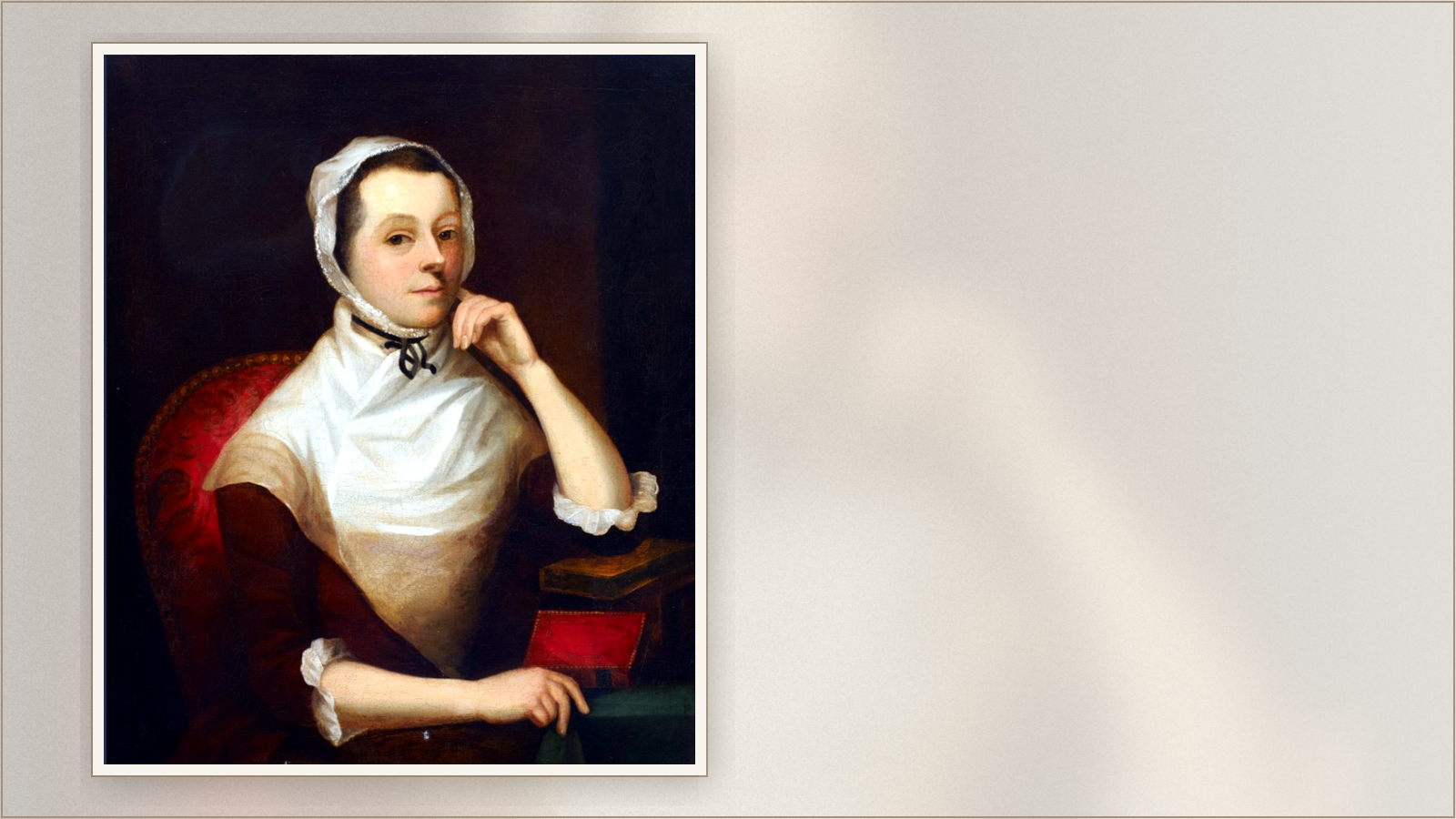
Some reputations rest upon a lifetime of public work. That of Ann Griffiths rests upon seventy-three surviving stanzas, eight letters and the extraordinary memory of another woman.
She held no religious office, published nothing in her own name and died before reaching thirty. Her life was spent almost entirely around Dolwar Fach, the Montgomeryshire farm where she was born. Yet from that seemingly narrow setting came some of the most concentrated and original religious poetry in the Welsh language.
Ann Griffiths was not simply a gifted hymn writer who happened to emerge from the Methodist revival. Her importance lies in the way she brought together several worlds which are too easily separated in retrospect: the old Welsh bardic tradition, the theology of the plygain carol, the disciplined introspection of the Methodist seiat, the rapidly expanding Welsh religious press and an intensely personal awareness of Christ. Her poems are learned without being academic, emotional without becoming sentimental, and mystical without losing their doctrinal foundations.
They also preserve something of the religious and cultural world of rural Wales at a decisive moment, when the older culture of parish, fair, bardic poetry and noson lawen was beginning to encounter the more disciplined spiritual culture of Methodism. Dolwar Fach became one of the places where those two cultures met, conflicted and, in Ann’s own life, were eventually fused.
Dolwar Fach and its world
Ann was born Ann Thomas at Dolwar Fach in April 1776 and baptised at Llanfihangel-yng-Ngwynfa parish church on 21 April. She was known locally as Nansi Thomas and did not become Ann Griffiths until the last year of her life.
Dolwar Fach was not an ancestral freehold. Ann’s grandfather, Evan Thomas, became tenant there in March 1770, and the tenancy passed to her father, John Evan Thomas, two years later. The family’s connection with the farm was therefore deep, but it was the connection of substantial tenants rather than landed proprietors. By 1841 Dolwar Fach formed part of the Wynnstay estate.
The house associated with Ann has also altered the way later generations imagine her world. The present stone farmhouse is a nineteenth-century successor. The house in which Ann lived stood a few metres away and was a long, low, thatched building. The surviving farmhouse became a place of pilgrimage, its parlour devoted to Griffiths memorabilia, but it should not be mistaken for the physical house in which her hymns were composed.
Dolwar Fach stood within a landscape of upland farms and deeply rooted Welsh-speaking communities. It was rural, but it was not isolated from the wider world. Routes towards Llanfyllin, Oswestry, Shrewsbury and Chester connected northern Montgomeryshire with the English borderlands, while the roads and tracks westward over the Berwyns led towards Bala, one of the great centres of Welsh Methodism. Contemporary coaching routes passed sufficiently close to make the district considerably less remote than a modern visitor might suppose.
Ann’s family was comfortably placed by the standards of the locality. Her father, John Evan Thomas, could read and write and served as churchwarden and overseer of the poor, offices which carried both responsibility and local standing. The family appears to have been hospitable, sociable and prominent in the cultural life of the neighbourhood. Ann therefore grew up in a household where religion, poetry, music and community affairs were already familiar parts of life.
A bardic inheritance
Ann’s poetic formation began long before her Methodist conversion. Her father belonged to a local circle of poets associated with Harri Parri of Craig-y-gath, an important bardic teacher in the district. Some of John Evan Thomas’s own englynion survive, and later tradition held that Ann herself could compose an impromptu englyn by about the age of ten.
More concrete evidence survives in the manuscript usually called Llyfr Dolwar Fach, the Book of Dolwar Fach, now among the Cwrt Mawr manuscripts at the National Library of Wales. It contains poetry by local and better-known poets and appears to have passed from Harri Parri’s possession into that of the Dolwar Fach family. In 1796 Ann wrote her own name and address in the volume. This is a small but significant trace of her place within a living manuscript culture.
The influence can be heard in the hymns. E. Wyn James has drawn attention to Ann’s sensitivity to balance, her occasional use of the sound-patterning associated with cynghanedd, and above all her delight in paradox. Methodism redirected her imaginative power, but it did not create it from nothing.
The same is true of theology. Northern Montgomeryshire possessed an especially strong plygain tradition. These Christmas carols were not simple Nativity songs. They could be extended sermons in verse, tracing the history of salvation from the Fall through incarnation and redemption to judgement and eternity. Ann’s father was remembered singing such carols while the family spun and wove wool. The theological density which later distinguished Ann’s hymns therefore had roots in a domestic and communal culture in which sophisticated biblical thought could be sung by ordinary Welsh-speaking men and women.
Her early years should not be imagined as an unbroken preparation for sainthood. The family attended the parish church, but also enjoyed dancing, harp music, fairs and the noson lawen. Later Methodist accounts remembered Ann as lively, eloquent and fond of social entertainment. She could even turn that eloquence against the Methodists, who were still treated with suspicion and ridicule by many respectable church-going families.
This matters because her conversion was not simply the continuation of an exceptionally pious childhood. It involved a break with much of the social culture in which she had been raised.
Ann’s mother died in January 1794, when Ann was seventeen. With her elder sisters already away from home, she became mistress of Dolwar Fach. This was a substantial practical responsibility. She supervised the domestic work of the household and its servants, helped with milking and dairy production, prepared food and took part in the processing and spinning of wool.
At the time of her death, the farm possessed around eighty sheep, five spinning wheels and a loom. Dolwar Fach was therefore not merely the picturesque background to Ann’s spiritual life. It was a working household within the mixed agricultural and domestic economy of upland Montgomeryshire. Her religious meditations were formed amid butter-making, wool, livestock, servants, visitors and the recurring demands of the farming year.
The coming of Methodism
The Welsh Methodist revival had begun in south Wales during the 1730s through the work of Howell Harris, Daniel Rowland and William Williams Pantycelyn. By the later eighteenth century it had spread strongly into the north, particularly through the preaching and educational work associated with Thomas Charles of Bala.
Welsh Methodism was not an offshoot imported from England. It developed as an indigenous Welsh evangelical movement, predominantly Calvinistic in theology and, during Ann’s lifetime, still formally contained within the Established Church. It did not separate from the Church of England and begin ordaining its own ministers until 1811, six years after her death.
In practice, however, the Methodists had already created much of the structure of a separate religious community. Their members met in local societies known as seiadau, attended monthly meetings and travelled to the great quarterly associations. Preachers circulated across wide districts, carrying news and religious ideas between communities which were geographically scattered but spiritually connected.
The seiat was particularly important. It was not simply a prayer meeting. Members were encouraged to examine their inner lives, speak about temptation and assurance, and submit their religious experiences to the judgement of the group. This produced a culture in which ordinary men and women acquired an unusually precise vocabulary for discussing the movements of the soul.
Methodism was not always welcomed peacefully. In 1795 the preacher Edward Watkin of Llanidloes was struck by a stone while preaching outdoors at Llanfyllin, leaving blood running over his Bible. Physical assault was exceptional, but ridicule and suspicion were common. Ann’s own mockery of the Methodists therefore belonged to a broader local hostility rather than to a merely private prejudice.
Methodism entered the Dolwar Fach household through local and family connections. Ann’s brother John joined first, followed by other members of the family. Ann resisted for longer. The movement’s rejection of familiar entertainments and its searching attention to personal sin may initially have appeared joyless and excessive.
The decisive change began at Llanfyllin during Easter 1796. According to the most credible surviving tradition, Ann had gone there for the holiday festivities and encountered an open-air sermon by Benjamin Jones of Pwllheli. His preaching disturbed her. What followed was not an instant and uncomplicated conversion, but months of spiritual unease.
At Christmas that year the tension became sharper. Ann went alone to the early plygain service at Llanfihangel-yng-Ngwynfa while her two brothers attended the Calvinistic Methodist service. Comments made by the curate after the parish service appear to have contributed to her final break with the religious world in which she had been raised. She sought spiritual help elsewhere and in 1797 joined the Methodist seiat at Pontrobert.
The transition is revealing. Theologically, Welsh Calvinistic Methodism still understood itself as an evangelical movement within Anglicanism. At the level of personal experience, however, the boundary could already feel like a separation. Ann’s conversion was therefore a spiritual change and a cultural crossing.
The change spread through the whole household. Methodist meetings had probably begun at Dolwar Fach by about 1798. On 28 May 1803 an application was sent to the Bishop’s Court at St Asaph to register Dolwar Fach formally as a place of public worship. It was signed by seven men, including Ann’s father and both her brothers, who were described in the legal wording as men “dissenting from the Church of England”. Registration followed on 9 June.
The phrase is striking. Formal denominational separation still lay eight years in the future, yet the practical and legal reality of local religious life had already moved beyond the old parish framework. A farm once associated with music, dancing and sociability had become one of the meeting places of the local revival. In this small transformation can be seen something of the much larger religious change then taking place across Wales.
A religion experienced and read
Methodism gave Ann a setting in which serious religious thought was not confined to clergy or university-educated theologians. The sermon, the Bible, the letter, the printed tract and the seiat all invited reflection. Ann responded to that culture with unusual intellectual and imaginative power.
She travelled across the Berwyns to Methodist gatherings at Bala, where she received communion from Thomas Charles. She also formed an important spiritual friendship with John Hughes, a weaver who became a teacher in Charles’s circulating schools and later a Methodist preacher.
Hughes lodged at Dolwar Fach around 1799 and 1800. He later remembered spending hours with Ann discussing scripture and religious experience, conversations so absorbing that the time seemed to pass unnoticed. After he left the farm, they continued those discussions by letter. Seven of Ann’s surviving letters were addressed to him, although the originals have not survived and are known through Hughes’s copies. One further letter, addressed to Elizabeth Evans, survives in Ann’s own hand.
These are not casual private letters in the modern sense. They belong to the disciplined language of the seiat. Ann examines the state of her soul, applies passages of scripture to her experience and discusses the condition of the Methodist cause. Hughes apparently read some of her letters aloud at society meetings for the instruction of others.
Nor should Ann be imagined as someone whose theology came only through oral preaching. Documentary traces show her engagement with the Welsh religious press. On 3 May 1798 she wrote a note in a copy of Benjamin Jones of Pwllheli’s Athrawiaeth y Drindod, The Doctrine of the Trinity, published five years earlier. The preacher associated with her spiritual awakening was therefore also present in her reading.
The Dolwar Fach circle also had access to the periodical Trysorfa Ysprydol, begun by Thomas Charles and Thomas Jones of Denbigh in 1799. John Hughes owned its first volume. More important still was Charles’s vast Geiriadur Ysgrythurol, his Scriptural Dictionary. Although the first completed volume bears the date 1805, it began appearing in parts from about June 1802. The first sections therefore circulated during precisely the period in which Ann appears to have composed most of her surviving hymns.
This places Ann within a remarkable Welsh-language culture of biblical study. Scripture was heard in sermons, discussed in societies, sung in carols, quoted in letters and increasingly supplemented by dictionaries, magazines and theological books. Her formidable biblical knowledge was not an inexplicable achievement produced in isolation. It grew within a network of reading and conversation which made serious theology available in the vernacular.
That network was wider than Montgomeryshire. John Davies, a close friend of Ann’s brother John and another member of the local Methodist circle, taught in Thomas Charles’s circulating schools before leaving Britain in 1800 as a missionary of the London Missionary Society to Tahiti. A copy of his farewell letter to the Pontrobert society survives in John Hughes’s hand. Ann need not be turned into a participant in overseas missions to recognise the significance of the connection. Her apparently small rural world was linked through Methodism to an expanding international Protestant movement.
It was connected to European events too. Britain was at war with Revolutionary and Napoleonic France for almost the whole of Ann’s adult life apart from the short Peace of Amiens. John Hughes later remembered that the conflict weighed heavily upon her, and she attended Methodist prayer meetings held specifically to pray about the war. The detail is a useful corrective to any image of Ann as a mystic concerned only with the private condition of her soul.
Hymns composed for her own comfort
Ann appears to have begun composing most of her surviving hymns between 1802 and 1804. They were not originally written as conventional congregational hymns. They were closer to a spiritual journal expressed in verse.
John Hughes recalled that she composed when some particular matter occupied her mind. A moment of biblical meditation might produce a single stanza, which could later become part of a larger poem. Of the thirty hymns attributed to her with reasonable confidence, some consist of only one stanza, while her longest, Rhyfedd, rhyfedd gan angylion, extends to seven.
The intensely personal origins of the poems help to explain their unusual concentration. Ann was not writing to fill a hymnbook or meet the practical requirements of congregational singing. She was attempting to comprehend an experience. The hymn became a means of fixing a spiritual insight in the memory. Her best-known opening demonstrates the quality of that vision:
Wele’n sefyll rhwng y myrtwydd
Wrthrych teilwng o fy mryd;
Er mai o ran, yr wy’n adnabod
Ei fod uwchlaw gwrthrychau’r byd.
The lines may be rendered:
Behold him standing among the myrtles,
The object worthy of my thought;
Though I know him only in part,
He is above all objects in the world.
The myrtles come from the vision in the Book of Zechariah. Ann joins that prophetic image to the language of personal devotion. Christ is at once the object she observes, the subject of scripture and the beloved upon whom her mind rests. The next stanza names him as the Rose of Sharon, drawing upon the Song of Songs:
Rhosyn Saron yw ei enw,
Gwyn a gwridog, teg o bryd;
Ar ddeng mil y mae’n rhagori
O wrthrychau penna’r byd.
The imagery can be placed unusually close to the actual preaching heard at Dolwar Fach. On the evening of 14 December 1802, John Parry and Griffith Jones preached there. Parry’s text was Song of Solomon 5:10, “My beloved is white and ruddy, the chiefest among ten thousand”. The verbal world is strikingly close to Ann’s “white and ruddy” beloved who surpasses ten thousand. It would be too much to claim that the sermon directly produced the stanza, because the chronology of composition cannot be fixed so precisely. What it does show is the living process by which biblical text, preaching, conversation and private meditation could converge in her imagination.
The language is sensuous, but its purpose is theological. The beauty of Christ surpasses every earthly object. Griffiths’s mysticism does not dissolve Christian doctrine into vague feeling. Its intensity comes from contemplating particular doctrines, the incarnation, atonement, resurrection and the believer’s union with Christ, until they become almost visible.
This combination of thought and feeling is central to her work. She could write of sin and judgement with the full severity of Calvinistic Methodism, but the dominant movement of her poetry is towards wonder. The redeemed soul does not merely accept a proposition. It looks, longs and is astonished.
Ruth Evans and the survival of the hymns
The survival of Ann’s work depended above all upon Ruth Evans, a servant at Dolwar Fach and one of her closest spiritual companions. Ruth entered the household in 1801 and possessed an exceptional memory. Ann recited many of her verses to her, and Ruth learnt them.
Some verses were already known beyond the household. Visiting preachers carried them to other societies, and individual stanzas circulated in letters. Others remained private. One tradition holds that Ann sometimes placed written verses beneath the cushion of a chair, where Ruth secretly found and memorised them.
When encouraged to preserve her work, Ann reportedly replied that she composed the verses for her own comfort and did not consider them worthy of survival. Very little in her own hand remains. The only surviving example of her poetry written by Ann herself is a stanza appended to her letter to Elizabeth Evans.
Yet Ruth was not the only person to recognise the value of the hymns while Ann was alive. Around 1803, shortly before his death, John Evan Thomas copied a number of his daughter’s hymns onto blank sheets which Ann’s sister Jane had arranged to have bound with her own hymnbook. Her father thus became one of the earliest identifiable scribes of Ann Griffiths.
Ruth left Dolwar Fach when she married John Hughes in the spring of 1805. After Ann’s death, she recited the verses to Thomas Charles at Bala. As Ruth could not write, Charles urged John Hughes to record them. Hughes entered the stanzas into two copybooks, creating the documentary foundation upon which Ann’s literary reputation would be built.
A substantial number appeared in print within months. Around two-thirds were included in Casgliad o Hymnau, published at Bala early in 1806, while other verses appeared in connection with Robert Jones of Rhos-lan’s influential collection Grawn-sypiau Canaan.
The printed texts were not always faithful to what Ruth had remembered and Hughes had recorded. Thomas Charles, Robert Jones and perhaps Hughes himself edited wording and combined stanzas into new arrangements. John Hughes also treated Ann’s letters editorially rather than as documentary texts. Three appeared in print between 1819 and 1823, while the remaining five were published with his biography of her in 1846, but even there he revised the language rather than reproducing his manuscript copies exactly.
The recovery of the hymns was similarly gradual. Seven stanzas in Hughes’s notebooks remained unpublished after 1846. Five appeared only in 1882 and the final two in 1903. Owen M. Edwards’s Gwaith Ann Griffiths of 1905 was therefore a landmark because it brought the manuscript forms before readers much more comprehensively.
Ann Griffiths’s legacy was created through several stages, composition, recitation, memory, manuscript, editing and print. At every stage another person could influence the form in which the work survived. In that sense the Ann Griffiths revered by nineteenth-century Welsh congregations was partly a reconstructed Ann Griffiths, mediated by editors who wished to make the hymns usable and intelligible in print. The history does not diminish her achievement. It reveals the communal and oral world in which Welsh religious literature was made.
Literacy and standing
The surviving evidence also makes it difficult to sustain the old romantic picture of Ann as an almost untutored peasant visionary. She had no university education and her learning was largely informal, but she was plainly literate and accustomed to written culture. She signed or witnessed formal parish transactions, including marriages in 1793, 1798 and 1801. In May 1805 she and Thomas Griffiths were the official witnesses at the marriage of Ruth Evans and John Hughes.
Set beside her inscription in the poetry manuscript, her note in Benjamin Jones’s theological book and the surviving autograph letter, these details show a woman comfortable with books, manuscripts and formal written acts. Her genius was rural, but it was not intellectually primitive.
Marriage, childbirth and death
Ann’s father died in February 1804, leaving Ann and her brother John responsible for Dolwar Fach. On 10 October that year she married Thomas Griffiths, a farmer from Meifod and a member of the Methodist movement. Parish-register evidence assembled by the Cardiff Ann Griffiths project identifies him as the Thomas Griffiths baptised at Meifod in September 1776, making him approximately Ann’s own age. Older reference works give a later birth year, so the exact identification should be treated with the register evidence in mind rather than repeated uncritically.
Thomas moved to Dolwar Fach, rather than taking Ann away from the household over which she had presided since her mother’s death. Their married life lasted only ten months.
Ann gave birth to a daughter, Elizabeth, on 13 July 1805. The baby was dangerously weak and was baptised the same day by Jenkin Lewis, the Congregational minister of Pen-dref chapel in Llanfyllin. That detail is revealing of the permeability of evangelical relationships. In an emergency, access to a trusted minister mattered more than neat denominational boundaries.
Elizabeth died and was buried on 31 July. Ann herself did not recover following the birth and died soon afterwards, aged twenty-nine. She was buried at Llanfihangel-yng-Ngwynfa on 12 August 1805.
The following Sunday John Hughes preached her funeral sermon at Pontrobert from Philippians 1:21, “For to me to live is Christ, and to die is gain”. The choice was especially apt because the same verse held an important place in Ann’s surviving autograph letter to Elizabeth Evans. Her own devotional language had become the language through which her friends interpreted her death.
Later accounts naturally interpreted the events through the tragedy of the infant’s death, but the surviving evidence does not justify a detailed medical diagnosis or a romantic account of grief carrying Ann to the grave. What can be said is stark enough. Within eighteen months, Dolwar Fach lost Ann’s father, welcomed her husband and child, and then lost both mother and baby.
The household itself soon disappeared. Richard and Mary Davies took over the tenancy of Dolwar Fach in March 1806. Ann’s brother John died early in 1807 and Thomas Griffiths followed in April 1808. In only a few years the family circle which had sustained Ann’s life and work was largely broken apart.
A woman’s voice in Welsh religious culture
Ann Griffiths might easily be described as a woman who overcame the exclusion of her sex by becoming a public theologian. The truth is subtler. She did not preach, seek publication or openly challenge the structure of Methodist authority. Her hymns emerged from private meditation and the shared spiritual life of the seiat.
Yet those very circumstances make her survival remarkable. Women were central to Welsh Methodism. They hosted meetings, provided food and lodging for travelling preachers, raised children within the movement and took part in the searching discussions of the societies. Much of their religious knowledge was expressed orally and disappeared with them.
Ann’s voice survived because another woman recognised its value. Ruth Evans was not simply a passive carrier of the hymns. Through attention, memory and determination, she became the first great custodian of Ann Griffiths’s work. John Hughes supplied the writing, Thomas Charles helped bring the verses into print, and Ann’s father had already copied some of them, but without Ruth much of the corpus would almost certainly have disappeared.
Their story offers a glimpse of the intellectual life which could exist within an early nineteenth-century Welsh farmhouse. Neither woman possessed institutional power. One composed while managing a working farm household; the other preserved the compositions while serving within it. Together they transmitted one of the major achievements of Welsh religious poetry.
The making of a Welsh icon
Ann Griffiths’s reputation grew steadily during the nineteenth century as her hymns entered Methodist collections and Welsh Nonconformity became one of the principal forces shaping national life. She came to represent the spiritual seriousness, biblical literacy and poetic richness of the chapel tradition.
The centenary of her death in 1905 marked an important stage in that process. Major celebrations were held at Llanfyllin on 11 August. The National Library of Wales preserves the handwritten addresses delivered there, correspondence connected with the commemoration, a contemporary Montgomeryshire Express report and a connecting narrative by Owen M. Edwards. The commemoration coincided with Edwards’s textual recovery of the manuscript forms of the hymns. The year 1905 therefore did more than remember Ann Griffiths. It helped create the modern form of her national reputation by bringing commemoration and textual scholarship together.
Her reputation cannot, however, be explained by Nonconformist reverence alone. The small body of work she left continues to withstand close literary examination. Saunders Lewis regarded Rhyfedd, rhyfedd gan angylion as one of the majestic achievements of European religious poetry. Her hymns have been translated, studied and sung far beyond the Montgomeryshire societies for which they were first remembered.
The best known, Wele’n sefyll rhwng y myrtwydd, occupies an unexpectedly important place in the history of one of Wales’s most famous hymn tunes. John Hughes composed the tune now known as Cwm Rhondda for a singing festival at Capel Rhondda, Hopkinstown, in 1907. Its first printed text was not William Williams Pantycelyn’s Arglwydd, arwain trwy’r anialwch, but Ann Griffiths’s Wele’n sefyll rhwng y myrtwydd. The pairing with “Guide Me, O Thou Great Redeemer” came later. Ann’s words therefore belong to the birth history of Cwm Rhondda, not merely to its subsequent Welsh repertoire.
Her twentieth-century reception also widened beyond the Calvinistic Methodist world. The papers of the artist and writer David Jones at the National Library contain a typescript English translation of Ann Griffiths’s letters. Another file from 1967 contains copies of her hymns and an introduction to her work sent with a covering letter from the Anglican theologian Donald Allchin, who later wrote one of the most important modern studies of Griffiths. Her work had become part of a broader literary and ecumenical conversation about Christian mysticism and Welsh culture.
The surviving Dolwar Fach itself became part of this afterlife. The successor farmhouse was listed in 1953 and remained a destination for visitors, including pilgrims from the United States. The physical place outlived the family which made it famous and acquired a second life as a site of memory.
Ann Griffiths belongs to several histories at once. She is part of the history of Montgomeryshire farming, of women’s religious experience, of the Methodist revival, of Welsh biblical culture, of bardic tradition, of vernacular print and of the transmission of literature through oral memory. To reduce her to any one of these would miss the breadth of her significance.
Her life was geographically confined and chronologically brief, but her imagination was neither. From a tenant farm in northern Montgomeryshire she contemplated sin, grace, incarnation and eternity in language of exceptional clarity and force. She possessed no pulpit, university or public platform. What she had was a bardic inheritance, the Welsh Bible, the plygain, the Methodist seiat, access to an increasingly rich Welsh religious print culture, an extraordinary mind and friends who listened, copied and remembered.
That was enough to give her a voice which Wales has never entirely ceased to hear.
Related Essays
- Thomas Charles of Bala (1755–1814): The Man Who Gave the Welsh Revival Permanence
- William Williams Pantycelyn (1717–1791): The Voice of the Welsh Methodist Revival
- Howell Harris (1714–1773): The Making of Evangelical Wales
- Daniel Rowland (1713–1790) of Llangeitho: Preaching, Revival and Religious Authority in Wales
Explore more Welsh religious history
Continue with the Welsh Nonconformity guide, or browse the related essays above.
Sources and Further Reading
- E. Wyn James, The Ann Griffiths Website, Cardiff University, especially the biographical chronology and introduction.
- “Griffiths, Ann (1776–1805), hymn-writer”, Dictionary of Welsh Biography.
- National Library of Wales, Ann Griffiths manuscripts and associated collections, including the Neuadd Wen Manuscripts, Cwrt Mawr Manuscripts and David Jones Papers.
- E. Wyn James, ed., Rhyfeddaf Fyth: Emynau a Llythyrau Ann Griffiths (Gwasg Gregynog, 1998).
- E. Wyn James, “Cushions, Copy-books and Computers: Ann Griffiths (1776–1805), Her Hymns and Letters and Their Transmission”, Bulletin of the John Rylands Library, vol. 90, no. 2, 2014.
- A. M. Allchin, Ann Griffiths: The Furnace and the Fountain (University of Wales Press, 1987).
- H. A. Hodges, ed. E. Wyn James, Flame in the Mountains: Williams Pantycelyn, Ann Griffiths and the Welsh Hymn (Y Lolfa, 2017).
- Royal Commission on the Ancient and Historical Monuments of Wales, Coflein record for Dolwar Fach.
- Cadw, listed building record for Dolwar-fach or Dolwar-fechan, Grade II, reference 7630.
- Hymnology Archive, Chris Fenner with E. Wyn James and Rhidian Griffiths, history of Cwm Rhondda and its first publication with Wele’n sefyll rhwng y myrtwydd.