
20 July 2025 will remain a date I never forget. It was a Sunday, and I bent to lift a box from beneath a shelf, incorrectly assuming that it was light. It was not. In that moment I sustained a back injury which was diagnosed as a slipped disc. The sensation has stayed with me ever since, a sharp, sickening explosion in my back.
For the next month I was effectively confined to home. The sciatic pain was so severe that I could neither walk properly nor sleep in a bed. Instead, I found myself trying to rest while kneeling on the floor, supported against a chair. It was a debilitating and humbling experience. Ordinary movement became difficult, sleep was broken, and everyday life narrowed suddenly and dramatically. By the end of August I believed I had recovered sufficiently to resume something like a normal life. I was wrong. I suffered a minor relapse at the end of October 2025, followed by a far more serious one at the beginning of December, which left me incapacitated once again. This time I required a crutch to move about. As of March 2026, I have still not fully recovered and continue to struggle with mobility.
An injury of that kind alters more than the body. It changes one’s sense of time, one’s priorities, and one’s perspective on work and purpose. When movement is restricted and the ordinary routines of life fall away, the mind turns elsewhere. In my case, a period of pain and frustration also became, unexpectedly, a period of concentration.
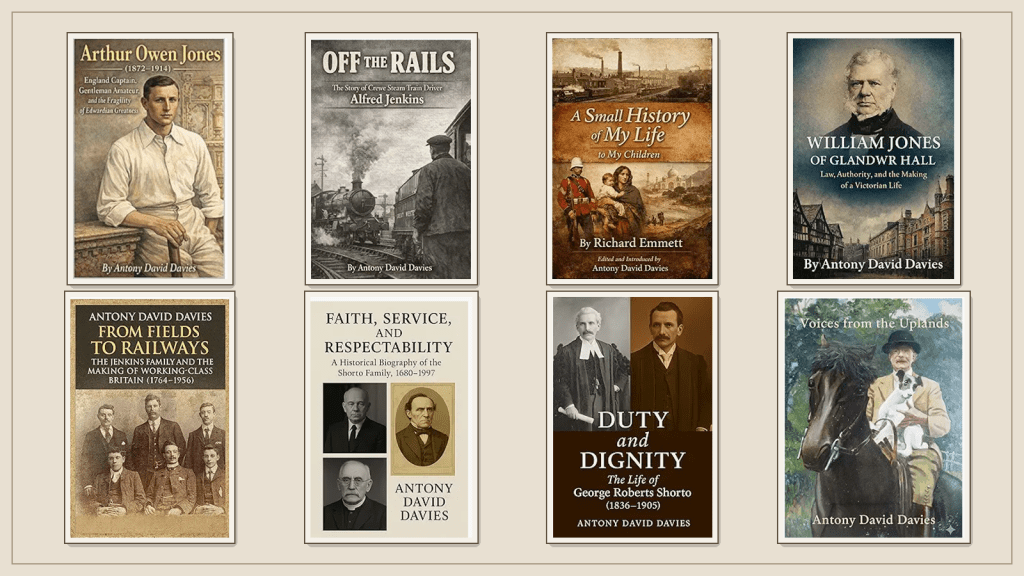
Although the injury brought obvious limitations, it also gave me something that ordinary life rarely does, uninterrupted time. That time allowed me to complete research and publish books that I had been working on, on and off, for years. I was able to self-publish works such as Voices from the Uplands, From Fields to Railways, and Faith, Service and Respectability, all of them substantially revised and expanded versions of books I had first written more than a decade earlier. These were not books produced quickly in the sense that the public might assume from their appearance within a relatively short period. Their foundations had been laid long before.
Much of this work had developed slowly over many years. Bits and pieces had already been drafted in earlier books, notes, or fragments, then revised and updated as new records became available. I had spent a great deal of time trawling through newspaper archives, consulting printed sources, and reading widely in order to recover, as fully as possible, the worlds in which these people had lived. I wanted to do more than assemble names, dates, and family connections. I wanted to bring back something of the texture of their lives, their communities, their values, and the social setting that shaped them. Confinement at home finally gave me the chance to collate that material properly, interpret it afresh, and bring it into print.
In some cases I devoted entire volumes to significant figures from my own ancestry, including William Jones, Arthur Owen Jones, and Alfred Jenkins. These projects rested on long-accumulated research and, in truth, had been waiting patiently for years. The injury did not create that work, but it did create the conditions in which it could at last be completed.
I self-publish by choice. Much of my work is necessarily niche, and my principal aim is the preservation of history and memory rather than commercial success. Self-publishing offers a direct and effective means of doing that. I have enjoyed a successful career and have no interest in entering the academic world, nor do I feel any need for the supposed glamour of a named publisher. My books are not designed to be mass-market titles, and for that reason many publishers would have little interest in them. I have been told more than once that there is no real market for books about the rural uplands of mid Wales. That may be true in commercial terms, but it does not make the history any less valuable, nor any less deserving of preservation.
Being incapacitated also revived a dormant interest in politics. As a teenager and young adult I had been fascinated by public life. My own family produced a number of local politicians, and I can place my ancestors within movements such as Cymru Fydd and the Revolt of the Schools. I am also related to Elinor Bennett, the wife of Dafydd Wigley. In that sense, perhaps my renewed interest was only to be expected. I was a committed Liberal Democrat in the late 1990s and early 2000s, but in time became disillusioned by what I increasingly saw as a tendency to take members and support for granted.
During recovery I had time not only to write, but also to look again at the political landscape as it now stands. I was deeply troubled to see a party led by Nigel Farage polling so strongly in Wales. Viewed from the standpoint of governance and ethics, it seemed to me that Reform UK was, in effect, an English nationalist party. More alarming still was the shallowness of Farage’s politics and movement. They generate noise, anger, and headlines, but then quickly move on once a subject has exhausted its immediate usefulness. My own voice is a small one, but I have nevertheless tried, in however modest a way, to encourage others to see that more clearly.
Looking back, there is a supreme irony in the injury itself. I had spent much of my career in the third sector carrying out physically demanding work, lifting heavy furniture, hauling black bags of donations up flights of stairs, and undertaking the kind of labour that wears the body down over time. I am, after all, a verified manual handling trainer. To be injured in such a way was therefore an especially cruel irony. It was not the result of some great exertion, but of an ordinary movement carried out on an ordinary day, with extraordinary consequences.
Yet time has a way of changing the meaning of hardship. What first appeared simply as misfortune has, with hindsight, acquired another significance. The injury slowed me down, forced me inward, and made me return to work that had long mattered to me but had too often been deferred by the pressures of ordinary life. It reminded me that the preservation of memory is not something to be postponed indefinitely. There comes a point when notes must be ordered, research must be written up, and the fragments of the past must be given lasting form.
My Calvinistic Methodist ancestors believed in predestination. From that older perspective, they might well have seen my injury as a form of divine intervention, forcing me at last to write up old research notes and preserve them for future generations. Whether one believes that or not, I can at least see the irony. What injured the body also created the space to complete work that had been waiting for years. In that respect, a period of pain and limitation became, unexpectedly, a period of recovery of another kind.
