
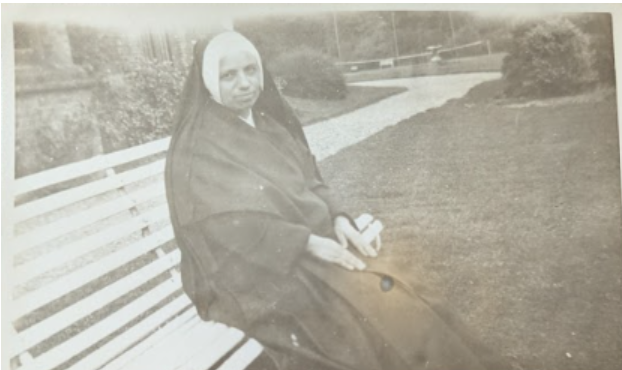
In an old family photograph, passed down without explanation, there sat a woman in religious habit. She was elderly, composed, dignified, with the softened features of age and devotion. There was no name on the reverse, no date, no inscription, no helpful family note to explain who she was or why her image had been preserved. Like so many fragments of family history, the photograph had survived almost by accident, valued enough not to be thrown away, yet not sufficiently understood to be remembered. For years, she remained simply “the nun in the photograph.”
Then curiosity did what curiosity so often does in family history, it unsettled silence. I wanted to know who she was. I wanted to know why her photograph had been kept. More than that, I wanted to understand what life lay behind that still, modest, Catholic image.
The answer led me far beyond a single family drawer. It took me across generations, across languages and across the Mediterranean, to Malta, England, Sicily and the archives of the Society of the Sacred Heart. What began as a genealogical enquiry became a rediscovery of vocation, memory and the hidden power of a life given quietly to God.
The woman in the photograph was Sister Annunciata Briffa, my distant cousin, a Maltese religious sister of the Society of the Sacred Heart.
I am, by background and vocation, a historian and writer. Much of my work has been concerned with the lives of ordinary people, farmers, teachers, ministers, tradesmen, mothers, public servants and local figures whose lives rarely trouble national history, yet whose influence shaped families, communities and moral worlds. I have long believed that history is not only the story of the famous. It is also the recovery of those who lived faithfully within the circumstances given to them.
Even so, I was not prepared for the emotional and spiritual force of uncovering Sister Annunciata’s story.
The first clear clue came from a letter of the early 1950s, sent from the Sacred Heart Convent in St Julian’s, Malta. It was addressed affectionately to “Dear Little Margaret” and signed with the warmth of a cousin who happened also to be a nun. The tone was simple, intimate, almost domestic. Yet behind that familiar language lay something larger. In our family, the Maltese connection had existed only in hints and fragments.
I had certainly never been told that there was a nun within that branch of the family. The photograph and the letter raised the same question, who was she?
In the hope that someone might recognise her, I placed the photograph in the Times of Malta. I expected, perhaps, silence. Instead, the response was immediate and moving.
The convent itself replied, confirming that Sister Annunciata had indeed lived and served there for many years. More moving still were the responses from women who had known her as pupils. They had been girls when she cared for them, and decades later they still remembered her.
Mary Josephine Grech recalled her with striking tenderness: “She was a kind face. She worked in the Infirmary and looked after us girls. I remember her well.”
Another response came from Sister Marie Scicluna, who explained that Sister Annunciata was remembered with real affection: “She was a dearly loved person. Quiet, kind, prayerful. One of those people who never drew attention to themselves, but who left a mark.”
Those words changed the nature of the search. I was no longer merely identifying a face. I was encountering a life remembered through kindness. The archive could provide dates, movements, vows and formal records, but these personal recollections supplied something equally important, the moral impression she left upon those entrusted to her care.
The documentary record gradually filled in the outline. Sister Annunciata Briffa was born on 26 October 1906 in Balzan, Malta, the daughter of Giorgio Briffa and Rosaria Sciberras. She entered the Society of the Sacred Heart on 3 March 1933, received the habit in January 1934 and made her first vows two years later. Yet the religious community into which she entered had a history in Malta stretching back only three decades, and that history had itself been shaped by one of the great upheavals experienced by Catholic religious life in early twentieth-century Europe.
The Society of the Sacred Heart had been founded in France by Saint Madeleine Sophie Barat in 1800 and had developed into a major international congregation devoted particularly to the education and formation of girls and young women. From 1903, however, French secularisation legislation forced religious congregations from their schools and houses. Within four years, forty-seven Sacred Heart houses in France were closed and approximately 2,500 Religious of the Sacred Heart had to be resettled elsewhere. Superior General Mother Mabel Digby responded by expanding the Society’s international presence, and Malta was among the countries in which a new foundation was established.
The first Sacred Heart sisters arrived in Malta in August 1903. They were a small and strikingly international group, reflecting the character of a congregation whose members were already accustomed to crossing national boundaries in obedience to their vocation. They initially occupied Villa Portelli in Rue d’Argens, Sliema, where conditions were modest and space was limited. The convent nevertheless became a school almost immediately. On 1 October 1903 the first seven girls arrived, and within days their number had grown.
From its beginnings, the Society did not conceive education solely as a privilege for those able to pay. Saint Madeleine Sophie Barat’s educational vision had commonly placed two schools alongside one another, a fee-paying boarding school and a free or inexpensive day school for poorer children in the surrounding district. Malta followed the same pattern. The Rosary School opened on 3 October 1904 with twenty-three children attending in the morning and another ten in the afternoon. Within weeks the number had risen sharply, and by the time the community moved to St Julian’s in 1907 more than a hundred children were attending the Rosary School.
This is important to understanding the world in which Annunciata would later live. The Sacred Heart establishment at St Julian’s was not simply an elite convent school for daughters of prosperous Maltese families. It was part of a wider educational mission that crossed social boundaries. The boarding school offered languages, history, geography, arithmetic, domestic skills, first aid, literature, music, drama and sport, while the Rosary School brought education to children whose families often had very little money. Both belonged to the same conviction that the education of girls carried spiritual, intellectual and social importance.
The permanent St Julian’s property, at Tal-Ballut Landar, had been purchased from the Maltese Government on 20 April 1904. The foundation stone was laid on 27 June that year and construction continued for about three years. The complex was arranged around a square quadrangle with cloisters whose design consciously recalled older monastic buildings. Even the furnishings embodied the international history of the Society. Furniture came from Sacred Heart houses closed in France and from Roehampton in England, material remnants of one European religious world being transplanted into another.
The first sisters moved into the unfinished St Julian’s building during the summer of 1907. There were still rooms without doors, windows without glass and floors awaiting completion. The rest of the community arrived in September and the school opened there on 1 October. By then the institution contained thirty boarders, twenty-two day boarders and 104 pupils of the Rosary School. The chapel followed a few years later. Thus, long before Annunciata entered religious life, St Julian’s had developed into a substantial female educational community whose history connected Malta with France, England, Rome and the wider Catholic world.
It was into this established but internationally minded tradition that Annunciata entered in 1933. Her vocation began at a particularly interesting moment in the history of the Society. Madeleine Sophie Barat had been canonised by Pope Pius XI only eight years earlier, on 25 May 1925. The foundress was therefore not merely a distant historical figure for Annunciata’s generation. Her canonisation belonged to living memory, and the ideals attached to her name, prayer, education, formation of character and devotion to the Sacred Heart, remained central to the religious culture in which Annunciata was formed.
In September 1937 Annunciata travelled to England, where she completed her religious formation at the Society’s established convent at Hove, generally described in the records as Brighton. Her journey was not an isolated posting. England had possessed Sacred Heart communities since 1842 and the Society had established a school at Hove in 1877. The English province had itself played an important role in the creation of the Maltese foundation. Indeed, the Society’s own history identifies Malta as one of the international foundations that grew from England.
Annunciata’s movement between Malta and England therefore belonged to a much wider circulation of religious women within an international congregation. A nun did not ordinarily choose where she would spend her life according to personal preference. Community, formation and ministry could carry her from one country to another. In Annunciata’s case, this pattern would ultimately take her through Malta, England and Sicily.
Her passport, issued in 1937, records her movement across Europe for “religious duties” in France, England and Italy. The words are characteristically sparse, the language of bureaucracy reducing vocation to two words. Yet behind them lay an entire world of obedience, discipline, sacrifice and belonging. These journeys were part of a religious culture in which nationality mattered less than membership of a congregation that regarded itself as one body dispersed through many countries.
The timing was also ominous. Europe was moving towards war. Annunciata had entered religious life during the interwar years and completed her formation only two years before the outbreak of the Second World War. Malta would become one of the most heavily bombed territories of the Mediterranean war, subjected to prolonged air attack and severe deprivation because of its strategic position between Europe and North Africa. The Sacred Heart community, like every institution on the island, lived through a society transformed by siege, shortages, danger and wartime disruption.
Annunciata returned to Malta in 1945, at precisely the moment when the island and the Sacred Heart community were entering another period of transformation. The war had barely ended, but the convent at St Julian’s had already begun assuming an important new role in Malta’s educational development.
On 20 October 1944, while the war was still continuing elsewhere in Europe, the Sacred Heart sisters opened a teacher-training course at St Julian’s. The first group consisted of twenty-five young women. Initially intended as a short ten-week programme, the course expanded as Malta sought to increase educational provision and required larger numbers of professionally trained teachers. The work gradually developed into a longer residential programme.
Annunciata therefore returned not simply to the convent she had known before the war, but to an institution participating in the reconstruction of Maltese society. The training of female teachers was particularly significant. Education offered increasing numbers of Maltese women a recognised professional role beyond the home, while those teachers in turn carried their influence into classrooms throughout the island. Within the walls of St Julian’s, a religious congregation founded for the education of girls was now helping to train the women who would educate another generation.
There is no evidence that Annunciata herself taught on the teacher-training course, and it would be wrong to suggest that she did. Her remembered work was in the infirmary. Yet this does not make her role peripheral to the educational mission. A residential convent school was an entire community rather than a collection of classrooms. Girls lived there, studied there, worshipped there, became ill there, suffered homesickness there and passed through many of the ordinary anxieties of childhood and adolescence within its walls.
The woman who cared for a sick child in the infirmary therefore contributed to the formation of that child no less genuinely because she was not standing before a blackboard. Former pupils remembered Annunciata not for an academic subject, public achievement or administrative office, but because she was kind when they were vulnerable. In an institution whose purpose was the development of the whole person, such care belonged naturally to its mission.
The teacher-training work begun at St Julian’s eventually became Mater Admirabilis Training College. A new building was erected at Tal-Virtù and formally opened by Queen Elizabeth II on 4 May 1954. The initial short course had by then developed into a two-year residential training programme. The college continued until 1973, by which time generations of Maltese women had passed through its doors before entering the teaching profession.
The surviving family letter from Annunciata belongs to the early 1950s, precisely the period when this transition was underway. Its intimate family language sits therefore against a much larger background. While she wrote affectionately to “Dear Little Margaret”, the community around her was participating in the reshaping of female education in post-war Malta.
There is something revealing in that contrast. Large social changes are rarely experienced by the individuals living through them as neat historical developments. They occur amid ordinary routines, letters to relatives, meals, prayers, illness, household duties and personal relationships. Annunciata did not need to think of herself as participating in the modernisation of Maltese education for her life to have belonged to the institution helping to accomplish it.
She remained in Malta until 1961, when she was posted to Catania in Sicily. Later she moved to Palermo. Once again, this movement reflected the international character of Sacred Heart religious life. She had been born into a Maltese family, but her vocation gradually widened the geography of her existence. England had formed part of her religious preparation, Malta had been the centre of decades of service, and Sicily became the setting of her later years.
She died in Palermo on 6 January 1992, aged eighty-five. By then she had spent almost sixty years in the Society of the Sacred Heart.
There is no great public drama in her life. No political office, no published work, no public monument, no great institutional achievement can securely be attributed to her name. She did not command public attention or alter the visible course of history. Yet this is precisely why her story matters.
Most lives are not lived at the scale by which conventional history measures importance. Most religious lives are certainly not. They are lived in repetition, duty, prayer, obedience, fatigue, service and faithfulness. Their substance lies not in isolated dramatic acts but in thousands of ordinary choices made over decades.
In Sister Annunciata’s case, that service was expressed through community life, through care for pupils and particularly through her work in the infirmary. To modern eyes, such work might appear merely practical or maternal. Within the spirituality of the Society of the Sacred Heart, however, education was understood much more broadly than academic instruction. The Society joined contemplation with apostolic service and sought the formation of the whole person. Care, listening, reassurance and the protection of the vulnerable were therefore not incidental to the work. They were part of it.
This also requires some precision in how a life such as Annunciata’s is described. She belonged to a disciplined religious community and lived under the obligations of religious obedience, but the Society of the Sacred Heart was not simply a cloistered contemplative order removed from the world. Its sisters were contemplative and apostolic. They prayed, but they also taught, administered schools, trained teachers, nursed, travelled and served in a succession of active ministries. Annunciata’s hiddenness arose not because her vocation lacked engagement with society, but because the work she performed was rarely of the kind that leaves an individual name prominently in public records.
That distinction matters. Her life was quiet, but it was not passive. This is what struck me most forcibly as her story emerged. Her life had not disappeared. It had continued in memory. It survived in the recollections of former pupils, in the records of the convent, in family correspondence and in one old photograph preserved without explanation. The world may not have recorded her prominently, but those who had been cared for by her did not forget.
That, in itself, is a form of legacy. We live in an age preoccupied with visibility. Achievement is often measured by platform, recognition, profile and public reach. Lives are judged by what can be displayed, counted or advertised. Yet the rediscovery of Sister Annunciata Briffa speaks to a different understanding of value.
Her life was not public in the modern sense. It was hidden from prominence, disciplined by community life and shaped by religious obedience. But it was not small. A life can exert influence without becoming famous, and kindness can survive in human memory long after institutions, buildings and official responsibilities have changed.
The words of Christ in Matthew 6:6 come often to mind when I think of her: “But when you pray, go into your room, close the door and pray to your Father, who is unseen. Then your Father, who sees what is done in secret, will reward you.”
There is something profoundly Catholic in that hiddenness. Catholic memory does not only honour the famous saint, the martyr, the founder or the reformer. It also understands the sanctity of hidden sacrifice. It recognises the grace of the ordinary vocation, the uncelebrated act of mercy and the life spent in service without applause. Sister Annunciata’s story belongs to that tradition.
Yet her life also belongs to histories much larger than the family story with which my search began. She belonged to a congregation whose arrival in Malta resulted from the secularisation struggles of France. She served in a convent established by an international group of displaced religious women. She belonged to an educational tradition that deliberately placed the schooling of affluent girls beside provision for poorer children. Her religious formation carried her to England through institutional connections extending back into the nineteenth century. She returned to Malta as St Julian’s became involved in the training of women teachers for the post-war generation, and she ended her days in Sicily after decades of service across an international religious network.
None of these wider histories makes Annunciata famous. Nor should they be used artificially to enlarge a life that did not seek enlargement. Their importance lies elsewhere. They allow us to see more clearly the world through which she moved.
The history of women religious is easily reduced to buildings and institutions, convents founded, schools opened, colleges established and communities closed. Behind those institutional histories, however, were individual women. Some possessed formidable administrative talents. Some were scholars, teachers or founders. Others performed quieter tasks without which communal life could not have functioned. Annunciata appears to have belonged chiefly among the latter.
The memory preserved by her former pupils is therefore especially valuable. Institutional histories can tell us when a school opened. Archives can tell us when a sister entered, professed vows or moved from one community to another. Passports can record a journey. None of those sources can easily record the fact that a frightened or sick girl once encountered a woman whose face seemed kind and remembered that kindness half a century later.
For me, recovering her life has meant more than solving a family mystery. It has restored a spiritual connection. I began with a photograph and found a woman of prayer, tenderness, discipline and service. I found a cousin whose life had crossed nations, convents and generations, and whose memory still had the power to move those who encountered it.
In our own time, religious life is less visible than it once was. Many convents that shaped whole generations have closed, changed purpose or diminished. The vast educational establishments once staffed almost entirely by religious communities have largely passed into lay hands. Vocations are fewer and the social world that produced women like Sister Annunciata has changed almost beyond recognition. Yet the witness of those women endures.
It endures in the people they taught, in the children they comforted, in the teachers they helped to form, in the communities they sustained and in the quiet spiritual inheritance they left behind. It also endures in archives and family collections, sometimes reduced to the fragile evidence of a letter or an unidentified photograph awaiting someone curious enough to ask a question. When I look again at the photograph now, I no longer see an unknown nun.
I see Sister Annunciata Briffa of Balzan, daughter of Giorgio Briffa and Rosaria Sciberras, Religious of the Sacred Heart, cousin, infirmarian and servant of God. I see a woman whose vocation carried her through Malta, England and Sicily, whose religious life belonged to an international story much larger than she was, and whose character was nevertheless remembered in the simplest terms, quiet, kind and prayerful. I see a woman whose life was not lost.
It was simply waiting to be remembered. Above all, I see a vocation fulfilled.
A life given in love. And, in that still and gentle face, something of the Church itself, quiet, faithful, maternal, marked by time perhaps, but enduring.
Related Essays
Explore more Welsh religious history
Continue with the Welsh Nonconformity guide, or browse the related essays above.
Sources and Further Reading
This essay began with a surviving family photograph and has been reconstructed through family testimony, correspondence, records supplied by the Society of the Sacred Heart, civil and genealogical evidence, and published material relating to the history of the Society in Malta and Britain. Particular contextual sources include the Society of the Sacred Heart’s histories of the congregation and its English foundations, the Archdiocese of Malta’s account of the Society in Malta, Sacred Heart College Malta’s history of the St Julian’s foundation and Rosary School, and Sister Catherine Mifsud RSCJ’s history of Mater Admirabilis Training College and the teacher-training work begun at St Julian’s in 1944. Where surviving documentation does not permit certainty, the distinction between established fact, personal recollection and interpretation has been retained.