
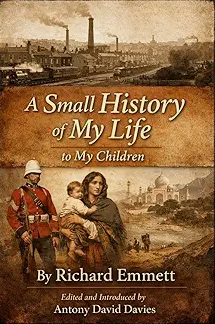
A Small History of My Life to My Children
The Memoir of Richard Emmett, a Victorian Soldier
A rare first-person account by a nineteenth-century working man.
Richard Emmett wrote his memoir for his children in the 1880s. Born into a precarious working-class family in Salford, he became a rank-and-file soldier and recorded a life shaped by poverty, mobility, military discipline, family responsibility and endurance. This edition preserves his voice while providing the context needed to understand the world he inhabited.
How the memoir came to me
Like many people interested in their ancestry, I joined Ancestry in the early 2000s and maintained a subscription well into the following decade. Over those years I was contacted by numerous relatives, some close and others very distant, and these exchanges added considerably to my knowledge of different branches of the family.
The most remarkable contact came around 2012, when a distant cousin sent me a copy of memoirs written by my great-great-great-grandfather, Richard Emmett, during the later nineteenth century. Family historians are accustomed to reconstructing lives from census returns, certificates and other records, but it is exceptionally rare to encounter an ordinary ancestor speaking directly in his own words. I immediately recognised that the memoir was something unusual and worth preserving.
Richard had written the account for his children rather than for publication. It recorded his experiences of poverty, family life, military service and personal responsibility from the perspective of a nineteenth-century working man. The survival of such a document seemed to me important not only to his descendants, but as a historical source in its own right.
Why I published the memoir
Having received the manuscript, I felt strongly that it should not remain confined to a private family collection. I therefore prepared the memoir for publication, and the first edition appeared in 2013. My principal purpose at that stage was preservation, to make Richard Emmett’s account permanently accessible and ensure that his words were not again lost within the family.
I returned to the memoir more than a decade later. By 2026 my own historical work had developed considerably, and I felt that the original publication did not provide modern readers with enough information to understand the people, places and circumstances Richard described. I therefore prepared a second edition containing substantially more historical and biographical context.
The purpose of the new edition was not to rewrite Richard’s testimony. His own voice remains at the centre of the book. My role was to provide the background needed to understand the world in which he lived, the social conditions from which he came, his military experience and the wider nineteenth-century setting that shaped his life.
Editorial approach
The edition separates the surviving first-person memoir from the editorial framework around it. An introduction, background material and notes place Emmett within the industrial world of Salford, military service and later family life, but they are not substitutes for his testimony. Where modern readers need explanation, I provide context; where Emmett speaks clearly for himself, I leave him to do so.
Why the source matters
The memoir is unusual because Richard Emmett was not a celebrated soldier, politician or public figure. He was an ordinary working man who chose to leave his children an account of the life he had experienced. That makes the document particularly valuable. Much of nineteenth-century working-class life has to be reconstructed from records created by institutions; here, the individual himself speaks.
For me, the importance of publishing the memoir has therefore always rested on two things. It preserves the voice of an ancestor for his descendants, but it also contributes a small first-person testimony to the much larger history of ordinary people whose thoughts and experiences so rarely survive in their own words.
How it fits into my wider work
This volume connects closely with my interest in overlooked lives and working-class history. It also represents a different kind of historical responsibility from biography: rather than reconstructing a life mainly from external records, the task is to preserve and contextualise a voice that has already survived.
Publication details
- Author of the memoir: Richard Emmett
- Edited and introduced by: Antony David Davies
- First edition: 2013
- Second, expanded edition: 2026
- Formats: Kindle and paperback
Read A Small History of My Life to My Children
Richard Emmett’s memoir, edited and introduced with historical context, is available in paperback and Kindle editions.