
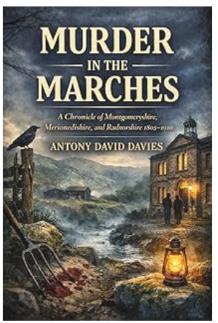
Murder in the Marches
A Chronicle of Montgomeryshire, Merionethshire, and Radnorshire, 1805–1910

A social and legal history of violence, justice and community in the Welsh Marches.
Across Montgomeryshire, Merionethshire and Radnorshire between 1805 and 1910, the book reconstructs killings, suspicious deaths and criminal cases from inquests, assize reporting and contemporary newspapers. The crimes provide the starting point; the larger subject is the society around them.
Why I wrote this book
The murders and suspicious deaths recorded in nineteenth-century newspapers are compelling in their own right, but I did not want to write a collection of sensational stories. What interested me was what violence exposed about the communities in which it occurred: poverty and status, gender expectations, shame, family relationships, policing, medical uncertainty and the operation of justice in places where everybody often knew everybody else.
I therefore treated each case as a form of microhistory. A single death can open a window onto a household, a village, an occupation or an institution. The surviving evidence is sometimes abundant and sometimes frustratingly incomplete, and the book deliberately preserves that uncertainty rather than forcing every case into a neat conclusion.
The historical questions
The book asks how rural communities understood violence; how class and reputation shaped the treatment of victims and suspects; how women and men were judged differently; how coroners, magistrates, juries and assize courts worked; and what happened when contemporary medicine and forensic knowledge could not provide certainty. Newspaper language itself becomes evidence, revealing the moral assumptions through which crime was reported to the public.
Sources and method
The principal evidence comes from contemporary newspapers, inquest reporting, assize and court coverage, civil records and genealogical reconstruction. Wherever possible, individuals are placed back into their family and occupational settings so that a victim or defendant is not reduced to the few dramatic days that brought a name into the press.
The method depends on resisting retrospective certainty. A verdict recorded in the nineteenth century is evidence of what a court concluded, not necessarily proof that every modern question can be answered. Where the sources conflict or remain incomplete, the book says so.
How it fits into my wider work
Murder in the Marches extends my interest in overlooked lives beyond family history and biography. It uses exceptional events to recover ordinary social worlds and is closely connected to my broader work on rural Wales, authority and institutions. In this case, the institutions are those of law, policing, medicine and local reputation.
Publication details
- Author: Antony David Davies
- Published: January 2026
- Formats: Kindle and paperback
Explore related material in Welsh Rural History and the Essays collection.
Read Murder in the Marches
The full study of violence, justice and community across the Welsh Marches is available in paperback and Kindle editions.