
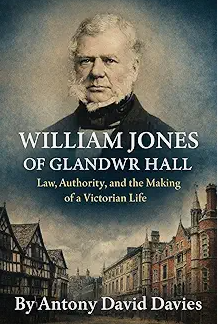
William Jones of Glandwr Hall
Law, Authority, and the Making of a Victorian Life
A professional and institutional biography of a Welsh-born Victorian solicitor.
William Jones rose from Welsh provincial origins to establish himself in London law and public life. His career provides a way of examining professional authority, civic service, property, social mobility and the habits through which Victorian respectability was made visible and credible.
Why I wrote this book
William Jones of Glandwr Hall grew directly from the research undertaken for Old Llyfnant Valley Farming Families. William Jones had originally appeared as one figure within the much wider history of the families connected with the Llyfnant Valley and Glandwr Hall, but the more I researched him, the more apparent it became that his life deserved much fuller treatment.
He had enjoyed a highly successful Victorian career and achieved a considerable amount, particularly after leaving Wales and establishing himself in London. Yet despite that success, he had become largely forgotten. His life had never received the detailed biographical treatment that I felt it merited.
I therefore decided to separate his story from the wider family history and develop it as a volume in its own right. The earlier research provided the foundation, but the new book allowed me to extend the investigation considerably and to place William Jones within the professional, social and institutional world in which he lived.
From family history to biography
The material concerning William Jones in Old Llyfnant Valley Farming Families had necessarily formed only one part of a much larger genealogical study. A separate biography allowed me to return to the surviving evidence with different questions.
Rather than concentrating principally on descent and family relationships, I wanted to understand how a man from rural Wales established himself successfully in Victorian London, how professional reputation was built, what role property and public service played in social advancement, and how someone could become influential within his own lifetime yet fade so substantially from later memory.
The new volume therefore combined material extracted from the earlier family research with substantial additional investigation. Newspapers, legal and professional evidence, property records, public appointments and other sources allowed the outline preserved in the genealogical work to be developed into a much fuller account of his life.
Why his life mattered
William Jones interested me precisely because he was not one of the major public figures of Victorian Britain. His significance lay in the scale of what he achieved within the professional and civic world of his own time.
His story offered an opportunity to examine the way Victorian authority was created through profession, reputation, property and service. It also demonstrated how easily a successful life can become obscured once personal memory disappears and the surviving evidence becomes scattered among archives and newspapers.
For that reason, the book became both an attempt to recover William Jones as an individual and an exploration of the social world that had allowed him to rise from Welsh provincial origins to a successful professional life in London.
Sources and method
The biography uses genealogical records, census returns, civil registration, newspapers, legal and professional evidence, property material and records of public service. The method is deliberately restrained. Where the evidence records an action, office, transaction or relationship, it can be discussed directly. Where motive or emotion is not documented, I avoid converting possibility into fact.
What the book explores
Jones’s story is used to examine law as a source of authority, the relationship between professional success and civic standing, the continuing importance of land and property, and the ways Victorian legitimacy was built through service, reputation and institutional membership. His Welsh origins remain important, but the book is equally concerned with the wider machinery of nineteenth-century professional life.
How it fits into my wider work
This book represents one of the clearest examples of my move from family reconstruction into institutional biography. It also established a method I have increasingly tried to follow elsewhere: make the evidence carry the argument, acknowledge the limits of the archive, and allow an apparently quiet life to illuminate larger structures of authority and social change.
Publication details
- Author: Antony David Davies
- Published: January 2026
- Formats: Kindle and paperback
See also Old Llyfnant Valley Farming Families and Research Methods.
Read William Jones of Glandwr Hall
The complete biography is available in paperback and Kindle editions.