
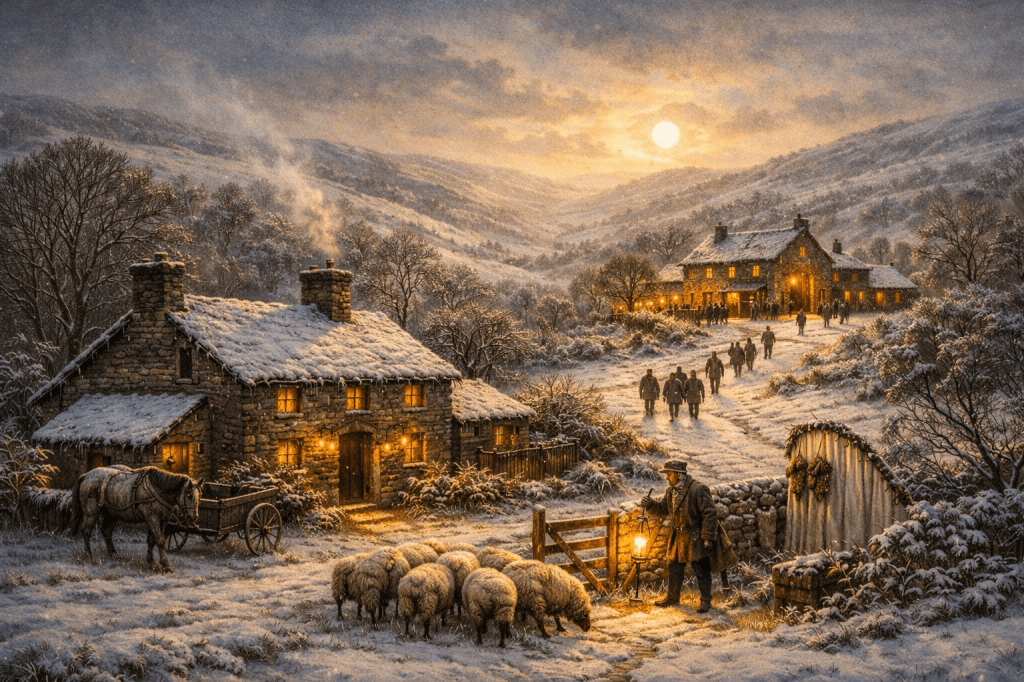
In the high country of mid and north Wales, where the hills folded into one another like great, weathered blankets and the lanes were little more than tracks worn by generations of hooves and boots, Christmas in the Victorian era arrived quietly. There was no sense of sudden abundance, no dramatic break from the rhythm of rural life. Instead, Christmas was woven gently into it, marked by restraint, reverence, and an unspoken gratitude for survival through another hard year.
By December, the upland farms lay under a pall of cold. Frost hardened the ground, and snow, when it came, lingered in drifts against stone walls and hedgebanks. The sheep were brought closer to the homestead where possible, checked daily, their welfare a constant concern. Christmas did not excuse labour. Cows still needed milking in the half-light of dawn, water had to be broken from ice, and fodder carried across yards slick with frozen mud. Yet there was a sense that these tasks were undertaken with greater care, even tenderness, as the season reminded families of their dependence on both land and providence.
Inside the farmhouse, preparations were modest but deliberate. The house was scrubbed, the hearth cleaned, and fresh rushes or straw laid where floors were bare stone. Holly and ivy were gathered from nearby hedges and tucked above the mantel or around the door, greenery offering colour against the winter gloom. Candles were saved and trimmed carefully, to ensure there was enough light for Christmas Eve and Christmas Day. Nothing was wasted, nothing taken for granted.
As Christmas approached, certain customs, quiet, local, and deeply rooted, threaded themselves through the season. On the nights leading up to Christmas, families might gather for Noson Gyflaith, the toffee-pulling evening. A pan of sugar and butter was boiled over the fire until it turned a deep amber, then poured onto a greased slate or board. Once cool enough to handle, the toffee was pulled and twisted into golden strands, laughter rising in the warm kitchen as fingers stuck and the mixture stiffened in the cold air. It was one of the few moments in the year when sweetness was abundant.
Christmas Eve carried its own solemn rituals. Before night fully settled, families often walked to the chapel graveyard, clearing snow from stones, placing sprigs of holly, or simply standing in silence among the resting places of kin. It was a gesture of continuity, a reminder that the living and the dead shared the same land, the same winters, the same hope for renewal.
Later that night, or in the small hours before dawn, the uplands stirred again for plygain. Lanterns bobbed along frozen lanes as men and boys made their way to the chapel for the early-morning service. Inside, breath misted in the cold air as voices rose in unaccompanied harmony. Anyone could stand and sing. The carols were long and intricate, carrying the weight of generations. The sound, solemn and unwavering, echoed against wooden galleries and stone walls, a testament to faith that required no ornament to be profound.
In some districts, a quieter and more restrained form of the Mari Lwyd appeared during the season. Unlike the raucous coastal versions, the upland Mari was subdued, a horse’s skull draped in a white sheet, carried by a neighbour who knew the farms well. It was less a performance than a blessing. The Mari might visit only a handful of homesteads, offering good fortune for the coming year before disappearing back into the dark lanes.
Food, though plain by modern standards, held deep significance. Christmas dinner might centre on a joint of mutton or beef if circumstances allowed, more often supplemented by bacon, broth thick with barley and vegetables, and bread baked with particular care. Mince pies, when they appeared, were precious, the dried fruit and spices a reminder of distant trade routes and rare indulgence. Ale or small beer might be brewed specially for the season, shared sparingly but warmly.
Religion lay at the heart of Christmas in the Welsh uplands. The chapel, often perched above the valley or set beside a stream, drew families together on Christmas Day and Boxing Day alike. Services were long, sermons earnest, hymns sung with the full force of communal memory. Voices carried the theology of endurance, humility, and hope. For many, this was the true feast of Christmas, the reaffirmation of faith and belonging in a world that could be harsh and unforgiving.
In the days between Christmas and the New Year, families prepared calennig, apples decorated with cloves, oats, or evergreen sprigs. Children carried them from house to house on New Year’s morning, offering blessings in exchange for coins, bread, or small treats. The preparations themselves, apples polished by firelight and greenery gathered from hedges, added a gentle sense of anticipation to the quiet days after Christmas.
Evenings remained subdued. After supper, families gathered around the fire for candlelit readings, passages from the Bible, verses of hymns, or stories of winters past. The glow illuminated faces lined by work and weather. Children might receive a small gift, an apple, a homemade toy, a book if the family was fortunate, but expectation was tempered by understanding. Christmas was not about novelty but continuity.
What defined a Victorian Welsh uplands Christmas most of all was its moral texture. It was a season shaped by duty, mutual reliance, and a keen awareness of fragility. Neighbours checked on one another, particularly the elderly or those struggling after illness or poor harvests. Charity was quiet and almost invisible, offered as a sack of coal, a joint of meat, or help with livestock rather than through ceremony.
In these upland homes, Christmas did not shout. It whispered. It lived in the crackle of the fire, the steady cadence of hymns, the soft pull of toffee on a winter’s night, the lantern-lit walk to plygain, the hush of a graveyard under snow. It was not a pause from life, but a moment within it, affirming that even in cold, scarcity, and uncertainty, there was warmth enough to be shared, and faith enough to carry a family, and a community, through the long winter ahead.
