
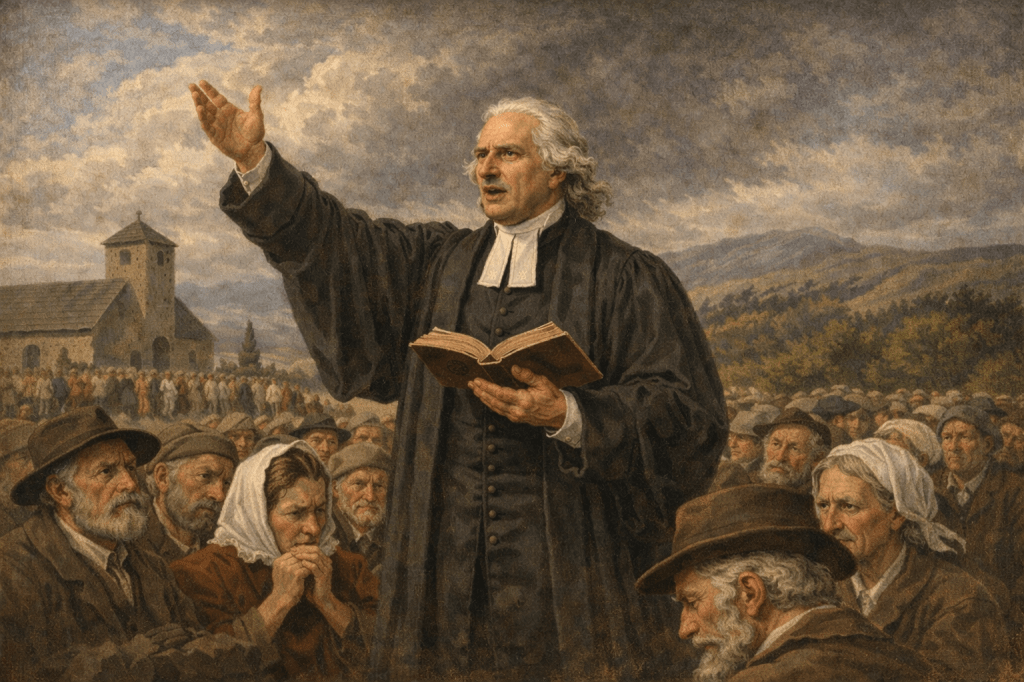
There are certain names in Welsh religious history which do not merely belong to their century, they reshape the centuries that follow. Daniel Rowland of Llangeitho is one of those figures. In the eighteenth century, when Wales was still largely rural, linguistically distinct, and socially conservative, Rowland became the most powerful preacher the nation had ever produced.
He did not hold political office. He did not command armies. He did not found universities or write great treatises. Yet the movement he helped ignite, the Welsh Methodist Revival, altered the moral landscape of Wales so thoroughly that its echoes remained audible into the twentieth century, and arguably beyond.
To understand Daniel Rowland is not simply to study a preacher. It is to understand how Wales became a nation shaped by chapel culture, evangelical discipline, popular literacy, and a particular kind of moral seriousness, rooted in the Welsh language and the communal experience of worship.
Wales Before the Revival
By the early eighteenth century, Wales was in a complex condition. It was formally Anglican, culturally Welsh, and socially fragmented. The Church of England was the established church, but in many rural areas its practical reach was uneven. Clergy were often non-resident, under-educated, or disconnected from the language and everyday lives of their parishioners.
This is not to claim that Wales was spiritually barren, far from it. It remained a deeply religious country. But there was a growing sense, particularly among ordinary people, that something was missing. Religious life could be formal, distant, and increasingly unable to speak to the emotional and moral anxieties of a society undergoing subtle but real change.
The eighteenth century was not static. The rural economy was shifting, patterns of landholding were tightening, and the pressures of poverty and insecurity were persistent. In such a world, religion was not a hobby or a private comfort, it was the primary lens through which people interpreted suffering, duty, providence, and hope.
Into that landscape came the Revival.
The Making of a Preacher
Daniel Rowland was born in 1713, and like many of the great leaders of the Welsh Revival, he began firmly within the Anglican system. He was ordained as a priest in the Church of England and served as curate at Llangeitho in Cardiganshire.
That detail matters. Rowland was not an outsider attacking the church from beyond its walls. He was one of its own clergy, trained within its structures, speaking from its pulpits, and initially working within its discipline.
Yet he underwent a profound evangelical conversion, a spiritual awakening which changed not only his theology but his entire sense of what preaching was for. His sermons became urgent, emotionally intense, and saturated with the language of personal salvation.
This was not simply a new style. It was a new religious psychology. The Revival demanded that the individual confront their spiritual condition directly. It insisted on the reality of grace, the seriousness of sin, and the necessity of conversion. For many, it was a terrifying and exhilarating message.
Rowland became its greatest voice.
Llangeitho and the Birth of a National Phenomenon
Llangeitho, today a quiet rural village, became one of the most extraordinary pilgrimage sites in Welsh history. People travelled immense distances, often on foot, to hear Rowland preach.
Contemporary accounts describe crowds of thousands, gathering in open air meetings and chapel-like assemblies, creating scenes of emotional intensity that astonished observers. Some were moved to tears. Others cried out. Many experienced what the revivalists understood as spiritual conviction.
It is difficult for modern readers to grasp what this meant in a world without mass media, without entertainment culture, and without modern mobility. To walk miles across Welsh hills to hear a sermon was not casual. It was a statement of spiritual hunger and communal momentum.
Rowland’s preaching was not merely popular. It was transformative.
The Revival in Wales was not a passing enthusiasm. It created new networks, new disciplines, new expectations of moral behaviour, and ultimately new religious institutions. It laid the groundwork for the later dominance of the chapel in Welsh life.
The Power of the Welsh Language
One of the most important aspects of Rowland’s influence was linguistic. He preached in Welsh, and he preached with a mastery of Welsh that made the language itself feel like a sacred instrument.
This was not incidental. Wales in the eighteenth century was still overwhelmingly Welsh-speaking, especially in rural areas. Yet the structures of establishment often leaned toward English cultural norms. The Revival, by contrast, sanctified Welsh in the most emotionally powerful arena imaginable, the pulpit.
In doing so, it reinforced Welsh identity at a moment when the political and administrative life of Britain increasingly ran through English.
This is one reason why the Revival cannot be understood merely as a religious movement. It was also a cultural movement. It strengthened Welsh-language community life, Welsh moral discourse, and Welsh forms of collective identity.
Rowland and Howell Harris, Two Forces of the Revival
No account of Daniel Rowland can ignore Howell Harris, the great lay evangelist of Trevecka. The two men, along with William Williams Pantycelyn and others, formed the central constellation of the Welsh Methodist movement.
Yet Rowland and Harris were profoundly different figures.
Harris was a restless organiser, a charismatic layman, a builder of communities, and at times a deeply controversial personality. Rowland was a clerical preacher of immense authority, more stable in temperament, and more rooted in the pulpit than in organisational experiments.
Their relationship was at times strained, shaped by differing approaches to leadership and discipline. But together they represent something crucial about the Revival, it was not a single personality cult. It was a movement broad enough to contain multiple leadership styles.
Rowland’s genius lay in preaching. Harris’s genius lay in mobilisation. Between them, they built something that Wales could not easily forget.
Theological Depth and Emotional Force
Rowland’s preaching was evangelical and Calvinistic in emphasis. He believed in the sovereignty of God, the necessity of grace, and the centrality of Christ’s atonement.
But he was not a dry doctrinalist. His sermons were known for their emotional power, their vivid imagery, and their ability to bring theological ideas into direct contact with human fear, guilt, longing, and joy.
In this, Rowland represents a wider pattern in Welsh religious culture, the union of doctrinal seriousness with emotional intensity.
This combination became one of the defining features of Welsh Nonconformity in the nineteenth century. It produced a nation where chapel sermons were intellectually demanding, morally exacting, and emotionally charged.
Rowland was one of the founding architects of that tradition.
The Break with the Established Church
For much of his ministry, Rowland remained within the Church of England, even while preaching in ways that alarmed church authorities.
Eventually, however, the tensions became unsustainable. Rowland was effectively excluded from preaching in many parish churches. The institutional church, uneasy with revivalist enthusiasm and its challenge to clerical order, increasingly moved against him.
This was one of the turning points in Welsh religious history.
The Revival began inside the Church of England, but it could not be contained by it. The movement’s energy demanded structures of its own. The result was the gradual emergence of Welsh Calvinistic Methodism as a distinct tradition.
Rowland did not set out to create a new denomination. But by the end of his life, he had helped make it inevitable.
The Social Consequences of the Revival
The impact of Rowland and the Revival cannot be measured only in theology or church history. It had profound social effects.
The Revival promoted moral discipline, sobriety, and communal accountability. It created networks of fellowship and oversight. It encouraged literacy through Bible reading and hymn singing. It placed spiritual authority in the hands of Welsh-speaking leaders, rather than in distant institutions.
Over time, these forces helped create the nineteenth-century Welsh chapel culture which shaped everything from education and politics to community organisation and national identity.
One can trace a line, not perfectly straight but unmistakable, from Rowland’s open-air preaching in Cardiganshire to the later moral authority of the chapel in industrial Wales.
Even Welsh political radicalism, so often linked to Nonconformity, draws part of its cultural energy from this revivalist inheritance.
Rowland’s Legacy and the Mythic Status of the Preacher
Daniel Rowland died in 1790, but his legacy did not die with him.
In Welsh cultural memory, he became more than a historical figure. He became an archetype, the preacher as national leader. The man of the pulpit as moral authority. The minister as a kind of uncrowned king.
This is one of the most striking aspects of Welsh history. In England, national leadership was embodied in aristocracy, monarchy, parliament, and the military. In Wales, especially in the nineteenth century, the minister often carried a comparable social authority within local life.
Rowland helped create that model.
He demonstrated that in a Welsh-speaking, chapel-centred society, the preacher could become the most influential figure in the community. Not by force, but by voice. Not by wealth, but by moral seriousness. Not by political power, but by spiritual authority.
Conclusion, Daniel Rowland and the Soul of Wales
Daniel Rowland was not simply a preacher of the eighteenth century. He was one of the founding figures of modern Wales.
Through his ministry, Llangeitho became a spiritual centre. Through his preaching, thousands encountered a form of religion that was urgent, personal, and transformative. Through the Revival he helped lead, Wales moved toward a chapel culture that would dominate its social life for generations.
To understand Rowland is to understand something essential about Wales itself.
It is to see how a nation, lacking a state, lacking institutions of power, and often marginalised within the British political structure, created its own internal sources of authority. The pulpit became a throne. The sermon became a national event. The minister became a leader.
And for a time, in the rain-dark valleys of rural Wales, the people did not wait for politicians.
They waited for the Preacher.
