
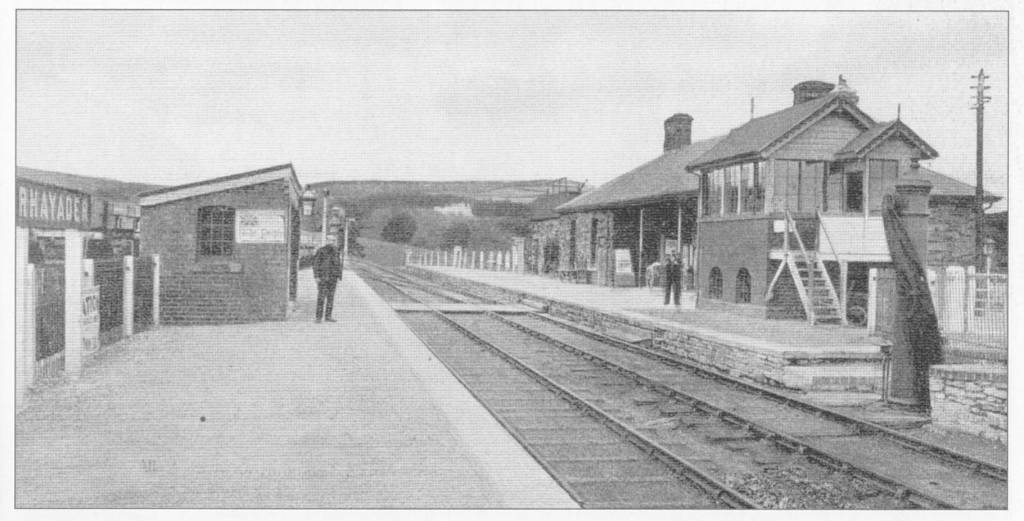
There are places in Wales where the landscape still feels like an argument. Not in the sense of conflict, but in the way it insists upon its own logic, steep, stubborn, beautiful, and not designed to make life easy for those who live within it. Mid Wales is one of those places. It is a country of distances, of upland horizons, of valleys that run for miles without offering you the comfort of a quick crossing.
That is precisely why the Mid Wales Railway mattered.
It was never just a rural line, and it was certainly not a quaint Victorian curio. It was an act of connection through the centre of Wales, a statement that the country’s heartlands were not to be treated as empty space between north and south, or as a wilderness to be bypassed on the way to somewhere more “useful”.
For almost a century, the Mid Wales Railway did what Wales has always needed its infrastructure to do, it made the country legible, liveable, and connected on its own terms.
And when it was closed, the damage went far beyond transport.
A Railway Born from Geography, and from Necessity
To understand the Mid Wales Railway properly, you start with the landscape itself.
Mid Wales is not flat, and it is not forgiving. Rivers cut deep valleys, hills force settlements into pockets of habitability, and the human geography is defined by market towns and dispersed farms rather than industrial conurbations. The economy was pastoral and agricultural, the social life shaped by chapel culture, fairs, markets, and the rhythms of rural labour.
In the nineteenth century, railways did not simply move people and goods. They transformed the meaning of distance. They made it possible to run a business, a farm, and a civic life without being trapped by geography. The Mid Wales Railway was created in that spirit, ambitious, imperfect, and in its own way visionary.
Where It Actually Ran, and Why Its Junctions Were the Whole Point
The Mid Wales Railway is often described as if it ran between two points and served only the settlements in between. That misses the essence of it.
It was, above all, a junction railway, a central Welsh connector that stitched together several major systems.
In the north, it began at Moat Lane Junction, just outside Caersws, where it connected directly to the Cambrian Line, the great railway artery of north and west Wales. From there it ran south through Llandinam, then on through Llanidloes, and down into the upper Wye and Irfon country towards Rhayader, Newbridge-on-Wye, and Builth Road.
Builth Road mattered not because it was a “stop”, but because it was a junction. It sat at the meeting point of systems, a place where passengers and freight could connect into the north to south route that survived as the Heart of Wales Line, and into the wider Welsh network beyond.
The Mid Wales line then continued south through Erwood and Boughrood to Three Cocks Junction, a name that reads like a footnote until you grasp what it signified. From here the railway plugged into two worlds at once, south-west towards Brecon and Talyllyn Junction, and east via the Hereford, Hay and Brecon Railway towards Hereford.
In other words, the Mid Wales Railway was not a self-contained rural corridor. It was a central Welsh spine connecting north Wales, mid Wales, south Wales, and the border counties. It helped Wales function as a joined-up country, not merely as regions facing outward.
What It Did for Mid Wales, Economy, Society, and Identity
Railways are often described in narrow economic terms, as if their only value is what can be counted in passenger numbers and freight tonnage. In rural Wales, that is an incomplete way of seeing.
The Mid Wales Railway did four things whose value is structural rather than glamorous.
It made rural life viable at scale, moving livestock, agricultural inputs, coal, timber, parcels, and mail with a predictability the pre-motor age could not otherwise supply.
It anchored the market towns, places like Llanidloes, Rhayader, and Builth, not as picturesque backwaters, but as administrative centres and commercial hubs with a reliable route into the wider economy.
It strengthened internal Welsh coherence, by creating a genuine connecting thread between the Cambrian system in the north, the junction geography around Builth Road, and the Brecon connections to the south. This mattered, because Wales has always suffered from a transport logic that pulls too often east to west into England, and too rarely north to south within Wales.
And it made mid Wales a place you could pass through, not just endure. When a region is connected, it becomes part of the national imagination. When it is disconnected, it becomes a blank space, a place you “go around”.
Why It Declined, and Why Closure Came Earlier Than Beeching
The Mid Wales Railway ran through difficult country, steep gradients, sharp curves, and low-density settlements. It was costly to operate, and its long-distance ambitions were constrained early by parliamentary competition and limited finance.
Over time, independence became unsustainable. The company amalgamated with the Cambrian Railways in 1904, a rational consolidation rather than a dramatic collapse.
The sharper shift came later, and it was ideological. By the mid twentieth century, the language of rail changed. It was expected to justify itself as a business rather than defended as a public good. Rural Wales was never going to win that argument.
One detail strengthens this point. The Mid Wales Railway’s passenger closure in December 1962 pre-dated the Beeching Report of 1963. That matters historically. It shows that the state’s logic of withdrawal from rural lines was already at work before the “Axe” was formally named.
Closure, 1962, and the Moment Mid Wales Was Unstitched
Passenger services ended in late December 1962, with the final trains running on 30 December 1962.
This is sometimes treated as a footnote, an early casualty on the eve of Beeching. In Welsh terms it was something far more serious.
It was the removal of a spine.
The closure did not simply end a service. It changed the region’s future. It accelerated road dependency, reduced mobility for those without cars, weakened the market towns, narrowed economic options, and reinforced the broader pattern of Wales becoming a nation whose internal travel is fragmented, slow, and too often forced outward.
The Replacement Myth, and a Journey That Proves It
Whenever rural rail closures are defended, the same argument appears. Buses will replace the trains.
In mid Wales, as across rural Britain, that has always been a comforting fiction.
Here is what that fiction looks like in practice. Imagine a straightforward human problem, a person in Llanidloes needing to get to Brecon for a hospital appointment, a college interview, or simply to see family. In railway days, the journey was not an adventure. It was a timetable. You went to the station, you travelled through the centre of the country, you arrived.
Now, the journey is typically a patchwork, a bus to one town, a wait, another bus, a timetable that thins in the evenings, a service that can disappear entirely on Sundays, and a constant dependence on connections that do not have the resilience of rail. If you miss one link, your day collapses.
In a city, a missed connection is an irritation. In rural Wales, it can be the difference between holding down a job and losing it, between attending college and giving up, between maintaining social life and sliding into isolation.
Buses matter, and in some places they do heroic work. But they are rarely a like-for-like substitute for rail, and they are often more vulnerable to funding decisions and service reductions. The result is a quiet modern transport inequality, felt most sharply by the young, the elderly, and anyone whose life cannot be organised around private motoring.
The Long Shadow, How Closure Reshaped Modern Communities
A railway closure does not simply remove trains. It rewrites the assumptions a community can make about everyday life.
Without rail, the radius of realistic commuting shrinks. Work becomes local or impossible, especially for the young, who then face the choice between leaving or accepting limited opportunity.
Education and aspiration become more fragile. Colleges, training schemes, and universities are all shaped by transport access. Rural communities can survive without rail, but they struggle to retain ambition without it.
Healthcare access becomes harder precisely as healthcare becomes more centralised. A missed bus is not simply inconvenient when it is an outpatient appointment, a hospital visit, or an urgent journey.
And then there is social isolation, the least visible consequence and often the most damaging. Reduced public transport deepens loneliness, particularly among older residents, and thins the everyday social life that makes rural communities resilient.
The railway’s disappearance did not cause every modern difficulty in mid Wales. But it removed a form of infrastructure that made mid Wales more viable, more connected, and more confident.
The Scenic Asset Wales Would Now Be Proud to Market
There is a bitter irony in the Mid Wales Railway story. If the line still existed today, it would be a modern national asset.
The route threaded through river country that still defines the modern Welsh imagination, the long curves of the Wye, the changing light on upland slopes, the sense of travelling through a country rather than skirting its edges. Not far from the line, the Elan Valley scheme reshaped the landscape around Rhayader, with reservoirs such as Caban Coch now forming part of the region’s visual identity, a reminder that Wales has always invested in grand infrastructure, just not consistently in infrastructure that connects Welsh communities to each other.
In the twenty-first century, scenic railways are not liabilities. They are marketed, photographed, and used as reasons to visit. In an age shaped by sustainability, carbon awareness, and car-light travel, a continuous scenic route through mid Wales would be a product, a brand, and a practical connector.
Instead, it is a ghost.
The Damage, Lost Rail Tourism and a Thinned Regional Economy
We cannot put a single clean figure on what Wales has lost in rail tourism from the closure of lines like this, because the loss is cumulative and unfolds over decades. But the direction of travel is plain.
A continuous scenic route through mid Wales would have created a chain of destinations, not one. It would have supported rail-based day trips and weekends, walking and cycling tourism linked to stations, dispersed visitor spending across multiple towns, off-season travel, and the kind of spontaneous tourism that thin rural bus networks rarely sustain.
Instead, mid Wales is now experienced by many visitors only by car, passing through on the way to somewhere else, or bypassed entirely.
When you remove rail, you remove not only access, but visibility. Towns fall off the mental map. Places become harder to market. The visitor economy becomes concentrated in fewer areas. The region loses yet another structural advantage.
The Divided Nation, and the Survivor’s Line That Shows What Wales Lost
The final truth about the Mid Wales Railway is the one that stings most, because it is present tense.
Here is the blunt truth. There is no continuous, practical rail link from mid Wales into south Wales that avoids either going east into England, via Shrewsbury, Hereford, and the border main lines, or dropping onto buses for part of the journey. You can travel a long way down through north and mid Wales on Welsh rails, and you can even contrive an all-Wales itinerary in theory, but in practice you reach a hard break in the network. The system still pushes the usable north to south journey out through England, because Wales lacks a through rail spine across its centre. That is not a quirk of timetabling, it is a structural consequence of what was removed.
That is not simply inconvenient. It shapes how Wales functions.
It affects business links, student movement, cultural exchange, and the ordinary sense of national unity. It reinforces the idea that Wales is not one connected country, but a set of regions oriented outward.
The closure of the Mid Wales Railway did not create that problem on its own, but it contributed to the pattern.
It removed one of the few lines that ran through the centre, and it reinforced the habit of bypass.
The contrast is instructive. The Heart of Wales Line survived. It remains a thin, beautiful, stubborn north to south thread, and its survival almost sharpens the loss, because it shows what a Welsh internal route can still do, even in reduced form. The Mid Wales Railway did not survive to play that role through the country’s centre. One line lived, one line died, and the map of modern Wales still carries the consequences.
Conclusion, A Railway That Measured Wales’s Value to the State
The Mid Wales Railway was built in the nineteenth century with a certain Victorian confidence, the belief that infrastructure could overcome geography, and that rural regions deserved to be connected.
Its closure in December 1962 reflected a very different philosophy, that sparsely populated Wales could be managed rather than developed, and that rural connectivity was a luxury rather than a foundation, a logic that was already taking hold even before Beeching formalised the mood of the age.
In hindsight, that closure looks less like rational planning, and more like a long-term strategic mistake.
Because in the modern world, where scenic travel is an industry, where regional regeneration depends on connectivity, and where sustainability demands alternatives to the car, the Mid Wales Railway would not be a burden.
It would be one of Wales’s great assets.
And perhaps that is the saddest part of all.
Wales did not merely lose a railway.
It lost a vision of itself as a country connected from within.
