
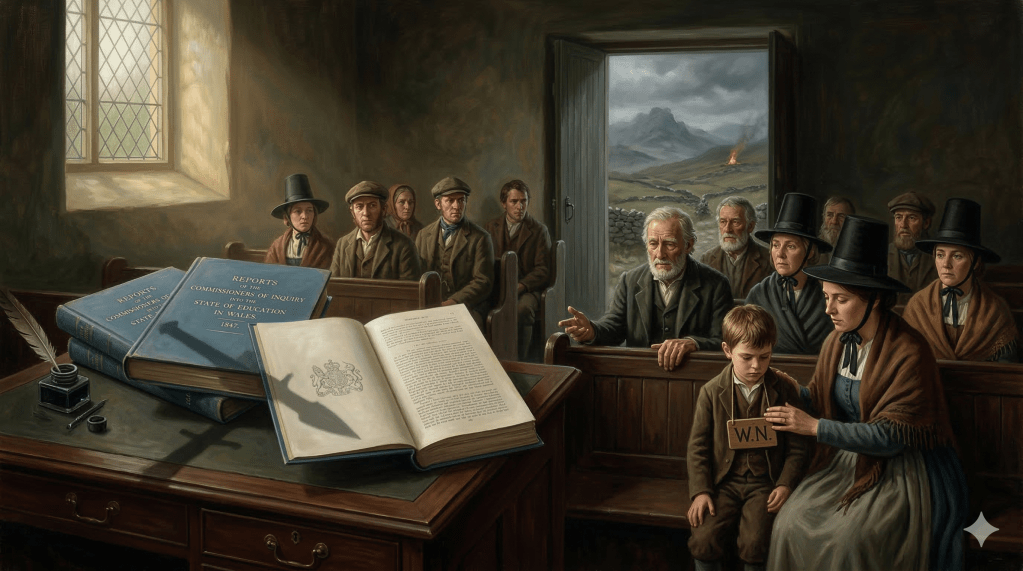
In 1847 three substantial parliamentary reports were laid before Westminster under the unromantic title Reports of the Commissioners of Inquiry into the State of Education in Wales. Their blue covers gave them their enduring popular name, the “Blue Books”, and their conclusions, or at least the spirit in which those conclusions were delivered, detonated across Welsh public life. They were not merely an investigation into schooling. They became a state-sanctioned moral verdict upon a people, their language, their religion, their domestic life, and their fitness to govern themselves.
And to grasp why this still matters, even for readers with no prior knowledge of Wales, one anchor fact is enough. Within little more than a century, a country that had been overwhelmingly Welsh-speaking became one in which Welsh was increasingly pushed to the margins, treated as a private inheritance rather than a public right. The shift was not caused by any single report, but the Blue Books helped to legitimise the notion that progress and Welshness were in tension.
The sharpest wounds are not always those inflicted upon land or law, but those inflicted upon confidence and imagination.
It is also important to note that the inquiry was not, in its origins, conceived as a simple act of English hostility toward Wales. The motion that triggered it was moved by William Williams, a Welshman and MP for Coventry, who appears to have believed that greater access to English would improve the prospects of the Welsh poor in a modernising economy. Yet the final reports did not read like a practical programme for social uplift. Contemporary reactions suggest that even Williams was taken aback by their contemptuous tone. The significance of this detail is not to soften the story, but to sharpen it. It shows how “good intentions” can be absorbed into a colonial mindset, where the language of opportunity becomes a language of deficiency, and where reform slips into moral verdict.
The Blue Books are often recalled as an insult, and they were that, but they also represent something more instructive and more enduring: an episode in psychological colonisation, the slow reshaping of a nation’s inner life, its standards of respectability, its sense of worth, and the language in which it is permitted to speak well of itself. The deepest injuries are not always the ones that can be measured in statutes. Some settle into the mind, and stay there for generations.
“Psychological colonisation, often dresses itself as parental love.”
Wales on the Eve of the Inquiry
The 1840s were years of economic distress, political agitation, and profound social strain across Britain. In Wales these pressures were intensified by rapid industrialisation in parts of the south, continued rural poverty in large areas, and the unsettled aftermath of protest movements, including the Rebecca disturbances. At the same time Wales remained a nation with a powerful internal culture, dominated in many districts by Nonconformist chapel life, an inherited oral tradition, and a Welsh language that was still the ordinary medium of home, community, and worship for a large proportion of the population.
To metropolitan eyes, this combination often looked like disorder. Nonconformity was easily interpreted as dissent rather than conscience, the Welsh language as an obstacle rather than a vehicle of culture, and the sheer distinctiveness of Wales as a kind of provincial stubbornness. The Blue Books emerged from this mental climate. They were framed as a neutral inquiry into education, but they were conducted in a political atmosphere that already associated social “improvement” with anglicisation.
What the Blue Books Actually Did
The commissioners were not Welsh, and they depended heavily on local informants who were often drawn from the Anglican clergy and English-speaking elites. That structural imbalance mattered. A nation was being examined largely through intermediaries whose worldview was not that of the majority population.
The reports did identify genuine problems. Wales in the mid nineteenth century had uneven provision of schools, teacher quality varied widely, and poverty and child labour constrained attendance. Literacy rates were improving but were not universal, and the educational landscape was fragmented among charitable, denominational, and private efforts. There was much to reform, and many Welsh people themselves knew it.
Yet what made the Blue Books infamous was not their discussion of schoolrooms, it was their sweeping moral and cultural commentary. The Welsh language was treated as a barrier to progress, not as an inheritance to be cultivated. Nonconformity was portrayed as socially destabilising. Welsh women, in particular, were subjected to insinuations about morality and domestic virtue that went far beyond anything a serious educational report should have ventured. The effect was to turn a question of educational provision into a judgement upon the character of Wales.
This is why the Welsh memory of 1847 is not simply one of insult. It is one of being spoken about, spoken over, and defined from outside.
The “Treason” and the Wound to National Self-Regard
Wales did not experience the Blue Books as a polite critique. They were received as a national humiliation, a public shaming. The phrase “Brad y Llyfrau Gleision”, the “Treachery of the Blue Books”, entered the cultural bloodstream because the reports were felt to be treacherous in two senses. First, they were perceived as hostile, unfair, and ignorant of Welsh realities. Second, they were seen as aided by local collaborators, those willing to supply condemnatory testimony about their own communities in order to please the centre, climb socially, or vindicate sectarian grievance.
It is tempting to treat this reaction as wounded pride. It was more serious than that. The reports threatened the legitimacy of Welsh language and Welsh religious culture at precisely the moment when ordinary people were striving for respectability in a modernising economy. When your nation is told, officially, that its everyday speech is a problem, and that its moral life is suspect, you do not merely feel anger. You begin to face a choice, to resist and be labelled backward, or to conform and hope for acceptance.
That is the psychological mechanism of colonisation. It is not always enforced by law. It is enforced by aspiration.
Psychological Colonisation, How the Mind is Reordered
Psychological colonisation works by altering the standards by which a people judge themselves. It creates an inner tribunal that speaks with the voice of the dominant culture. In the Welsh case, the Blue Books strengthened three corrosive propositions.
First, that Welshness needed translation into English to be respectable, not bilingual skill as enrichment, but English as a moral upgrade.
Second, that Welsh social life required supervision, that the chapel-based culture of community could not be trusted to cultivate virtue without external correction.
Third, that success meant leaving something behind, leaving an accent, leaving a language, leaving a set of manners and loyalties that were reclassified as provincial.
This was not invented in 1847, but the Blue Books legitimised it with parliamentary authority. They gave an existing prejudice the sheen of official knowledge. They made it easier for employers, officials, and educational reformers to treat Welsh as a deficiency, and easier for Welsh parents to fear that their children would be punished economically for remaining culturally Welsh.
Even the well-meaning desire to equip Welsh children for economic survival could be repurposed into a doctrine that treated Welshness itself as the problem.
One can see the long shadow in later educational practices, including the stigma attached to Welsh in some school settings, the pressure to “improve” speech, and the broader nineteenth and twentieth century association between Englishness and advancement. The point is not that Welsh people lacked agency, they had plenty. The point is that the social rewards were structured so that self-alteration looked like self-improvement.
“The dominant culture installs a judge inside the mind of the marginalised.”
The Complicated Welsh Response, Resistance and Accommodation
The story does not end with victimhood. Wales responded. The outrage of 1847 energised a cultural and educational awakening. The later growth of national institutions, the strengthening of eisteddfodic culture, the rise of Welsh-language publishing, and renewed efforts to improve schooling were shaped, in part, by the determination to refute the Blue Books’ contempt.
Yet resistance and accommodation often existed in the same person, even in the same household. A parent could resent the insult to Wales while still believing that their child must master English to avoid being trapped. A chapel community could defend its moral life while also adopting the Victorian language of respectability, discipline, and “improvement” that aligned, sometimes uncomfortably, with metropolitan judgement. This is how psychological colonisation embeds itself, not by erasing identity overnight, but by bending it, by forcing it to negotiate with shame.
It is also why simplistic narratives can mislead. The Blue Books did not single-handedly cause the decline of Welsh language use, nor did they create modern Wales out of nothing. Economic shifts, migration, industrialisation, state schooling, and labour mobility all mattered enormously. The Blue Books were a symbolic accelerant and a moral permission structure, one that helped normalise the idea that Welshness was something to outgrow.
The Gendered Dimension, A Targeted Humiliation
One of the most damaging aspects of the reports was the way they spoke about Welsh women. In Victorian Britain, female respectability was treated as a measure of the moral health of an entire community. To impugn women was to impugn the nation at its supposed moral core.
Here the psychological effect was doubly sharp. A people already anxious about economic change and social standing were told that their mothers and daughters were morally suspect, and that their domestic culture was inadequate. The insult was intimate. It entered the home, and that is precisely how psychological colonisation functions, it makes public power felt in private life.
It also reinforced a particular form of cultural hierarchy, the idea that Welsh-speaking rural and working communities were not merely poor, but improper. Poverty can be fought, but impropriety must be corrected, often by adopting the manners, language, and social norms of those who claim authority to judge.
Education as a Battlefield of Identity
Education is never neutral. It is a means by which a society reproduces itself, its language, its values, its sense of what is admirable. In Wales, the nineteenth century saw education become a contested space in which competing visions of the nation’s future were played out.
The Blue Books pushed one vision, Wales made governable and “improvable” through English-language schooling and a moral framework aligned with Anglican and metropolitan standards. Welsh communities, including many Nonconformists, pushed another, education as uplift without cultural erasure, literacy without contempt for the mother tongue, progress without surrender.
The tragedy is that the state’s model carried the greatest institutional weight. When school inspection regimes, examinations, and employment opportunities reward one language and marginalise another, the psychological lesson is learned quickly. Children are pragmatic. Parents are pragmatic. Communities become bilingual under pressure, then often become monolingual in the language of power, not necessarily because they despise themselves, but because they want their children to live.
And that is the most painful truth about psychological colonisation, it often dresses itself as parental love.
The Long Shadow, and the Modern Parallel
The Blue Books matter now because they remind us that contempt can be bureaucratised. A people can be damaged not only by laws, but by narratives, especially when those narratives are clothed in expertise. They remind us, too, that reform without respect is never neutral. When improvement is offered as a bargain that requires self-abandonment, it is not improvement. It is assimilation, presented as virtue.
The modern parallel is not that Wales is being openly denounced in parliamentary prose, but that the old habits still surface in more “reasonable” forms. You can still hear a reflexive suspicion toward Welsh language provision, as if it is an indulgence rather than infrastructure. You can still detect the insinuation that Welsh identity is a private sentiment, and that public life should default to the norms of the centre. You can still see how “efficiency”, “modernisation”, and “standards” are sometimes invoked in ways that subtly position Welsh distinctiveness as a complication to be managed.
This is the quieter afterlife of 1847. Not persecution, but permission. Permission to treat Welsh as optional, and to treat anglicisation as common sense.
What 1847 Still Teaches Us
If Wales is to read the Blue Books with maturity, it must do so without nostalgia and without self-hatred. It must recognise both the injustice and the agency, the insult and the response, the pressure and the creativity. Above all, it must insist on the simple principle that a nation’s language and culture are not obstacles to progress, they are part of what progress ought to serve.
Because the deepest victory of psychological colonisation is achieved when the colonised begin to believe that their inheritance is a burden. The task, then as now, is not merely to defend Wales against external contempt, but to refuse the inner voice that repeats it.
