
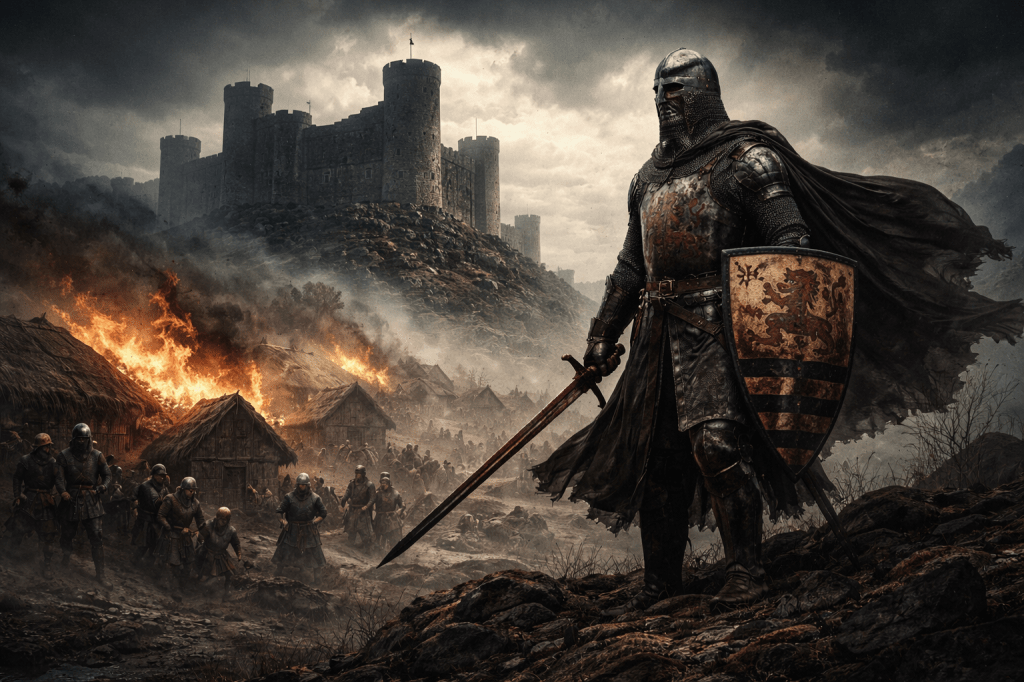
There is a particular kind of violence that flourishes on borders.
Not the open violence of battlefield armies, marching under banners and accountable, at least in theory, to a crown or parliament. But the private violence of semi-autonomous men, installed at the edge of a realm, given licence to do what the centre cannot openly do, and then quietly indulged for it.
In medieval Wales, and along the Anglo-Welsh frontier, this violence took a recognisable form. It had names, coats of arms, charters, and stone castles. It had legal privileges. It had private courts, private armies, private prisons, and private gallows. It had the cold, systematic logic of power without oversight.
We call its architects the Marcher Lords.
They are often remembered as colourful figures of feudal romance, castle-builders, border barons, the hard men of the Norman conquest. But that memory is too soft. It flatters the conqueror. It obscures the machinery. The Marcher Lords were not merely noblemen on the frontier. They were, in effect, state-sponsored warlords, the delegated enforcers of a conquest the English crown wanted, but did not always want to be seen doing.
And for roughly two centuries, that bargain came with a price, kings often found themselves managing, and at times genuinely fearing, the monsters they had created on the border.
If you want to understand how brutality becomes policy, how private violence becomes “law and order”, and how a border becomes a laboratory for cruelty, you start with the March.
A Border That Was Not a Line, But a System
The first point to grasp is that the Welsh Marches were not a tidy boundary. They were a zone.
A shifting, contested, militarised frontier, stretching from the Dee to the Severn and down to the Wye, where English authority and Welsh resistance pressed against one another, and where neither side could ever fully relax. This was not simply “England” meeting “Wales”. It was a region with its own culture of coercion, its own political logic, and its own habit of violence.
The Norman conquest of England in 1066 did not automatically produce a conquest of Wales. Wales was not taken in one stroke. It was bitten into, gradually, aggressively, opportunistically. The Marcher Lords were the teeth.
And crucially, the English crown did not always have the administrative capacity, or the political appetite, to govern Wales directly. What it did have was a pool of ambitious, land-hungry, militarised aristocrats, who could be unleashed on the frontier in exchange for territory and extraordinary privileges.
The Marcher settlement was, in effect, outsourcing.
The Crown’s Dirty Work, Privatised
The Marcher Lords were granted powers that were exceptional even by medieval standards.
They could build castles without royal permission. They could establish boroughs. They could hold courts. They could execute criminals. They could wage war. They could negotiate with Welsh princes. They could impose their own customs. Many could treat their lordships as virtually sovereign.
This is why the March was so dangerous.
Because the Marcher Lord was not simply a local magnate. He was a man authorised to use violence as a tool of state expansion, but without the normal constraints of the state. His power was justified by a permanent emergency, the frontier condition, the supposed unruliness of the Welsh, the necessity of force.
And once a man is told he may do anything because the border is “unstable”, the border will never be stable.
The instability becomes profitable.
It also becomes politically convenient for the centre. When a Marcher lord razed a settlement, took hostages, or pushed the frontier forward, the crown gained territory and leverage, while retaining a measure of distance, a way of saying, in effect, that was the frontier doing frontier things. But this convenience had a dark symmetry, the crown was empowering men who were not easily controlled, and who could just as readily turn their autonomy into private feuds, local tyranny, and ultimately a threat to the king’s own authority.
Castles Were Not Symbols, They Were Machines
We romanticise castles.
We talk about their silhouettes, their towers, their picturesque ruins. We photograph them in the golden hour and call them heritage. But Marcher castles were not built for beauty. They were built to dominate.
A Marcher castle was a machine for coercion.
It controlled roads, river crossings, and valleys. It anchored new towns, often planted deliberately as English enclaves. It provided a base for raiding. It stored supplies. It housed garrisons. It served as a visible statement to the local population that a new order had arrived, and that resistance would be punished.
The Marcher landscape became studded with these fortresses, not as passive architecture, but as active infrastructure. Each castle was a node in a system. Each was a threat made of stone.
And the threat was not theoretical.
“Brutality as Policy”, and the Shock of Abergavenny
It is one thing to speak abstractly about terror. It is another to name what it looked like.
In 1175, at Abergavenny, William de Braose, a Marcher lord whose name became synonymous with calculated ruthlessness, invited Welsh leaders to a feast, and had them killed. It is remembered as the Massacre of Abergavenny, and it endures precisely because it captures the Marcher method in miniature, hospitality turned into a weapon, the ritual of peace converted into theatre, and the message sent outward to the wider landscape, no custom is binding when conquest is the aim.
This is what “border brutality” means in practice.
Not merely the violence of open war, but the violence that corrodes the rules which make any society liveable, trust, oath, safe conduct, and the basic expectation that a meeting under truce is not a trap. The Marcher lordships were not simply militarised, they were experiments in unaccountable power, and when unaccountable power is anxious, it tends to become exemplary, punitive, and performative.
It is not accidental that families like the de Braose become so useful to the crown and so feared by their neighbours. The March rewarded those who could act quickly, strike hard, and cultivate reputations that did some of the conquering work for them.
Private War as a Way of Life
One of the most revealing aspects of Marcher rule is that warfare was not always episodic. It was structural.
Raiding, counter-raiding, cattle theft, hostage-taking, punitive expeditions, and the burning of settlements were not merely wartime practices. They were part of the border economy. They were how power was maintained. They were how reputations were built.
This was not a frontier of gentlemen.
It was a frontier of men whose legitimacy depended on their capacity for violence.
The Marcher Lords lived in a world where to be seen as weak was to invite destruction. Their households were militarised. Their retinues were armed. Their alliances were fluid. Their feuds were long.
And their victims were often not soldiers.
They were farmers. Tenants. Women and children. The poor, who could not retreat behind walls.
In such a system, brutality is not a regrettable side effect. It is a strategy.
Law in the March, Power Dressed as Justice
The Marcher Lords did not only conquer by force. They conquered by law.
Or rather, by something that looked like law.
In the March, legal authority was not neutral. It was part of the conquest. Marcher courts enforced the lord’s interests. They regulated landholding. They punished Welsh customs when convenient. They privileged English settlers. They extracted fines. They asserted the lord’s right to decide who belonged, and who did not.
This is one of the most underappreciated truths of the medieval frontier.
Violence and legality were not opposites. They were partners.
The Marcher Lord did not simply burn your home. He could also dispossess you in court, and call it order.
He could create a legal framework in which the conquered were permanently vulnerable.
And he could do it while claiming that he was bringing civilisation.
The Myth of the “Unruly Welsh”, and the Name They Never Liked to Mention
Every empire needs a story about why it is violent.
The Marcher story was that the Welsh were naturally rebellious, lawless, and incapable of stable government. Therefore, extraordinary measures were necessary. Therefore, harsh rule was justified. Therefore, the Marcher Lord’s privileges were not an indulgence, but a burden.
This is a familiar pattern.
It is the rhetoric of colonialism long before the age of overseas empires. It is the moral laundering of conquest. It is the claim that brutality is defensive, that dispossession is reform, that domination is protection.
But the historical reality is that Welsh political society was sophisticated, and Welsh law, though different, was coherent. Indeed, it had a codified tradition associated, in popular memory and in real legal culture alike, with Hywel Dda, the great Welsh law-maker, whose name stands precisely for the idea that Wales possessed not chaos, but order, not mere custom, but jurisprudence.
The “unruliness” of Wales was, in large part, the natural response of a people resisting conquest.
The Marcher Lords did not discover chaos.
They helped create it, and then used it to justify their existence.
The Mortimers, When a Marcher Dynasty Became a Parallel State
If the Marcher Lords were an expedient, the Mortimers were the moment the expedient began to look like a rival.
Rooted at Wigmore, enriched by Marcher estates and alliances, and hardened by the frontier’s permanent state of readiness, the Mortimers grew into more than local strongmen. They became a dynastic power with reach, wealth, armed capacity, and a political imagination that did not stop at the border.
By the early fourteenth century, Roger Mortimer, 1st Earl of March, had become so formidable that he could help lead revolt against Edward II, escape imprisonment, return at the head of a successful invasion with Queen Isabella, and for a short period act as the de facto ruler of England itself, until the crown struck back and destroyed him.
That arc is the Marcher system’s secret written in capital letters.
Outsource coercion long enough, and you do not merely brutalise the frontier, you breed men who learn to treat the state itself as negotiable.
A Frontier Culture of Cruelty
Borders do something to people.
They harden them. They encourage paranoia. They reward aggression. They cultivate a sense that ordinary moral rules do not apply. They produce a culture in which violence is normalised, and mercy is treated as weakness.
The Marcher Lords were shaped by this environment, but they also shaped it in return. Over time, the March developed its own identity, distinct from both England and Wales, a hybrid region where loyalty was transactional and where power was always contested.
It is no accident that the March produced families who could be both kingmakers and kingbreakers, both defenders of the realm and threats to it.
When you create a class of semi-independent warlords, you do not only unleash them on your enemies.
You also unleash them on yourself.
The Marcher Lords as a Warning, Not a Curiosity
The Marcher system is often treated as an archaic footnote, a medieval peculiarity, something confined to the age of castles and chainmail.
That is a mistake.
Because the logic of the Marcher Lord is not medieval. It is perennial.
It is the logic of outsourcing violence to people who can do what the state cannot do openly. It is the logic of granting extraordinary powers to men on the frontier, and then pretending that those powers will not be abused. It is the logic of permanent emergency, where the border is always unstable, and therefore anything is permissible.
The Marcher Lords were the crown’s plausible deniability in armour.
(If you use Substack’s Pull Quote feature, make it that line. It summarises the entire argument in nine words.)
The End of Marcher Autonomy, and the Afterlife of Its Mindset
By the sixteenth century, the Marcher system had become intolerable, even to the English crown.
Not because it was unjust, but because it was disorderly.
The very autonomy that made the Marcher Lords effective conquerors also made them dangerous. Their private wars disrupted trade. Their feuds destabilised governance. Their courts competed with royal authority. Their power was too entrenched, too personal, too uncontrollable.
The Laws in Wales Acts of 1535 and 1542 were part of the attempt to end this frontier exceptionalism, to bring Wales into a single legal and administrative system, and to dismantle the Marcher Lordships.
The irony is sharp.
Wales was formally integrated into the English state partly to restrain the English warlords who had been unleashed to conquer it.
Yet the end of Marcher autonomy did not end the deeper legacy.
Because the mindset remained.
The idea that Wales was a place to be managed, disciplined, improved, anglicised. The idea that Welsh law and culture were inferior. The idea that Welsh identity was a problem. The idea that order required control from the centre.
These ideas did not die with the Marcher Lords. They simply changed clothes.
Why This Still Matters
There is a temptation, especially in Britain, to treat conquest as something that happened elsewhere.
To imagine colonialism as a story of India, Africa, the Caribbean, and to forget that the British state learned its habits at home first. The Marcher Lords are part of that domestic apprenticeship in domination.
They show us how conquest is normalised.
How brutality is bureaucratised.
How a border becomes a testing ground for power.
How legal exceptionalism is used to justify cruelty.
How a ruling class convinces itself that it is civilising while it is dispossessing.
And perhaps most importantly, they show us how quickly the state will tolerate lawlessness, provided it is the right kind of lawlessness, committed by the right people, against the right targets.
The Marcher Lords were not a medieval oddity.
They were a prototype.
Conclusion, The Border as a Mirror
If you want to understand the Anglo-Welsh relationship, you do not only look at treaties and parliaments.
You look at the March.
You look at the private warlords, the castle-builders, the men who operated between legality and violence, and who made the border their personal empire.
The Marcher Lords did not merely occupy territory.
They shaped a political culture.
They created a frontier tradition in which brutality was not an accident, but a method. In which law was not a shield, but a weapon. In which power was personal, militarised, and often unaccountable.
And that is why they still matter.
Because every society has its March.
Every state has its frontier where it is tempted to suspend its principles.
And every age produces its own Marcher Lords, men who thrive when the rules are blurred, when oversight is weak, and when violence can be justified as necessity.
The medieval Welsh border is not just history.
It is a warning.
