
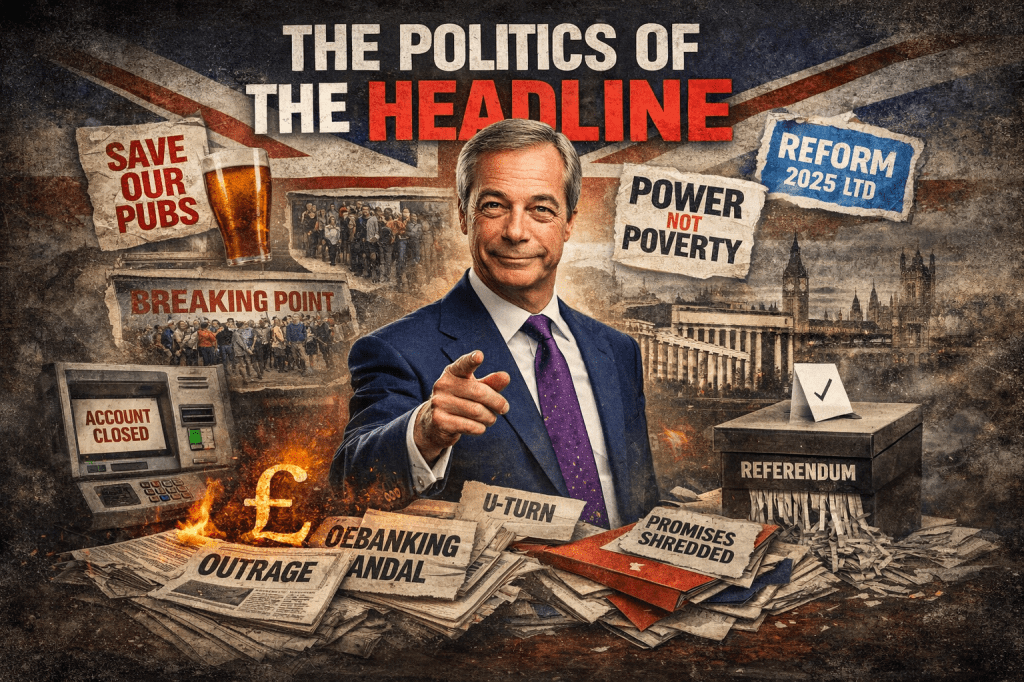
Nigel Farage’s most reliable talent is not governing, nor even organising, it is sensing the national temperature and turning it into a slogan before anyone else. He is a political mood-board, not a builder. He does not cultivate institutions, he cultivates moments. He does not carry arguments through to delivery, he carries them to the point of maximum attention, then he pivots.
That is the essence of his shallowness. Not a lack of intelligence, but a lack of depth, patience, and ownership. A serious political figure treats campaigns as commitments. Farage treats them as content.
HE DOES NOT BUILD INSTITUTIONS, HE BUILDS MOMENTS.
The recurring pattern is simple. First, find a live anxiety, cost of living, distrust of elites, cultural disorientation, a sense of national decline. Second, attach a line that flatters the public’s frustration and frames him as the lone truth-teller. Third, stage a “campaign”, often as a media event first and a policy programme second. Finally, when complexity intrudes, when it demands numbers, structures, legislation, and stamina, move on.
What remains is theatre, and a public trained to confuse heat for substance.
Power Not Poverty, a campaign built for headlines
In 2022 Farage launched “Vote Power Not Poverty”, presented as a major drive for a referendum on net zero. The subject matter, energy costs and the burdens of transition, is real enough. The method is the tell.
Almost immediately, the campaign’s most visible moment became its absence. Its planned Bolton launch event was cancelled, with organisers citing “abuse, threats and intimidation”. A durable movement survives a cancelled rally and persists through local structure, policy detail, and measurable goals. A headline movement tends to fade when the showpiece collapses, because the showpiece was the product.
(See Sources 1–2.)
WHEN THE LAUNCH IS THE PRODUCT, A CANCELLED LAUNCH IS NOT A SETBACK, IT IS THE END OF THE STORY.
Britain Means Business, the disposable wrapper, and the structure that makes it possible
The net zero push did not simply appear as “Power Not Poverty”. It sat within a branded vehicle, “Britain Means Business”, associated with Farage and Richard Tice, which served as the organisational wrapper for the “referendum on net zero” burst.
(See Sources 3–4.)
This matters because it exposes something structural. These vehicles often lack what traditional parties, at their best, must possess, membership that can vote, committees that can argue, local branches that can resist the leader’s whims, minutes, procedures, and accountability mechanisms. They are not built as democratic communities. They are built as campaign shells.
And in the background sits the same organisational thinness elsewhere too. Reform has operated through corporate vehicles rather than the classic membership party model, and in February 2025 Farage announced that the party’s control had been transferred into a new entity, Reform 2025 Ltd, described as a non profit body limited by guarantee, with no shareholders. Yet reporting at the time also questioned how far this “democratisation” translated into meaningful member power in practice.
(See Sources 5–6.)
That is why the wrappers are disposable. When the vehicle is not rooted in a membership culture with internal democracy, it can be dropped, rebranded, or quietly abandoned without any formal reckoning. The grievance remains, the label changes, and the audience is carried forward by emotion, not by structure.
NO MEMBERSHIP INFRASTRUCTURE, NO INTERNAL DEMOCRACY CULTURE, NO CONSEQUENCES. THAT IS WHY THE WRAPPERS ARE DISPOSABLE.
Anti-lockdown Reform, a “new mission” that quietly receded
The same pattern is visible in the late 2020 rebrand of the Brexit Party into Reform UK, pitched explicitly as an anti-lockdown voice. It was presented as a pivot to a new, urgent national cause, with Farage again cast as tribune against establishment coercion.
(See Source 7.)
Then the political weather changed. The centre of gravity moved on to other themes, and the anti-lockdown posture receded, not through a serious reckoning with its claims, not through sustained programme-building, but through simple replacement.
This is how he bridges the gaps. The subject changes, but the spine of the story does not. Whatever the topic, the through-line is always the same, “The Elite vs You”. It keeps the audience intact while the headline changes. It allows the movement to shift without ever admitting it has shifted.
Debanking, a personal dispute inflated into a national crusade, then recycled
Then came “debanking”. Farage’s dispute with Coutts and NatWest was transmuted into a populist morality play about elite censorship and institutional power. It had real-world consequences, including government proposals to require notice and explanation before accounts are closed, framed explicitly in response to the political heat the dispute generated.
(See Sources 8–9.)
Supporters point to this and say, “Look, he gets things done.” But the Farage method is still on display. First, the drama is perfectly designed for self-centering, Farage as victim, Farage as spokesperson for “the people”, Farage as proof that the system punishes dissent. Second, the policy complexity remains hazy, because the point is the emotional narrative, not the granular architecture of regulation. Third, once peak attention passes, the story becomes portable, something to be invoked whenever a fresh grievance needs credibility.
The dispute itself was later settled confidentially, with NatWest apologising, the terms undisclosed. Yet even after settlement, the episode remains politically useful as a reusable grievance narrative.
(See Source 10.)
DEBANKING BECAME LESS A POLICY QUESTION THAN A RENEWABLE FUEL SOURCE FOR OUTRAGE.
The shock tactic model, Breaking Point, maximum heat, minimum ownership
Opportunism is not only about abandoned policy banners, it is also about disposable outrages.
Farage’s 2016 “Breaking Point” poster was a deliberate provocation. It generated instant controversy, and was reported to police.
(See Source 11.)
Crucially, Farage later described it as only the campaign’s message for “one day”, before other adverts were used. That is headline politics at its purest. Maximum heat now, minimum long-term ownership later.
(See Source 12.)
But here is the sharper point. Even if the poster was “for one day”, the image lived on for years. It entered the political bloodstream, it became a reference point, a shorthand, a scar. This is the residue problem. The instigator can declare the stunt finished, while the country is left living with the cultural after-effects. The asymmetry is the whole trick, the provocateur moves on, the public carries the image.
If your message is “for one day”, it is not a sustained argument, it is a weaponised moment, and the clean-up is left to everyone else.
IF YOUR MESSAGE IS “FOR ONE DAY”, YOU ARE NOT PERSUADING, YOU ARE DETONATING.
Grand promises become “aspirations”, the escape hatch word
A serious leader guards credibility by treating pledges as binding. An opportunist treats pledges as marketing.
In late 2025 Farage retreated from Reform UK’s election-era promise to cut £90bn of taxes, reframing it as an “aspiration”. That single word is the escape hatch. It means the pledge did its job at the time and can now be softened without admission of failure, because the entire enterprise is built to move on before the public demands receipts.
(See Sources 13–14.)
Save Our Pubs, live, and perfectly designed for the headline
Now, in February 2026, comes “Save Our Pubs”, launched as a “fiscally neutral” plan to rescue hospitality, complete with a promise of a 5p reduction on a pint and a suite of tax changes framed as a defence of community life.
(See Sources 15–16.)
And here the content-first instinct is almost too neat. Reporting notes that the plan’s claimed funding route is to reinstate the two child benefit cap, effectively trading a complex, high-stakes social policy about child poverty for a pint-sized headline about beer prices and pub nostalgia.
(See Source 16.)
That is the Farage method in miniature. Present a popular symbol, pubs, pints, community. Bolt it to a funding mechanism designed to polarise and mobilise. Announce it as “neutral” and “common sense”. Let the argument burn hot, then move on when the numbers, the ethics, and the second-order consequences demand serious scrutiny.
IT IS ALWAYS EASIER TO SELL A SYMBOL THAN TO GOVERN A CONSEQUENCE.
The “catalyst” defence, and why impact is not responsibility
At this point the strongest defence appears, the Farage supporter’s argument that he is not meant to be a builder at all. He is a catalyst. He forces the “legacy parties” to move, he drags taboos into daylight, he makes institutions respond. Brexit, they will say. Debanking rules, they will say. He does not need branches and committees if his job is to shift the terms of debate.
There is truth in the claim of impact. But impact is not responsibility.
A catalyst can start a reaction without taking responsibility for the outcome. A catalyst can create motion without owning where it ends. And when politics is reduced to catalytic provocations, the country pays the price, because someone still has to govern the consequences, stitch up the ruptures, fund the promises, carry the institutional risk, and answer for the harm when slogans turn out to be shortcuts.
IMPACT IS NOT THE SAME AS RESPONSIBILITY.
Conclusion, a performer, not a steward
None of this requires a conspiracy. The pattern is visible in the open.
Farage launches with fanfare, “Power Not Poverty”, the Britain Means Business net zero push, the anti-lockdown Reform rebrand, “debanking”, “Save Our Pubs”, punctuates his career with shock tactics like “Breaking Point”, and when the bill comes due, in detail, in delivery, in consistency, he steps sideways and changes the subject.
That is opportunism. A politics of surfaces. A permanent audition for relevance.
The final test is the simplest. When the slogan has faded, what remains, in institutions, in legislation, in measurable outcomes?
And one further question, because it goes to the heart of why this works at all. Have the established parties become so hollowed out, so managerial, so frightened of conviction, that they have made headline politics not only possible, but inevitable?
Sources / footnotes (links)
- Vote Power Not Poverty, “Bolton Event Cancelled” (statement citing “abuse, threats and intimidation”)
https://votepowernotpoverty.uk/bolton-event-cancelled/ - The Independent, “Nigel Farage’s new group cancels Bolton rally” (21 March 2022)
https://www.independent.co.uk/climate-change/news/nigel-farage-net-zero-campaign-cancelled-bolton-b2040369.html - Carbon Pulse, “Brexit architect Farage launches campaign to ditch UK’s net zero target” (7 March 2022)
https://carbon-pulse.com/152919/ - BusinessGreen, analysis noting the campaign run by Farage’s Britain Means Business group (7 March 2022)
https://www.businessgreen.com/news-analysis/4046088/reasons-net-zero-referendum-terrible-idea - Reuters, “Nigel Farage gives up ownership of Reform UK to make party more democratic” (20 February 2025)
https://www.reuters.com/world/uk/nigel-farage-gives-up-control-reform-uk-make-party-more-democratic-2025-02-20/ - The Guardian, “Not-for-profit appears to own Reform UK despite Farage’s ‘democratisation’ pledge” (20 February 2025)
https://www.theguardian.com/politics/2025/feb/20/not-for-profit-appears-to-own-reform-uk-nigel-farage - The Guardian, “Reform UK: Brexit party to rebrand as anti-lockdown voice” (2 November 2020)
https://www.theguardian.com/politics/2020/nov/02/reform-uk-brexit-party-to-rebrand-as-anti-lockdown-voice - Reuters, “Britain proposes ‘debanking’ law after NatWest debacle” (14 March 2024)
https://www.reuters.com/business/finance/britain-proposes-debanking-law-after-natwest-debacle-2024-03-14/ - City A.M., “Government proposes ‘debanking’ law after Farage NatWest row” (14 March 2024)
https://www.cityam.com/government-proposes-debanking-law-after-farage-natwest-row-and-surge-in-complaints/ - Reuters, “Brexit campaigner Nigel Farage and NatWest settle ‘debanking’ dispute” (26 March 2025)
https://www.reuters.com/business/finance/nigel-farage-natwest-settle-debanking-dispute-2025-03-26/ - The Guardian, “Nigel Farage’s anti-migrant poster reported to police” (16 June 2016)
https://www.theguardian.com/politics/2016/jun/16/nigel-farage-defends-ukip-breaking-point-poster-queue-of-migrants - Wikipedia, “Breaking Point (UKIP poster)” (summary including Farage’s “one day” remark, with embedded citations)
https://en.wikipedia.org/wiki/Breaking_Point_(UKIP_poster) - The Guardian, “Nigel Farage backtracks on Reform UK’s promise to cut £90bn of taxes” (3 November 2025)
https://www.theguardian.com/politics/2025/nov/03/nigel-farage-backtracks-reform-uk-promise-cut-90bn-taxes - PoliticsHome, “Nigel Farage abandons Reform UK’s promise to cut taxes” (3 November 2025)
https://www.politicshome.com/news/article/nigel-farage-abandons-reform-uks-promise-cut-taxes - Reform UK, social post announcing “plan to save Britain’s pubs”, including 5p pint claim and duty cut framing (3 February 2026)
https://www.facebook.com/61576658961977/posts/this-afternoon-we-launched-our-plan-to-save-britains-pubs-by-reinvesting-3bn-in-/122158571174888632/ - The Big Issue, “Farage puts pints over poverty…” (3 February 2026)
https://www.bigissue.com/news/politics/nigel-farage-beer-prices-two-child-benefit-limit/
