
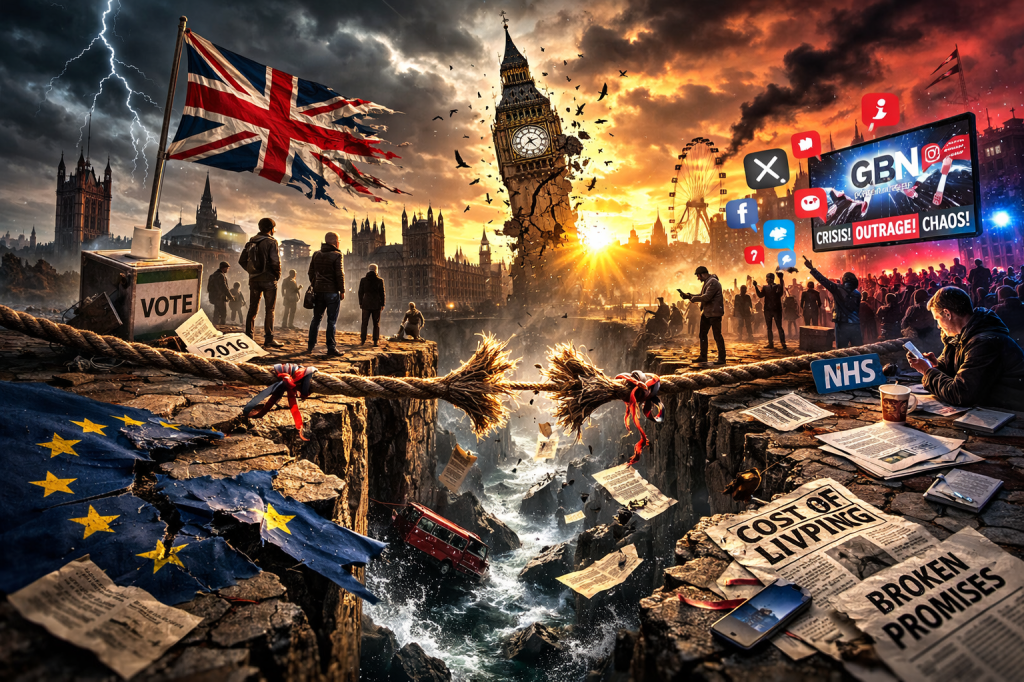
Brexit, whatever your vote, did real damage to trust.
Not simply because it divided the country, but because it exposed something more corrosive than disagreement, a political system that struggled to hear its own people, then proved unable to manage the consequences of the decision it had itself offered.
Millions felt unheard before the referendum, millions felt unheard afterwards, then we compounded the fracture with ill suited leaders, a Westminster culture that often feels sealed off from the public, and a media environment that fills the quieter moments with manufactured drama and permanent outrage. (source 2) (source 6)
When politics becomes a bubble, instability is not a scandal.
It is the predictable outcome.
1. Brexit Was Not Just a Vote, It Was a Verdict
The 2016 referendum is often treated as a single moment, a binary decision, a democratic instruction, but for many voters it was not an instruction at all. It was a verdict.
The result itself is not in dispute. It is recorded, official, and historically decisive. (source 1)
Brexit cannot be reduced to technical arguments about trade or regulation. It was also a cultural event, a rebellion against distance, and against the suspicion that Westminster, and much of the professional class around it, had stopped speaking the same language as the public.
The referendum did not resolve the underlying causes of distrust. It revealed them, then placed them under pressure. (source 2)
2. “Unheard” Became a Permanent Political Identity
The most damaging legacy of Brexit is not withdrawal itself. It is the normalisation of the feeling of being unheard. (source 2)
A large section of the electorate came to believe that democratic participation was only respected when it aligned with elite preferences. Many Remain voters, meanwhile, came to believe that complex realities were being bulldozed by slogans, and that the country was drifting into a politics of mood rather than judgement.
Both sides emerged with a story of betrayal.
That is the key point. Brexit did not create one wounded constituency. It created two.
And when you have two large groups of citizens, each convinced the system has failed them, you have a society primed for permanent volatility, because mistrust becomes political identity rather than civic glue. (source 2)
This is how trust collapses. Not in one dramatic event, but in the slow accumulation of grievance, cynicism, and mutual disbelief.
3. The Leadership Chain That Turned a Shock into a Crisis
Brexit demanded emotional intelligence, administrative competence, constitutional sensitivity, and a willingness to speak plainly.
Instead, Britain cycled through leaders who were either ill suited to the moment, or unable to command the seriousness required, and each failure reinforced the public suspicion that the system was not merely divided. It was unserious. (source 3)
David Cameron: The Unforgivable Abdication
David Cameron called the referendum, lost it, then ran away from the consequences.
That decision is still not fully reckoned with. It was not simply a resignation. It was an abdication of responsibility at precisely the moment the country needed stability, reassurance, and long term political management. (source 4)
Cameron’s departure created a vacuum. Brexit was a constitutional earthquake, and the Prime Minister who triggered it left the scene before the dust had even settled.
Theresa May: Paralysis and the Collapse of Authority
Theresa May inherited an impossible task. But she also approached it with a fatal weakness. She tried to manage Brexit as a closed process.
Her premiership became defined by paralysis, internal party warfare, and repeated defeats. She could not command Parliament, could not unify the country, and could not create a settlement that felt legitimate. (source 4)
For the public, this was devastating. It confirmed the suspicion that the political class did not know what it was doing, or could not deliver what it promised. (source 2)
Boris Johnson: The Populist Who Won, Then Failed to Govern
Boris Johnson was, in essence, a populist communicator. In the specific context of 2019, against Jeremy Corbyn, he was electorally inevitable.
But the problem with Johnson was never winning. It was governing.
His administration repeatedly privileged loyalty, messaging discipline, and internal theatre over institutional competence, and the consequence was a style of government that looked louder than it was capable. (source 3)
The inevitable happened. Government became a machine for slogans rather than administration, and public trust was drained further. (source 2)
Liz Truss: The Disaster, Then the Alibi
Then came Liz Truss.
Her premiership was not simply short. It was economically destabilising and politically catastrophic, and the subsequent tendency to frame failure as institutional obstruction is not an explanation, it is an alibi structure, and it corrodes accountability by implying that failure is always someone else’s sabotage. (source 3)
Rishi Sunak: Well Meaning, Not a True Leader
Rishi Sunak brought a measure of managerial calm after chaos. But calm is not leadership in an age of democratic fragility.
He never rebuilt trust. He administered a system already bleeding legitimacy, and his premiership did not restore seriousness so much as pause the freefall. (source 3)
Sir Keir Starmer: Authority, Legibility, and the Trust Gap
Now Britain has Sir Keir Starmer.
The question is not whether he is competent. It is whether he projects authority that feels legible to the public, and whether his government looks like it understands the emotional shape of low trust politics.
So far, Starmer has struggled to project steadiness. His early reversals have reinforced the impression of a government that is reactive rather than confident. (source 5) (source 7)
A recent example is the attempted postponement of local elections in 30 councils, followed by a reversal, with Starmer defending what was widely described as a U turn and insisting the approach had been “locally led”. (source 5) The technicalities may be arguable, but the political effect is predictable. It reinforces the sense that decisions are made inside the machine, then justified afterwards.
This is precisely where legalistic competence fails to bridge the trust gap. Trust is not rebuilt by being defensible. It is rebuilt by being legible, consistent, and plainly connected to the public’s priorities.
4. Westminster Culture: A Closed Loop Masquerading as Politics
The deeper problem is that Westminster increasingly operates as a closed loop.
It is a world of briefing, manoeuvre, factional intrigue, and media management. It rewards those who master its internal rituals, not those who build public confidence.
Brexit should have forced humility. Instead, it intensified the bubble, and the public were treated less as citizens to be persuaded, more as problems to be managed. (source 2)
This is one reason politics now feels like theatre, and why the public so often describe the system as detached from ordinary life.
When a country stops believing its leaders are serious, it begins looking elsewhere.
Not always to better places.
5. The Media: Manufactured Drama, and the Collapse of Authority
The media ecosystem has not helped the rebuilding of trust.
Not all journalists, not all outlets, and not all reporting, but the wider environment increasingly fills quieter moments with manufactured drama and permanent outrage. Conflict as content. Drama as a business model. (source 6)
The incentive structure is not simply moral failure. It is commercial pressure, and the commercial pressure has intensified. (source 8)
When the public are fed a constant diet of scandal, outrage, and personality warfare, they do not become better informed. They become exhausted, cynical, and detached. (source 6)
The Decline of Mainstream Media
Over the last decade the mainstream media has also gone into visible decline, in reach, revenue, and cultural authority, and that decline has restructured the entire information environment in which politics now operates. (source 8)
The BBC remains the country’s central public service broadcaster, but it is under constant political pressure and financial strain, with recent reporting indicating the BBC is preparing for cuts of up to £600m over the next three years. (source 9) (source 10)
There is a grim irony here that practically writes its own satire. Britain complains, rightly, about misinformation, conspiracy, and the fragmentation of truth, then responds by carving hundreds of millions out of the one institution designed to provide a shared evidential baseline. (source 9) (source 6)
The newspapers, once the daily bloodstream of British politics, have suffered long term circulation collapse, while the wider journalism economy has struggled to replace print advertising with sustainable digital income, leaving fewer reporters, thinner local coverage, and more empty space for outrage to fill. (source 8)
In that vacuum, highly polarised niche outlets can claim striking audience milestones that would once have looked marginal, because the audience is no longer gathered in one place. It is sliced into segments, and those segments can be intensely loyal. GB News is the clearest illustration, with trade reporting citing BARB comparisons that show it matching or overtaking legacy competitors at certain times and by certain measures. (source 11)
Many people now get a significant share of their news via social platforms and other digital channels, including via personalities rather than institutions, and that shift is not a minor lifestyle change. It is a power shift. (source 6)
A large part of Westminster still appears not to have grasped the consequence. The public do not experience politics as the bubble experiences it. They experience it through what reaches them on their phone, through local consequences, and through the pressure points of daily life. (source 6)
That is why the average person is often far more concerned with what directly affects their family. GP access. NHS waiting lists. Public transport. Inflation. Energy bills. (source 12) These are not niche concerns. They are the public’s own stated priorities.
By contrast, many issues that dominate elite conversation struggle to compete for attention, not because people are indifferent to the wider world, but because attention is finite, and daily pressures are immediate. (source 12)
It is not ignorance. It is rational prioritisation.
6. The Rise of Reform UK, and the Recycling of Populism
This instability has not remained politically neutral. It has given credit and rise to other parties and movements, notably Reform UK and Nigel Farage. (source 13)
Farage benefits from the collapse of trust in the old order. But what many people still fail to notice is how readily the culture of Boris era populism can be absorbed, repackaged, and resold as anti establishment insurgency, even when it is staffed by familiar faces.
Reform’s recent unveiling of Robert Jenrick as its Treasury spokesperson, widely reported as a “shadow chancellor” style role, underlines the point. This is not simply a new party. It is, increasingly, a new home for disillusioned Conservative populism. (source 13)
In effect, the very instincts that made a mess in office are now being marketed as the alternative to politics as usual. Failure is not treated as failure. It is treated as proof of persecution, proof that the system will not let them deliver, which is exactly the rhetorical move that keeps mistrust alive.
That is one of the great ironies of modern Britain. The people who helped make a mess in government can now position themselves as the cure for government failure, because trust is not rebuilt by logic alone. It is rebuilt by the feeling of being heard. (source 2)
7. When the Bubble Seals, Influencers Become Politically Powerful
As Westminster becomes more sealed, online influencers become more politically influential.
This is not a sideshow. It is a structural shift in how legitimacy is distributed.
People increasingly seek figures who appear present, responsive, and human, especially when mainstream politics feels scripted and managerial. (source 6)
A commentator who replies to messages can feel more real than a minister who speaks in rehearsed lines.
But there is a danger here that must be said plainly. Feeling heard via a reply on X is not democratic agency. It is a simulation of agency, a momentary emotional substitute for the slow work of representation, scrutiny, policy, and delivery.
And if we confuse the sensation of being listened to with the reality of being represented, we will continue to reward those who perform attention rather than those who build capacity.
That is how politics becomes a marketplace of feelings, not a system of accountability.
8. The Polling Reality: The Old Order Is Falling Away
This loss of trust is not merely cultural commentary. It is now measurable.
YouGov’s February 2026 favourability analysis shows Starmer remains deeply negative overall, even after a month to month improvement, a pattern that signals volatility rather than settled authority. (source 7)
And when voters begin to treat leaders and parties as disposable, fragmentation becomes normal, and the system begins to behave like a permanently unstable marketplace.
9. When Politics Becomes a Bubble, Instability Is Inevitable
Here is the core argument.
Brexit did not create instability by itself. It revealed a pre existing fragility, then accelerated it. (source 2)
A system that has lost trust cannot absorb shocks. It cannot ask for patience. It cannot ask for sacrifice. It cannot ask for complexity.
Because people do not accept difficulty from leaders they do not respect. (source 2)
This is why Britain has looked politically unstable for almost a decade. Not because the public are uniquely irrational, but because the system has normalised the conditions for instability. (source 3)
Large groups feel unheard. Leaders appear ill suited. Parliament appears self absorbed. The media amplifies conflict. Public life feels like a performance rather than a shared project. (source 6) (source 2)
In those conditions, volatility is not a surprise.
It is structural.
10. What Rebuilding Trust Actually Requires
Trust is not rebuilt by slogans about moving on.
It is rebuilt by conduct, competence, and the slow re creation of seriousness. (source 2)
But Substack readers are right to ask the practical question.
What now?
A re opened Westminster cannot be a mood. It has to be a programme.
1. Make politics locally legible again
If people care most about cost of living pressures, the NHS, transport, inflation, then democratic power must be closer to the point of impact. (source 12) That means serious devolution within England, strengthened local government, and clearer lines of responsibility so voters can reward or punish the right people.
2. Put deliberation back into democracy
Citizens’ assemblies are not magic, but they are a credible way to make complex issues public again, to rebuild legitimacy through structured listening, evidence, and trade offs rather than slogans. (source 14)
3. Clean up the political information environment
If politics is now distributed through digital channels and personalities, democratic resilience requires transparency, enforceable standards, and a political culture that stops rewarding manufactured outrage as a substitute for delivery. (source 6)
4. Consider institutional reforms that reduce the winner takes all mentality
Electoral reform is contentious, and it must be debated honestly, but fragmentation raises a legitimate question. Does a system built for two large parties still fit a country that no longer behaves like one?
Why none of this has happened yet
Here is the blunt reason these reforms stall. They require the bubble to voluntarily surrender power, status, and control, and political systems rarely give up advantage without being forced. In low trust conditions, Westminster instinctively centralises, it clings, it manages, it message disciplines, and it defends, even though those reflexes are precisely what deepen the crisis.
That is the loop. We keep demanding trust. We keep offering management.
Conclusion: The Real Damage Was Not Policy, It Was Trust
Brexit did real damage. But the most enduring damage was not in trade flows or legal structures.
It was in trust. Trust that voices matter. Trust that leaders are competent. Trust that institutions can resolve conflict. Trust that politics is something more than theatre. (source 2)
A democracy can survive disagreement. It cannot survive sustained contempt. (source 2)
Britain has spent nearly a decade teaching millions of people, on both sides of the Brexit divide, that the system does not hear them unless they shout.
When politics becomes a bubble, instability is not a scandal.
It is the predictable outcome.
Footnotes and Sources
(source 1) UK Electoral Commission, EU Referendum results (2016)
https://www.electoralcommission.org.uk/who-we-are-and-what-we-do/elections-and-referendums/past-elections-and-referendums/eu-referendum/results-and-turnout-eu-referendum
(source 2) NatCen, Trust and confidence in Britain’s system of government at record low (12 June 2024)
https://natcen.ac.uk/news/trust-and-confidence-britains-system-government-record-low
(source 3) Institute for Government, Ministerial turnover (explainer)
https://www.instituteforgovernment.org.uk/explainer/ministerial-turnover
(source 4) House of Commons Library, Brexit: Timeline and Parliamentary Votes
https://commonslibrary.parliament.uk/research-briefings/cbp-7960/
(source 5) ITV News, Starmer defends “disgraceful” local elections U turn (18 Feb 2026)
https://www.itv.com/news/2026-02-18/starmer-defends-disgraceful-local-elections-u-turn
(source 6) Reuters Institute for the Study of Journalism, Digital News Report 2025
https://reutersinstitute.politics.ox.ac.uk/digital-news-report/2025
(source 7) YouGov, Political favourability ratings, February 2026
https://yougov.co.uk/politics/articles/54093-political-favourability-ratings-february-2026
(source 8) House of Lords Communications and Digital Committee, Breaking News? The Future of UK Journalism
https://publications.parliament.uk/pa/ld5801/ldselect/ldcomuni/176/17604.htm
(source 9) The Telegraph, BBC plots £600m of cuts with fears for jobs and programming (12 Feb 2026)
https://www.telegraph.co.uk/business/2026/02/12/bbc-plots-600m-of-cuts-with-fears-for-jobs-and-programming/
(source 10) CSI Magazine, BBC targets up to £600m of cuts (13 Feb 2026)
https://www.csimagazine.com/csi/bbc-cost-cuts.php
(source 11) BeBroadcast, GB News ratings milestone (BARB cited comparisons)
https://bebroadcast.co.uk/gb-news-ratings-milestone/
(source 12) Office for National Statistics, Public opinions and social trends, Great Britain: December 2025 (published 23 Jan 2026)
https://www.ons.gov.uk/peoplepopulationandcommunity/wellbeing/bulletins/publicopinionsandsocialtrendsgreatbritain/december2025
(source 13) The Guardian live blog, Robert Jenrick announced as Reform UK’s “shadow chancellor” (17 Feb 2026)
https://www.theguardian.com/politics/live/2026/feb/17/reform-farage-shadow-cabinet-local-council-elections-labour-starmer-latest-news-updates?filterKeyEvents=false&page=with%3Ablock-699436838f0898719ade4d58
(source 14) UCL Constitution Unit, Citizens’ Assembly on Brexit
https://www.ucl.ac.uk/social-historical-sciences/constitution-unit/constitution-unit-research-areas/deliberative-democracy/citizens-assembly-brexit
