
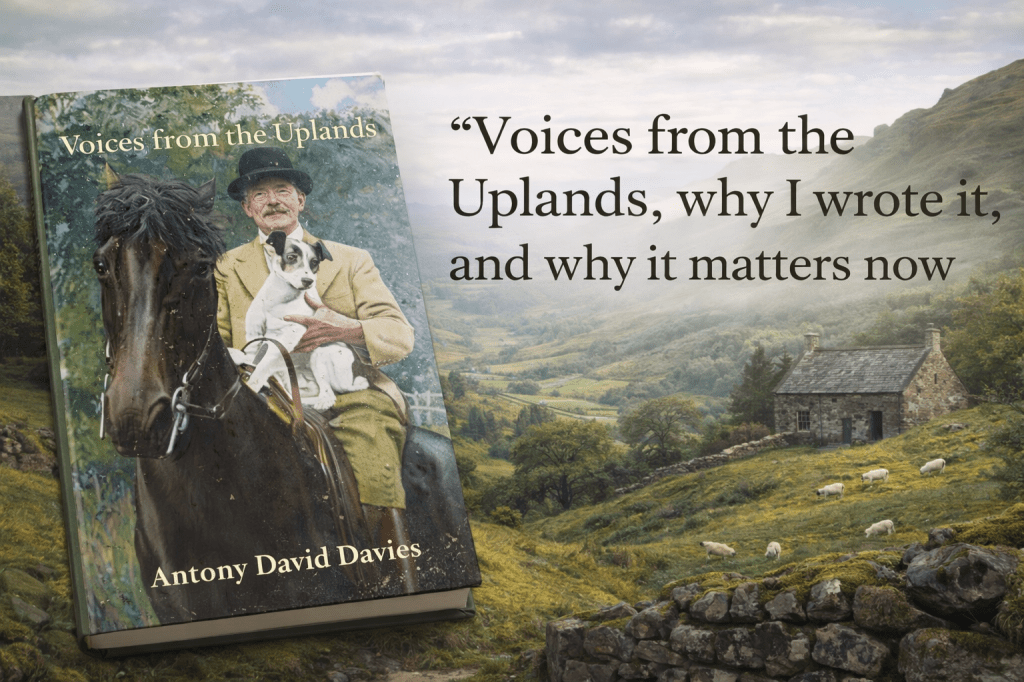
Voices from the Uplands: The Davies Family and the Soul of Rural Wales is, in the simplest sense, a book about my own ancestors, the Davies family of Caeadda, Llanwrin. But I did not write it to produce another neatly ordered pedigree, nor to add one more family tree to the growing pile of genealogical summaries that tell us who belonged to whom, while leaving the real substance of life untouched.
I wrote it because I wanted something more ambitious, and, I hope, more faithful to the lived reality of rural Wales, a social history of the world in which the Davies family lived, worked, worshipped, endured, and made meaning. I wanted to bring that world back to life in the mind’s eye, not as nostalgia, and not as rural theatre, but as a recoverable human environment, textured, disciplined, often pressured, and culturally distinctive.
And I wrote it with urgency, because the record is vanishing.
Beyond a pedigree, a moral landscape
The uplands of Montgomeryshire were not simply “countryside”. They were a complete social and moral system, shaped by land and weather, sustained by kinship, regulated by reputation, and underwritten by Nonconformist discipline. The Davies family appear in the surviving sources as tenants, farmers, householders, parents, and widows. Those labels matter, but they are not the life itself.
What mattered, and what I have tried to reconstruct, is the world behind those labels, the weekly rhythm of chapel and market, the moral economy of respectability, the obligations between neighbours, the hierarchies that existed without always being spoken, the deep relationship between household labour and survival, and the way faith shaped both private conduct and public standing.
In the book, Llanwrin is not treated as a backdrop. It is a living ecology, a place where language, religion, agricultural practice, and community expectation were fused into something coherent, and where, over time, that coherence came under strain.
Machynlleth, the hills’ civic hearth
To understand an upland family you must also understand the market town that tethered them to modernity. Machynlleth was more than a shopping trip. It was an economic hinge, a place where livestock became cash, where news travelled, where reputations were seen, where the state was felt in small forms, and where wider forces, railways, markets, politics, and administrative change, touched people who otherwise seemed far from the centres of power.
This matters, because rural Wales was never as sealed off as it is sometimes portrayed. Even the most remote farm was entangled in wider systems, agricultural depression, shifting prices, education policy, migration, illness, and war. The uplands were not static. They were pressured and negotiated, often without the people involved having any real ability to set the terms.
The women who held the culture together
A further purpose of the book is corrective. The continuity of upland life was sustained as much by women’s authority as by men’s labour, yet women’s influence is routinely flattened in conventional local history. I wanted to bring their roles into sharper focus, not sentimentally, but historically.
The Welsh uplands were never run by men alone. Women held households together, set standards, taught children, carried faith, enforced discipline, and maintained the subtle social codes by which communities judged themselves. In lives that were rarely public, they were often quietly decisive.
The quiet heroism of Thomas Davies
Thomas Davies of Caeadda (1827–1891) is not written as a romantic patriarch, but as a serious historical type, the upland Welsh farmer negotiating the pressures of nineteenth-century change while holding fast to a moral framework shaped by chapel and community expectation. His life illustrates the hard reality of rural continuity, adaptation under constraint, family labour, hard choices, and the constant need to balance dignity with survival.
Even in death, the wider world intrudes. Illness did not stop at the mountain’s edge. The uplands were never fully protected from national and global forces, they simply experienced them later, and often with fewer resources.
Why the record is vanishing, and why that should worry us
There is a silence growing in rural Wales, and it does not arrive dramatically. It arrives slowly, through clearance, disposal, forgetting. Farms change hands. Chapels close. Houses are emptied. Boxes of papers are thrown away because they are “only family things”. The last living links to remembered reputations, to local speech patterns, to the half-known stories that still sit behind surnames, disappear with every funeral.
Official records will survive, up to a point. But the richest archive of upland life has always been the small domestic archive, letters, diaries, photograph albums, account books, annotated hymnals, chapel ephemera, funeral cards, school certificates, and the scraps that look unimportant until they are gone. Once discarded, they are not merely “lost”. They are irrecoverable.
That is why I wrote this book as an act of preservation as much as interpretation.
What I hope this book prompts others to do
I also hope it encourages something practical, especially among families from this part of Wales.
If you have a box in an attic, open it. If you have a photograph album, label it while someone is still alive who knows the faces. If you have letters, do not assume they matter only to you. If you have chapel papers, farm books, or diaries, treat them as historical artefacts rather than clutter. Small records, carefully kept, can restore entire strands of local history that would otherwise vanish.
This is not simply a plea for sentiment. It is cultural self defence. Rural Wales has too often been written about from the outside, flattened into stereotype, or treated as a picturesque backdrop to other people’s stories. The most authoritative history of these communities is still held in families’ hands, if they choose to preserve it, and, when appropriate, to share it.
A book written as stewardship
The Davies family of Caeadda are my ancestors. I owe them more than a list. I owe them attention, context, and seriousness, and I have tried to give them what the record allows, a restoration of their world so that a reader can see it, hear it, and understand it, even if they have never stood in those hills.
The uplands have voices. If we do not listen now, and preserve what can still be preserved, the silence will not be sudden. It will simply arrive, one discarded paper, one forgotten name, one closed chapel at a time.
A final word of thanks
I end with a personal note of gratitude. I am deeply grateful to my fellow Caeadda descendant, Elinor Bennett, who has done so much over many years to preserve and share our heritage, and who kindly wrote the foreword to this book. Her commitment to family memory, and to the careful handing-on of what might otherwise have been lost, exemplifies the very spirit that Voices from the Uplands seeks to honour.
