
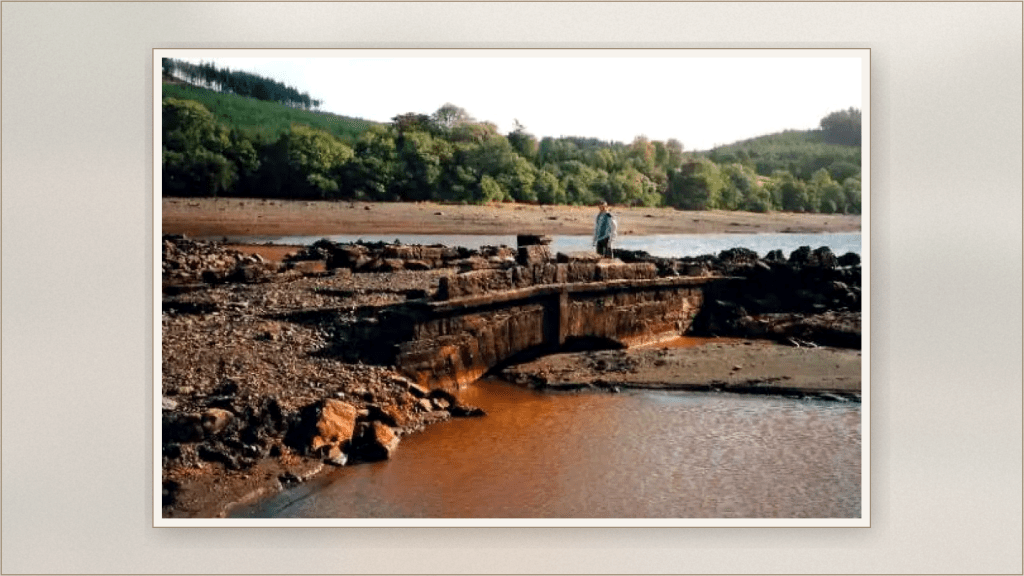
In the summer of 2018, after weeks of sustained heat, the waters of Lake Vyrnwy receded to levels rarely seen in recent decades (source 1). Along the exposed margins of the reservoir, fragments of masonry and faint outlines of foundations emerged from the silt, traces of lanes and walls briefly visible once more (source 1). Visitors described the phenomenon as a “ghost village” resurfacing from beneath the water (source 1).
What reappeared was Llanwyddyn.
More than a century earlier, in the closing decades of the nineteenth century, this quiet farming parish in the upper Vyrnwy valley had been extinguished, not by war nor by famine, but by statute and engineering ambition (source 2). The village was cleared, demolished, and ultimately submerged to create Lake Vyrnwy, a reservoir constructed to supply the growing industrial city of Liverpool with clean water (source 2).
The episode has often been presented as a triumph of Victorian infrastructure and municipal reform (source 3). It was that, undeniably, a remarkable feat of engineering and civic planning. Yet it was also something else: the deliberate sacrifice of a rural Welsh community in the name of metropolitan necessity (source 4).
A Parish Before the Dam
Llanwyddyn lay in the upper reaches of the Vyrnwy valley, surrounded by upland pasture and modest farms that sustained families across generations (source 2). It was not a large settlement, but like many Welsh rural parishes it possessed a distinct moral and social ecosystem, chapel, church, school, farms, kin networks, and memory (source 5).
The parish church, dedicated to St Wyddelan, stood as both a religious and geographical anchor (source 2). Around it clustered cottages and farmhouses built in local stone, practical and unadorned, shaped by climate and necessity rather than architectural ambition (source 5).
Montgomeryshire in the nineteenth century was marked by modest tenant farming, periodic agricultural depression, and outward migration, particularly among younger generations (source 6). Yet communities such as Llanwyddyn were socially cohesive and culturally resilient, grounded in Welsh language and Nonconformist practice even where Anglican structures formally prevailed (source 6). What distinguished Llanwyddyn was not prosperity, but continuity. Families were rooted in land and parish, their identities shaped by landscape as much as by lineage.
Liverpool’s Decision
By the 1870s, Liverpool faced mounting public health pressures linked to industrial growth and urban overcrowding (source 3). The city’s existing water supply was increasingly regarded as inadequate in both quantity and purity, particularly in light of Victorian sanitary reform movements (source 3).
Municipal authorities sought a large upland source, remote from industrial contamination (source 3). The upper Vyrnwy valley, sparsely populated and hydrologically suitable, appeared suitable for development (source 2). In 1880, Parliament passed the Liverpool Corporation Waterworks Act, granting Liverpool authority to acquire land in the valley and construct a dam (source 2). The scheme was lawful and framed as civic necessity. It was also an assertion of metropolitan power over a peripheral rural community (source 4).
The valley did not choose this role.
Dissolution
The project required the compulsory purchase and demolition of Llanwyddyn village and surrounding farms (source 4). Residents were relocated, buildings dismantled, and the parish church deconsecrated and removed before inundation (source 2).
Construction of the dam began in the early 1880s and was completed in 1888, creating what was then the first large masonry dam in Britain (source 2). The scheme was celebrated as a model of municipal foresight (source 3). Approximately one hundred residents were directly affected, their homes erased and their parish dissolved (source 4). Graves were relocated, walls dismantled, and centuries of accumulated memory were disrupted in the process (source 4).
Unlike the Highland Clearances, Llanwyddyn’s removal occurred through parliamentary procedure rather than landlord coercion. It was bureaucratic clearance rather than feudal eviction.
An Extractive Pattern
The drowning of Llanwyddyn formed part of a broader nineteenth century pattern in which Welsh upland landscapes were integrated into what historical geographers would describe as an extractive economy (source 7). Water, slate, coal, and labour flowed eastward to industrial centres, while capital, legislative authority, and infrastructural decision-making flowed westward (source 7).
Lake Vyrnwy was an early example of this asymmetry. The valley’s primary function was redefined, not for local sustenance, but for metropolitan consumption.
In the twentieth century, the flooding of Capel Celyn to create Llyn Celyn revived debates about Welsh consent and constitutional voice (source 8). Tryweryn became a rallying cry; Llanwyddyn had occurred in an era when Wales possessed no devolved legislature and limited institutional leverage (source 6). Liverpool could legislate; Llanwyddyn could petition.
Monument and Memory
Today, Lake Vyrnwy is presented as a site of scenic beauty and ecological management (source 2). Rising from its surface stands the Gothic Revival straining tower, deliberately ornamental and highly visible (source 2). It embodies Victorian civic confidence in architecture as statement as well as utility.
The contrast is striking. Above the water stands architectural assertion. Beneath it lies the footprint of vernacular cottages, modest and locally rooted.
The churchyard of St Wyddelan was cleared, yet the symbolic geography of the parish remains preserved in archival record (source 4). In most years, nothing is visible. The loss appears complete.
And yet, in summers of drought, the outlines return (source 1). Foundations surface. The valley briefly reveals what it once contained. The phrase “ghost village” may be journalistic, but it captures something historically resonant: erasure in law is not erasure in memory.
The landscape remembers.
Holding Two Truths
It would be simplistic to frame Lake Vyrnwy as mere exploitation. Liverpool’s water reforms materially improved urban public health and reduced disease (source 3). Victorian reformers believed they were acting in the public interest (source 3).
Yet public good, defined in one place, can entail dispossession in another.
The story of Llanwyddyn requires balance. It was an engineering achievement. It was also communal erasure. It was progress. It was loss.
Lake Vyrnwy glitters in the Welsh hills, serene and composed. Beneath it rests a parish whose fields, cottages, and church once formed a living social world. Infrastructure, however rational, is never neutral. It is built upon choices, and those choices are rarely borne evenly.
In dry summers, the valley reminds us.
Footnotes and Sources
Source 1:
BBC News, “Welsh ‘ghost village’ emerges as heatwave lowers Lake Vyrnwy water levels”
https://www.bbc.co.uk/news/uk-wales-45054255
Source 2:
Wikipedia, “Lake Vyrnwy”
https://en.wikipedia.org/wiki/Lake_Vyrnwy
Source 3:
BBC News, “Lake Vyrnwy: The dam that supplied Liverpool”
https://www.bbc.co.uk/news/uk-wales-16851208
Source 4:
Royal Commission on the Ancient and Historical Monuments of Wales (RCAHMW), “Llanwyddyn and the Vyrnwy Valley before the Dam”
https://rcahmw.gov.uk/llanwyddyn-vyrnwy-valley
Source 5:
GENUKI, “Llanwyddyn Parish, Montgomeryshire”
https://www.genuki.org.uk/big/wal/MON/Llanwyddyn
Source 6:
Encyclopaedia Britannica, “Wales: Nineteenth-century Wales”
https://www.britannica.com/place/Wales/Nineteenth-century-Wales
Source 7:
National Library of Wales, essays on industrial Wales and resource extraction
https://www.library.wales/discover
Source 8:
BBC News, “The drowning of Tryweryn and the legacy of Capel Celyn”
https://www.bbc.co.uk/news/uk-wales-36124452
