
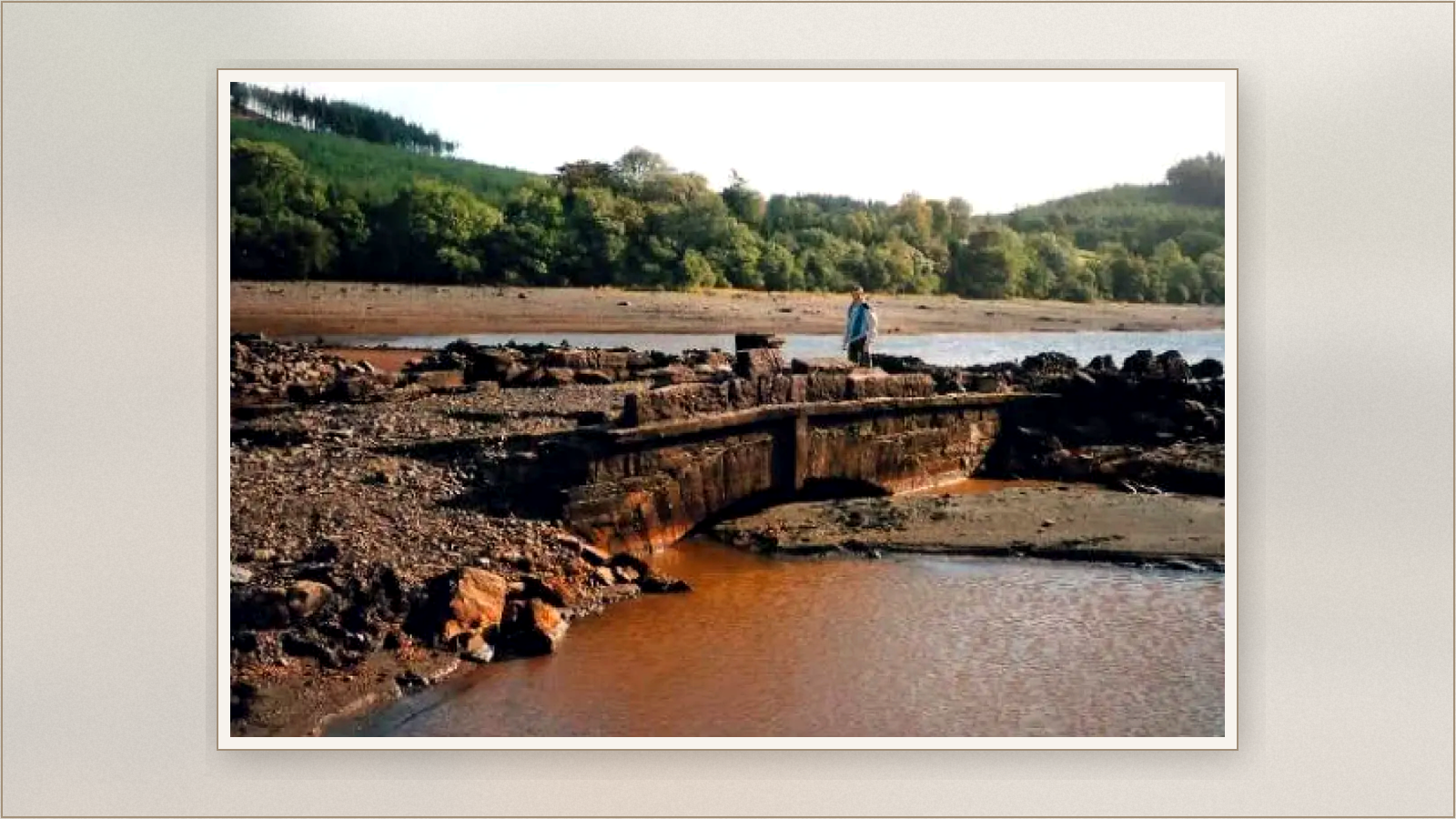
During the hot summer of 2018, falling water levels at Lake Vyrnwy exposed fragments of an earlier landscape. Masonry appeared along the reservoir’s margins. Old foundations and parts of the road system could once again be traced through ground normally concealed beneath the water.
Reports described a lost or “ghost” village returning from the lake. The description was irresistible, but not quite literal. Llanwddyn did not reappear intact. Its church, houses, chapels and inns had been demolished before the valley was flooded. What emerged were fragments, the material outline of a community deliberately removed during the 1880s.
More extensive remains became visible during the drought of 2022, when stretches of stonework, roads and building foundations again attracted public attention. Similar exposures had occurred during the severe drought of 1976.
The ruins belong to old Llanwddyn, a farming settlement in the upper Vyrnwy valley of Montgomeryshire. Its buildings were cleared to make way for a reservoir supplying Liverpool, almost seventy miles away.
Lake Vyrnwy was a formidable Victorian engineering achievement. It provided clean water for a rapidly expanding industrial city and became an important monument to municipal ambition. Yet its creation also required an unequal exchange. A Welsh valley surrendered its homes, farms and social geography so that an English city might grow more safely.
The history deserves neither uncritical celebration nor retrospective simplification. Liverpool’s need for water was real. So was the loss borne by Llanwddyn. The deeper history also shows that the transformation did not end when the reservoir filled. Liverpool progressively acquired and managed much of the surrounding watershed, reorganised farming, encouraged afforestation, employed generations of local people and helped create the wooded landscape now regarded as part of Lake Vyrnwy’s natural beauty.
Llanwddyn Before the Reservoir
Old Llanwddyn stood near the meeting of the Vyrnwy and Cedig rivers. Its name derived from Wddyn, a figure remembered locally as an early Welsh saint. The parish church, however, was dedicated to St John, reflecting the medieval association of the manor with the Knights Hospitaller of St John.
By the nineteenth century, Llanwddyn was a small but recognisable rural centre. It contained about 40 houses, three public houses, a school, shops, a post office, a corn mill, a parish church and several Nonconformist congregations. Ten farms in the surrounding valley were also affected by the reservoir scheme. Eunant Hall, the home of a local landowning family, stood among the buildings eventually demolished.
The parish population had already been declining before Liverpool arrived. In 1831, it contained 668 inhabitants. By 1871, the figure had fallen to 433. Higher wages in industrial districts had drawn people towards north-west England and the Midlands, while agricultural change reduced the capacity of upland communities to retain their young.
Llanwddyn should not therefore be romanticised as a timeless society untouched by the nineteenth century. Its population was mobile, its economy vulnerable and its future already uncertain. Nevertheless, it remained a living community rather than an empty valley waiting to be put to more profitable use.
Farming dominated local life. Families raised sheep and store cattle on difficult upland ground, enclosed better valley land for hay and crops, cut peat on the moors for domestic fuel and depended upon large tracts of rough grazing beyond the improved fields. Contemporary and later local accounts describe a simple diet in which mutton broth, porridge, gruel and milk remained familiar foods. Such details matter because they recover something of the ordinary economy beneath later images of Vyrnwy as scenery.
Religious life was also more varied than the surviving replacement landscape might suggest. Alongside the parish church were several Nonconformist congregations, part of the dense chapel culture characteristic of nineteenth-century Wales. Church, chapel, school, inn and shop connected otherwise scattered farms and households. Bethel Calvinistic Methodist Chapel would later carry a particularly explicit memory of displacement into the new village.
This social geography cannot be measured only by the number of houses lost. A village is also a network of paths, neighbours, fields, customary meeting places and accumulated associations. Rehousing could replace a building, but not the precise relationship between household and landscape.
Liverpool’s Water Problem
Liverpool’s population expanded dramatically during the nineteenth century. Its growth as a port and industrial city produced wealth, but also severe overcrowding, insanitary housing and pressure upon public services.
A dependable supply of clean water had become both a practical necessity and a central concern of Victorian municipal government. Cholera and other waterborne diseases had demonstrated the lethal consequences of contaminated supplies. Water was no longer regarded merely as a commodity. It was essential infrastructure for public health, firefighting, industry and domestic life.
Liverpool Corporation had already developed reservoirs at Rivington in Lancashire, but even that extensive system was struggling to meet growing demand. At times the city’s distribution arrangements became so restricted that domestic water could be available for only a few hours each day. By the 1860s and 1870s the Corporation was therefore looking beyond its existing catchments for a source capable of serving a much larger future population.
Why Llanwddyn?
The choice of Vyrnwy was not inevitable. Liverpool’s engineers examined a remarkable range of alternatives, including Windermere, Haweswater, Ullswater, the Rivers Hodder and Ribble, the Wyre, Bala Lake and the Dee. These investigations reveal that Llanwddyn was selected from among competing landscapes rather than because no other solution existed.
George Frederick Deacon brought Vyrnwy firmly into consideration during the later 1870s. The valley offered heavy rainfall, a large upland catchment, comparatively little industrial contamination and a narrow point suitable for a substantial masonry dam. Its elevation also allowed water to travel towards Liverpool largely by gravity.
Water quality strengthened the case. Analysis by Professor J. Campbell Brown rated the proposed Vyrnwy supply very highly, while Deacon believed that the catchment had the potential eventually to yield tens of millions of gallons each day.
Cost mattered as well. Vyrnwy was initially estimated at about £1.2 million, compared with roughly £1.5 million for Haweswater, one of its most serious rivals. Sir William Forwood, later recalling the internal debate, stated that Liverpool Council itself had been sharply divided and that Vyrnwy prevailed by a majority of only three votes.
That narrow margin is historically important. Llanwddyn was not destroyed because events had moved irresistibly towards one unavoidable site. An English municipal council compared possible valleys, assessed engineering and financial advantages and made a contested choice. From the standpoint of Liverpool, Vyrnwy appeared to offer an exceptional combination of water, elevation and economy. From the standpoint of Llanwddyn, it was home.
Parliament and the Balance of Power
Liverpool could not simply enter Montgomeryshire and take possession of the valley. It required parliamentary authority to purchase land, impound the Vyrnwy and construct the reservoir and aqueduct.
Local people opposed the proposal and presented a petition, but the surviving records show that resistance was broader and more organised than the familiar image of a small village petitioning an overwhelmingly powerful city. The National Library of Wales preserves a substantial Wynnstay Estate series relating to the scheme between 1880 and 1893. Among the papers is a printed petition by Sir Watkin Williams Wynn against Liverpool’s bill, together with maps showing lands and easements sought across Llanwddyn, Hirnant, Llanrhaeadr-ym-Mochnant, Llansilin, Oswestry and Selatyn.
Later correspondence records continuing negotiation over amendments, rights and compensation. The Severn Commissioners opposed provisions affecting their interests, while individual occupiers and landholders pursued claims of their own. The surviving papers include, for example, a compensation matter concerning Mr Davies of Bwlch Farm. Liverpool therefore faced resistance from villagers, tenants, major landowners, riparian interests and others affected along the route of the wider works.
The Liverpool Corporation Waterworks Act received royal assent on 6 August 1880. It granted the city the powers needed to proceed, including compulsory acquisition of land for a defined period of seven years.
The legislation also embodied concessions secured during the parliamentary process. Liverpool was required to provide a new church and school for Llanwddyn. Sporting rights over the future reservoir were preserved for the Earl of Powis, a revealing detail in a settlement where different kinds of interest in the landscape were capable of receiving very different forms of protection.
The contrast should not be exaggerated into a simple morality tale, but it exposes the social structure of Victorian land law. A tenant family could be compensated for a holding and required to leave it. An aristocratic sporting interest could be translated into the new landscape and explicitly preserved.
The legislation made the project lawful. Lawfulness did not make its consequences neutral. Parliamentary procedure determined whose definition of the public interest would prevail. Liverpool’s need for water was recognised as a sufficiently important civic purpose to justify the removal of a community elsewhere.
The inhabitants received compensation and Liverpool Corporation built a replacement village. This distinguishes Llanwddyn from an indiscriminate clearance. Yet compensation was calculated through property and tenancy. It could not easily account for attachment, family association or the loss of an inherited landscape.
Victorian government could value a house. It was less capable of valuing a sense of place.
Building the Dam
Work began in 1881. Thomas Hawksley, one of the leading water engineers of his generation, was appointed engineer-in-chief, working with Liverpool’s borough engineer, George Frederick Deacon. The undertaking was enormous. At its height, approximately 1,000 men were involved. Temporary accommodation, workshops, transport systems and supporting services transformed the valley into a major industrial construction site.
The dam was built across the Vyrnwy from large blocks of stone. It was among the earliest great masonry dams in Britain and incorporated technical innovations intended to control pressure and manage overflow. Measuring approximately 358 metres across and rising 44 metres from the valley floor, it combined engineering purpose with architectural display.
The cost was not confined to land and buildings. A memorial near the dam commemorates 44 men who died during the years of construction. Ten were killed in workplace accidents, while another 34 died from other causes.
Their deaths complicate any simple division between Liverpool and Llanwddyn. Many of the labourers who built the reservoir belonged to the same working society whose lives urban water reform sought to improve. Victorian infrastructure frequently rested upon dangerous manual work performed far from the people who would receive its benefits.
The dam remains their monument as well as Liverpool’s.
The Vyrnwy Controversy
The heroic story of Victorian engineering becomes considerably more complicated when the professional and financial disputes surrounding the scheme are examined.
Hawksley and Deacon developed an increasingly bitter relationship. Hawksley believed that Deacon would act as a subordinate resident engineer, while the terms under which Liverpool employed Deacon allowed him to work more independently and effectively placed the two men in competing positions of authority. Hawksley repeatedly objected to Deacon’s conduct and eventually resigned from the undertaking.
The dispute later became public. After Hawksley successfully pursued arbitration against Liverpool Corporation, the Liverpool Mercury ran a series in 1888 under the memorable heading “The Vyrnwy Scandal”. The newspaper subjected the Corporation’s management of the project to fierce scrutiny and raised questions not simply about engineering judgement but about municipal administration and the relationship between Deacon and influential figures on Liverpool’s Water Committee.
There was also real technical unease. In 1886 The Engineer reported concerns attributed to Hawksley about the dam, prompting Liverpool to obtain independent professional examination of the works. The reservoir that later became a symbol of Victorian confidence was therefore constructed amid argument, anxiety and institutional mistrust.
The Cheap Scheme That Became Expensive
The financial history carries an especially striking irony. Vyrnwy had been attractive partly because it appeared cheaper than several alternatives. Deacon’s early estimate was around £1.2 million. By the middle of the 1880s Liverpool councillors were confronting projections closer to £2 million, while later contemporary accounts put the total at about £2.5 million.
The dam itself became a focus of criticism as expected expenditure increased dramatically. Parliamentary compensation, alterations to the design, changes to tunnelling and the complexity of the works all contributed to rising costs. Councillors who had supported Vyrnwy partly on grounds of economy now found themselves defending a scheme approaching twice its original estimate.
This matters to the history of Llanwddyn because it removes any suggestion that the valley was sacrificed to an obviously superior and financially certain solution. The choice had been contested within Liverpool, and one of the principal arguments in its favour proved much less secure than anticipated.
The Removal of the Old Village
As construction advanced, Liverpool Corporation prepared a new settlement lower down the valley. Houses, a church and other facilities were provided for displaced inhabitants. Some residents moved into the replacement village, while others left the locality. The old settlement was then dismantled.
Thirty-seven houses, ten farmhouses, three inns, chapels and the parish church were among the buildings removed. The exact totals vary slightly between accounts, partly because sources distinguish differently between the village itself, separate congregations and the surrounding valley.
The old church of St John possessed medieval origins and had served generations of parishioners. Its loss was particularly poignant because it had been partly rebuilt in 1847 and restored again in 1875 at considerable local expense. Within little more than a decade of that restoration, the building stood in the path of the reservoir and was demolished.
Gravestones and human remains were transferred from threatened burial areas. The church bell and selected fittings were preserved. The replacement church of St Wddyn, designed by F. W. Holme, was erected at Liverpool Corporation’s expense in 1887 and consecrated during 1888. Surviving sources conflict over the precise consecration date, so the year is safer than repeating a single day as uncontested fact. An inscription on the porch stated plainly why the new church existed:
The old Church of St John being covered by the Lake Vyrnwy this Church of St Wddyn was erected AD 1887.
The new building contained physical connections with its predecessor. The old bell was retained, a bookrest was carved from yew taken from the former churchyard, gravestones were relocated, and saplings from the old site were planted in the new grounds. The Royal Commission’s inventory also recorded a stone model of the old church made by a parishioner and preserved within the replacement building.
Bethel Calvinistic Methodist Chapel carried the memory of removal just as explicitly. Its commemorative inscription records that the congregation’s former building was moved from the old village in September 1888 and rebuilt in the new settlement.
These acts suggest an awareness that replacement alone was insufficient. Material fragments were carried forward because the new village required a relationship with the one being lost.
The Coming of the Water
Once the dam was ready and the old settlement cleared, the valves were closed and water began to gather behind the masonry barrier. By November 1889 the reservoir had filled sufficiently for water to pass over the overflow.
The filling of the reservoir transformed the upper valley into a lake covering more than 1,100 acres. The course of the river broadened into an expanse of water almost five miles long. Fields, roads and the cleared foundations of Llanwddyn disappeared beneath it.
The completion of the dam did not immediately place Vyrnwy water in Liverpool homes. An aqueduct approximately 68 miles long still had to carry the supply eastwards. The system included tunnels, pipes, balancing reservoirs and crossings beneath difficult terrain.
The Gothic Revival straining tower, designed by Deacon, stood within the reservoir near its northern shore. Water entered through its filtration arrangements before beginning the journey towards Liverpool.
On 14 July 1892, the supply reached the city. The date completed an extraordinary transfer. Rain falling on the Montgomeryshire uplands could now travel by gravity into the homes and streets of one of Britain’s largest cities.
An Expanding Water System
Vyrnwy was not a finished system in 1892. The first aqueduct main was capable of carrying only part of the quantity Liverpool eventually required. A second main was completed by 1905, while further expansion followed during the twentieth century.
The catchment itself was enlarged. Water from the Marchnant and Cownwy was diverted into Lake Vyrnwy through additional dams and tunnels, increasing the effective supply. Completion of these works was ceremonially marked in 1910 by the Prince of Wales, the future George V.
The reservoir therefore became the centre of an expanding hydraulic network rather than a single isolated dam. What began as the appropriation of one valley developed into a much larger engineered system connecting upland Montgomeryshire with the daily life of Liverpool.
What Liverpool Gained
It would be wrong to treat the scheme as a work of municipal vanity without practical justification.
Liverpool’s earlier water system had become inadequate. Population growth placed constant pressure upon supply, while Victorian public health demanded cleaner and more dependable provision. Vyrnwy water helped support hundreds of thousands of people and served the city for generations.
Clean water reduced exposure to disease, improved domestic sanitation, supplied industry and allowed municipal authorities to respond more effectively to fire. These were not trivial advantages enjoyed only by the wealthy. Working-class districts stood to gain considerably from a safer public supply.
The reservoir also embodied a progressive principle. Water provision was being undertaken by a municipal corporation on behalf of the population rather than left entirely to fragmented private interests. The scheme reflected the growing Victorian belief that local government could act decisively to improve urban life.
Lake Vyrnwy was therefore genuinely a public-health achievement. The historical question is not whether Liverpool needed water. It is why the cost of meeting that need fell upon this particular Welsh community, and how fully the people affected were permitted to shape the decision.
What Llanwddyn Received
The consequences for Llanwddyn were not wholly destructive. Liverpool Corporation built new houses and public buildings. The replacement church was architecturally accomplished. Construction and the subsequent management of the water estate created employment. New roads and services connected an isolated district more closely with the wider economy.
The compensation water released downstream from the dam also created an opportunity that had not formed part of the original village economy. In 1902 Liverpool Corporation installed generating equipment which used the flow to produce hydroelectricity. The supply served Llanwddyn, Corporation buildings and the hotel until mains electricity arrived in 1960.
This was an unusual benefit for such an isolated upland community. Water diverted principally for Liverpool allowed the replacement Llanwddyn to enjoy locally generated electricity surprisingly early.
The population stabilised for a considerable period after the reservoir was built. The community survived and retained the name Llanwddyn. Today it continues across settlements near the dam and at Abertridwr. These facts matter. Llanwddyn was displaced, not annihilated.
Yet survival did not remove loss. The new settlement was laid out according to the requirements of the waterworks rather than the accumulated development of the old parish. Farms disappeared, neighbours were redistributed and the physical centre of communal memory was removed. A planned village could reproduce houses and institutions, but not the experience of continuity.
Liverpool’s Welsh Estate
The most important long-term consequence of the reservoir was that Liverpool’s intervention did not stop at the waterline. To protect the purity of the supply, the Corporation gradually acquired extensive land across the surrounding watershed. By the early twentieth century the Vyrnwy estate had grown to roughly 26,000 acres.
Major landowners, including the Earl of Powis and the Williams-Wynn estate, sold land to the Corporation. Liverpool thereby became not merely the owner of a reservoir but one of the principal landholders in this part of Montgomeryshire.
The purpose was practical. Activities throughout the catchment could affect the purity of water destined for an urban population many miles away. Control over land use became part of water engineering. Farms, grazing, forestry, housing and employment could all be regulated in the interests of the reservoir.
This greatly enlarges the meaning of the Vyrnwy scheme. Liverpool had not simply flooded a village. It had acquired and begun to manage a large piece of Welsh upland countryside as part of the infrastructure of an English city.
Farming, Forestry and a Second Transformation
Before Liverpool’s acquisition, the catchment was predominantly pastoral. Hill sheep and store cattle grazed extensive rough uplands, while enclosed valley fields provided better ground. Natural woodland covered only a small part of the area.
That landscape changed increasingly after the reservoir was completed. Liverpool Corporation became interested in afforestation both as an economic use of its estate and as a means of managing the watershed. In 1896 it consulted the distinguished forester William Schlich, and by 1912 about 900 acres had been planted. A government survey in 1913 examined several thousand acres for possible further afforestation.
During the twentieth century plantations of Douglas fir, Sitka spruce, Norway spruce, Japanese larch and other species spread across slopes that earlier generations had known largely as open grazing. Some farms survived as Corporation tenancies, while other land was absorbed into forestry. Smallholdings and houses were also created for workers.
This was a second transformation of Llanwddyn. The first had replaced river and farmland with a reservoir. The second increasingly converted open upland and pastoral ground into a managed municipal forest estate.
The 1923 Evictions
The continuing power of Liverpool Corporation over the catchment became a matter of national political discussion in 1923. Questions in the House of Commons concerned the termination of agricultural tenancies at Vyrnwy as land was taken over for afforestation.
The official explanation was that greater control of the catchment reduced risks of pollution and that forestry might ultimately employ more people than the farms it replaced. Legally, however, existing tenants could be required to leave when their tenancies ended, and the Forestry Commissioners had no power to prevent Liverpool from proceeding.
The episode is important because it shows that displacement at Llanwddyn did not end in the 1880s. Decades after the old village had disappeared, the logic of the reservoir continued to reorganise settlement and land use. The requirements of distant water consumers could still determine whether farming families remained on holdings in the Vyrnwy catchment.
A Welsh Landscape Reassigned
The Vyrnwy scheme belonged to a larger history in which the natural resources of Wales were drawn into the development of industrial Britain.
Welsh coal powered factories and shipping. Slate roofed expanding towns. Water from upland valleys sustained English conurbations. Labour moved outward, while outside capital and statutory authority moved into Welsh districts.
This should not be reduced to a simple colonial formula. Welsh landowners, politicians, workers and contractors also participated in these processes. The economic relationships between Wales and England were complex, and infrastructure could bring local employment as well as disruption.
Nevertheless, the geography of power was unmistakable. The principal beneficiaries of Vyrnwy water lived almost seventy miles from the valley. The authority to determine the scheme rested with a powerful municipal corporation and Parliament. The local community could object, but it could not exercise a veto.
The landscape was reassigned to a new purpose. What had sustained farms and households became part of Liverpool’s civic machinery. In time, even decisions about which slopes should carry sheep and which should carry conifers could be shaped by the needs of that distant municipal system.
From Working Valley to Picturesque Landscape
One of the most striking features of Lake Vyrnwy’s later history is the speed with which a landscape of displacement became a landscape of leisure.
A hotel developed around the period when the reservoir opened, growing from accommodation associated with visitors to the waterworks into part of the tourism economy surrounding the lake. Fishing and shooting became important attractions, and the reservoir itself was stocked with trout.
Grant Allen’s 1890 article, A Submerged Village: Llanwddyn, illustrated by W. Biscombe Gardner, is especially valuable because it appeared while the transformation was still recent. Gardner’s images recorded the bridge, church, inn, post office, farms and other parts of the old settlement at the very moment when Llanwddyn was passing from lived environment into memory.
Within a generation, visitors could encounter the new lake primarily as scenery. That shift matters. An inhabited valley which had been cleared for municipal necessity was increasingly consumed as a picturesque landscape of water, woodland, fishing and Gothic architecture.
The apparent naturalness of Lake Vyrnwy is therefore doubly deceptive. The lake itself was engineered. Much of the woodland that now frames it was deliberately planted after Liverpool acquired the watershed.
The Architecture of Confidence
The surviving structures at Lake Vyrnwy present the engineering scheme at its most assured.
The dam is both functional and monumental. Its arches, towers and stonework give it the appearance of a civic structure rather than a purely industrial barrier. The straining tower rises from the lake like a small Gothic castle, its ornamental form transforming the intake of water into an architectural spectacle.
Victorian engineers and municipal leaders understood that infrastructure could express authority. The tower announced that Liverpool’s water system was not merely useful, but civilised, permanent and worthy of admiration.
There is a striking contrast between the visible monument and the submerged remains. Above the water stands a carefully designed declaration of civic confidence. Below it lie the foundations of ordinary houses, farms and roads.
The monumental architecture belongs to those who possessed the power to build. The fragments belong to those required to move.
Llanwddyn and Tryweryn
The later drowning of Capel Celyn to create Llyn Celyn inevitably changed how Llanwddyn was remembered.
Liverpool obtained parliamentary authority for the Tryweryn scheme in 1957 despite the opposition of almost every Welsh MP. The reservoir opened in 1965. The destruction of Capel Celyn became a defining grievance in modern Welsh politics and contributed to the growth of national consciousness, campaigns for the language and demands for constitutional recognition.
There are obvious parallels. In both cases, a Welsh-speaking rural community was displaced to supply Liverpool with water. In both, an Act of Parliament overrode local opposition. Both demonstrated the limited power of Welsh communities when confronted by external municipal need. The differences are equally important.
Llanwddyn occurred in the 1880s, before the emergence of organised Welsh nationalism in its modern form and before Wales possessed national political institutions. Liverpool constructed a replacement settlement and church. The transformation also created local employment and a continuing waterworks community.
At Capel Celyn, the political context was different. A national press could carry the grievance. Plaid Cymru existed to organise opposition. Welsh MPs voted overwhelmingly against the measure, and the absence of Welsh consent became central to the meaning of the event.
Tryweryn became a national symbol. Llanwddyn remained, for much longer, a local memory incorporated into the picturesque history of Lake Vyrnwy.
The earlier experience nevertheless reveals that Tryweryn did not appear from nowhere. The principle had already been established: a sufficiently powerful city could obtain parliamentary authority to reorganise a Welsh valley in pursuit of water.
A Paternalistic Municipal Community
For much of the twentieth century Liverpool Corporation was more than a remote owner. It was landlord, employer, forester and water authority. Housing and employment were closely tied to the estate, producing a relationship that local accounts have described as paternalistic.
This system could provide security and services, but it also meant that a remarkable degree of local life remained dependent upon an institution based in another country. The Corporation was reluctant for many years to sell houses into private ownership, preserving the estate character of the community.
After the Second World War, changes in forestry and estate arrangements helped support further development at Abertridwr, including housing, a school and community facilities. Modern Llanwddyn therefore emerged in stages. The community was not simply moved once in the 1880s and then frozen in its replacement form.
The institutional relationship changed significantly in 1974, when national water reorganisation transferred the Vyrnwy undertaking away from direct Liverpool Corporation ownership. That administrative change did not erase nearly a century in which an English municipality had exercised extraordinary influence over the land, employment and settlement pattern of a Welsh upland parish.
Drought and the Return of Memory
When reservoir levels fall, visitors sometimes imagine that Llanwddyn has risen intact from the water. It has not. The old church does not reappear with its tower standing, nor do complete cottages emerge from the lake.
What becomes visible is less dramatic and, perhaps, more affecting. Roads can be followed. Building lines become legible. Stone walls and foundations interrupt the exposed ground. A bridge, millstone or section of former streetscape may appear in severe drought conditions.
These remains are not a supernatural return. They are archaeological evidence of a landscape deliberately altered within modern historical time.
Their appearance also challenges the scenic completeness of Lake Vyrnwy. On an ordinary day, the reservoir seems natural, as though water had always occupied the valley. Its wooded shores and Gothic tower have become part of the accepted beauty of the place.
Yet even the woods are part of the story. Much of the forested character familiar to modern visitors was created after Liverpool acquired the catchment. What appears to be an ancient natural landscape is, in important respects, the product of municipal water policy, twentieth-century forestry and deliberate environmental management.
Low water unsettles the picturesque surface. It shows that the lake is not simply landscape. It is an engineering decision, surrounded by another century of human decisions about land use.
Remembering Both Llanwddyns
The history of old Llanwddyn must not be used to deny the legitimacy of the community that exists today. The replacement settlement is not an artificial footnote to the village that was lost. It is Llanwddyn’s continuation.
Its church preserves the bell, gravestones, the model of the old church and other material memory of the former parish. Bethel preserves its own written record of removal. Its people have lived beside the reservoir for generations. Waterworks, forestry, tourism and conservation have become part of the modern local economy.
The story is therefore not one of a Welsh village that disappeared completely. It is one of displacement, reconstruction and adaptation.
That makes it more historically interesting. Communities do not always vanish when their physical centres are destroyed. They carry names, memories, institutions and relationships into new surroundings. Continuity survives, but in altered form.
Progress and Its Price
Lake Vyrnwy supplied clean water on an enormous scale. It demonstrated engineering skill, strengthened municipal government and improved urban life. The dam and aqueduct deserve their place in the history of Victorian achievement. Llanwddyn deserves an equal place in that history.
The reservoir was not created in an empty upland basin. It was built across an inhabited landscape. Its success depended upon compulsory purchase, demolition, relocation and dangerous manual labour. Liverpool’s public good required another community to accept consequences it had not chosen.
Nor was Llanwddyn merely submerged. Its landscape was transferred from one system of ownership, livelihood and memory into another. Liverpool first took the valley for water, then acquired much of its watershed, regulated its farming, planted its slopes, housed its workers and helped turn an engineered landscape into the picturesque Lake Vyrnwy known today.
To acknowledge this is not to condemn every engineer or municipal reformer involved. It is to recognise that infrastructure distributes benefits and burdens unevenly. The lake remains beautiful. The dam remains impressive. The new Llanwddyn remains alive.
Beneath the water lies the evidence that all three were created through human choices. In dry summers, those choices become visible again.
Related Essays
Explore more Welsh rural history
Continue with Welsh Rural History, or browse the related essays above.
Sources and Further Reading
- Llanwddyn Community Council, “History”.
- People’s Collection Wales, “The Village of Llanwddyn After Demolition, c. 1887”.
- People’s Collection Wales, “Llanwddyn Village, Lost Beneath Lake Vyrnwy in 1888”.
- People’s Collection Wales, Grant Allen, “A Submerged Village: Llanwddyn”, 1890, with illustrations by W. Biscombe Gardner.
- Coflein, St Wddyn’s Church, Llanwddyn.
- Coflein, Bethel Calvinistic Methodist Chapel, Llanwddyn.
- Coflein, Lake Vyrnwy Hotel and associated historic buildings.
- Royal Commission on the Ancient and Historical Monuments of Wales, An Inventory of the Ancient Monuments in Wales and Monmouthshire: County of Montgomery.
- National Library of Wales, Wynnstay Estate Records, Liverpool Corporation Waterworks papers, 1880–1893.
- National Library of Wales, petition of Sir Watkin Williams Wynn against the Liverpool Corporation Water Supply Bill and related maps, amendments and compensation papers.
- University of London Press, Waterscapes: Remaking the Countryside, Urban Engineering and the Pursuit of Water, discussion of Liverpool, Vyrnwy, Hawksley and Deacon.
- Liverpool Mercury, 1888 reports on “The Vyrnwy Scandal”.
- The Engineer, 1886 reports concerning professional examination of the Vyrnwy dam.
- UK Parliament, Hansard, 5 June 1923, questions relating to agricultural tenancies, forestry and Liverpool Corporation at Vyrnwy.
- Forestry Commission and Forest Research publications on Lake Vyrnwy, catchment forestry and the development of the Corporation estate.
- Thomas H. Evans, “A History of the Parish of Llanwddyn”, Montgomeryshire Collections, vol. VI.
- Historic and statutory records relating to St Wddyn’s Church and the former church of St John.