
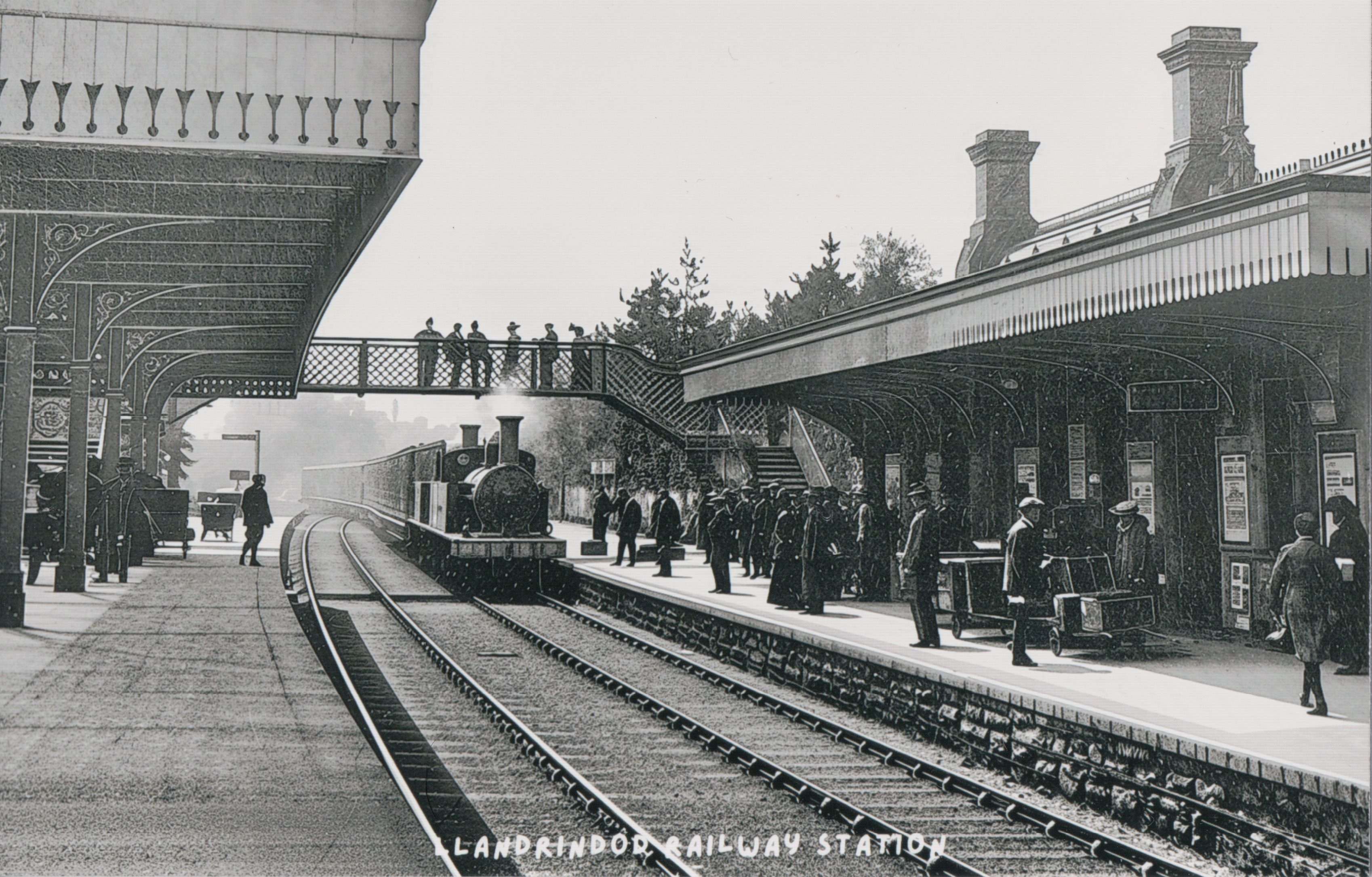
There are buildings in Llandrindod Wells which represent particular parts of the town’s history. The great hotels speak of the thousands who once came to take the waters, the pump rooms of the spa itself, and the shops and villas of the commercial and residential town which grew around them. The railway station is different. It belongs not simply to one part of the story, but to the mechanism which made much of the later town possible. Without the mineral waters there would have been little reason for Llandrindod to become a spa, but without the railway it is difficult to see how that spa could ever have developed into the Victorian town which emerged during the second half of the nineteenth century.
When the railway reached Llandrindod in 1865, there was still remarkably little here that a modern visitor would recognise as a town. The mineral springs had been known for generations, visitors had been coming to the district long before the railway, and places such as Rock House, Rock Park and the Pump House already belonged to the developing spa landscape. Yet this remained essentially a rural watering place on an exposed Radnorshire common. Distance imposed a very real limitation. Reaching the wells required time, money and a willingness to undertake a journey which could still be inconvenient. The coming of the railway did not create the waters or the first visitors, but it changed the scale upon which the place could develop.
Within little more than a generation, Llandrindod had become one of the principal inland resorts in Wales, with substantial hotels, boarding houses, shops, villas and places of entertainment, together with a seasonal population drawn from far beyond Radnorshire. The enclosure and development of the common were fundamental to that transformation, but the railway gave the new town access to the outside world. It brought people, goods, letters, newspapers, building materials and investment into a place which had previously been restricted by geography. The railway did not arrive because a large town required a station. To a considerable extent, the large town grew because the railway had arrived.
The coming of the railway
The railway reached Llandrindod in October 1865 as the Central Wales Railway pushed southwards through Radnorshire. The opening was celebrated on 10 October, when a special train came from Shrewsbury. Accounts of the occasion describe an extraordinary train of eighteen coaches hauled by two locomotives. Despite poor weather, people gathered to witness its arrival, and around 150 guests later attended a banquet in the grounds of Rock House. It was a celebration not simply of a new railway connection, but of the possibilities which that connection appeared to offer a place which had long possessed attractions but lacked easy access.
It is worth considering what those first railway passengers actually saw when they arrived. They were not stepping into the mature Victorian town familiar from later photographs. There was no fully developed commercial centre, comparatively little dense development around the station, and none of the architectural confidence which would later characterise the resort. The railway had effectively arrived amidst common land and countryside. For its first few years Llandrindod stood close to the end of the line, but in 1868 the route was completed southwards to Llandovery, forming part of the through railway between the Swansea and Llanelli districts, Mid Wales and Shrewsbury. Llandrindod had been drawn into a national system of movement and communication.
That altered what was economically possible. By the later nineteenth century, through carriages and railway connections brought visitors from London, Birmingham, Liverpool, Manchester and other large centres. The railway ceased to be merely a means of reaching the town and became one of the foundations upon which its tourist economy rested. A visitor could leave one of the great industrial or commercial centres and arrive directly in the heart of Radnorshire without the long and uncomfortable final road journey which had previously restricted the market for inland spas. Local railway history records that through carriages once connected the Central Wales route with places including Manchester, Liverpool, Birmingham and London.
For many visitors, therefore, the railway station was their first sight of Llandrindod. Hotel porters waited to identify new arrivals and take charge of luggage, while horse-drawn carriages gathered outside to convey guests towards the Pump House, Rock Park, the larger hotels, boarding houses and private lodgings. The spacious station forecourt, now familiar principally as a parking area, would once have echoed to the movement of horses, carriages, porters, luggage and arriving visitors. During the height of the season this must have been one of the most animated places in the town.
The timetable consequently became one of the rhythms by which Llandrindod lived. Hotels organised themselves around arrivals and departures, traders awaited deliveries, visitors planned excursions according to train times, and letters, newspapers and parcels moved through the same railway system. The station was not simply a building at the edge of the town. It was the point at which Llandrindod met the wider world.
William Killan and the early railway
No individual illustrates that transformation better than William Killan. The surviving London & North Western Railway staff material records his entry into railway service at Llandrindod in August 1866, less than a year after the line opened. His later railway obituary remembered that he came to Llandrindod as stationmaster soon after the opening of the railway, when the place was still very small. Killan did not arrive to take charge of an established station serving a mature Victorian resort. He arrived while railway and town were both still in their infancy.

The obituary later described Killan as one of the links between the old and new Llandrindod Wells, and there was considerable truth in the phrase. He had known the place when the Pump House, Rock Park Hotel and Llanerch were among the relatively few substantial buildings, and when much of the later centre had not yet taken shape. Over the following thirty-six years he watched streets advance across former open land, hotels multiply, passenger traffic increase and the railway station itself develop alongside the town. His career and the making of Victorian Llandrindod therefore ran almost in parallel.
One of the most revealing details concerns the beginning of his married life. According to the railway obituary, Killan and his bride initially occupied two rooms above the railway goods shed because suitable accommodation had not yet been provided for the stationmaster. It is a wonderfully human detail, but also an important piece of evidence for the very early railway settlement. The company had appointed a responsible official to manage its station, yet the infrastructure which would later surround the post had not caught up with the development of the line.
The building in which the young couple lived can also be identified. The goods shed had been erected in 1865, the very year in which the railway reached Llandrindod. It stood on what became Station Crescent and survived, heavily adapted, for more than a century and a half. In its last decades most local people knew it not as an old railway building but as Eric Evans Car Sales. The Clwyd-Powys Archaeological Trust recorded it in detail in December 2018, identifying substantial surviving fabric of the original 1865 goods shed before its demolition. Until 2019, therefore, Llandrindod still possessed a building directly associated not only with the opening of the railway, but with William Killan’s earliest married life.
The census returns allow his household to be followed through the developing railway settlement. In 1871 he was living at Railway Cottage and was already described as stationmaster. By 1881 he and his wife Lucy were there with their daughters, Lilian and Agnes, together with a relative and a domestic servant. The presence of domestic help is worth noticing because it helps place Killan socially. He was a railway employee, but the stationmaster belonged to the supervisory ranks of the company, with secure employment, authority and a degree of middle-class respectability. Railway companies were intensely hierarchical institutions, and that hierarchy could be expressed just as clearly in housing and domestic circumstances as in uniforms and titles.
Some years after Killan’s marriage, the railway company provided a more substantial stationmaster’s residence. By 1891 the census records him at a property named Station House. He was then a widower, living with his daughter Lilian and a domestic servant. Immediately following the household in the enumeration were the refreshment rooms at the London & North Western Railway station, where a barmaid was resident. This places Killan firmly within the railway complex and provides an unusually intimate glimpse of the relationship between workplace and home.
A photograph of Station Crescent taken around 1893 brings that evidence vividly to life. The railway buildings stand to the left, while opposite them is a substantial detached house behind carefully maintained hedges. Powys local-history material identifies it specifically as the stationmaster’s house. Taken together with the 1891 census and Killan’s obituary, the evidence strongly associates the house with his tenure. It was no modest railway cottage. Its scale and position reflected the social standing of the stationmaster, the senior local representative of a company upon which so much of the town’s prosperity depended.

The photograph reveals something else as well. Almost thirty years after the first train arrived, Station Crescent still retained a surprisingly rural appearance. Hedges and open ground remained within sight of a station bringing visitors from cities hundreds of miles away. The railway represented steam, telegraphy, timetables and national communication, yet immediately beside it survived a landscape still recognisably belonging to rural Radnorshire. The picture captures the new Llandrindod being built over the old.
The station grows with the town
The physical station developed in much the same way. The railway site dates from 1865, but it did not remain unchanged. Cadw’s listing for the surviving signal box specifically refers to the 1874 rebuilding and enlargement of the station, providing important evidence that the first railway establishment was substantially developed less than a decade after opening. The No. 1 signal box, originally erected beside the Brookland Road level crossing and opened in 1876, belongs to this period of expansion. Killan was already stationmaster, and he therefore witnessed not simply the growth of the town around his station, but the enlargement of the railway establishment itself.
This mid-1870s rebuilding makes historical sense. The station built for the small watering place of 1865 could scarcely have been expected to meet indefinitely the demands of a town developing with extraordinary speed. More passengers required more accommodation, more luggage had to be handled, goods traffic increased and the workings of the railway became progressively more complex. What began as a comparatively modest rural station was being adapted to serve a fashionable resort.
Killan appears to have taken particular pride in the appearance of the station. His obituary records that he planted many of the trees which adorned the station and its approaches. That detail changes the way the surviving photographs can be read. The stationmaster was not concerned solely with signalling, timetables and staff discipline, but with the impression made upon visitors arriving in Llandrindod. In a spa town, where reputation and appearance mattered greatly, the railway station functioned as a public entrance. A well-kept approach, carefully planted and maintained, helped establish an immediate impression of order and prosperity.
His long service also made him a familiar figure to generations of visitors. The obituary records that Killan became personally known to some of those who returned regularly to the spa. Most strikingly, the celebrated soprano Adelina Patti was remembered as someone who made a point of seeing him when visiting Llandrindod. He also formed friendships through his passion for fishing, and was sometimes invited to join visitors on fishing expeditions. The picture which emerges is not of an anonymous uniformed official, but of a man who had become part of the social fabric of the resort.
Killan’s enthusiasm for fishing produced one of the best surviving anecdotes of the early railway. In the quieter years, when comparatively few trains stopped at Llandrindod, he could go fishing between services. His obituary recalled how he once returned only minutes before a train was due, hurriedly changed into his stationmaster’s uniform, saw the train through the station, then changed back into his fishing clothes and went out again. The story is amusing, but it also measures the transformation of the railway. The station which later dealt with great seasonal crowds had once been quiet enough for its stationmaster to disappear to the river between trains.
Fire at the station
That comfortable routine was shattered on Tuesday 23 October 1888, when fire broke out during the early hours of the morning. The South Wales Echo reported the incident that same day, while the Waterford Standard carried the story in Ireland on the following morning. The waiting rooms, booking office and refreshment rooms were among the accommodation burnt out, with contemporary reports making clear that this was not a minor fire but a serious attack upon the passenger side of the station.
The fire belongs at the centre of the architectural history as well as Killan’s personal story. The station had been rebuilt and enlarged in the 1870s, but the passenger accommodation which emerged afterwards could not simply have remained unchanged through 1888. Rooms had to be repaired, reconstructed or refitted following the blaze. The station visible in photographs of the 1890s was consequently a product not merely of the 1865 foundation and 1874 enlargement, but of reconstruction after one of the most serious incidents in its nineteenth-century history.
For Killan, the immediate problem was practical. A railway could not simply close indefinitely because part of the station had burnt. Trains still had to be handled, railway movements controlled, passengers accommodated and damaged premises made safe. Contemporary reporting indicates that traffic was maintained using the opposite side of the railway. There appears to have been no loss of life, but the fire destroyed something less visible and historically just as important.
On 25 October, two days after the fire, the London & North Western Railway issued an internal circular concerning Llandrindod. The surviving archive catalogue describes the matter in stark language, recording the station as destroyed by fire and noting that records were lost. That brief administrative phrase is one of the most important pieces of evidence connected with the incident. It confirms that the destruction went beyond timber, plaster, furniture and station fittings. Part of the documentary memory of the early railway disappeared with them.
Precisely what those records contained is not known. They may have included correspondence, accounts, staff papers, operational documents or other local station material. Whatever they were, their loss may partly explain why some aspects of the early physical and administrative history of the station are now difficult to reconstruct. Victorian railway companies generated formidable quantities of paperwork, yet a few hours of fire could destroy the local record of decades.
The census of 1891 provides a particularly interesting view of the station only three years later. Immediately after Killan’s household at Station House, the enumerator recorded the refreshment rooms at the LNWR station, where a barmaid was resident. The refreshment rooms were therefore not simply a counter at which passengers bought food and drink. They formed part of a working and partly residential railway environment. The rooms damaged in 1888 were connected directly with the lives of the people employed there.
By about 1893, the station was again being photographed as an apparently settled railway establishment. The surviving Station Crescent view is therefore more valuable than it first appears. It shows the railway functioning normally only about five years after the fire and provides a visual marker between the known enlargement of the 1870s and the further developments of the Edwardian period.
Another mishap followed remarkably soon after the fire. In 1889 a portable steam engine belonging to a Cardiff firm was loaded onto a wagon at Llandrindod goods yard. The station apparently lacked a loading gauge with which to establish whether the unusually high load would clear structures along the route. The train left Llandrindod, but at Penybont the engine struck a bridge. The LNWR was ordered to compensate its owner, with the damage assessed at £40. The incident may appear almost comic beside the fire, but it provides a rare glimpse of the goods yard handling heavy machinery and of the practical complications which accompanied Victorian freight traffic.
Passengers, goods and the working railway
The passenger railway naturally dominates the history of Llandrindod because visitors made the spa profitable, but the goods railway was no less important to the functioning of the town. Hotels accommodating hundreds of people required food, coal, furniture, linen and innumerable other supplies. Builders needed timber, stone, ironwork and manufactured fittings. Shops required stock, businesses depended upon regular deliveries, while agricultural produce from the surrounding countryside could be dispatched towards wider markets. The goods yard west of the station formed an essential part of this economic system.
The railway therefore contributed to Llandrindod in two distinct but inseparable ways. Passenger trains delivered the people upon whom the spa economy depended, while goods trains helped build, feed, heat and furnish the town in which they stayed. The rise of the great hotels cannot properly be understood without appreciating the supply system which sustained them. A fashionable spa in central Radnorshire had to import enormous quantities of goods, and the railway made that possible on a scale which road transport had not previously allowed.
Communication was another part of the story. Mail and newspapers travelled by train, reinforcing the connection between railway and Post Office and allowing the increasingly sophisticated businesses of the spa to communicate rapidly with the rest of Britain. The later building of the main Post Office directly opposite the station on Station Crescent seems particularly appropriate. Railway and post had both helped overcome the geographical isolation which had once constrained the place.
The railway was also a substantial workplace. Behind the public face represented by Killan were clerks, porters, signalmen, goods staff and men employed on the permanent way. Railway employment imposed a form of discipline very different from the traditional rhythms of agricultural life. Trains could not run approximately on time. Watches, bells, signals, telegraph messages, regulations and written instructions governed the movement of trains and the conduct of staff. A successful railway depended upon hundreds of apparently ordinary actions being performed correctly every day.
Nowhere was this more obvious than in the signal boxes. Llandrindod possessed more than one, with No. 1 box opening at the Brookland Road crossing in 1876. The box now preserved on the station platform is that structure, although it no longer occupies its original position. Coflein describes it as an LNWR Type 4 box and records that the 17-lever frame inside is thought to date from 1906, evidence of another phase of railway modernisation in the opening years of the twentieth century.
This helps resolve the earlier suggestion that the whole station was built anew in about 1905. The evidence now points to a much more gradual evolution. The railway site was established in 1865, substantially rebuilt and enlarged in 1874, equipped with the new signal box in 1876, damaged and partly reconstructed after the fire of 1888, and modernised further during the Edwardian period. The 1906 signal frame is tangible evidence of that continuing investment, but there is no need to imagine the entire earlier station being swept away and replaced in a single operation. Llandrindod station grew in stages, just as the town around it did.

Killan’s later years and Alfred Thomas
William Killan remained in charge until 31 May 1902, by which time he had served at Llandrindod for about thirty-six years. His railway staff record shows his salary rising over the course of his career, reaching an annual figure of around £130 by the end of the nineteenth century. The progression reflects both his long service and the importance which the station had acquired since his arrival in 1866.
His private life had also changed. Lucy Killan had died before the 1891 census, leaving William a widower. By 1901 he was still recorded as a railway stationmaster, and after retirement he remained in Llandrindod rather than returning permanently to his native Shropshire. In 1911 he was living at Rockfield, aged seventy-four, and described himself simply as a retired railway stationmaster. The census schedule bears his own signature and records that the two children of his marriage were both still living. The occupation had become part of his identity.
Killan died on 17 April 1919 at the Nursing Home in Spa Road. His address was then Merlin, Temple Street, and probate was granted at Hereford in June. His estate, valued at £637 4s. 4d., was respectable rather than wealthy, entirely consistent with the circumstances of a long-serving senior railway employee who had spent most of his adult life in one provincial town.
The railway’s obituary understood the significance of his career unusually well. In describing him as one of the links between the old and new Llandrindod Wells, it recognised that his life coincided almost exactly with the making of the Victorian town. Killan had arrived when modern Llandrindod scarcely existed. He had lived above the goods shed, occupied the stationmaster’s house, planted trees around the station approaches, watched the traffic increase, made friends among generations of visitors, dealt with the fire of 1888 and remained at his post until the opening years of the twentieth century. His obituary was accompanied by a photograph, allowing us to put a face to the man who stood at the centre of railway Llandrindod for more than three decades.
By the time of his death, another stationmaster occupied the company residence. Alfred Thomas belongs to the next generation of the story. Later evidence shows that Thomas became a figure of some standing in the town, serving as a Justice of the Peace and participating in local organisations before retiring in 1925. The contrast between the two men is historically useful. Killan arrived while Llandrindod was being created. Thomas inherited the mature resort which resulted.
The station they knew, however, continued to evolve. Improvements in signalling around 1906 show that the LNWR was still investing in the railway during the Edwardian peak of the spa. The idea of a single “1905 station” is therefore too simple. By then the site already embodied four decades of development, the opening of 1865, the rebuilding and enlargement of 1874, the fire and reconstruction after 1888, and continuing alterations as the traffic of the mature resort demanded them.
A railway that never really slept
The fashionable visitor saw only one side of the railway. Behind the daytime bustle of arrivals and hotel carriages was a line which continued working after the town’s visitors had gone to bed. Freight remained important enough for the Central Wales route to operate twenty-four hours a day into the early 1960s. At night, goods trains passed through Llandrindod while signalmen remained at their posts, signals and lamps illuminated the railway and staff continued working in conditions largely invisible to those staying in the hotels above the town.
This is worth remembering because the comparatively quiet station of the present can distort our understanding of what it once was. Railway traffic was not simply a sequence of daytime passenger trains serving holidaymakers. It was part of a continuous transport system carrying goods, mail and people through Mid Wales. The station, goods yard, signal boxes and level crossing formed a working railway landscape as much as a tourist gateway.
The connection between railway and resort nevertheless remained powerful into the twentieth century. On 23 October 1952, exactly sixty-four years after the great station fire, Queen Elizabeth II arrived at Llandrindod on her way to open the Claerwen Dam in the Elan Valley. A stone from the dam was later set into the platform to mark the place where she first stepped onto Welsh soil after her accession. The coincidence of the date is striking. On one 23 October, the station was burning and records were being lost. On another, it was receiving a young Queen.
The station’s ceremonial role in 1952 also demonstrates that, despite the declining spa economy and growing importance of the motor car, the railway remained Llandrindod’s principal formal point of arrival. The same essential function which had shaped Killan’s working life in the nineteenth century continued into the reign of Elizabeth II.
Post-war contraction and survival
The world around the railway was nevertheless changing rapidly. After the Second World War, private motor-car ownership increased, bus and coach travel expanded, freight increasingly moved by road, and the long spa season which had generated so much railway traffic had largely disappeared. Facilities constructed for the needs of Victorian and Edwardian Llandrindod began to seem excessive, and British Railways responded by progressively reducing the station.
The original platform canopies disappeared, sidings and signalling were simplified, and the goods facilities declined. In 1955, the up, or western, platform and its buildings were taken out of railway use and the rails beside them were lifted. Importantly, the substantial passenger building itself survived, standing for three decades beside a platform which had lost its normal railway function. The platform and buildings were fully reinstated when the passing loop returned to the station in 1986.

Another structure was less fortunate. No. 2 signal box closed in 1958 and was demolished. No. 1 box, at Brookland Road, continued operating until June 1986. When that too became redundant, preservation rather than demolition was chosen. The Victorian structure was dismantled and re-erected on the down platform in 1989, on the site of the demolished No. 2 box, and opened as a museum in 1990. The signal box seen at Llandrindod today is therefore genuine nineteenth-century railway fabric, but it is not in its original position.
The same mixture of survival and reuse can be seen in the canopy now standing on the main platform. It is not the original station canopy, but was salvaged from the Pump House Hotel when that great spa building was demolished and later re-erected at the station. There is something particularly appropriate about this. The Pump House and the railway had been two of the institutions most closely involved in the making of Victorian Llandrindod, one bringing visitors into the town, the other accommodating and treating them. The hotel has gone, but a fragment of it now survives beside the railway which once delivered its guests.
The modern station is therefore not an untouched Victorian monument. It is a layered historical site. Buildings have been enlarged, burnt, repaired, abandoned, restored and reused. One signal box disappeared, another was moved. Canopies were lost and one from a demolished hotel was brought in to replace part of what had vanished. Platform 2 was closed and later restored. The physical history is complicated, but that complexity is precisely what makes the station valuable as evidence for more than a century and a half of changing railway use.
The 1865 goods shed and Eric Evans
The old goods shed survived all of these changes for much longer than might have been expected. Its railway purpose eventually disappeared, but the structure found another use in the motor age. In January 1985 Eric and Ann Evans established Eric Evans Car Sales there, giving an 1865 railway building a new life associated with the very form of transport which had done so much to reduce the railway’s dominance.

Ann Evans later recalled helping to decorate the old railway shed when the business was established. The premises were subsequently expanded, a showroom was added, and in 1992 the company became a Vauxhall dealership. For more than thirty years the earliest railway building was therefore hidden in plain sight. Many people who knew it simply as Eric Evans’s garage were entering a structure which had stood since the first year of the railway and in which William Killan and his wife had once begun married life.
Eric Evans retired in 2018, and Powys County Council acquired the site. The Clwyd-Powys Archaeological Trust surveyed the building in December that year before redevelopment. The investigation confirmed the significance of the original 1865 structure and recorded the surviving stone fabric. The building was subsequently demolished as part of the development associated with the new transport interchange, which opened in 2019.
Its loss deserves more than a passing mention. The goods shed had survived the entire rise of the Victorian spa, the rebuilding of the station, the fire of 1888, two world wars, railway nationalisation, the decline of local freight and the rise of the motor car. It had stood for more than 150 years, long enough for people living today to remember using it as a garage, yet its railway origins reached directly back to the year in which modern Llandrindod began to take shape.
There is a certain irony in the end of the building. A structure erected for one transport revolution survived into another age, became a motor business, and was finally demolished as part of another transport redevelopment. Its disappearance in 2019 is also a useful reminder that heritage loss at Llandrindod does not belong only to the distant Victorian or post-war past. Significant historical fabric has continued to disappear within living memory.
The railway that made Llandrindod
It would be wrong to suggest that there was no Llandrindod before the railway. The waters had attracted visitors long before 1865, and the older spa landscape was already developing. What the railway changed was scale. It transformed the number of people who could realistically reach the town, brought the building materials from which Victorian Llandrindod was constructed, delivered coal, food, furniture, newspapers and mail, carried agricultural and commercial goods away from the surrounding district, and provided secure employment to generations of railway families.
Most importantly, it connected this small part of Radnorshire with a much larger world. The railway allowed Llandrindod to sell itself not merely to people within travelling distance by road, but to visitors across Britain. It made the huge investment in hotels and boarding houses economically credible. It made possible the movement of goods required to sustain them and created a dependable route through which visitors, money and information could enter the town.
William Killan’s life provides the clearest human expression of that transformation. He arrived in 1866 when modern Llandrindod scarcely existed. He and his young wife began married life above the goods shed, he later occupied the stationmaster’s house, raised a family here, planted trees around the station approaches, went fishing between trains during the quieter early years, became familiar to generations of visitors, knew figures such as Adelina Patti and faced the great station fire of 1888. During his career the station was rebuilt and enlarged, burnt and repaired, while the town beyond it expanded almost beyond recognition.
When Killan first arrived, the railway stood within a landscape which was still largely rural. By the time he retired in 1902, Llandrindod had become a mature spa town, and when he died in 1919 much of the Victorian townscape which remains familiar today was already established. The railway company’s description of him as one of the links between the old and new Llandrindod Wells was therefore entirely justified.
The railway outlasted him, and it has outlasted much of the world he knew. The great spa crowds have disappeared, the Pump House Hotel has gone, the Victorian goods yard has vanished and even the goods shed erected in the railway’s first year survived only until 2019. Yet trains still arrive at Llandrindod, more than 160 years after the special train from Shrewsbury first announced that a new age had reached the common.
The history of Llandrindod Wells railway station should not therefore be regarded as a specialist railway story standing apart from the history of the town. It belongs at the centre of it. Without the mineral waters there would have been little reason for Llandrindod to become a spa, but without the railway it is difficult to see how that spa could ever have become Victorian Llandrindod Wells.
Related Essays
- Llandrindod Wells History, the main guide to the town’s waters, hotels, railway, institutions, enterprise and social history.
- The Waters That Built a Town, the wider story of the mineral springs and the making of the Victorian spa.
- The Pump House Hotel, the hotel, spa economy and working community that grew alongside the railway age.
- The Welsh Shopping Centre, the Central Wales Emporium and the commercial life of railway-era Llandrindod Wells.
- The Mid-Wales Railway, the wider railway network that connected inland Wales with national markets and communities.
Explore more Llandrindod Wells history: Llandrindod Wells History brings together the town’s mineral waters, hotels, railway, enterprise, institutions and social history.
Sources and Further Reading
The principal primary sources for William Killan are the surviving London & North Western Railway staff records, the census returns for 1871, 1881, 1891, 1901 and 1911, probate records and his obituary in the London & North Western Railway Gazette of 1919. These provide the basis for his appointment, family circumstances, railway accommodation, later residence, retirement and death, while the obituary preserves the particularly valuable recollections of his early life above the goods shed, the planting of the station approaches, his sporting interests and his relationships with visitors.
The principal contemporary evidence for the fire is the South Wales Echo, 23 October 1888, and the Waterford Standard, 24 October 1888, together with London & North Western Railway Circular 2196 of 25 October 1888. The LNWR archive catalogue specifically records both the fire and the loss of station records.
The architectural history of the station and signal boxes is recorded by Cadw and the Royal Commission on the Ancient and Historical Monuments of Wales. Cadw identifies a rebuilding and enlargement of the station in 1874, while Coflein records the opening of No. 1 signal box in 1876, the probable 1906 date of its present lever frame, the closure and demolition of No. 2 box, the withdrawal of Platform 2 in 1955 and its reinstatement in 1986.
The former goods shed was recorded in detail by the Clwyd-Powys Archaeological Trust immediately before demolition in 2018. Local and planning records document its later use as Eric Evans Car Sales and the redevelopment of the site for the transport interchange. HistoryPoints provides additional material on the goods yard, the 1889 portable-engine accident, the loss of the old station canopies and the reuse at the station of the former Pump House Hotel canopy.
The photograph of Station Crescent dating from about 1893, together with the accompanying nineteenth-century mapping, remains particularly important visual evidence for the stationmaster’s house, the railway approaches and the still comparatively undeveloped landscape around the station. When read alongside the census returns and Killan’s obituary, it allows the railway environment of his long tenure to be reconstructed with unusual clarity.