
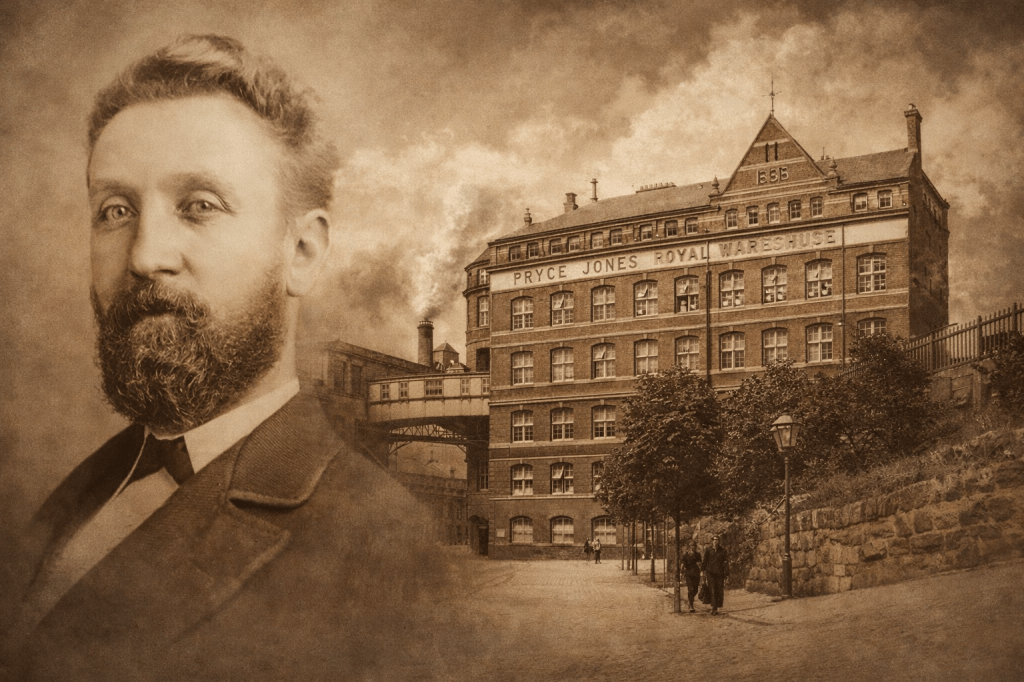
The Welsh Entrepreneur Who Engineered Distance from Newtown
In the standard story of modern retail, innovation belongs to cities. Manchester industrialises production, London refines display, Liverpool masters distribution. Yet one of the most consequential changes in consumer life began not in a metropolis, but in Newtown, Montgomeryshire. From this small mid-Wales market town, Sir Pryce Pryce-Jones built what is widely recognised as the world’s first large-scale mail-order enterprise, altering how goods moved, how rural households bought, and how distance functioned within the British economy. (source 1; source 7)
His achievement was not merely commercial. It was geographical.
Mid-Wales in the Nineteenth Century: Constraint and Possibility
When Pryce Jones was born on 16 October 1834 at Llanllwchaiarn, near Newtown, Montgomeryshire was overwhelmingly rural. (source 1) Its economy revolved around agriculture, chapel life, and market exchange. Settlements were dispersed. Capital was modest. Social authority was local.
Newtown, however, possessed a distinctive industrial character for so small a town. It had long been associated with flannel manufacture and woollen production, linking it to regional and national markets. (source 2) Yet before the railway reached the town in the 1850s, distribution was constrained. Roads were slow. Markets were periodic. Retail ambition typically remained within walking or carting distance.
The structural problem was not production. It was reach.
Pryce Jones understood that the arrival of rail and the maturation of the postal system were not incidental improvements. They were transformative instruments.
From Draper to System-Builder
Apprenticed in the drapery trade, he established himself in business in Newtown in the 1850s, later adopting the trading name “Royal Welsh Warehouse.” (source 1; source 4) The title was strategic. “Royal” conferred legitimacy. “Welsh” emphasised provenance. “Warehouse” signalled scale beyond the conventional shop.
But branding alone does not create a system. Connection does.
The arrival of the railway in Newtown, first with the Llanidloes and Newtown Railway in 1859 and then, more decisively, with the Oswestry and Newtown Railway in 1860–61, integrated the town into the expanding national rail network. (source 12; source 14) That connection was catalytic. A catalogue is theory until dispatch becomes reliable.
From this point, Pryce Jones developed the method that made him famous: catalogues and price lists distributed beyond the town, orders received by post, goods picked and packed in volume, parcels dispatched by rail. (source 1; source 7) Retail became choreography.
He did not merely exploit infrastructure, he helped shape it. The Dictionary of Welsh Biography records his advisory involvement around the Post Office Parcels Act of 1882. (source 1) He understood that state systems and private enterprise were mutually reinforcing.
In Montgomeryshire’s economic history, such structural imagination is rare.
Mail Order and the Gendered Household
It is easy to speak abstractly of “rural households” entering consumer culture. In practice, mail order had a distinctly gendered impact.
In small-town retail environments, purchasing could be mediated by familiarity, credit relationships, and social hierarchy. Catalogues altered that dynamic. They allowed browsing at home. They permitted comparison. They offered privacy of choice. In households where women managed domestic consumption in practice, even where men controlled formal credit, the catalogue represented a subtle shift in agency.
Scholarship on British mail order retailing emphasises that the industry became socially powerful when it aligned itself with the rhythms of women’s lives and increasingly addressed them directly as decision-makers. (source 17) Pryce Jones’s system, with its emphasis on direct correspondence and department-based selection, sits naturally within that trajectory.
Mail order did not simply sell cloth. It redistributed access.
The Royal Welsh Warehouse: Infrastructure in Brick
The Royal Welsh Warehouse was not simply a large shop. It was purpose-built commercial infrastructure.
Cadw’s Grade II listing confirms that the principal structure was erected in 1879 for Pryce Jones by David Walker of Liverpool. It was extended in 1886–87 and again in 1901 with a substantial wing toward Kerry Road, incorporating a post office to handle the immense volume of mail-order traffic. (source 15)
Architecturally, it is declarative. The principal elevation comprises seven bays, three storeys with attic and basement, in red brick laid in Flemish bond with freestone dressings. A central stepped gable bears the inscription “Pryce Jones, Royal Welsh Warehouse.” (source 15)
The façade carries ideological weight. It incorporates the Royal Arms and sculptural ornament representing Industry, alongside exhibition medallions commemorating Vienna 1873 and Philadelphia 1876. (source 15) These are not decorative afterthoughts. They are stone inscriptions of international legitimacy.
Most revealingly, Cadw records that a bridge once connected the warehouse to the factory opposite at third-floor level. (source 15) Manufacture, storage, packing, and dispatch were physically integrated.
The railway did not merely serve the warehouse, it completed it. Pryce Jones’s catalogue system was a disciplined method, a set of administrative routines for choice, ordering, picking, packing, and dispatch. But only the railway could convert that method into scale. The station was the hinge, the point at which Newtown’s internal order met the national network, and where a rural enterprise could operate with imperial reach. (source 15)
Modern data records the complex at approximately 6,192 square metres, around 66,654 square feet, adjacent to Newtown railway station. (source 16) In rural Montgomeryshire, such scale is extraordinary.
A Hybrid Enterprise: Warehouse and Department Store
The Royal Welsh Warehouse was not hidden industrial plant. It was open to the public.
While serving as the operational heart of a mail-order system, it also functioned as a department store and showroom. Customers could visit in person and purchase goods directly, even as thousands more ordered remotely. (source 15)
Pryce Jones fused two retail worlds under one roof: the counter and the catalogue, the showroom and the packing floor. That hybridity strengthens his claim to pioneering status.
The Euklisia Rug: Standardisation and Scale
The flannel and the catalogue formed the backbone of the enterprise, but Pryce Jones also understood the power of standardised products.
In 1876 he patented the Euklisia Rug, often described as the world’s first commercially produced sleeping bag. (source 5) Designed as a portable, fastened rug with an integrated pillow, it was built for durability and repeatable manufacture. The Newtown Textile Museum records that he secured a contract to supply 60,000 rugs to the Russian Army during the Russo-Turkish War, though part of the order was later cancelled, leaving surplus stock for wider markets. (source 5)
This episode encapsulates his logistical imagination: conceive a product suitable for scale, secure institutional demand, and use distribution networks to absorb surplus. It was industrial thinking applied to cloth.
Prestige and Provincial Power
Commercial success translated into public authority. He received royal patronage and was knighted in 1887, thereafter styling himself Pryce Pryce-Jones. (source 1) He served as Conservative MP for the Montgomery District of Boroughs in two periods between 1885 and 1895, and as High Sheriff of Montgomeryshire in 1891. (source 1; source 6)
Yet he did not relocate to London. He remained in Newtown.
That decision is historically significant. It meant that employment, prestige, and architectural statement were concentrated in a rural market town. He demonstrated that provincial did not have to mean peripheral.
Company as Civic Institution
The Royal Welsh Warehouse was more than a business. It was a civic presence.
A report in the Aberystwith Observer of 4 July 1907 describes a sports and band contest organised by the firm in commemoration of his knighthood, attracting around 10,000 attendees and requiring special trains. (source 8) In a town of modest scale, that is institutional influence.
Archival materials preserved in the Pryce Jones Collection confirm the administrative sophistication of the enterprise. (source 9)
Death and Wealth in Context
Sir Pryce Pryce-Jones died at Dolerw, Newtown, on 11 January 1920. (source 10) His obituary in the Montgomery County Times and Shropshire and Mid-Wales Advertiser emphasised both the scale of his achievements and his rootedness in Montgomeryshire society. (source 10)
A probate notice recorded unsettled property of £7,701 13s 6d gross, with net personalty of £6,607 19s 11d. (source 18) In 1920, agricultural labourers were earning roughly a couple of pounds per week, skilled building workers under five. (source 19) His estate represented decades of skilled wages, substantial provincial wealth, though not aristocratic scale.
He died as he had lived, locally anchored, nationally consequential.
After the Founder
Over the interwar period the dominance of the Royal Welsh Warehouse declined. In 1938 the company was taken over by Lewis’s of Liverpool, marking the end of effective family control. (source 20)
The building entered a long afterlife of varied commercial uses, later achieving Grade II listed status in 1988 in recognition of its architectural and historic importance. (source 15)
Historical Significance
Sir Pryce Pryce-Jones occupies a singular place in Welsh economic history. He demonstrated that rural Wales could generate systems of national and international consequence. He integrated rail, post, manufacture, and retail into a coherent operational organism. He built an empire without abandoning his hometown.
The Royal Welsh Warehouse remains a material testament to that achievement. It stands as evidence that in the nineteenth century a Welsh draper recognised that infrastructure was transformative technology, and that a market town could become a global address.
From Newtown, he reconfigured distance itself.
Sources
- Dictionary of Welsh Biography, “PRYCE JONES, Sir PRYCE (1834–1920)”
- Newtown Textile Museum, “The Collection”
- Newtown Textile Museum, “The First Royal Welsh Warehouse” (PDF)
- Newtown Textile Museum, “Euklisia Rug” (PDF)
- UK Parliament, Historic Hansard
- Archives Wales blog, “The stories in historic adverts”
- Welsh Newspapers Online, The Aberystwith Observer, 4 July 1907
- StoriPowys, “M/D/PJ The Pryce Jones Collection”
- Montgomery County Times and Shropshire and Mid-Wales Advertiser, obituary, 17 January 1920
- Llanidloes and Newtown Railway historical context
- Oswestry and Newtown Railway historical context
- Cadw Listed Building Report, Royal Welsh Warehouse (Grade II)
- Property listing data, Royal Welsh Warehouse floorspace
- Oxford Academic, Mail Order Retailing in Britain: A Business and Social History
- British Newspaper Archive, probate notice “Sir Pryce Jones’s Estate”
- UK Parliament, Hansard, “Average Weekly Wages,” 30 July 1925
- Pryce Pryce-Jones, takeover by Lewis’s of Liverpool (1938)
