
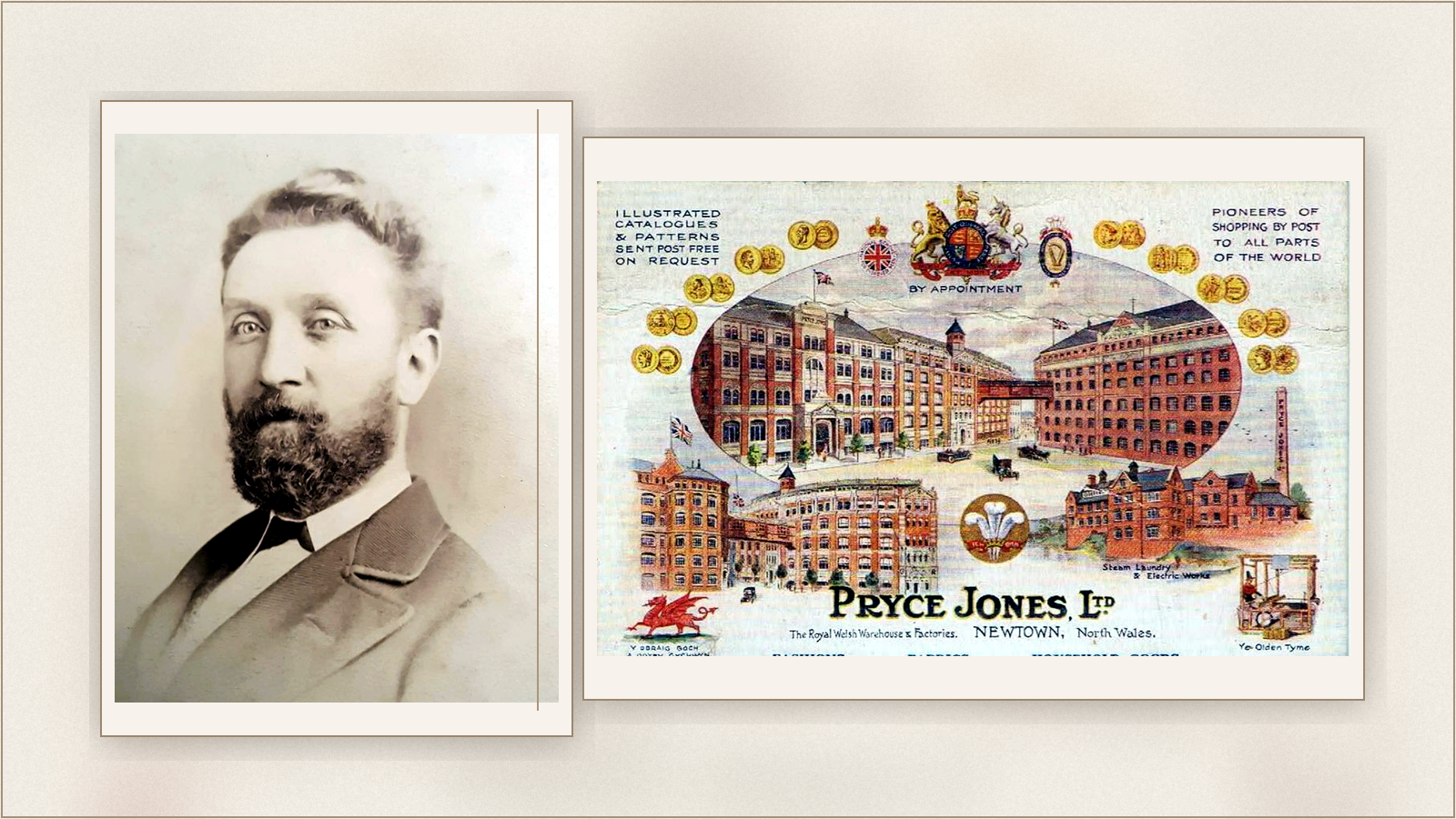
Growing up in mid Wales, a trip to Newtown was a big thing, and especially a trip to “Pryce Jones”. By the late 1980s and 1990s the great Royal Welsh Warehouse was already a very different place from the business created there by Sir Pryce Pryce-Jones more than a century earlier. Parts of the building were occupied by Poundstretcher, although the store I remember bore little resemblance to the narrower discount operation familiar today. It seemed to contain almost everything, with departments for clothing, shoes, toys, food and household goods. There was also a catalogue returns shop and a café, while away from the public areas of the building a catalogue call centre continued a direct connection with the trade that had made the place famous. To a child it seemed enormous, and even then I found the building fascinating. Newtown was not a large town, yet beside its railway station stood this immense Victorian commercial complex which seemed almost too substantial for its surroundings. You did not need to know anything about nineteenth-century business history to realise that something important must once have happened there.
That childhood impression was correct. The Royal Welsh Warehouse was the physical expression of one of the most remarkable Welsh businesses of the nineteenth century. From Newtown, Pryce Pryce-Jones developed a system of selling goods to customers who might never visit the town, combining catalogues, the postal service and the rapidly expanding railway network. His business reached across Britain and overseas, supplied royal households, employed large numbers of people and eventually carried its founder into Parliament, a knighthood and the upper reaches of Montgomeryshire society. The familiar description of Pryce-Jones as the inventor of mail order is perhaps too simple, because goods had been ordered at a distance before his time. What made him important was the scale and organisation of what he created. He recognised that several developments taking place around him, improved postal communication, railway transport, large-scale manufacturing, printing and advertising, could be brought together into a single commercial system. In doing so he reduced one of the greatest disadvantages faced by a business in rural mid Wales: distance.
Newtown, Welsh Flannel and the Railway
Pryce Jones was born on 16 October 1834 at Llanllwchaiarn, immediately outside Newtown, the second son of William Jones, a solicitor, and Mary Ann Goodwin. Through his mother there was also a distant family connection with Robert Owen, the Newtown-born social reformer whose ideas about industry, community and cooperation became internationally influential. The relationship should not be overstated, but it places Pryce-Jones within another strand of the remarkable nineteenth-century history of Newtown.
Local historical research gives a little more shape to his early life. He was educated in a schoolroom above the Green Tavern in New Church Street before entering the drapery trade, and the business itself moved through increasingly substantial premises in Newtown, from Broad Street to larger accommodation at the Cross and eventually to the purpose-built warehouse beside the station. A surviving photograph of Pryce and Eleanor taken in 1863, only a few years after the mail-order experiment began, appears to be the earliest known image of the couple. Newtown’s first professional photographic studio had opened only the previous year, and the portrait captures them before the titles, public honours and great warehouse that came to define the later story.
Montgomeryshire was still overwhelmingly rural, with agriculture dominating both the economy and the structure of everyday life, but Newtown had developed along a rather different path. The town stood at the centre of an important textile industry, particularly associated with Welsh flannel, and its manufacturers and merchants were already accustomed to selling beyond the immediate locality. Wool from the surrounding countryside fed an economy of spinning, weaving, finishing and distribution which connected a small Welsh market town with much wider markets. Pryce-Jones entered this world through the drapery trade, serving an apprenticeship before eventually taking over the business of John Davies in Newtown during the 1850s. Had circumstances remained unchanged, he might have become a prosperous provincial draper and little more.
The arrival of the railway changed the possibilities available to him. The Llanidloes and Newtown Railway opened in 1859 and further connections soon linked Newtown with Oswestry and the national railway system. For local manufacturers this meant cheaper and faster transport, but Pryce-Jones appears to have recognised something more fundamental. A business no longer needed to depend entirely upon customers being able to reach its premises. If descriptions and prices could be sent out by post, orders could return in the same way and the railway could carry the finished goods to distant customers. The significance lay not in any one of these elements individually, but in the way they were combined. The postal service carried information, the railway carried merchandise and the warehouse brought production, storage, packing and administration together in one place.
Price lists and catalogues allowed customers to examine goods without travelling to Newtown. Orders were received, selected, packed and dispatched, often to railway stations many miles away. There were earlier examples of remote selling and it would be unwise to claim that Pryce-Jones simply invented the entire concept from nothing, but he developed mail-order retailing on an unusually large and systematic scale. His achievement was to understand how the new infrastructure of Victorian Britain could transform the relationship between retailer and customer. A household in an isolated rural district no longer needed to undertake a long journey to obtain goods from a large shop. Pryce-Jones had found a commercial answer to geographical isolation, and he had done so from a town which itself suffered from that isolation.
The chronology can now be stated with unusual precision. On 3 October 1859 Pryce-Jones recorded sending flannel samples by post, free of charge, to prospective customers beyond Newtown. Exactly twenty years later, on 3 October 1879, the great Royal Welsh Warehouse opened beside the railway station. The coincidence of those dates neatly measures the transformation of the business. What began as an experiment in reaching customers who could not conveniently visit his shop had, within a generation, become an industrial-scale system of ordering, storage, packing and distribution.
His practical experience with distribution appears to have become sufficiently important that it fed back into national policy. The Dictionary of Welsh Biography records that Pryce-Jones developed his own parcel-post system through the railways and later advised the government when the national parcel-post service was introduced in 1882. If so, the relationship between his business and modern distribution was more reciprocal than is sometimes suggested. He built his enterprise by exploiting improvements in transport and communication, but the experience gained at Newtown also contributed to the development of the system itself.
From Draper to Gentleman
The census returns provide a particularly useful way of following the social consequences of that success. In 1861 Pryce Jones was still a comparatively young draper in Newtown, living with his wife Eleanor and their growing family. Later returns show a steady transformation in occupation, household and status as the business expanded. By the 1870s and 1880s he was no longer simply a shopkeeper but a substantial employer, while the increasing presence of domestic servants and the changing scale of the household reflect the family’s movement into the prosperous Victorian commercial middle class. These details matter because nineteenth-century social mobility was rarely expressed through money alone. Success altered where people lived, how households were organised, who served them, how their children were educated and the social circles within which the family could move.
By the beginning of the twentieth century Pryce-Jones was living at Dolerw, one of the substantial residences associated with his mature success. The 1911 census gives the clearest picture of the distance he had travelled socially. Sir Pryce Pryce-Jones, aged seventy-six, described himself as a retired merchant and company director, while Lady Eleanor Pryce-Jones was seventy-five. They had been married for fifty-two years and had had eight children, seven of whom were still living. Their son William Ernest Pryce-Jones, aged forty-three, was also recorded as a merchant and company director, showing that the family business had already entered a second generation. Most strikingly, the return recorded thirty-two rooms at Dolerw. Together with the household’s domestic staff, that figure gives a far more tangible impression of Pryce-Jones’s rise than any general statement about wealth. The young Newtown draper of the 1850s had become the head of a household operating on the scale expected of the late-Victorian and Edwardian elite.
Dolerw also became a setting in which commercial wealth, social ambition and an increasingly self-conscious interest in Welsh history met. In 1885 Pryce-Jones acquired substantial elements of Cwrt Plas y Dre at Dolgellau, a late-medieval hall house traditionally associated with Owain Glyndŵr. The hall, gallery and external staircase were dismantled and transported to Newtown for reconstruction in the grounds of Dolerw. The surviving architectural evidence requires caution, because the rebuilding was not an exact exercise in conservation and much fabric was replaced or recreated by Newtown craftsmen, but the episode remains revealing. Pryce-Jones had risen far enough from the drapery trade not merely to acquire a country residence, but to transplant into its grounds a building presented as a fragment of historic Wales. It was an expression of wealth, antiquarian taste and status, and another indication that by the later nineteenth century his ambitions extended well beyond commerce alone.
The Royal Welsh Warehouse
The business itself required premises capable of dealing with an entirely different volume of trade from the traditional draper’s shop. The Royal Welsh Warehouse became the great physical expression of Pryce-Jones’s ambition and remains the most visible reminder of it. The principal warehouse was erected in 1879 and enlarged substantially during the following decades, including important work in 1886–87 and another major phase in the early twentieth century. Its position immediately beside Newtown railway station was fundamental rather than incidental. The warehouse and railway functioned together, one processing the orders and goods, the other linking a small Montgomeryshire town with customers across Britain.
The complex was far more than a shop. It combined storage, manufacturing, administration, packing and dispatch, while further buildings developed around it as the company grew. Agriculture House stood across Station Approach and was linked to the warehouse at upper-floor level by a bridge, creating a substantial commercial complex on both sides of the road. Postal facilities were also incorporated into the operation, and the large 1901 warehouse wing included a Post Office because of the volume of orders being handled. Some of that commercial world remains legible inside the building. Cast-iron columns, an imperial staircase, stained glass carrying the Royal Arms and iron sliding fireproof doors survive from the Victorian and Edwardian warehouse, physical evidence of both the scale of the operation and the confidence with which it presented itself.
Expansion continued beyond the warehouse itself. In 1895 a new Royal Welsh Factory was built opposite the main premises, further concentrating manufacturing and distribution around the railway complex. Surviving photographs of its construction remain in the Pryce Jones company archive. This matters because Pryce-Jones was not simply a catalogue retailer buying finished goods elsewhere. By the 1890s manufacturing, advertising, ordering and distribution were increasingly concentrated within a single commercial system.

The name “Royal Welsh Warehouse” was itself carefully chosen. “Royal” advertised patronage and respectability, “Welsh” gave the business a clear identity, and “Warehouse” suggested an abundance of goods far removed from the image of the ordinary provincial draper. Pryce-Jones understood presentation almost as well as distribution. A Royal Warrant issued on 2 September 1880 formally authorised the use of Queen Victoria’s insignia, and by the following year the Princess of Wales had also been added to the firm’s royal appointments. Royal Arms, exhibition medals and lists of distinguished customers became part of a carefully constructed commercial identity. In 1889 he went a stage further and acquired his own printing press, allowing catalogues and other promotional material to be produced within the business itself.
Exhibitions, Reputation and Scale
The development of royal patronage can also be followed more closely than the later shorthand of a Royal Warrant suggests. At the Aberystwyth National Eisteddfod in 1865 Pryce-Jones displayed a particularly fine flannel made from Welsh mountain wool and a skirt made for presentation to the Princess of Wales. At Chester in 1866 he won both gold and silver medals, and in November of that year an order arrived directly from Queen Victoria at Windsor Castle for red flannel cloaks and ordinary Welsh flannel, some intended for charitable distribution. Contemporary reports described the excitement caused in Newtown by the royal order, while further aristocratic commissions followed. By 1869 newspapers were already referring to the Queen’s patronage as an annual occurrence. The important point is that the royal connection was built gradually through exhibition success, samples, repeat orders and skilful publicity. The firm appears to have been using the Royal Welsh Warehouse identity by the later 1860s, before the formal warrant of 1880, showing that Pryce-Jones’s instinct for branding preceded official recognition. A surviving labelled scarlet cloak, apparently made for a child, gives this otherwise promotional story a tangible form and corresponds closely with the type of garment ordered from the firm in the 1860s.
Pryce-Jones was also an unusually energetic promoter. From the early 1860s he exhibited Newtown flannel at Welsh National Eisteddfodau and at major international exhibitions in Paris, Brussels, Berlin, Vienna, Melbourne and Philadelphia. Medals and awards acquired at these events subsequently appeared in the firm’s advertising, providing another form of reassurance to customers who might never visit Newtown themselves. A surviving medal from the Vienna exhibition of 1873 is a reminder that the international reputation of the Royal Welsh Warehouse was deliberately cultivated rather than accidentally acquired.
The scale of the operation is difficult to measure precisely, not least because some surviving figures originated in the company’s own publicity, but it was unquestionably substantial. Pryce-Jones eventually claimed more than 300,000 customers around the world. Material preserved by Newtown Textile Museum records more than 300 direct employees in Newtown and Welshpool, with many hundreds more dependent indirectly upon the trade, while three dedicated railway carriages were said to leave daily for London Euston carrying goods for onward distribution. Even allowing for Victorian promotional enthusiasm, this was no longer remotely comparable with the small draper’s shop from which the business had begun.
Royal patronage formed an important part of the company’s public image, but the significance of mail order went far beyond elite consumption. Wealthy customers had always possessed the means to obtain goods from distant places. The real importance of Pryce-Jones’s system was that it widened access. Rural households, including those far from major towns, could choose goods at home and have them delivered through a national transport network. In a society in which travel remained expensive and time-consuming, that represented a substantial change in everyday consumer life.
The Euklisia Rug
Pryce-Jones also understood the advantages of standardised products. His best-known invention, the Euklisia Rug, patented in 1876, was a portable woollen sleeping arrangement frequently regarded as a predecessor of the modern sleeping bag. It was particularly suitable for military and travel use and could be manufactured, stored, advertised and dispatched in quantity. The Euklisia Rug attracted substantial institutional and military orders abroad, helping demonstrate that the company could operate on a scale far beyond individual retail purchases. The important point was not simply the invention of one useful item, but the way product, manufacturing and distribution had become parts of the same organised system.
Public Life and Newtown
Commercial success brought Pryce-Jones into the public life of both Montgomeryshire and Britain. He was knighted in 1887, served as Conservative Member of Parliament for the Montgomery Boroughs and became High Sheriff of Montgomeryshire in 1891. These honours reflected the extent to which commercial wealth could be translated into social and political authority during the later Victorian period. Yet Pryce-Jones did not detach himself from the town which had made his fortune. Newtown remained the centre of the business and the Royal Welsh Warehouse continued to dominate the area around the railway station.
This local dimension deserves greater emphasis than it sometimes receives. Pryce-Jones’s achievement was not merely personal. The company became one of the principal employers in the district and generations of Newtown families worked in its various departments. Manufacturing, packing, administration, retail, maintenance and distribution all required labour, and by the twentieth century Pryce Jones Ltd had become part of the social as well as the commercial identity of the town. The warehouse was not simply a monument to the ingenuity of one Victorian entrepreneur. It was a workplace upon which households depended and around which part of Newtown’s economic life was organised.
His parliamentary career was considerably more contested than a simple list of offices suggests. Pryce-Jones first fought the Montgomery Boroughs in 1880 and was defeated by F. S. A. Hanbury-Tracy. He narrowly won the seat in 1885, by only eighty-three votes, lost it again in 1886 and returned to Parliament in 1892. That final victory was itself challenged by an election petition alleging bribery and treating. After several days of evidence the judges upheld the result, finding the accusations insufficiently connected to Pryce-Jones or his authorised organisation. The episode places him firmly within the increasingly competitive political culture of late-Victorian Wales. Commercial prestige, royal patronage and local prominence gave him influence, but they did not confer an automatic political following in a constituency shaped by strong Liberal and Nonconformist traditions.
The First World War intruded heavily upon this established commercial world. Men associated with the company served and died, among them Sir William Lennox Napier, a long-serving director of Pryce Jones Ltd, who died during the Gallipoli campaign, and Rex Pryce-Jones, who was killed while serving with the Canadian Infantry in France in 1916. The war therefore affected not only the wider community of Newtown but the personnel and family networks surrounding the business itself.
The international reach of the family enterprise eventually moved beyond exporting goods from Newtown. In 1910 Sir Pryce’s son Albert Pryce-Jones established Pryce Jones (Canada) Ltd in Calgary, and a substantial store and mail-order operation opened there in February 1911. It became a serious local competitor in a market otherwise dominated by much larger firms such as the Hudson’s Bay Company. The Canadian venture is important because it shows the business model entering a new phase. The progression was no longer simply from a Newtown shop to British and overseas mail order, but from mail order to a permanent overseas commercial presence. By the final decade of Sir Pryce’s life, the system first developed in Montgomeryshire was being deliberately reproduced on another continent.
The influence of the company also extended into leisure and civic life. The Royal Welsh Warehouse Sports and Recreation Society developed into a significant Newtown institution, and in 1887 employees held a special sports event to celebrate Pryce-Jones’s knighthood. From 1889 the gathering was opened more widely to the public and eventually grew into a major annual festival of athletics, football, cricket, bowls, tennis, cycling, brass-band contests and other entertainments. Contemporary accounts suggest crowds that could reach many thousands, with special Cambrian Railways excursion trains bringing visitors into the town. One company excursion to Aberystwyth reportedly carried about 2,500 people.
Such provision can be read as part of the paternalist culture of large Victorian employers, benevolent in one sense, but also reinforcing loyalty to the firm and placing the employer at the centre of workers’ social as well as economic lives. Pryce-Jones’s purchase of Newtown’s old Flannel Exchange in 1890 belongs to the same wider story. The building, erected in 1832 for the older weekly flannel trade, was refurbished as a theatre and meeting hall, with the Post Office occupying the front. There is a powerful symbolism in the fact that the man who had transformed flannel selling by separating customer and seller through mail order acquired the building that had embodied the older face-to-face market system.
Sir Pryce Pryce-Jones died at Dolerw on 11 January 1920, aged eighty-five. His life had spanned an extraordinary transformation in communication and transport. When he was born there was no railway through Montgomeryshire and long-distance shopping remained cumbersome and expensive. By the time of his death, catalogues, postal ordering and national distribution had become familiar features of British commercial life. That familiarity was itself evidence of how successful the model had become, but it also created problems for the generations who followed him. The methods which had once distinguished Pryce-Jones from competitors were becoming increasingly common.
After the Founder
The company survived its founder, but recently examined evidence shows that its later history was considerably more difficult than the usual brief accounts suggest. In proceedings reported by the Western Mail on 25 May 1938, counsel for Pryce Jones Ltd told the Chancery Division that the company had experienced bad trading conditions since 1924. This date is significant because it places the beginning of the company’s difficulties only four years after Sir Pryce’s death and well before the worst years of the economic depression. No dividends had been paid on either the preference or ordinary shares for more than twelve years, substantial losses had accumulated and the company required fresh capital.
The figures disclosed to the court demonstrate the seriousness of the position. There was a debit of £60,705 on the profit and loss account, while freehold land and buildings which stood in the books at a cost of £195,785 had been revalued at only £49,940. Goodwill was to be written off and the company’s capital substantially reduced as part of a wider reconstruction. These were not the measures of a business experiencing a temporary setback. The company created by Pryce-Jones had entered a prolonged period of difficulty and required fundamental financial reorganisation before new money could be introduced.
The proposed rescue brought Pryce Jones Ltd into the orbit of Lewis’s, one of Britain’s major department-store concerns. Sir Frederick Marquis, chairman of Lewis’s Ltd, undertook to subscribe for new ordinary shares provided the existing capital was first reconstructed. Later accounts often state simply that Lewis’s took over Pryce Jones in 1938, but the contemporary court proceedings reveal a more complicated and historically more interesting process. A family business created in the Victorian age had accumulated years of losses and could no longer continue on the same financial basis. Its balance sheet had to be reorganised, accumulated losses absorbed and new capital introduced. The transition marked the movement of Pryce Jones from the world of founder-led provincial enterprise towards the much larger corporate structures increasingly characteristic of twentieth-century retail.
There is a wider explanation for the company’s difficulties. Pryce-Jones had prospered because he exploited systems which were new, railways, cheap post, catalogues and centralised distribution. By the 1920s these advantages were no longer unique. Competitors could use precisely the same infrastructure, while national retail groups possessed far greater capital and increasingly sophisticated distribution networks. The irony is difficult to miss. Pryce-Jones had helped demonstrate the enormous potential of mail-order retailing, but the success of that model created the competitive world in which his own company eventually struggled. Innovation had become convention.
Great Universal Stores and the Survival of the Name
The 1938 reconstruction did not end the company. Fifteen years later Pryce Jones Ltd remained sufficiently important to be described in the Western Mail as one of the largest employers in Montgomeryshire. On 20 August 1953 the newspaper announced that the “old-established family firm of Pryce Jones, Ltd., Newtown” had been taken over by Great Universal Stores Ltd, which had undertaken to retain all existing staff. That contemporary report is important because later sources sometimes give 1954 for the GUS acquisition, whereas the takeover had clearly been announced by August 1953.
The promise to retain the workforce also reveals the local importance of the business. By this stage the significance of Pryce Jones extended far beyond the founder’s reputation. The company had become part of the economic infrastructure of Newtown and any uncertainty over its future would have affected a substantial number of local families. It is equally revealing that the newspaper continued to describe it as a family firm more than thirty years after Sir Pryce’s death and despite the intervention of Lewis’s in 1938. The Pryce-Jones identity had acquired a value of its own.
Great Universal Stores did not immediately discard that identity. The Pryce Jones and Royal Welsh Warehouse names continued to appear in later catalogue operations, at times alongside other GUS companies including Marshall Ward. The Victorian founder had gone and the company was now part of a national catalogue empire, but the name created in Newtown remained commercially useful. This survival makes the later history especially significant because it connects Pryce-Jones directly with the great catalogue-shopping businesses of twentieth-century Britain.
The Building I Knew
By the time I knew the Royal Welsh Warehouse in the late 1980s and 1990s, its nineteenth-century commercial world had largely disappeared, but the connection with retail and catalogue shopping remained surprisingly strong. Poundstretcher occupied substantial public areas of the building, while the catalogue returns shop represented another side of the mail-order business. Goods which had been selected remotely, sent out to customers and subsequently returned were once again being sold within the very building whose history had begun with remote retail. Elsewhere in the complex, beyond the areas most customers ever saw, the catalogue call centre continued to process orders through a technology Pryce-Jones could never have imagined.
My own connection with the building did not end with childhood visits. Between 2013 and 2015 I worked there as Business Development Manager for Phoenix Community Furniture Scheme and, in that capacity, was part of the team involved in clearing the former catalogue call centre during a period when the building was again being adapted for new uses. It was a curious experience to work inside a place which had fascinated me as a child and to encounter, at close quarters, the remains of the later catalogue age. By then the technology and working practices associated with that operation had already become obsolete, yet the scale of the offices and the infrastructure left behind offered a tangible reminder of how important Newtown had remained to catalogue retail long after the Victorian origins of the business had faded from everyday memory.
The differences between Pryce-Jones’s day and the late twentieth century were obvious. The handwritten order had become a telephone call, Victorian ledgers had given way to computer systems and road haulage had largely displaced the railway parcel. Yet the underlying principle would have been entirely recognisable to Pryce-Jones. A customer somewhere else examined goods, an order reached Newtown, a central organisation processed it and the product was dispatched. The technology had changed almost beyond recognition, but the structure of the transaction had not.
Mail-order activity remained associated with the Royal Welsh Warehouse into the twenty-first century. Operations connected with Littlewoods and Shop Direct continued at Newtown until August 2011, bringing to an end more than 150 years of association between the town and catalogue retail. A catalogue returns and clearance operation survived for a further period, preserving one final public connection with the trade. The longevity is remarkable. What began in the middle of the Victorian period survived through the age of railway parcels, mass-produced catalogues, telephone ordering and computerised distribution before finally reaching the era of internet shopping.
What Became of the Royal Welsh Warehouse?
The building itself survived when many Victorian commercial and industrial structures did not. Its importance was recognised through Grade II listing in 1988, and despite changes of use much of its scale and character remain immediately apparent. Following the withdrawal of large-scale catalogue operations, the challenge became finding economically sustainable uses for a building designed for a form of retailing whose physical requirements had largely disappeared. The property was subsequently redeveloped for commercial occupation and changed ownership several times.
There was an unexpected element of continuity when clothing manufacture returned to part of the Royal Welsh Warehouse in the twenty-first century. Following the loss of employment associated with Laura Ashley’s manufacturing operations, experienced machinists were employed within the building to produce garments for modern retailers. More than a century after Welsh textiles had helped create the fortune of Pryce-Jones, clothing manufacture had returned to his warehouse. The scale and commercial context were entirely different, but the connection was difficult to ignore.
The building changed ownership again in 2025, entering another stage in a history already approaching a century and a half. Whatever uses eventually occupy it, the Royal Welsh Warehouse remains one of the most important surviving pieces of commercial architecture in mid Wales. Its unusual scale, which struck me so forcefully as a child, makes much greater sense when placed within the business that produced it. It was never designed simply to serve Newtown. It was designed to make Newtown the centre of a commercial network extending far beyond Montgomeryshire.
Pryce-Jones and the History of Modern Wales
The story also complicates the tendency to view nineteenth-century rural Wales principally through the things it was losing. Agriculture changed, populations moved, traditional communities were disrupted and the Welsh language came under increasing pressure in many districts. All of those processes are important, but Wales was not simply a place upon which modernity acted from outside. People within Welsh towns and communities also created and exploited modern systems for themselves.
Pryce-Jones belonged to that history. His business depended upon Newtown’s existing textile economy, but it also depended upon his ability to see opportunities created by national changes in transport and communication. He did not overcome the remoteness of Newtown by moving the business elsewhere. He made remoteness less important. The railway joined the town to national markets, the post allowed communication with customers and the warehouse converted those connections into an organised retail system.
His genius therefore lay less in a single invention than in understanding how different parts of a changing economy could be connected. Catalogue, post, railway, warehouse, manufacturing, printing, advertising and customer each existed independently. Pryce-Jones brought them together and demonstrated what could be achieved when they were treated as parts of one system. Later generations refined the model, national companies expanded it and eventually the internet replaced the printed catalogue, but the fundamental commercial relationship remained familiar. The customer no longer needed to stand inside the shop. That was the important change.
A Newtown Institution
When I think of Pryce Jones now, I still begin with the building rather than the businessman. I remember going there as a child, the scale of the place, the different departments, the café, the catalogue returns shop and the sense that the building contained far more than could be seen from the street. Years later I worked inside the same building and helped clear part of the call centre which represented one of the final stages of its catalogue history. At neither point did I fully appreciate how directly those experiences connected with a story that had begun in the middle of the nineteenth century.
The history makes those memories more interesting rather than replacing them. The Poundstretcher, returns shop and call centre belonged to the same long process of adaptation that had begun when a Newtown draper realised that a railway and a postal system could change the meaning of distance. The Royal Welsh Warehouse survived because it repeatedly found new functions, even when the business model for which it had been constructed changed around it.
It still looks unusually large for Newtown. That is precisely the point. Its scale records an ambition that was never confined to the town itself. Sir Pryce Pryce-Jones built an enterprise in Montgomeryshire which reached customers across Britain and overseas, and the commercial system he developed survived him by generations. His company eventually lost its independence, passed into national retail groups and disappeared as a separate concern, but the warehouse remained and the principles behind his business became part of ordinary modern shopping.
More than a century after his death, Pryce-Jones remains part of Newtown’s historical identity. In 2026 both Newtown Library and Newtown Textile Museum mounted exhibitions devoted to his life and commercial legacy, evidence that the significance of the Royal Welsh Warehouse is still being rediscovered and reassessed locally.
What looked extraordinary in Victorian Newtown eventually became something people barely thought about at all. That may be the clearest measure of Pryce-Jones’s success.
Related Essays
- David Davies, 1st Baron Davies of Llandinam (1880–1944): Wealth, Duty and the Search for an Enforceable Peace
- Arthur Charles Humphreys-Owen (1836–1905): Land, Liberalism and Public Duty in Victorian Montgomeryshire
- Clement Davies (1884–1962): Liberal Leader and MP for Montgomeryshire
- Robert Owen of Newtown (1771–1858): Industry, Character and the New Moral World
Explore more Welsh history
Browse more research in Essays and Notable People of Mid Wales.
Sources and Further Reading
- Dictionary of Welsh Biography, “Pryce-Jones, Sir Pryce”
- Cadw, listed-building record for the Royal Welsh Warehouse, Newtown
- Coflein, Royal Commission on the Ancient and Historical Monuments of Wales, Royal Welsh Warehouse
- Newtown Textile Museum, material relating to Sir Pryce Pryce-Jones, the Euklisia Rug, Royal Warrants, exhibitions and the Royal Welsh Warehouse
- Pryce Jones Collection, Powys Archives, reference M/D/PJ, including company papers, catalogues, photographs, accounts and later business records
- Elwyn V. Jones, Pryce Jones, Pioneer of Mail Order and Parcel Post and Founder of the World-Famous Business Pryce Jones Limited Royal Welsh Warehouse, National Library of Wales
- Census returns for the Pryce-Jones household, 1861, 1871, 1881, 1901 and 1911
- The Biograph, 1880
- Montgomeryshire Express, contemporary reports, advertisements and company material
- Aberystwith Observer, 4 July 1907
- Montgomery County Times and Shropshire and Mid-Wales Advertiser, obituary of Sir Pryce Pryce-Jones, 17 January 1920
- Western Mail, 25 May 1938, report on the financial reconstruction of Pryce Jones Ltd
- Western Mail, 20 August 1953, report on the acquisition of Pryce Jones Ltd by Great Universal Stores Ltd
- Kays Heritage, material on the later Royal Welsh Warehouse catalogue and Newtown operations
- Newtown and local-history material relating to the later use of the Royal Welsh Warehouse, including its twentieth and twenty-first-century commercial occupation