
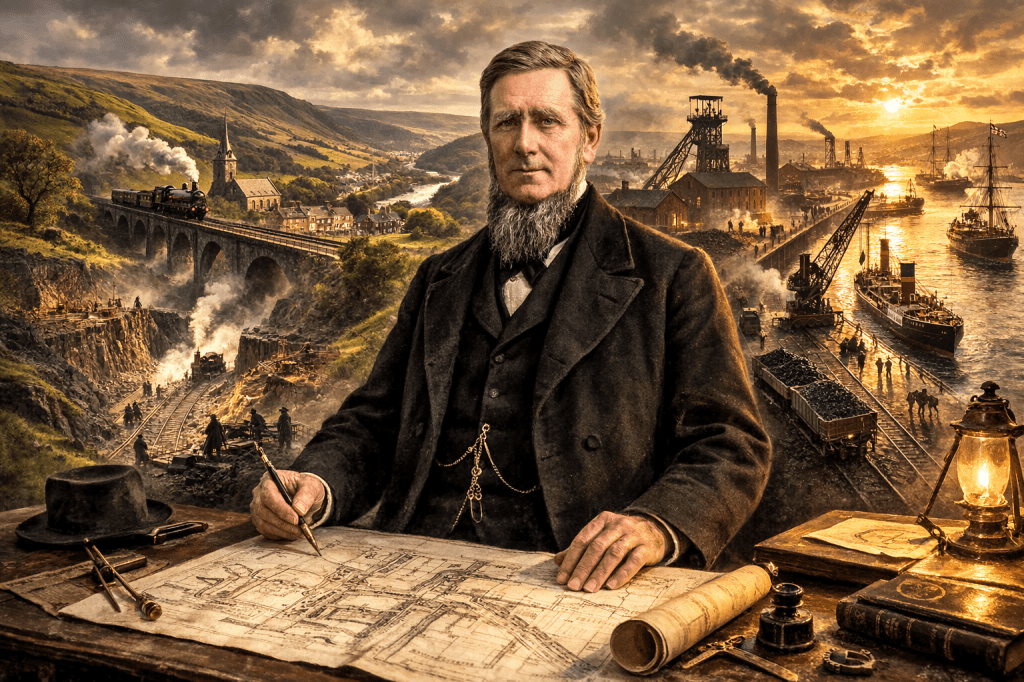
Industry, Faith, Infrastructure, and the Making of Modern Wales
There are certain nineteenth-century Welshmen whose lives do more than illustrate personal success. They expose the structural transformation of a nation. David Davies of Llandinam belongs firmly in that category.
Born in rural Montgomeryshire in 1818 and dying in 1890, Davies rose from sawyer and small contractor to coal magnate and dock founder. He reshaped railway alignments, coal production, and export infrastructure at a moment when Welsh steam coal was becoming a strategic resource in global shipping. Yet he remained culturally rooted in the Nonconformist rural society that formed him. His career sits at the junction of chapel Wales and industrial empire (source 1) (source 2).
This is not merely a story of accumulation. It is a study in power, transport, and social change.
Rural Formation and Early Enterprise
David Davies was born at Llandinam on 18 December 1818, the eldest of nine children. He left school young and worked alongside his father in farming and timber before establishing himself as a timber merchant (source 2). His early world was agrarian and chapel-centred, part of a mid-Wales society distant from the furnaces and collieries of the south.
Montgomeryshire in the 1830s and 1840s was economically peripheral. Opportunity lay not in inherited land, which was tightly structured, but in enterprise, contract work, and mobility. When Davies undertook work in 1846 connected with the approaches and foundations for a bridge over the Severn at Llandinam, he moved from rural labour into contracting, an early step into the age of infrastructure (source 3).
Railways were not simply engineering works. They were instruments of economic reordering. Those who mastered railway contracting mastered distance.
Railways and the Test of Nerve
The railway boom of the 1850s and 1860s was ruthless. Contractors misjudged gradients, geology, labour costs, or capital subscription at their peril. Many were ruined by the ordinary arithmetic of delay.
Davies prospered. In 1855 he secured the contract for the Llanidloes and Newtown Railway, opened in 1859, partnering with Thomas Savin (source 4). The partnership extended to the Newtown and Machynlleth Railway, opened in 1862 (source 5). Here, at Talerddig summit, an originally proposed tunnel was replaced by an immense rock cutting around 120 feet deep, long described as the deepest railway cutting in the world at that time (source 6). It was a project that demanded the hard virtues of Victorian contracting, workforce organisation, capital control, and resilience against weather and terrain.
Railways were Davies’ apprenticeship in scale and risk. They taught him a strategic lesson that would define his later career: infrastructure determines power.
Coal and the Expansion of Industrial Authority
In 1864 Davies entered the coal industry with a lease in the Upper Rhondda Valley, sinking the Parc and Maendy pits (source 2). He expanded steadily, forming David Davies & Co. in 1867 and developing additional collieries over the following decades (source 2).
Coal was the strategic fuel of the age. South Wales steam coal powered shipping and naval capability, and demand was global. Yet ownership of pits alone did not guarantee dominance. The decisive constraint lay in transport and export. By the 1880s Cardiff docks were congested and costly, and coal owners without independent access remained vulnerable.
Davies grasped that the future lay in integration.
Barry, Control from Seam to Sea
The creation of Barry Docks was Davies’ decisive intervention. After parliamentary contest, the Barry Railway Company secured authorisation, and Barry Docks opened in 1889 (source 7) (source 1). The effect was structural. Coal could move directly from the Rhondda valleys to a deep-water port under the control of those who produced it.
Few Welsh industrialists achieved such integration. Davies did not merely own pits. He controlled the railway that moved the coal and the dock that shipped it. That is why Barry became not only an engineering achievement but a redistribution of economic leverage within the south Wales coal trade (source 1).
Calvinistic Methodism and the Moral Register of Welsh Nonconformity
Davies remained closely associated with Calvinistic Methodism and the Nonconformist ethos of rural Wales (source 2). For an international audience, it is worth pausing briefly on what this meant in practice.
Welsh Calvinistic Methodism was not simply a church affiliation. It was a moral culture, intense, disciplined, and communal. It prized sobriety, self-scrutiny, and an ethic of work understood as duty, not merely ambition. It emphasised stewardship, the belief that time, talent, and resources were to be accounted for, used, and justified. In that environment, “respectability” was not ornamental. It was a form of social credibility, built through reliability, restraint, and visible public duty.
That moral register does not explain Davies’ success on its own, but it helps clarify the temperament that made relentless oversight, punctuality, and endurance appear not merely commercial virtues, but ethical ones.
Politics, Public Position, and Respectability
Davies served as Liberal Member of Parliament for Cardigan Boroughs and later Cardiganshire (source 2). His politics were reformist and commercially pragmatic rather than nationalist. He operated comfortably within British frameworks, even as he represented a Welsh social base shaped by chapel culture.
Industrial authority, chapel morality, and Liberal politics were intertwined in his public identity. In Victorian Wales, wealth could not simply exist, it had to be publicly legible as morally serious, particularly within Nonconformist communities that were instinctively suspicious of ostentation and inherited privilege.
Wealth and the Hierarchy of Titans
Davies died at Plas Dinam on 20 July 1890 (source 2). A contemporary probate report recorded that duty was paid on £260,135 12s as the net value of his personal estate (source 8). Even allowing for the limitations of probate figures, this was a vast fortune.
In modern consumer-price terms it equates to roughly £40–45 million (source 9). Measured against average annual earnings of the period, it represented the equivalent of many thousands of working incomes, not merely private comfort but economic power (source 10).
Hierarchy clarifies structure.
At the apex stood figures such as the 3rd Marquess of Bute, whose inherited land and dock revenues represented entrenched aristocratic capital, Anglican, landed, structurally dominant. Davies represented something different, new money, raised within one lifetime, Nonconformist in tone, commercially forged. If Bute symbolised inherited port power, Davies symbolised the industrial challenge to it through building an alternative.
A generational contrast also matters. The Guest family, associated with the Dowlais Ironworks, dominated earlier nineteenth-century Wales through iron. By the late century, coal and steam displaced iron as strategic commodities. Davies belonged to this later phase, the age of coal and rail magnates, where the commanding position lay not only in production but in export logistics.
Other coal owners could be prosperous without achieving Davies’ degree of integration. His significance lies precisely in the reach of his ownership, seam, railway, dock. The scale of this achievement is reflected in later assessments that Ocean Coal, at the time of his death, was regarded as the largest and most profitable coal company in south Wales (source 6).
Succession, Survival, and the Limits of Private Power
Davies did not outlive the full consequences of his own infrastructure. He died one year after Barry Docks opened. He was succeeded by his son Edward Davies, who inherited both fortune and burden, and who died in 1898 (source 6). The enterprise endured into the twentieth century, but the later story is also one of structural change. The era of family control could not survive the long twentieth-century shift toward state intervention and nationalisation of coal, docks, and railways, which ended private ownership of many of the systems that had made fortunes possible (source 6).
Infrastructure remained. Ownership did not.
Passing Through Llandinam, Memory and the Irony of Infrastructure
I have travelled through Llandinam many times and have often gazed up at his statue in the village. The bronze figure stands not in Cardiff or London but in the parish that formed him, anchoring global enterprise in local memory.
There is an irony that is difficult to ignore. For a man who carved railways through mountains and bound valleys to ports, Llandinam today no longer has a railway station. The lines that once symbolised progress and connection have retreated. The village that produced one of Britain’s most formidable railway contractors now lies beyond the rail network he helped expand.
That absence sharpens the biographical arc rather than diminishing it. Infrastructure is contingent. Industrial ascendancy is never permanent. Davies helped knit Wales into a global system of transport and export, and in the longer sweep of history the rails withdrew from his own doorstep.
The valleys fed the empire. The uplands remembered their sons.
The Llandinam Legacy, From Railways to International Peace
If Davies’ life represents the Victorian conquest of distance, his grandson’s career reveals how the family’s moral seriousness migrated into new arenas. David Davies, 1st Baron Davies of Llandinam, became a major philanthropist and an energetic advocate for international peace after the First World War (source 11) (source 12).
He was closely associated with the League of Nations movement, supporting the League of Nations Union in Wales and promoting the strengthening of international order, including advocacy for forms of collective security (source 12) (source 13). He also gave Welsh institutional form to this impulse, not least through his role in the conception and funding of the Welsh National Temple of Peace and Health in Cardiff, intended as a lasting civic monument to the struggle against war and disease (source 14) (source 15).
Seen in this light, the family trajectory forms a striking arc. The grandfather built railways, docks, and coal systems that served industrial empire. The grandson sought to build institutions that might restrain the forces that empire and industrial war had unleashed. The legacy moved from controlling trade routes to shaping moral and political imagination.
Conclusion
David Davies of Llandinam was not an aristocratic rentier, and he was not an early-century iron patriarch. He was a late Victorian industrial strategist who understood that control of infrastructure meant control of destiny. His life charts the movement of Welsh power from rural obscurity to global significance, and it shows how chapel seriousness could coexist with, and legitimise, industrial ambition.
His statue stands in Llandinam, and the village no longer has a station. Between those two facts lies the deeper truth of modern Welsh history, transformation is real, but it is never final.
Sources
(source 1) Wikipedia, “David Davies (industrialist)”. https://en.wikipedia.org/wiki/David_Davies_(industrialist)
(source 2) Dictionary of Welsh Biography, “DAVIES, DAVID, Llandinam (1818–1890)”. https://biography.wales/article/s-DAVI-DAV-1818
(source 3) National Library of Wales Archives, “David Davies of Llandinam Papers”. https://archives.library.wales/index.php/david-davies-of-llandinam-papers-2
(source 4) Wikipedia, “Llanidloes and Newtown Railway”. https://en.wikipedia.org/wiki/Llanidloes_and_Newtown_Railway
(source 5) Wikipedia, “Newtown and Machynlleth Railway”. https://en.wikipedia.org/wiki/Newtown_and_Machynlleth_Railway
(source 6) National Museum Wales, “The industrial legacy of David Davies”. https://museum.wales/articles/1046/The-industrial-legacy-of-David-Davies/
(source 7) Wikipedia, “Barry Railway Company”. https://en.wikipedia.org/wiki/Barry_Railway_Company
(source 8) Carnarvon and Denbigh Herald, probate report, 24 Oct 1890, Welsh Newspapers Online. https://newspapers.library.wales/
(source 9) UK Inflation Calculator, 1890 comparison. https://www.in2013dollars.com/uk/inflation/1890
(source 10) MeasuringWorth, UK earnings and prices dataset study (earnings context). https://www.measuringworth.com/datasets/ukearncpi/earnstudyx.pdf
(source 11) Dictionary of Welsh Biography, “DAVIES, DAVID of Llandinam (1880–1944), first Baron Davies”. https://biography.wales/article/s2-DAVI-DAV-1880
(source 12) Encyclopaedia Britannica, “David Davies, 1st Baron Davies”. https://www.britannica.com/biography/David-Davies-1st-Baron-Davies
(source 13) Welsh Centre for International Affairs, “David Davies 75: Internationalist ‘Father’ of the Temple of Peace”. https://www.wcia.org.uk/wcia-news/wcia-history/david-davies-75-father-of-the-temple-of-peace/
(source 14) Temple of Peace, Cardiff, “History”. https://templeofpeace.wales/en/history
(source 15) Institute of Welsh Affairs, “A New Mecca: The Story Behind the Temple of Peace”. https://www.iwa.wales/agenda/2022/08/a-new-mecca-the-story-behind-the-temple-of-peace/
