
Retail, Respectability, and the Democratization of the High Street
There is a recognisable Montgomeryshire pattern in the nineteenth century. Men formed in small, chapel-centred communities along the Dyfi valley stepped into the expanding commercial world of Britain and quietly reshaped it. Coal and rail have long dominated our understanding of Welsh industrial influence, yet modern Britain was also built in counting houses, drapery warehouses, and department stores.
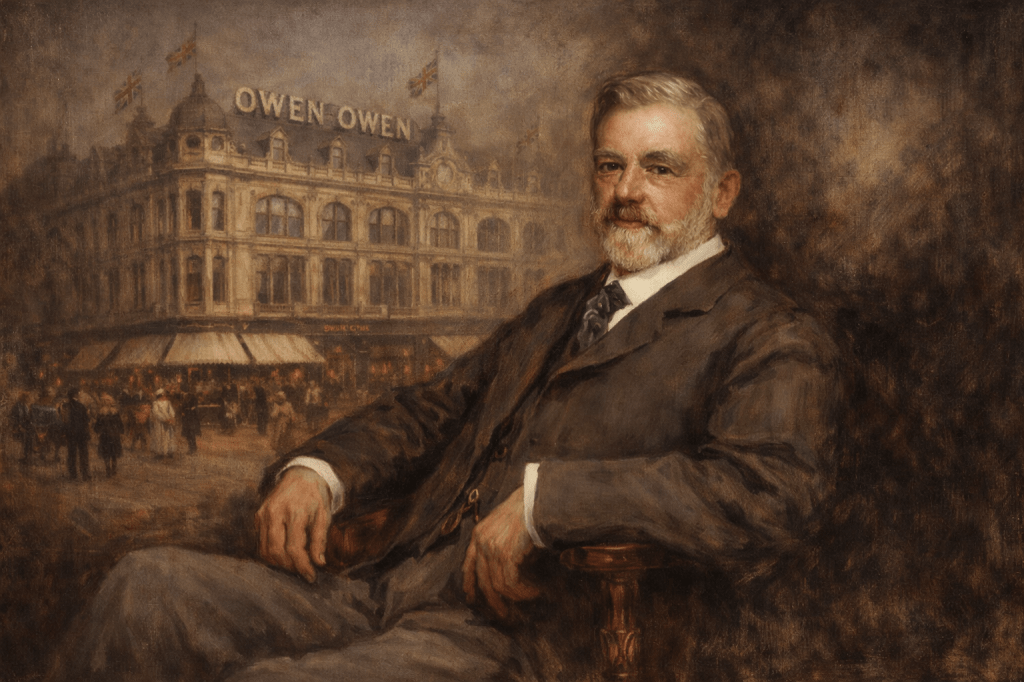
Owen Owen belongs firmly in that story. His life traces a trajectory from hill farm insecurity near Machynlleth to the ownership of a retail empire that, at its height, operated across Britain and beyond. His achievement was not merely financial. He helped normalise a new model of retail, disciplined, transparent, systematised, and in subtle but important ways, democratising.
Origins near Machynlleth
Owen Owen was born on 13 October 1847 at Cwmrhaeadr, near Machynlleth, in rural Montgomeryshire (source 1). His family were hill farmers, working land vulnerable to price fluctuation and debt. The mid nineteenth-century agricultural downturn placed immense strain on such holdings, and the family farm was eventually lost (source 2). That rupture matters. It impressed upon him both the precariousness of rural economy and the necessity of mobility.
Montgomeryshire at this time was intensely Nonconformist. The chapel functioned as school, debating chamber, and financial training ground (source 3). Literacy was valued. Public accountability was expected. Bookkeeping was not optional. Reputation operated as economic capital. These cultural disciplines travelled with Welsh migrants into English cities.
Apprenticeship and Formation
In 1860 Owen was apprenticed to his uncle Samuel Evans, a draper in Bath, and educated at Wesleyan College, Taunton (source 1). Drapery lay at the centre of Victorian consumption. Textiles and ready-made garments were increasingly accessible to urban populations, and retail was becoming professionalised.
The discipline of the drapery counter was exacting. Stock had to be managed tightly. Credit had to be judged carefully. Margins were narrow. Retail success depended not on speculation but on system.
1868: The First Store in Liverpool
In 1868, aged just twenty, Owen opened his own drapery emporium at 121 London Road, Liverpool (source 1). Liverpool was a commercial powerhouse, its docks linking Britain to global trade. By 1873 his premises employed over 120 staff and occupied substantial floor space, making it one of the largest retail operations in the district (source 4).
From the outset, Owen introduced progressive staff policies, including a weekly half-day holiday and a fund for retired employees (source 1). This was not philanthropy alone. It reflected managerial foresight. A department store required hierarchy, discipline, and loyalty.
The Department Store as Modern Breakthrough
The department store represented a structural break from older retail culture. Traditional small shops frequently operated on informal credit, with prices negotiated and accounts opaque (source 5). Customers might be drawn into cycles of dependency.
The emerging department store model introduced fixed prices, marked goods, wide display windows, and increasingly cash-based transactions (source 6). These practices reduced the humiliations of haggling and widened access to respectable consumption. Customers could browse and purchase on transparent terms without reliance on personal familiarity.
In that sense, the department store quietly democratised the high street. It standardised trust. It moved retail from negotiation to institution (source 6). Owen Owen understood this transformation. His success lay not merely in stock acquisition but in embedding structure, pricing clarity, and visible order into the architecture of commerce itself.
London, Property, and Restoration
In 1891 Owen married and moved to London while retaining involvement in his Liverpool enterprise (source 1). Rail connectivity enabled him to manage business across distance with modern efficiency.
As wealth accumulated, he invested in land. He acquired Plas Mariandir at Penmaenmawr in 1896, Tan-y-foel in 1902, and the Garthgwynion estate near Machynlleth in 1906 (source 4). Significantly, this included reacquiring the family hill farm once lost through debt (source 4). Migration and enterprise had enabled restoration.
Death and Estate
Owen Owen died of cancer in London on 27 March 1910, aged sixty-two (source 1). His estate was valued at approximately £463,568 (source 7). In Edwardian Britain this was a formidable fortune. At a time when skilled annual wages were often under £100, such a valuation placed him securely within the upper tier of private wealth (source 7).
Retail, by the early twentieth century, was capable of generating industrial-scale capital.
After Owen: Scale, Continuity, and Long Decline
The business continued under family control for decades after his death, expanding largely through acquisition (source 1). By 1979 the group operated 19 UK department stores, alongside three T J Hughes stores, and seven G W Robinson stores in Canada (source 1). This was the high-water mark of the Owen Owen retail network, stretching across major British towns and maintaining a presence overseas.
Thereafter the long structural squeeze on independent department stores intensified. Ownership changes, asset sales, and the consolidation of British retail reshaped the group (source 1). In 1996, Allders acquired several former Owen Owen stores, including branches at Basingstoke, Coventry, Ilford, Leeds, Oxford, Redditch, and Slough (source 8).
The company entered administration on 28 February 2007, and the Owen Owen brand ceased trading later that year, although some sites continued under new operators (source 1). The name disappeared, not through sudden scandal, but through gradual structural erosion of the traditional department store model.
Shrewsbury and Memory
For me, this history is not abstract.
I remember the old Owen Owen department store in Shrewsbury. It stood as a civic interior, serious and substantial, signalling that the town possessed an institutional retail presence rather than a scattering of small outlets. Department stores were social spaces, seasonal theatres, and symbols of municipal confidence.
Their disappearance marks more than a commercial failure. It reflects a shift from civic retail to transactional retail, from institutional permanence to brand fluidity.
Conclusion
From Cwmrhaeadr near Machynlleth to Liverpool and London, Owen Owen carried the discipline of chapel Wales into metropolitan commerce. He translated rural seriousness into urban system.
The department store was one of the great institutional inventions of the nineteenth century. Owen Owen helped entrench it in British life. His fortune, his estates, and the later rise and fall of his retail group together illuminate a wider truth about Welsh mobility, enterprise, and modernisation.
He was not merely a retailer. He was a builder of structure, and structure, in the nineteenth century, was power.
Sources
(source 1) Owen Owen biography and company history:
https://en.wikipedia.org/wiki/Owen_Owen
(source 2) Agricultural downturn context, mid nineteenth-century rural Wales.
(source 3) Welsh Nonconformity and chapel culture studies.
(source 4) National Library of Wales, Owen Owen manuscripts and estate acquisitions:
https://archives.library.wales/index.php/owen-owen-liverpool-manuscripts
(source 5) Studies of nineteenth-century retail credit culture.
(source 6) Retail history on fixed pricing and department store development.
(source 7) Probate valuation reference:
https://www.coulthart.com/avery/company-pages/evans-bath-history.htm
(source 8) Allders acquisition history:
https://en.wikipedia.org/wiki/Allders
