
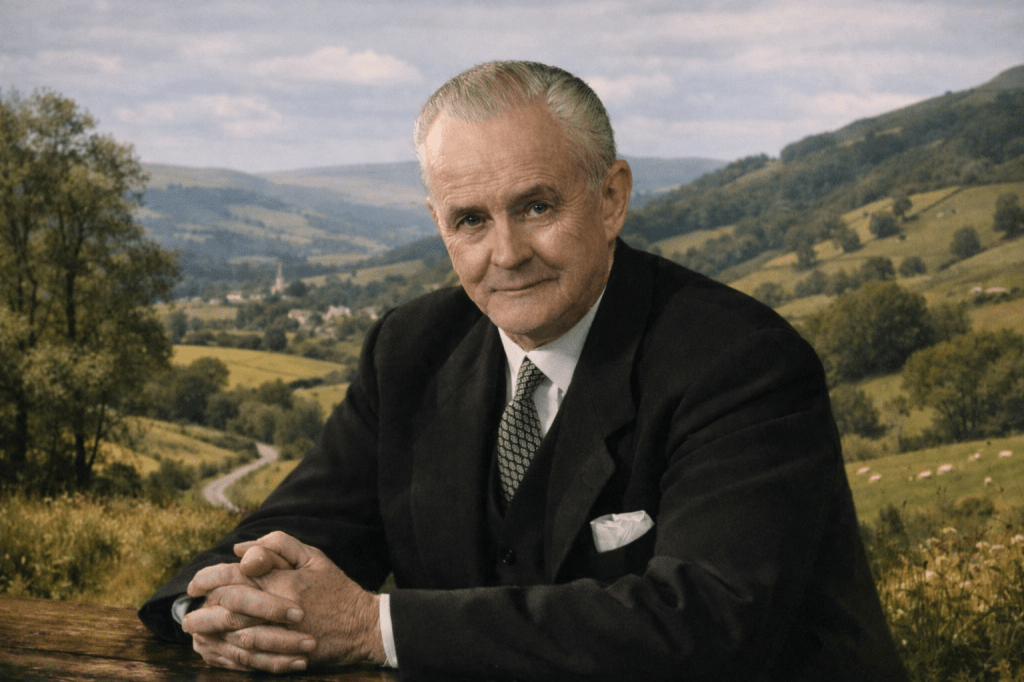
Montgomeryshire’s Last Liberal Statesman
In the political history of rural Wales, certain figures stand not merely as representatives of constituencies but as embodiments of an older political culture. Clement Edward Davies, born 14 February 1884 and died 23 July 1962, belongs unmistakably to that tradition. Lawyer, parliamentarian, wartime critic, and ultimately leader of the British Liberal Party, he represented Montgomeryshire for thirty-three years, yet his significance reaches far beyond electoral longevity. He was, in many respects, the final serious expression of Welsh Liberalism as a governing moral philosophy rather than an electoral brand.
His career traces the long twilight of a movement that had once dominated Welsh political life.
Liberal Wales and the Montgomeryshire Tradition
To understand Clement Davies, one must first understand Montgomeryshire itself. Throughout the nineteenth and early twentieth centuries, the county formed part of what historians have termed the Welsh Liberal heartland, shaped by Nonconformist religion, tenant farming communities, educational self-improvement, and suspicion of centralized authority.
Liberalism here was not abstract ideology. It was lived experience. Chapel democracy, local governance, and moral seriousness combined to produce a political culture rooted in independence of thought and civic duty. The Liberal MP was expected to function not merely as legislator but as advocate and moral representative.
Davies inherited this tradition rather than inventing it.
Born at Llanfyllin, the son of a Baptist minister, his upbringing reflected the intellectual seriousness characteristic of upland Wales. Ministerial households frequently acted as centres of literacy and debate within rural communities, and Davies absorbed early the Nonconformist emphasis upon conscience, restraint, and public duty (source 1).
Educated at Trinity Hall, Cambridge, he trained as a barrister before establishing a successful legal career. Like many Welsh professionals of his generation, he moved between metropolitan opportunity and rural belonging, maintaining deep ties to Montgomeryshire even while operating within the legal and political world of London.
Entry into Parliament and Liberal Fragmentation
Davies entered Parliament in 1929 as Liberal MP for Montgomeryshire, succeeding within a constituency long accustomed to Liberal representation. Yet he arrived at Westminster during the effective disintegration of Liberal unity.
The interwar Liberal Party fractured between followers of H. H. Asquith, David Lloyd George, and Liberal Nationals increasingly aligned with Conservatism. Davies resisted easy factional alignment. His politics were shaped less by party manoeuvre than by personal judgement, a quality admired locally but often inconvenient within national party structures (source 2).
This independence would become the defining characteristic of his parliamentary career.
War, Conscience, and the Norway Debate
Davies’ national prominence emerged during the crisis of 1940. As military failure unfolded in Norway, parliamentary confidence in Neville Chamberlain collapsed. During the historic Norway Debate of May 1940, Davies delivered a speech contributing to the growing revolt within the House of Commons.
The debate fatally weakened Chamberlain’s authority and cleared the path for Winston Churchill’s accession as Prime Minister (source 3).
Davies’ intervention was characteristic. He was neither theatrical nor revolutionary. Instead, he represented a distinctly Welsh parliamentary tradition, restrained but morally decisive, guided by duty rather than ambition.
Personal Loss and Public Stoicism
The moral seriousness often attributed to Davies was not merely political temperament. His private life was marked by profound personal tragedy.
During the years surrounding the Second World War, he and his wife Jano endured devastating loss. Three of their four children died within a short period. One son died in 1939, his daughter took her own life in 1941, and another son was killed on wartime service in 1942. Such experiences do not reduce political character to biography, yet they illuminate the emotional context within which Davies continued his public duties.
The quiet endurance with which he returned to parliamentary work and constituency service lends deeper meaning to his reputation for steadiness and restraint. What critics sometimes interpreted as caution may equally be read as resilience forged through grief (source 4).
Leader of a Dying Party
The general election of 1945 transformed British politics. Labour achieved overwhelming victory, the Conservatives reorganised in opposition, and the Liberal Party was reduced to near extinction.
Davies nevertheless became Liberal leader in 1945, inheriting not a party of government but one fighting for survival. Parliamentary representation fell to single figures, finances collapsed, and many observers assumed Liberalism would soon disappear altogether (source 5).
His leadership has frequently been dismissed as uninspiring. Such judgement misunderstands the historical task before him.
Davies’ role was preservation rather than revival.
Through administrative patience and political moderation, he maintained parliamentary continuity and organisational existence at the moment when extinction appeared likely.
The 1951 Cabinet Offer
That commitment to independence faced its greatest test in October 1951. Winston Churchill, returning to power, offered Davies a place in government as Minister of Education. The proposal recognised both Davies’ stature and the potential usefulness of Liberal cooperation.
Acceptance would have granted office and influence. Yet it would also have risked dissolving the Liberal Party into Conservative administration at precisely the moment when its independent identity remained fragile.
Davies refused.
The decision was neither dramatic nor ideological theatre. It reflected a clear constitutional instinct. A minor party, he understood, may survive defeat, poverty, or marginalisation, but rarely survives absorption. By declining Cabinet office, Davies placed institutional survival above personal advancement, preserving Liberal independence for future generations (source 6).
The Rural Liberal Mind
Throughout his career Davies remained deeply embedded in constituency life. He represented the older model of the county MP, accessible, locally trusted, and personally known across dispersed farming communities.
Montgomeryshire politics depended upon reputation rather than spectacle. Agricultural concerns, rural transport, land management, and local governance dominated his work far more than ideological display.
Even as Liberalism collapsed nationally, Montgomeryshire continued returning Davies to Parliament. His electoral endurance testified not merely to personal popularity but to the lingering strength of a political inheritance stretching back to nineteenth-century Welsh Liberal culture (source 7).
The End of an Era
By the time Davies died in 1962, the social world that had produced him was rapidly disappearing.
Chapels declined, rural depopulation accelerated, and politics increasingly rewarded media presence and centralized party machinery rather than local moral authority. The Wales that had sustained Liberal dominance since the Victorian era was fading.
Davies’ death therefore marked more than the end of a parliamentary career. It symbolised the passing of Liberal Wales as a governing cultural force.
For decades Montgomeryshire would again elect Liberal representatives, yet under fundamentally different political conditions. The continuity survived in name, but not entirely in spirit.
Historical Significance
Clement Davies occupies an unusual position in British political history. He was neither populist reformer nor charismatic national visionary. His importance lies instead in continuity.
If David Lloyd George represented the dramatic ascent of Welsh Liberalism, Clement Davies represented its dignified conclusion.
By preserving the Liberal Party through its darkest years, he ensured its survival long enough for later renewal. By representing Montgomeryshire with restraint and independence, he embodied the final maturity of a political tradition rooted in chapel democracy, conscience, and public duty.
Political history often celebrates those who transform systems. Davies reminds us of the equal importance of those who quietly prevent them from disappearing.
Footnotes
Source 1: Dictionary of Welsh Biography, DAVIES, CLEMENT EDWARD (1884–1962)
https://biography.wales/article/s2-DAVI-EDW-1884
Source 2: History of Parliament Online, Davies, Clement Edward
https://historyofparliamentonline.org/volume/1918-1945/member/davies-clement-edward-1884-1962
Source 3: UK Parliament Hansard, Norway Debate, May 1940
https://api.parliament.uk/historic-hansard/commons/1940/may/07/norway
Source 4: Dictionary of Welsh Biography, family and personal life section
https://biography.wales/article/s2-DAVI-EDW-1884
Source 5: Liberal Democrat History Group, The Post-War Liberal Party
https://liberalhistory.org.uk/history/the-post-war-liberal-party/
Source 6: J. Graham Jones, Churchill, Clement Davies and the Ministry of Education
https://liberalhistory.org.uk/wp-content/uploads/2014/10/27_jones_churchill_clement_davies-3.pdf
Source 7: BBC News Election Archive, Montgomeryshire constituency history
http://news.bbc.co.uk/1/shared/vote2005/html/451.stm
