
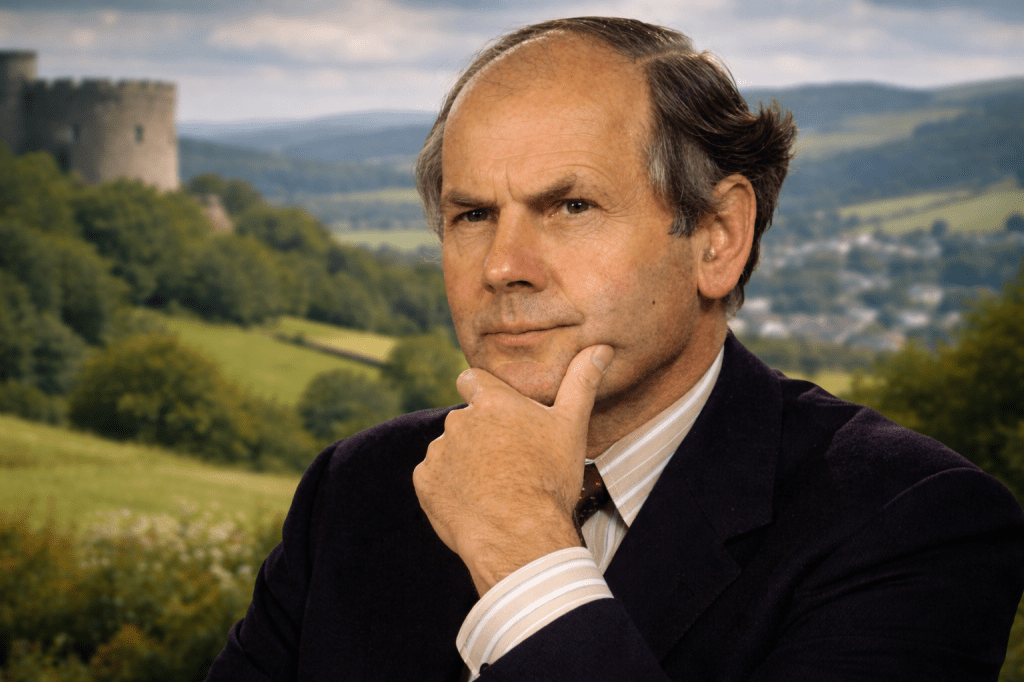
The Barrister Who Carried Welsh Liberalism Through Its Leanest Years
In the long aftermath of Lloyd George, Welsh Liberalism did not collapse in a single dramatic moment. It thinned, election by election, chapel by chapel, until it seemed less a political force than a memory. Emlyn Hooson matters because he refused to accept that quiet extinction. He did not restore the old order, no one could, but he preserved continuity at a moment when extinction was plausible, and he helped keep alive a distinctive Welsh strain of liberal constitutionalism, grounded in localism, civil liberty, and the ethical habit of dissent. (source 1)
Hooson belongs to that recognisable mid twentieth-century Welsh type, the provincial professional who moved between law, politics, public service, and business without surrendering his attachment to place. His temperament was lawyerly rather than theatrical, forensic, procedural, sceptical of grand abstractions, and alert to the ways power can slip its proper restraints. (source 2)
Origins and Formation
Born at Colomendy in Denbighshire in 1925, into a Welsh speaking farming family, Hooson was educated at Denbigh Grammar School before reading law at Aberystwyth and proceeding to Gray’s Inn. (source 1) Called to the Bar in 1949, he rapidly made his name on the Wales and Chester circuit, becoming Queen’s Counsel in 1960, a strikingly early distinction that spoke to both intellectual force and professional confidence. (source 1)
His legal career anchored his public reputation. As QC, he defended Ian Brady at Chester Crown Court in the spring of 1966, one of the defining trials of postwar Britain. (source 1) That single fact, widely recognised, does more than add colour. It signals the level at which he operated, and the sort of moral and evidential complexity that forms an advocate’s habits of mind, precision under pressure, distrust of assumption, and an insistence that the state prove its case. (source 1)
Montgomeryshire and the Burden of Inheritance
When Clement Davies died in 1962, the Montgomeryshire by-election was not merely a rural contest. It was a test of whether Welsh Liberalism retained any organic life at all. Hooson’s victory placed him in direct succession to a tradition that had shaped the county since the late nineteenth century, and which still carried the echoes of chapel radicalism, local autonomy, and an older moral politics. (source 1)
Yet he did not treat that inheritance as museum property. He understood that sentiment could not substitute for organisation. Within Liberal circles, he pushed for a more coherent Welsh structure, including a distinct Welsh Liberal Party in federated relationship with the wider British organisation, an attempt to turn fading historical identity into workable modern machinery. (source 3)
This is the context for the famous contemporary description of Hooson as a political solitary. In April 1967, Norman Cook, writing in the Liverpool Daily Post at the end of a tour of Welsh constituencies, described him at Westminster as “a kind of one-man parliamentary party like Mr Gwynfor Evans … the solitary pride and joy of all that is left of the glorious Welsh Liberalism of years gone by.” (source 4) The remark was not merely a flourish. It was a snapshot of a political reality, Hooson as the parliamentary embodiment of a once dominant Welsh political culture now reduced to a single Commons seat. (source 4)
Devolution Before Its Time
Hooson’s historical importance rests partly on his early, legislative commitment to devolution. He pursued Welsh self-government not as romantic nationalism but as constitutional reform, a redistribution of authority within the state rather than a severing from it. The record of his papers and later commentary consistently places him among the early parliamentary advocates of a Welsh legislature. (source 3)
This matters because it complicates the common shorthand history in which devolution is treated as a late twentieth-century Labour project, or as a concession wrested from the centre by nationalist agitation. Hooson represents a liberal route to devolution, rooted in dispersal of power, cultural recognition, and administrative rationality, and expressed from within Westminster rather than against it. (source 1)
Europe and the Evolution of Caution
Hooson’s relationship with Europe is best understood as a shift in emphasis rather than a sudden conversion. He is described as initially Eurosceptic, his instinct was constitutional caution, a suspicion of distant, consolidating authority, and an anti-imperialist sensibility wary of grand political projects presented as inevitable. (source 5)
By 1975, the referendum year, he treated the question with a lawyer’s concern for legitimacy, arguing in Commons debate that a referendum was consistent with parliamentary sovereignty, Parliament could not bind itself, yet government would be politically bound by the electorate’s decision. (source 6) Europe, in other words, was not only economics, it was also constitutional settlement, public consent, and the moral authority of the state.
In later life his tone softened, and his anxieties shifted towards the political consequences of strident Euroscepticism and the wider return of self-glorifying nationalism. The Guardian obituary captures that late perspective explicitly, linking his outlook to the experience of minority culture and a distrust of chauvinist political myth-making. (source 5)
1979 and the End of a Century
The convergence of the 1979 devolution referendum and the general election proved decisive. Wales rejected devolution overwhelmingly, 79.7 percent voting “No” across the country. (source 7) In Powys, the “No” vote was even higher, 81.3 percent. (source 8) Those figures matter because they show the scale of the wall Hooson, and Welsh devolutionists generally, were trying to climb. In 1979, this was not a narrow failure, it was a national repudiation. (source 7)
Soon after, in the 1979 general election, Hooson lost Montgomeryshire, ending nearly a century of Liberal representation in the constituency. (source 1) The symbolism was profound. The rural Liberal chain that had once defined Welsh political life was broken, and the county’s political identity entered a different era.
Yet his public life did not end in defeat. He was elevated to the House of Lords later that year, where his legal expertise and civil libertarian instincts found a natural arena, and where he continued to take part in debates on law, procedure, and public policy. (source 2)
Lords, Civic Wales, and the Professional Public Man
As a life peer, Hooson remained active rather than ornamental. His parliamentary record reflects a continuing interest in legal and constitutional questions, consistent with a career formed in the adversarial discipline of the courts. (source 2) Beyond Parliament, his business roles and public appointments reflected a late twentieth-century British pattern in which senior professionals moved between public service and corporate governance, carrying influence across institutional boundaries. (source 1)
Throughout, he retained an attachment to Montgomeryshire and rural Wales. This grounded his constitutionalism in lived locality. He was not a theoretician of nationhood, but a practitioner of civic responsibility.
Legacy
Emlyn Hooson’s legacy lies less in dramatic triumph than in continuity under pressure. He preserved Welsh Liberal parliamentary presence through decades when it might have vanished entirely. He advanced devolutionist argument early, and in legislative form. He embodied a liberal constitutional tradition in which Welsh identity and British parliamentary government were not enemies but tensions to be managed through institutional balance. (source 1)
If Clement Davies represented the twilight of Liberal Wales, Hooson represented its disciplined afterlife, professionalised, reorganised, and aimed toward constitutional reform rather than nostalgia. He could not rescue the old Liberal order. That was impossible. What he achieved was subtler, and more durable. He kept alive the argument, and he kept it respectable.
Footnotes
Source 1: Dictionary of Welsh Biography, “HOOSON, HUGH EMLYN (1925–2012)”
https://biography.wales/article/s8-HOOS-EML-1925
Source 2: UK Parliament, “Parliamentary career for Lord Hooson”
https://members.parliament.uk/member/1654/career
Source 3: National Library of Wales Archives, “Lord Hooson Papers”
https://archives.library.wales/index.php/lord-hooson-papers-2
Source 4: J. Graham Jones, “Emlyn Hooson (1925–2012)”, Journal of Liberal History, citing Norman Cook, Liverpool Daily Post, 15 April 1967
https://www.liberalhistory.org.uk/wp-content/uploads/2015/04/86-Jones-Emlyn-Hooson.pdf
Source 5: Andrew Roth, “Lord Hooson obituary”, The Guardian, 26 February 2012
https://www.theguardian.com/politics/2012/feb/26/lord-hooson
Source 6: Hansard, House of Commons debate, “EEC Membership (Referendum)”, 11 March 1975
https://hansard.parliament.uk/commons/1975-03-11/debates/9095b321-bb47-4108-aff7-ec2dbd40218b/EecMembership(Referendum)
Source 7: The Open University, “Introduction to law in Wales, Votes on devolution”, noting 1979 rejection by 79.7%
https://www.open.edu/openlearn/history-the-arts/introduction-law-wales/content-section-2.2
Source 8: 1979 Welsh devolution referendum results by counting area, Powys “No” 81.3%
https://en.wikipedia.org/wiki/1979_Welsh_devolution_referendum
