
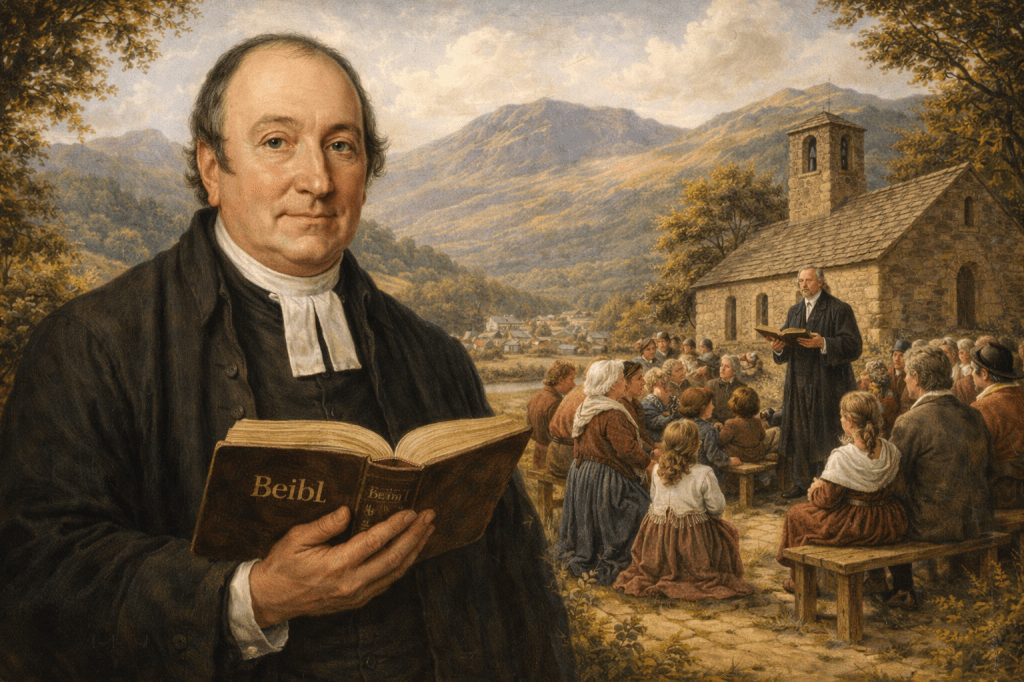
Among the architects of modern Welsh religious culture, few figures exercised an influence comparable to Thomas Charles of Bala. A Calvinistic Methodist minister, educational reformer, and promoter of biblical literacy, Charles played a decisive role in transforming the evangelical revival of eighteenth-century Wales into the structured Nonconformist culture that would dominate Welsh society throughout the nineteenth century.
The Welsh revival had begun earlier in the century through the charismatic preaching of figures such as Howell Harris and Daniel Rowland, whose itinerant ministry stirred widespread religious enthusiasm. Yet revival movements often burn brightly and then fade. What ensured the survival of the Welsh awakening was the emergence of leaders capable of providing organisation, theological depth, and institutional continuity.
Thomas Charles was one of those figures. Through the creation of a vast network of Sunday schools, the promotion of Welsh-language Scripture, and his role in the founding of the British and Foreign Bible Society, he helped construct the intellectual and spiritual infrastructure of Welsh Nonconformity. In doing so, he ensured that the revival became not merely a religious episode but a defining cultural force in Welsh life.
Early Life and Education
Thomas Charles was born on 14 October 1755 at Pantdwfn in the parish of Llanfihangel Abercywyn, near St Clears in Carmarthenshire, into a modest rural family (source 1). The Wales of his childhood remained overwhelmingly agricultural, with scattered settlements, limited educational provision, and a church structure that struggled to meet the spiritual needs of many communities.
Charles received his early education at Carmarthen Grammar School, where he displayed considerable intellectual promise. Like many ambitious Welshmen of the period, he proceeded to Jesus College, Oxford, an institution with long-standing Welsh associations (source 2). He matriculated in 1775 and graduated in 1778.
Oxford exposed Charles to the structures and expectations of the Anglican establishment. Yet it was also a period of personal religious transformation. Influenced by the evangelical revival then spreading across Britain, he experienced a profound spiritual conversion that reshaped his intellectual and pastoral outlook.
Ordained in the Church of England, Charles initially served as a curate in Somerset. His evangelical preaching soon brought him into tension with ecclesiastical authorities. His growing association with the Calvinistic Methodist movement, which increasingly operated outside formal Anglican structures, made his position within the established church progressively more difficult.
Bala and the Consolidation of the Welsh Revival
In 1783 Charles settled in Bala, a small market town in Merionethshire that would become the centre of his life’s work. The region had already been influenced by the earlier revivalist preaching of Howell Harris and Daniel Rowland, whose ministry had stirred profound religious enthusiasm across rural Wales (source 3).
Charles quickly emerged as one of the most influential leaders of the Calvinistic Methodist movement in North Wales. Unlike the earlier revivalists, whose strength lay primarily in charismatic itinerant preaching, Charles possessed a distinctive gift for organisation and institutional development.
He understood that the survival of the revival depended not merely upon emotional enthusiasm but upon education, literacy, and disciplined religious practice. The key to sustaining revival, in his view, was the creation of structures capable of shaping the religious habits of entire communities.
Circulating Schools and the Educational Vision
To appreciate the scale of Charles’s educational ambition, it is necessary to understand the distinction between circulating schools and Sunday schools, both of which formed part of his strategy for promoting biblical literacy.
The model of the circulating school had been pioneered earlier in the eighteenth century by Griffith Jones of Llanddowror. These schools were intentionally mobile. Teachers moved from one village to another, remaining in each location for a limited period, often several months, before travelling onward. Their purpose was to teach people, often adults as well as children, to read the Welsh Bible (source 4).
The system proved remarkably effective in spreading basic literacy across rural Wales. Yet its very mobility meant that it rarely created permanent educational institutions within local communities.
Thomas Charles recognised both the strengths and limitations of this approach. While he supported the continuation of circulating schools, he also realised that literacy required ongoing reinforcement. A community might learn to read during the presence of a circulating teacher, but without regular instruction the skill could easily decline.
Charles therefore promoted a complementary system in which Sunday schools provided continuing instruction within each locality (source 5).
The Sunday School Movement
The development of the Welsh Sunday school movement became the most enduring achievement of Thomas Charles.
Although Sunday schools had appeared earlier in England through the work of Robert Raikes, Charles transformed the idea into something far more expansive in Wales. In many rural districts formal schooling remained scarce, and large numbers of people had little access to education.
Charles therefore adapted the Sunday school into an institution that combined religious instruction with mass literacy.
Through these schools:
- children and adults learned to read the Welsh Bible
- scriptural knowledge spread widely through rural society
- chapel communities gained a structured educational culture
By the early nineteenth century thousands of people across Wales attended Sunday schools each week (source 6).
The crucial difference from circulating schools was permanence. While circulating schools ignited literacy, Sunday schools sustained it. They became fixed institutions within chapel communities, reinforcing reading skills and embedding biblical knowledge into weekly communal life.
The Welsh Language and Scripture
A central element of Charles’s vision was his unwavering commitment to the Welsh language.
At a time when political administration, commerce, and elite education increasingly favoured English, Charles insisted that religious instruction must take place in Welsh. Scripture, he believed, must speak directly to the people in their own language.
By promoting widespread access to the Welsh Bible, Charles helped ensure that Welsh remained not merely a spoken vernacular but a language of literacy, theology, and intellectual engagement (source 7).
In this respect his influence extended beyond religion. The religious culture he fostered played an important role in preserving Welsh linguistic identity during the profound social changes that accompanied the Industrial Revolution.
Mary Jones and the Founding of the Bible Society
One of the most famous episodes associated with Thomas Charles illustrates both the religious hunger of the period and the scarcity of Welsh Bibles.
Around 1800, a young girl named Mary Jones walked many miles from her home in Llanfihangel-y-Pennant to Bala in order to obtain a copy of the Welsh Scriptures. Such books were rare and expensive, and many families possessed none.
When she arrived, Charles was deeply moved by her determination. Although he had few copies available, he eventually provided her with a Bible (source 8).
The story became widely known among evangelical leaders in Britain and highlighted the urgent need to make Scripture more widely available.
In 1804, Charles played a key role in the founding of the British and Foreign Bible Society, an organisation dedicated to distributing Bibles across the world. What began with the needs of Welsh-speaking believers soon developed into one of the most influential missionary institutions of the nineteenth century.
The 1811 Ordination and the Secession from the Church of England
A decisive moment in Welsh religious history occurred in 1811, when the Calvinistic Methodists took the historic step of ordaining their own ministers.
For decades the movement had maintained a complex relationship with the Church of England. Methodist societies operated alongside the established church, and many leaders hoped that the revival might continue within Anglican structures.
Thomas Charles himself had long been cautious about a formal break. Yet the rapid growth of Methodist congregations created practical difficulties, particularly the shortage of ordained ministers able to administer the sacraments.
By 1811 the situation had become unavoidable. At gatherings in Bala and Llandilo, the first Calvinistic Methodist ministers were ordained. The event effectively marked the birth of a separate Welsh denomination, which would later become the Presbyterian Church of Wales (source 9).
This development represented a major turning point in Welsh religious history, signalling the transformation of Methodism from revival movement to independent church.
Bala as a Spiritual Centre
Under Charles’s leadership, Bala became one of the most influential religious centres in Wales.
Ministers, teachers, and lay leaders travelled there for guidance and instruction. Networks of Sunday schools extended across North and Mid Wales, linking scattered rural communities through shared religious education.
In effect, Bala functioned as a training centre for Welsh Nonconformity, shaping the leadership and intellectual character of the movement during a crucial period of expansion.
Death and Legacy
Thomas Charles died in Bala on 5 October 1814, leaving behind a movement profoundly shaped by his organisational vision and educational commitment (source 10).
His legacy can be understood on several levels.
First, he provided the institutional framework that allowed the Welsh revival to survive beyond its original generation.
Second, through the Sunday school movement he helped create one of the most literate rural societies in Europe, with biblical study serving as the foundation of education.
Third, his commitment to Welsh-language Scripture helped preserve the cultural and intellectual vitality of the Welsh language during a period of social transformation.
Finally, his role in founding the British and Foreign Bible Society connected the religious life of rural Wales with the global missionary movements of the nineteenth century.
Conclusion
Thomas Charles occupies a central place in Welsh religious history. Standing at the intersection of revivalism, education, and institutional religion, he transformed evangelical enthusiasm into a disciplined and enduring cultural system.
If Howell Harris and Daniel Rowland were the prophetic voices of the Welsh revival, Charles was its architect. Through literacy, organisation, and theological leadership, he ensured that the movement would leave a lasting imprint on Welsh society.
The chapel-centred Wales of the nineteenth century, characterised by remarkable literacy, moral seriousness, and deep attachment to Scripture, owed much to the vision of Thomas Charles of Bala.
Footnotes
- Eifion Evans, Thomas Charles of Bala (1755–1814), Banner of Truth, 1973.
- Geraint H. Jenkins, The Foundations of Modern Wales 1642–1780, Oxford University Press, 1987.
- D. Densil Morgan, The Span of the Cross: Christian Religion and Society in Wales, University of Wales Press, 1999.
- Welsh Biography Online, National Library of Wales, entry on Griffith Jones of Llanddowror.
- Welsh Biography Online, National Library of Wales, entry on Thomas Charles.
- Geraint H. Jenkins, A Concise History of Wales, Cambridge University Press, 2007.
- Prys Morgan, The Eighteenth Century Renaissance, University of Wales Press, 1981.
- Christopher Anderson, Annals of the English Bible, London, 1845.
- R. Tudur Jones, Faith and the Crisis of a Nation: Wales 1890–1914, University of Wales Press, 2004.
- Welsh Biography Online, National Library of Wales, “Thomas Charles (1755–1814)”.
