
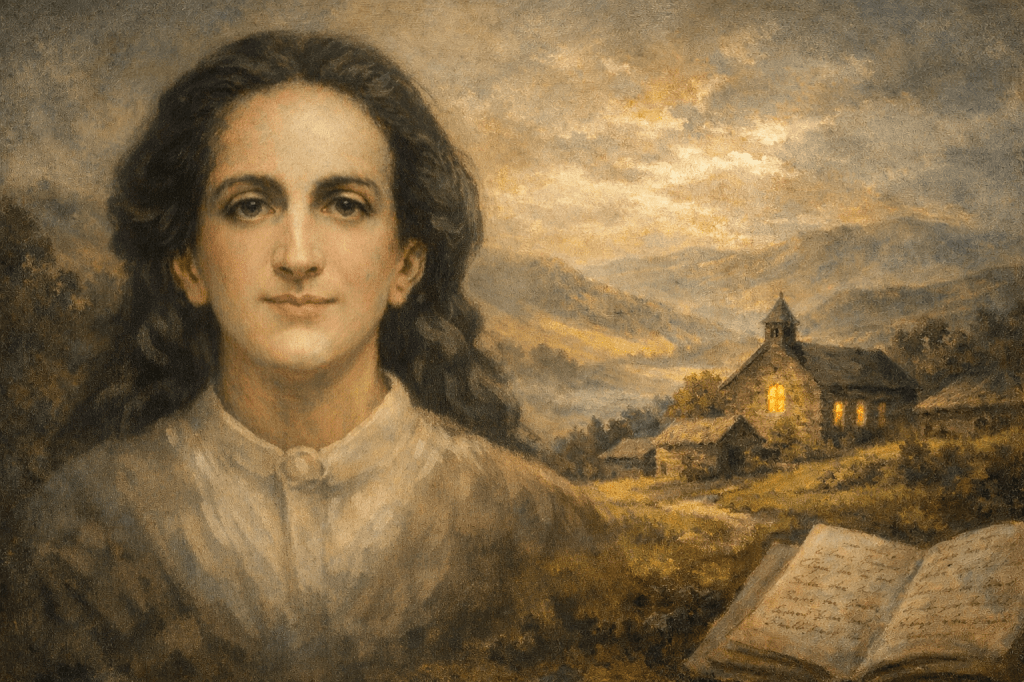
Within the religious and cultural history of Wales, few figures possess the quiet yet enduring authority of Ann Griffiths, the celebrated hymn writer of Montgomeryshire. Though her life was tragically short, ending at the age of only twenty-nine, her influence on Welsh Nonconformist spirituality has been profound and lasting. In an era when women rarely possessed a public voice in theology, Griffiths emerged as one of the most remarkable devotional poets in the Welsh language.
Her hymns, deeply mystical yet rooted in the Calvinistic Methodist tradition, helped shape the spiritual imagination of generations of Welsh chapel-goers. Through them, Griffiths articulated a distinctive vision of personal salvation, divine grace, and spiritual struggle that resonated powerfully within the evangelical revival that transformed Welsh society during the late eighteenth and early nineteenth centuries.
Ann Griffiths therefore stands not merely as a religious poet, but as a central figure in the devotional culture of Welsh Methodism and in the wider literary tradition of Wales.
Montgomeryshire and the Methodist Revival
To understand Griffiths’ life and work, it is necessary to place her within the broader context of the Welsh Methodist Revival, one of the most significant religious movements in modern Welsh history.
Beginning in the 1730s under the leadership of Howell Harris, Daniel Rowland, and William Williams Pantycelyn, the Calvinistic Methodist revival sought to renew spiritual life within the Church of England through evangelical preaching, emotional conversion experiences, and organised societies for prayer and discipline (source 1).
The movement spread rapidly across Wales, particularly in rural communities where the established church often struggled to provide regular pastoral care. Methodist meetings offered intense spiritual fellowship, moral discipline, and a powerful emotional theology centred upon Christ’s redemptive sacrifice.
By the late eighteenth century this revival had reshaped the religious landscape of many rural counties, including Montgomeryshire. Chapel societies had become integral to community life, providing not only spiritual instruction but also networks of social support and moral regulation.
One distinctive feature of Welsh Methodism was the “Seiadau”, or experience meetings. These small gatherings allowed members to describe their spiritual struggles, conversions, and moments of divine insight. They formed an intimate devotional culture in which personal religious reflection could be shared and discussed (source 2).
It was within these Seiadau that Ann Griffiths’ early poetic reflections are believed to have circulated. Her hymns likely emerged first as spoken or sung testimonies within these gatherings before gradually assuming their more formal poetic structure.
Early Life in the Uplands of Montgomeryshire
Ann Griffiths was born in 1776 at Dolwar Fach, a modest farm in the parish of Llanfihangel-yng-Ngwynfa in Montgomeryshire (source 3). The surrounding landscape of upland farms, scattered tenant holdings, and Welsh-speaking rural communities formed part of the cultural heartland of mid-Wales.
Her family belonged to the class of small farmers that sustained the rural economy of Montgomeryshire. Such households lived modestly yet maintained a strong sense of independence, moral discipline, and attachment to religious life.
Ann’s upbringing followed the familiar rhythms of rural society, agricultural labour, domestic responsibilities, and attendance at Methodist society meetings. Yet beneath this outwardly ordinary existence there developed a profound spiritual sensitivity.
The sermons she heard during Methodist gatherings left a deep impression upon her. Among the most influential voices was Thomas Charles of Bala, whose preaching emphasised personal conversion, biblical literacy, and disciplined religious life (source 4).
Charles’ efforts to expand education through circulating schools and Sunday schools also contributed to a growing culture of scriptural reading in rural Wales. This environment profoundly shaped Griffiths’ spiritual imagination.
Conversion and Spiritual Awakening
The Methodist revival placed great emphasis on conversion, understood as a transformative encounter with divine grace rather than merely intellectual agreement with Christian doctrine.
For Ann Griffiths this experience appears to have taken place during her youth. Methodist accounts describe a period of deep spiritual reflection and emotional struggle before she arrived at a powerful assurance of redemption through Christ.
This experience became the central theme of her later hymns. Unlike earlier Welsh religious poets who focused primarily on doctrinal exposition, Griffiths wrote from a deeply personal devotional perspective.
Her hymns repeatedly explore:
- the soul’s longing for redemption
- the believer’s struggle against sin
- the overwhelming grace of Christ
- the mysterious union between the human soul and the divine
In this sense Griffiths belongs firmly within the evangelical tradition of eighteenth-century Protestantism. Yet her poetry also reveals a striking mystical depth rarely equalled in Welsh hymnody.
Marriage and Life at Dolwar
In 1804 Ann married Thomas Griffiths, a fellow member of the Methodist society in the district (source 5). Their marriage appears to have been grounded in shared religious commitment and spiritual sympathy.
The couple settled at Dolwar, where Ann continued to participate actively in the life of the local Methodist fellowship. It was during this brief period of married life that many of her hymns reached their mature form.
Like much Welsh devotional poetry of the period, her hymns circulated orally rather than being written down immediately. She would recite or sing them during moments of spiritual reflection or within Methodist gatherings.
Her maid Ruth Evans memorised many of these hymns, recognising their spiritual significance. After Griffiths’ death, Ruth recited them to the Methodist preacher John Hughes of Pontrobert, who carefully transcribed them into written form (source 6).
Without this remarkable chain of oral preservation and transcription, one of the most important voices in Welsh religious literature might easily have been lost.
A Theology of Mystical Union
What distinguishes Ann Griffiths within Welsh religious literature is the theological sophistication of her hymns. At their centre lies the theme of mystical union with Christ, a concept rooted in Calvinist theology yet expressed through language reminiscent of earlier Christian mysticism.
Her poetry frequently explores the paradox of the finite human soul encountering the infinite divine presence.
One striking line expresses this tension:
“Y tragwyddol Iôr a drig mewn pridd”
The eternal Lord dwelling in dust.
The juxtaposition of tragwyddol (eternal) with pridd (dust or earth) captures the profound paradox of divine transcendence entering human fragility.
Another hymn expresses her spiritual longing with direct emotional force:
“Tyn fy nghalon at y Gŵr
Fu ar bren y groes.”
Draw my heart toward the Man
Who hung upon the tree.
Here the simple yet powerful language reflects the speech patterns of rural Montgomeryshire Welsh, while conveying a deep theological vision rooted in scripture, particularly the imagery of the Song of Songs, long interpreted within Christian mysticism as symbolising the union between Christ and the believer (source 7).
Death and the Preservation of Her Hymns
Ann Griffiths’ life ended tragically in 1805, shortly after giving birth to a daughter, Elizabeth, who survived only two weeks (source 8). The combined grief of childbirth and loss proved overwhelming, and Griffiths herself died soon afterwards at the age of twenty-nine.
Yet her voice was not silenced by death. Through the efforts of several individuals her hymns were preserved for future generations.
Three figures proved crucial:
- Thomas Griffiths, her husband, who valued and circulated her work
- Ruth Evans, her maid, who memorised many of the hymns
- John Hughes of Pontrobert, who transcribed them into written form
This process reflects the wider culture of Welsh religious communities, where poetry, preaching, and song frequently circulated through memory before reaching print.
Over the nineteenth century her hymns gradually entered Welsh hymn books and became widely sung across chapel congregations.
Ann Griffiths and the Voice of Welsh Women
Ann Griffiths’ significance extends beyond theology and literature. She also represents one of the rare preserved female devotional voices within eighteenth-century Welsh religious culture.
Women played essential roles in sustaining Methodist societies, hosting meetings, supporting itinerant preachers, and nurturing the spiritual life of their communities. Yet their intellectual and theological contributions were rarely preserved in written form.
The story of Griffiths’ hymns surviving through Ruth Evans’ memory adds a powerful dimension to this legacy. It illustrates how women themselves acted as custodians of religious culture.
In this sense Ann Griffiths’ legacy is not purely individual but reflects the broader spiritual participation of Welsh women within the Methodist revival.
Memory in Welsh Religious Culture
Today Ann Griffiths occupies a revered place within Welsh religious history. Memorials mark the site of Dolwar, and her hymns remain part of the living tradition of Welsh chapel worship.
Her enduring appeal lies in the authenticity of her spiritual voice. Unlike many writers whose influence fades with changing intellectual fashions, Griffiths speaks directly to the universal human search for redemption, grace, and divine love.
Within the wider narrative of Welsh history she represents the spiritual culture created by the Methodist revival, a movement that profoundly shaped Welsh identity, literacy, and religious life.
In the quiet uplands of Montgomeryshire, far from the centres of political power, Ann Griffiths produced one of the most profound bodies of devotional poetry in the Welsh language.
Her voice, preserved through memory, faith, and community, continues to echo through Welsh culture more than two centuries after her death.
Footnotes
- Eifion Evans, The Welsh Revival of 1735–1760 (Banner of Truth, 1969).
- R. Tudur Jones, Faith and the Crisis of a Nation: Wales 1890–1914 (University of Wales Press, 2004).
- Enid R. Morgan, Ann Griffiths (University of Wales Press, 1970).
- Thomas Charles, Memoirs of the Rev. Thomas Charles of Bala (1838).
- Geraint H. Jenkins, A Concise History of Wales (Cambridge University Press, 2007).
- E. Wyn James, “Ann Griffiths and the Welsh Hymn Tradition,” Welsh Journal of Religious History.
- D. Densil Morgan, The Span of the Cross: Christian Religion and Society in Wales 1914–2000 (University of Wales Press, 1999).
- Enid R. Morgan, Ann Griffiths (University of Wales Press, 1970).
