
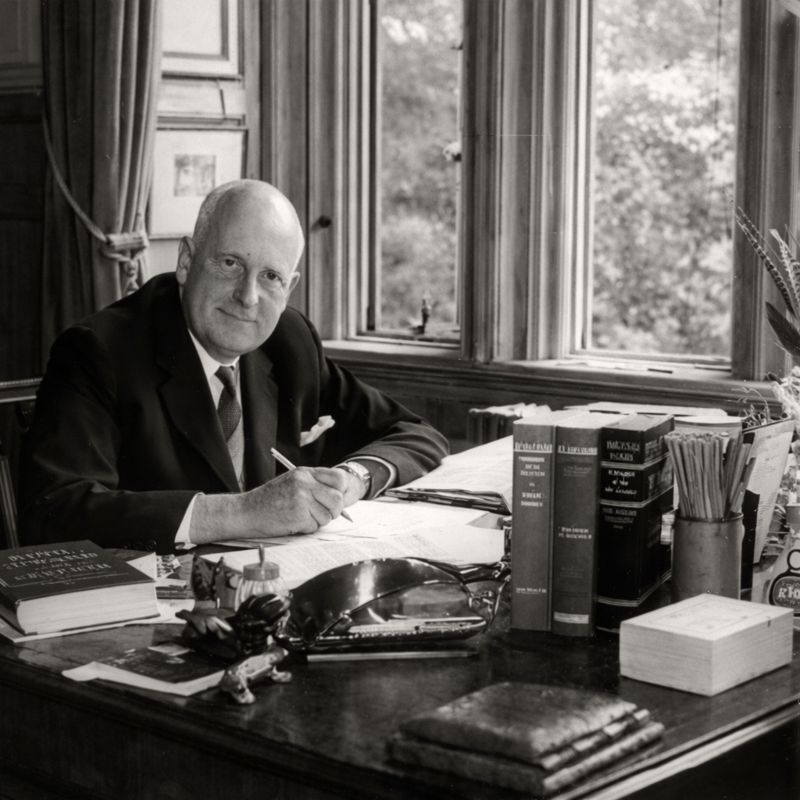
The Sir Philip Magnus-Allcroft I grew up with already felt as though he belonged to a different world. Even in the 1980s he carried himself with a kind of upright formality that seemed older than the house we lived in. To a small boy wandering through Stokesay Court he looked almost impossibly composed. Courteous. Deliberate. Aristocratic in a way that was not performed but simply lived. It was the natural shape of him.
There was something quietly Edwardian about the way he moved through a day. Not just the clothes or the voice, though those were part of it, but the small rituals he never abandoned. Courtesy was not a gesture. Routine was not a burden. Books were not decoration. They were part of the furniture of his mind. Even the act of changing shoes for slippers before dinner had a kind of ceremony to it, and I noticed that even as a child.
One of my favourite tasks was taking those slippers to him in the early afternoon. His bedroom and his study felt, to a child, as though they were separated by miles of corridor. The walk was worth it because he kept a box of Black Magic chocolates in his desk. He would look up, accept the slippers, and ask in that unmistakable voice whether I might care for a sweet. There were After Eights in the sitting room and travel sweets in the car. Stokesay was full of quiet rooms, long corridors and strategically placed confectionery.
But the chocolates are not the reason he stayed in my memory.
Sir Philip was one of the first adults to take my interest in history seriously. He gave me a guidebook to Stokesay Castle and asked questions that assumed I had answers. Who built it. Why it was fortified. What made it matter. He encouraged me to explore the library. At Christmas he chose presents that were startlingly serious for a child not yet ten. An Oxford English Dictionary. My first encyclopaedia. The encyclopaedia was meant to be my gift in 1988. He died days before Christmas and I never thanked him.
Only later did I understand what those gifts meant. He was not indulging a precocious child. He was telling me, in the understated language of his generation, that knowledge mattered.
Nearly forty years on, after a life spent researching and writing, I can see the influence clearly. He did not set out to make a historian of me. He simply behaved as though curiosity deserved encouragement. Sometimes that is enough.
A Family of Books and Expectation
Philip Montefiore Magnus was born in Westminster on 18 February 1906 into a family where books and public life were part of the air. His father Laurie Magnus was an author and publisher. His grandfather, the first Sir Philip Magnus, was a major figure in Victorian and Edwardian educational reform. His maternal grandfather Sir Isidore Spielmann was prominent in British cultural and Anglo-Jewish affairs.
He inherited not only a name but a tradition of public duty and scholarship.
His childhood was intellectually privileged but not always emotionally easy. His sister Ruth remembered a gifted and highly strung boy who was sensitive to criticism and conscious that much was expected of him. The composed public figure of later years seems to have been built partly upon a more restless temperament beneath the surface.
There were early signs of independence. As a boy he became fascinated by Dracula. When parental disapproval intervened he simply used his London Library membership to obtain another copy. It was typical of him. Listen politely. Form his own judgement. Proceed quietly.
At Westminster School he distinguished himself as a writer and won a poetry prize for work on Marie Antoinette. At Wadham College Oxford he combined intellectual seriousness with meticulous dress. He was remembered as something of a dandy complete with top hat.
The elderly gentleman I later saw sunbathing in a three piece suit, polished brogues, an overcoat and a sombrero had clearly been refining his sartorial independence for decades.
Duty, Politics and the Difficult 1930s
After Oxford he entered the Civil Service, joining the Board of Education in 1928. It was a fitting path for someone from a family steeped in educational reform. For him status required usefulness.
The 1930s reveal a more complicated figure than the kindly historian I knew. Like some upper class Conservatives of his generation he was briefly drawn to aspects of authoritarian politics at a time when communism, economic crisis and instability seemed to threaten the established order. He associated with the January Club and admired Mussolini in Italy.
This should neither be hidden nor exaggerated. He rejected Hitler and the racial politics of Nazism. The violence and antisemitism of the movement repelled him. As British fascism became increasingly tied to antisemitism he moved away from it.
The issue was personal. He came from one of Britain’s established Jewish families. His father publicly condemned Nazi persecution. Sir Philip lectured on Jewish history. In 1935 he argued against Nazi antisemitism and reminded audiences of the thousands of German Jews who had died fighting for Germany in the First World War.
His political journey was neither simple nor unique. Educated Europeans were trying, sometimes badly, to understand movements whose consequences were not yet fully visible. What matters is that his attraction to order did not overcome his objection to racial hatred.
By 1939 he believed another war was coming. He distrusted appeasement and prepared for military service.
War, Intelligence and Italy
Sir Philip’s war was not one of battlefield heroism. It suited him precisely because it was not.
He began in home defence and then transferred to the Intelligence Corps, training at Oxford. From November 1941 to September 1942 he served as a cable censor in Iceland, strategically placed on the North Atlantic routes that were vital to the Allied effort. Later he undertook intelligence and staff work in Britain and Northern Ireland.
His progression was steady. Second lieutenant in September 1939. Lieutenant in 1940. Captain in 1942. Major in January 1944.
His most significant appointment came when his administrative experience was used in the Allied Military Government of Italy. From January 1944 to September 1945 he worked in Rome, helping administer liberated territory and rebuild civil institutions after two decades of Fascist rule.
It was not glamorous work. That was why it suited him. Military government required judgement, patience and discretion. He possessed those qualities in abundance.
He was proud of that service. I remember his medals displayed in his bedroom at Stokesay. The Defence Medal. The 1939 to 1945 Star. The Italy Star. The War Medal.
The Historian Emerges
War interrupted what had already begun to reveal itself as his vocation.
His first major biography, Edmund Burke, appeared in June 1939. It was an apt subject for a man drawn to continuity, institutions and inherited obligation. After the war he returned briefly to government service, working on amenities and ancient monuments. In 1947 he criticised owners who allowed historic houses to decay through ignorance. Yet he was not simply nostalgic. He believed houses should find new purposes if they could no longer survive as private homes.
In 1950 his wife Jewell inherited Stokesay Court. Under the terms of the inheritance they became Magnus-Allcroft. Sir Philip left the Civil Service and devoted himself to writing and to Shropshire. His books appeared under the name Philip Magnus. He did not trade on title or surname. His work would stand or fall on merit.
His breakthrough came with his 1954 biography of Gladstone, which sold around fifty thousand copies and revived interest in Victorian political history. He examined uncomfortable aspects of Gladstone’s private life rather than preserve him as a national monument.
That willingness to investigate character was his strength and sometimes caused trouble.
His 1958 biography of Lord Kitchener challenged heroic interpretations and contributed to a darker understanding of the man. Sir Philip later believed he had gone too far. His admission that he had got the man wrong matters. Historians are often reluctant to admit error. Magnus could.
By 1960 his standing was high enough for Oxford to invite him to deliver the Ford Lectures. He withdrew, partly out of anxiety about academic reception. Despite success he remained something of an outsider. An independent scholar who had entered by a different door.
His final major biography, Edward the Seventh, published in 1964, was based on access to the Royal Archives granted by Queen Elizabeth the Second. It sold more than twenty thousand copies and became a thirteen-part television series.
He achieved something difficult. Serious history that was readable, accessible without being patronising, and researched enough to command academic attention.
In 1971 he was appointed CBE.
The Shropshire Gentleman
At Stokesay Sir Philip occupied a role that was already disappearing. He became, in effect, the squire, but not in the expansive Victorian manner of John Derby Allcroft. The foundations of landed paternalism were gone. His authority rested on reputation, education, service and conduct.
He involved himself in county government, education, magistracy, heritage and the arts. Privilege, for him, implied obligation.
He also possessed a wonderful eccentricity.
He loved South Shropshire and Mid Wales. In his final years my father, his head gardener and chauffeur, drove him through the countryside on Sunday afternoons. Country houses fascinated him. Whether they were open to visitors was not always decisive. If he wished to inspect one my father might find himself instructed to proceed up the drive regardless.
And then there was his sunbathing. On hot days he would sit on the terrace in a deckchair, asleep beneath the sun, wearing a sombrero, a three piece suit, polished brogues and a heavy overcoat.
Nobody who saw that could accuse him of being governed by fashion.
The Quiet Narrowing of a Life
Age imposed limits that temperament had not. His eyesight deteriorated. It was a cruel loss for a man whose life revolved around books and documents. Research became difficult and then impossible. A biography of Curzon remained unfinished. He declined the chance to write Wellington. He continued reviewing and reading.
When he could no longer read books were read aloud to him. One of the last was a biography of Oscar Wilde. A man who had spent decades recovering the lives of the dead was eventually dependent on another voice to keep the world of books open.
Stokesay itself contracted around him. Rooms closed. Parts of the house were no longer inhabited. Lady Jewell suffered serious ill health. The household continued but in diminished form, preserving habits of an earlier world while the conditions that created it disappeared.
Yet he did not seem embittered. He remained courteous, interested, capable of humour and kind.
Sir Philip Montefiore Magnus-Allcroft died peacefully in his sleep on 21 December 1988, aged eighty two. Elizabeth Longford described him as a wonderful companion with whom to explore the past.
It is an excellent description.
My own memory is simpler.
I remember an elderly gentleman behind a desk, an old fashioned voice, a pair of slippers and a box of chocolates. I remember being asked questions about a medieval castle and being expected to know the answers. I remember books placed in my hands because someone older had noticed that I was interested.
I did not know he had been an intelligence officer, administered part of liberated Italy, worked in preservation, written important biographies, moved among public figures or been honoured by the Crown.
He was simply Sir Philip.
Perhaps that is why the memory matters.
His public legacy lies in his books, his service and his contribution to historical understanding. His private legacy is quieter. Conversations remembered. Books given. Curiosity recognised.
For me that legacy has lasted a lifetime.
I have often wondered where the instinct to look backwards began. The urge to ask who lived in a house, why an institution developed, what became of a family, or what lies behind the neat version of a life preserved in an obituary.
There is no single answer.
But somewhere near the beginning stands an upright old gentleman at Stokesay Court, asking a small boy what he knew about the castle down the road. And if the answer was satisfactory, offering him a chocolate.
Related Books
The House of Allcroft: Power, Paternalism, and Decline at Stokesay Court
A broader history of Stokesay Court, the Allcroft family and the changing social world in which Sir Philip Magnus-Allcroft lived.
Kindle · Paperback
The Allcroft Family: From Worcester to Stokesay
The earlier genealogical study of the family, useful for readers interested in the lineage and family background behind Stokesay Court.
Kindle · Paperback
Explore more: Continue with Country Houses & Estates for related work on owners, servants, estate communities, inheritance and the social world of the country house.