
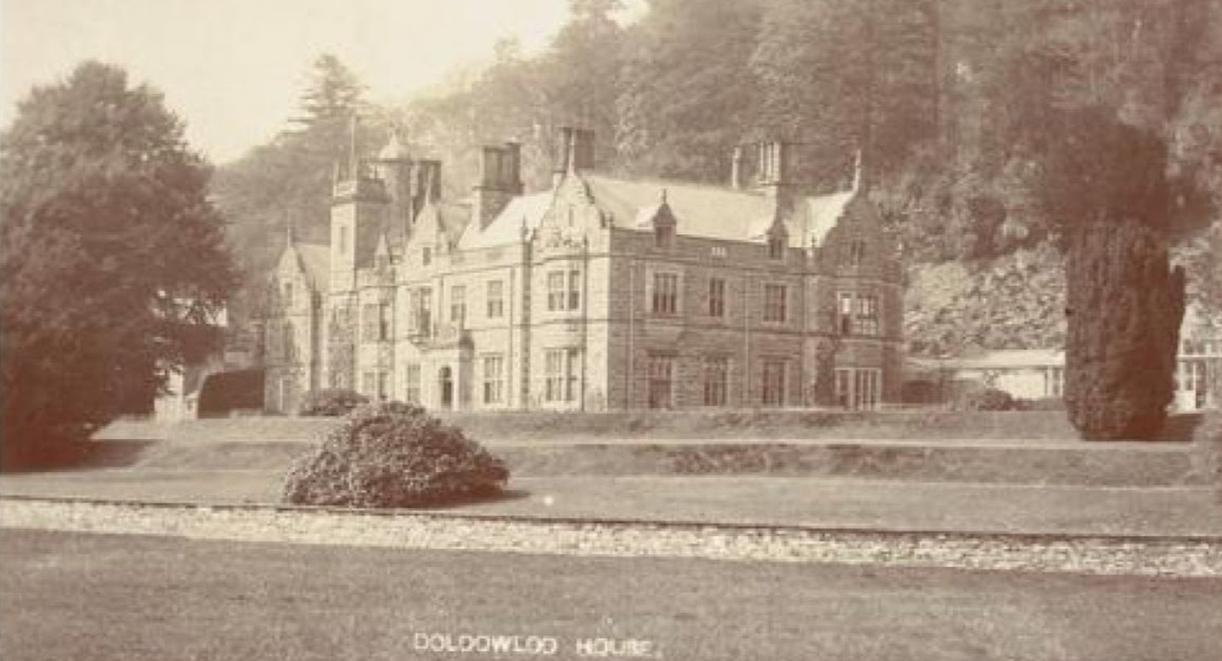
There are country houses which dominate their surroundings and others which seem to belong to them. Doldowlod is one of the latter. Travelling south from Rhayader along the upper Wye valley, it is possible to pass remarkably close to the house without fully appreciating what lies below the road. Doldowlod stands on the eastern bank of the River Wye, sheltered by a steep wooded slope and looking across its compact park towards the rising ground beyond. The position is picturesque without being theatrical, and house, pasture, woodland and river seem to occupy the same confined landscape rather than compete with one another.
That setting is important because Doldowlod was never one of the enormous aristocratic seats of Wales, nor was it the ancient home of a medieval Welsh dynasty. Its importance lies somewhere more interesting. It was created from the wealth of the Industrial Revolution, developed into a Victorian landed estate, absorbed into the social world of Radnorshire and then repeatedly adapted as that world changed. At its centre stands a Grade II* listed house, principally formed in the nineteenth century, while the surrounding park and garden are registered at Grade II. Lodge, gates, terraces, service buildings, cottages, farms, woodland and the remarkable walled garden make the place more than an attractive country residence. Taken together, they preserve an unusually coherent record of the way industrial wealth could be translated into land, architecture, social standing and, eventually, inherited responsibility.
For me there is inevitably another layer to the story. Between 1995 and 1997 my father worked at Doldowlod as a gardener, and the estate became part of my teenage world. I knew something of the practical life of the place long before I understood its history, and only much later did I realise that the trees, terraces, garden walls, estate buildings and even the reduced scale on which everything had to be maintained represented different stages in a story stretching back almost two centuries. That personal connection is one reason I have returned to Doldowlod so often, but it is not the reason the place matters. Its wider importance is that the history remains visible in the landscape.
Before the country house
The history of Doldowlod as a landed estate begins not with a grand mansion but with agricultural property beside the Wye. At the opening of the nineteenth century this was a remote part of Radnorshire. Rhayader was a small market and droving town, communications were difficult and the modern road system was still far in the future, but the valley possessed obvious attractions. There was productive land along the river, extensive woodland, sporting potential and scenery of a kind increasingly valued by an age developing a taste for the picturesque.
The man who changed Doldowlod’s future was James Watt. His name belongs principally to the history of industry, because his improvements to the steam engine transformed the practical use of power and his partnership with Matthew Boulton placed him near the centre of the technological culture of late eighteenth-century Britain. Yet the fortunes created by industry did not necessarily remain within industry. Land offered security, status and permanence, and for successful manufacturers, merchants and professional men it could also offer distance from the urban and industrial worlds in which their wealth had been made. The acquisition of country estates by newly wealthy families was one of the great social movements of Georgian and Victorian Britain, not because old landed society simply disappeared, but because it absorbed newcomers.
The surviving Watt papers in Birmingham allow the beginnings of Doldowlod to be traced with rather more precision than later family tradition sometimes permitted. Watt had begun buying property in Wales by 1798, including Stonehouse near Gladestry, and in 1803 his agent James Crummer negotiated the purchase of Doldowlod from the absentee owner Penry Price. The original acquisition comprised Doldowlod itself, five other farms and a mill on the Breconshire side of the Wye, amounting to just under 500 acres and costing £6,000. Watt subsequently bought intervening farms and other property, gradually consolidating what the family records came to call the Wyeside estate.
The distinction matters because some later accounts gave the impression that James Watt created Doldowlod from nothing or had been buying the estate since the 1770s. The archive shows a more recognisable process. There was an existing agricultural landscape, there were previous owners and occupiers, and the Watt estate was assembled over time through purchase and consolidation. What changed after 1803 was not the existence of the land but the scale of capital available to shape it.
James Watt senior never made Doldowlod his principal home. His visits were relatively infrequent and he died in 1819 at Heathfield Hall near Birmingham, another property associated with the family. The deeper attachment to Radnorshire belonged to his eldest son, James Watt junior, and it was through him that Doldowlod moved from investment towards country-house estate.
James Watt junior and the making of Doldowlod
James Watt junior was more than the son of a famous inventor. He became an important figure in the family business in his own right, took a close interest in steam navigation and marine engineering, and was a cultivated man with antiquarian, architectural and agricultural interests. At Doldowlod those interests came together. Estate papers record his involvement in plantations, nurseries, timber, farming and improvement, and after about 1809 he used the property increasingly as a residence and retreat rather than merely as an investment.
The architectural development was gradual. Surviving drawings include a “Sketch of a house to be built at Doldowlod” from 1818 and another design from around 1820, evidence that Watt junior had been thinking about a more substantial residence for many years before the principal surviving phase was built. From 1818 he also leased Aston Hall near Birmingham, one of the great Jacobean houses of England, and its influence on Doldowlod is unmistakable. Aston offered precisely the kind of historical architecture which nineteenth-century patrons associated with ancestry, stability and an older domestic order.
Cadw dates the main early phase of the present Doldowlod House to 1843–45. It was built against the older farmhouse and remained comparatively modest, with an entrance hall, dining room, drawing room and library while much of the service accommodation continued to occupy the earlier structure. The precise architectural authorship is not completely simple, but the Mylne family was certainly central. Architectural historians have associated the work with William Chadwell Mylne and his son Robert William Mylne, and the National Library of Wales preserves twenty-seven letters from James Watt junior to Robert William Mylne written between 1845 and 1847 concerning the rebuilding.
The choice of style tells us a great deal about the meaning of the house. The son of one of the defining figures of the Industrial Revolution did not build a residence that celebrated factories, machinery or steam power. Instead, Doldowlod looked backwards, using mullioned and transomed windows, shaped gables, tall chimneys and the language of Jacobean domestic architecture. Industrial modernity had created the wealth, but historical architecture provided the language in which permanence could be expressed.
It would be too easy to dismiss that as simple social pretension. Across nineteenth-century Britain, Tudor, Elizabethan, Jacobean and Gothic forms were revived during a period of astonishing technological and social change. Railways, factories and urban growth were transforming the country at extraordinary speed, and the country house could offer an image of continuity and rootedness. Doldowlod is a particularly clear example because the source of the money was so direct. Few estates can be connected so closely to the history of industrial power while presenting themselves so deliberately through the architecture of an earlier age.
James Watt junior never married and had no legitimate descendants. When he died in 1848, Doldowlod did not simply inherit land and buildings; it also became one of the principal repositories of the Watt family’s material and intellectual legacy. Objects and collections were transferred from Aston Hall, and in 1849 the executor Elizabeth Stockdale Wilkinson recorded that articles, coins and medals had been placed in Watt’s dressing closet at Doldowlod. The estate was becoming both a family home and a place of memory.
From Watt to Gibson-Watt
The inheritance passed through James Watt’s daughter Margaret, who had married James Miller. Their daughter Agnes Miller married the physician James Gibson, and their son, born in Edinburgh in 1831, was James Watt Gibson. Contemporary records show that in 1856 he assumed the Watt surname by letters patent when he succeeded to the estates of his great-uncle James Watt junior, thereafter becoming James Watt Gibson-Watt.
The timing is worth stating carefully because later summaries have sometimes treated 1874 as the moment at which Gibson-Watt first inherited Doldowlod. The contemporary record is more complicated. His 1891 obituary explicitly dated his succession to the Watt estates to 1856, and by 1861 a legal agreement already described “James Watt Gibson Watt of Doldowlod, p. Llanyre”. An 1874 conveyance likewise called him James Gibson Watt of Doldowlod. Cadw associates the major later rebuilding with the period after 1874, but that was also the year of his marriage to Emma Hoey. The safest conclusion is that he had succeeded to the Watt inheritance in the 1850s and that the major later transformation of Doldowlod belongs to the 1870s.
By this generation the family was no longer simply an industrial dynasty owning property in Wales. James Watt Gibson-Watt had been educated at Rugby and Magdalene College, Cambridge, and became firmly embedded in the landed society of Radnorshire. He served as a magistrate and Deputy Lieutenant and was High Sheriff of Radnorshire in 1859. Contemporary newspapers described him as a substantial county gentleman, while legal records show him dealing with farms, drainage, improvement, mineral-water property and urban development across a wide area.
The scale of the estate can be measured from the 1873 Return of Owners of Land, which recorded James Watt Gibson-Watt with 8,806 acres in Radnorshire and Breconshire and a gross estimated annual rental of £5,329. Such figures need some caution because estate totals vary according to date and method of calculation, but the return provides a firm contemporary benchmark. Doldowlod was not one of the largest aristocratic estates in Britain, yet within its local setting it was a major landed interest.
There was another inheritance as well. The Watt family papers, correspondence and collections remained at Doldowlod for generations. The material was used by nineteenth-century biographers, including Samuel Smiles, who acknowledged James Watt Gibson-Watt for information in his 1865 lives of Boulton and Watt. A substantial body of papers, after passing through the hands of J. P. Muirhead during the preparation of his biography of James Watt and becoming the subject of legal dispute, was returned to Doldowlod in 1870. Much of it remained there until Lord Gibson-Watt sold the collection to Birmingham in 1994. Doldowlod was therefore not merely the country estate bought with Watt money; for more than a century it was also one of the places in which the documentary memory of the Industrial Revolution was physically preserved.
The estate at its Victorian height
The 1881 census gives an unusually vivid glimpse of Doldowlod at the height of that Victorian world. The house appears not as “Doldowlod Hall” but simply as “Doldowlod”, schedule 70, within the township of Gwastedyn Fawr and the ecclesiastical district of Nantmel. That administrative geography explains why the property can be surprisingly difficult to locate in modern census searches, particularly when one looks for it under Llanyre or by the later house name.
The household itself consisted of James Watt Gibson-Watt, aged forty-nine, his wife Emma, their five-year-old son James Miller and their infant daughter Geraldine. Living with them were nine domestic servants, including a housekeeper, butler, housemaids, kitchen maid, nurse, under-nurse and groom. Thirteen people were therefore resident within the house on census night, before one begins to count gardeners, gamekeepers, farm workers, foresters, craftsmen and other estate employees living in cottages or on the surrounding farms.
That figure is useful because country-house history can too easily become a history of owners and architecture. Doldowlod functioned through labour. The household hierarchy recorded in 1881 represented only the most visible domestic layer of a much larger rural economy. The gardens had to be cultivated, horses cared for, roads and drains maintained, timber managed, farms worked and buildings repaired. The estate depended upon people whose names are far less likely than those of the Gibson-Watts to appear in published histories, yet without them the appearance of effortless permanence could not have existed.
The social reach of the estate appears again in the reports of James Watt Gibson-Watt’s death in 1891. He died at 13 First Avenue, West Brighton, on 19 June after a period of ill health, and his funeral took place from Doldowlod to Llanyre churchyard. Contemporary reports described around 160 tenants following the procession on foot and horseback despite heavy rain. The language of the newspapers, which spoke of “loyal and devoted tenantry”, was conventional and reflected the paternal assumptions of the period, but the scale of the attendance is nonetheless revealing. Separate wreaths from the servants at Doldowlod and from labourers on the estate also remind us that the household and estate formed a layered social world extending far beyond the family.
Doldowlod and the making of Llandrindod Wells
The reach of Doldowlod was not confined to the upper Wye valley. One of the most important parts of the Gibson-Watt story lies several miles to the east at Llandrindod Wells, where the family became involved in the transformation of a sparsely settled rural landscape into the most fashionable spa town in mid Wales.
The connection began before the great boom. An agreement of 1861 for draining and improving James Watt Gibson-Watt’s lands listed property in Llandrindod parish including Dolberthog, Llandritholfach, Llandritholfawr, Tynycoed and Redhouse and Boot. These holdings show that Doldowlod already possessed a landed interest in the district before the railway arrived and while much of what became the modern town still consisted of common, farms and scattered buildings.
The arrival of the Central Wales railway in 1865 changed the scale of possibility. The through route between Shrewsbury and Swansea was completed in 1868, bringing visitors directly into the district at the same moment that the old common of the manor of Swydd Neithon was being divided. Legislation obtained in 1862 came into effect in 1867, releasing land for roads, recreation and private development. When members of the Woolhope Naturalists’ Field Club visited in 1867, they could still see a largely open landscape, with the Llanerch, Pump House and Rock House among the principal buildings and the lines of the proposed town marked across the turf. Llandrindod was, quite literally, being planned before it had fully appeared.
The surviving Gibson-Watt title papers place the family directly within that transformation. The enclosure award of 31 December 1870 allotted James Watt Gibson-Watt, as lord of the manor, 61 acres, 1 rood and 18 perches from the waste of Swydd Neithon, and the award was confirmed the following year. The language of enclosure documents is dry, but the consequences were anything but. Land which belonged to an older rural economy could now be surveyed, enclosed, improved, leased, sold and built upon as a new town spread across the former common.
The family’s most visible connection was Rock Park. In 1879 James Watt Gibson-Watt gave an ornamental marble fountain and free chalybeate spring for public use, the inscription identifying him as Lord of the Manor. Cadw describes the Gibson-Watts by this period as the leading local family, while Thomas Heighway, one of the figures responsible for the ornamental planting of Rock Park, held the spa as their tenant. The gift was therefore not an isolated piece of philanthropy but part of a much deeper relationship between the family, the land and the way in which Llandrindod presented itself to visitors.
The property connection was deeper still. Powys Archives preserves title material recording a conveyance of 22 January 1885 involving James Watt Gibson-Watt and the Rock House Hotel and its lands. This is important because later summaries can create the impression that the Gibson-Watts became connected with the hotel only in the early twentieth century. The legal record places the relationship firmly in the 1880s, and subsequent building-control records show a continuing pattern of investment in the Rock House and Rock Park estate. Between 1897 and 1909 there were works to outbuildings, an engine shed, pump rooms, covered ways, bathrooms, pavilions and sanitary facilities, culminating in the major reconstruction of the Rock House Hotel in 1908.
The same records reveal how closely the country estate and the growing town could be connected. In March 1906 there was a proposal for a private road and sewer on Waterloo Farm for Captain James Miller Gibson-Watt, while in August 1907 he sold Plot 28 of what the deed explicitly called the “Llandrindod Building Estate”, an area of 2,982 square yards on the eastern side of Ithon Road at its junction with Dyffryn Road. A single building plot may appear trivial beside an estate of thousands of acres, but it shows land being converted from landed property into the physical fabric of a modern town.
The family also became part of Llandrindod’s public and recreational life. James Watt Gibson-Watt was associated with Llandrindod College in the 1870s, and when the first bowling green in Rock Park opened in 1912, his son Captain James Miller Gibson-Watt, locally described as the Squire of Rock Park, was invited to become president of the Radnor County Bowling Club. The Gibson Watt Cup for visitors subsequently became one of the best-known trophies of the inter-war tournament. This mixture of property ownership, civic presence and social patronage was characteristic of the family’s relationship with the town.
The contrast with Doldowlod is striking. At the Hall the family expressed continuity through Jacobean architecture, old trees, agricultural land and the ordered landscape of a country estate. In Llandrindod the same landed interest became involved with railways, enclosure, speculative building, hotels, pump rooms, roads, sewers, recreation and tourism. One landscape was designed to look rooted in the past, while the other was conspicuously new, but both belonged to the same nineteenth-century story of land, capital and opportunity.
The house takes its present form
The later nineteenth century produced the Doldowlod recognisable today. James Watt Gibson-Watt undertook a major enlargement in the 1870s, replacing the surviving older farmhouse element and extending the house substantially while keeping the Jacobean character established under his great-uncle. The result was not a complete break with the earlier building but a larger and more confident version of the same architectural idea.
The precise authorship again deserves caution. Cadw associates the house with Robert Mylne, and the long connection between the Watt family and the Mylnes makes that attribution plausible, while architectural evidence also points to later work by Stephen Williams of Rhayader in the early 1880s, including designs for a carriageway and conservatory. It is safer to see Doldowlod as the product of several phases and professional relationships rather than force the whole building into a single neat attribution.
What is certain is the effect of the later work. The enlargement introduced the picturesque outline of tower, shaped gables, bay and oriel windows, parapets and tall chimney shafts which gives the house much of its present character. Internally the plan was reorganised, the former entrance hall became a study, the dining room became the principal entrance hall, the drawing room and library were combined, and new principal rooms were created in the extension. The elaborate Jacobean-style staircase, modelled upon that at Aston Hall, carried Watt junior’s Birmingham influence into the heart of the later Victorian house.
Doldowlod nevertheless remained relatively compact beside the great aristocratic seats of Britain. That is part of its character and perhaps part of its survival. It was substantial enough to express position and continuity but sufficiently contained to remain recognisably a family house rather than a palace. Cadw’s Grade II* designation reflects that architectural quality, but it also recognises the importance of the house as the centrepiece of an estate in which the nineteenth-century relationship between building and landscape remains unusually clear.
Creating an estate landscape
The house was only one part of the design. Doldowlod occupies an exceptional position within a bend of the Wye, with a compact park of roughly twenty-five acres between the house and river and the land rising steeply behind towards the road. The owners used this geography rather than attempting to overwhelm it. A ha-ha separated the formal grounds from grazing land while preserving the view, the approach drive curved through the park and mature trees including copper beech, lime and horse chestnut strengthened the setting without obscuring the wider valley.
Closer to the house the gardens became more elaborate. Three grass terraces descended from the forecourt towards the ha-ha, stone steps emphasised the central line from house to park, and a circular lawn occupied part of the ground to the south-east. The wooded sections contained rhododendrons, Douglas firs, redwoods, beech and oak, while two natural streams were incorporated into the designed landscape through channels, cascades and pools. An Italianate garden was formed against the rocky bank and nineteenth-century maps recorded summer houses within the grounds.
A substantial conservatory once stood south of the house and included a rockwork grotto. It disappeared during the 1920s, when the site was adapted into stone Italianate terraces, but its former presence is another reminder of the labour and technology required to sustain a Victorian garden. Doldowlod’s landscape moved deliberately between formality and controlled wildness: near the house there were terraces, lawns, glass and architectural features; further away, paths disappeared into trees and water moved through ground which felt increasingly natural. It was a particularly appropriate treatment for the upper Wye, where the wider valley was always too strong a presence to be reduced to mere background scenery.
The world behind the garden wall
Perhaps no part of Doldowlod reveals the lost economy of country-house life more clearly than the walled kitchen garden. Situated some distance south-east of the house, it covers approximately an acre and is enclosed by high brick walls reaching around four metres in places. The surviving layout shows the familiar Victorian division into quarters, crossed by paths and organised around a central pool.
This was a place of production rather than display. The walls created a warmer and more sheltered microclimate, fruit trees were trained against them, and glasshouses extended the growing season. Surviving evidence points to several greenhouses, some heated, together with a peach house, cold frames, espalier apples and pears and a double-aisled glasshouse dating from around 1900. Bothies and a stove-house formed part of the working complex, while a gardener’s house stood across the road and there appears to have been a nursery area nearby.
At the height of the system, around four gardeners were employed. Their work required knowledge of propagation, pruning, soil, heating systems, fruit training, glasshouse cultivation and the careful succession of crops needed to supply a large household. The beauty of the country-house garden depended upon specialised labour, and the kitchen garden shows that more clearly than the ornamental lawns ever could. Its surviving walls are therefore not simply picturesque remnants; they are the shell of an industrially organised horticultural workplace.
When I knew Doldowlod in the 1990s, Lady Diana Gibson-Watt sometimes spoke about the number of men who had once been employed in the gardens. By then the contrast was enormous. My father was effectively carrying out work which earlier generations would have divided among several people, and the difference was not one of ambition so much as economics. The garden still mattered and was still cared for, but the labour system which had made its Victorian and Edwardian intensity possible had disappeared. That difference between the survival of the landscape and the disappearance of the workforce is one of the most important themes in the history of the estate.
Farms, timber and the working estate
Doldowlod was never simply a house surrounded by ornamental grounds. Agriculture and forestry were fundamental to the estate from the beginning, and the Watt papers contain repeated references to farming, sheep, hay, fruit, plantations, nurseries and timber. James Watt junior took a particularly close interest in trees and woodland, beginning a pattern of forestry management which remained part of the estate’s identity well into the twentieth century.
The physical remains of the estate make that practical character visible. The Green developed as a substantial estate farm and later included a sawmill, while elsewhere there were cottages, workshops and service buildings. Ordnance Survey evidence suggests that part of the farm complex was converted to sawmill use between the late nineteenth and early twentieth centuries, although a separate Boulton and Watt archive file concerning a James Watt Gibson-Watt sawmill in 1857–58 suggests that timber processing was already an estate concern before the later arrangement at the Green.
The lodge, built in 1881, repeated the Jacobean language of the main house, and the northern gateway carried family emblems. Such structures did more than mark a boundary. They extended the architectural identity of Doldowlod beyond the house itself, linking entrance, park, service buildings and productive estate into a single visual system. Behind that appearance, however, stood a working network of farms, woodland, cottages, roads, drains and employees.
The scale and organisation of that network changed over time, but it did not vanish. Estate wage books, rent books and work records surviving in Powys Archives and the National Library of Wales offer the possibility of reconstructing the lives of gardeners, labourers, carpenters, farm workers and others in far more detail than the public history of Doldowlod has so far attempted. Those records may ultimately tell us as much about the estate as the better-known correspondence of its owners.
Argoed Mill and an appropriate piece of modernity
One of the most attractive survivals in the wider Doldowlod story is Argoed Mill. A corn mill existed there by the 1840 tithe survey, while the surviving building dates from 1878 and continued to be used for milling into the twentieth century. During the 1930s it was adapted to generate hydro-electricity for Doldowlod House, providing private power until the arrival of National Grid electricity made the arrangement unnecessary in the late 1940s.
There is an obvious historical symmetry in an estate founded by James Watt eventually generating electricity for itself from the movement of water, but the point should not be pushed too far. The technology belonged to a completely different age and there was no direct continuation of Watt’s steam-engine work. What it does show is that country houses were not necessarily technologically conservative simply because their architecture looked backwards. Behind the Jacobean façade Doldowlod acquired plumbing, electricity, motor transport and the other technologies required to keep an old house functional in a modern world.
That contradiction runs through country-house history. The appearance of continuity often depended upon continual modernisation, and Doldowlod survived not because it escaped change but because successive generations accepted it.
War, loss and contraction
The twentieth century placed enormous pressure on landed estates across Britain, and Doldowlod was not immune. Agricultural incomes had already been under strain, the First World War disrupted staffing and accelerated social change, domestic service declined as other forms of employment became available, and taxation and death duties increased the cost of inherited property. After the Second World War those pressures intensified, and across Britain hundreds of houses were demolished while others became schools, hospitals, hotels or institutions.
Doldowlod survived, but survival required alteration. The great conservatory disappeared in the 1920s, the kitchen garden gradually lost the intensity of its earlier working life, parts of the service accommodation were demolished in the late 1940s and the old park drive fell out of regular use. Other features were added: a prunus walk belongs largely to the 1940s, a swimming pool was created in the 1960s on the site of an earlier croquet lawn, and Lady Gibson-Watt later developed the pool garden and bamboo walk. None of these changes represented a simple break between a “historic” estate and a modern one. They were part of the same continuing process of adaptation.
The family also experienced the personal costs of the century. Major James Miller Gibson-Watt, born in 1875, served in the South African War and was wounded. He later became an important figure in Radnorshire public administration, serving for many years on the county council and chairing both the Standing Joint Committee and the Main Roads and Bridges Committee. His involvement with roads is particularly appropriate to the history of a county moving from the railway age into the motor age, and his public work reminds us that the estate’s owners were involved not only in private land management but also in the infrastructure of modern Radnorshire.
James Miller died in a London nursing home on 4 August 1929, aged fifty-three, leaving his widow Marjorie and their children. Marjorie herself became a significant figure in local public life. During and after the Second World War she chaired the Labour Sub-Committee of the Radnor Agricultural Executive Committee and was appointed MBE in the 1949 New Year Honours. Her role deserves emphasis because the survival of estates in the twentieth century was not solely a story of male inheritance. Women often carried substantial administrative, agricultural and family responsibilities through periods of war, bereavement and financial change.
The next generation came of age under the shadow of another war. James David Gibson-Watt attained his majority on 11 September 1939, only eight days after Britain declared war on Germany. The Kington Times reported that celebrations planned at Doldowlod had been postponed because of the war and that he expected to join his regiment within days. He was commissioned into the Welsh Guards soon afterwards and went on to win the Military Cross and two Bars. His younger brother Martin Ricardo Gibson-Watt served in the Royal Navy, was awarded the Distinguished Service Cross and died in December 1941 after HMS Kandahar struck a mine. For a family whose nineteenth-century history had been built around inheritance and continuity, the twentieth century repeatedly demonstrated how fragile both could be.
The Gibson-Watts and public life
David Gibson-Watt’s later career belongs partly outside the history of the house, and I have written elsewhere about his wartime service, parliamentary career, work at the Welsh Office and involvement in forestry and agriculture. What matters here is the extent to which his public life remained connected with Doldowlod. After the war he returned to the estate, farmed, entered local government and eventually became Conservative MP for Hereford before serving as a minister at the Welsh Office. Later he became a Forestry Commissioner and held a leading role in the Royal Welsh Agricultural Society.
This continued a family pattern in which landed status was accompanied by public office. The culture was undeniably paternalistic and socially exclusive by modern standards, and it gave influence to a relatively narrow circle of families. Yet it would also be inaccurate to treat the accompanying ethic of service as entirely empty. Across several generations the Gibson-Watts undertook military, magisterial, agricultural, local-government and parliamentary responsibilities which were real and often demanding.
The estate itself was also changing beneath that continuity. A Danish forestry account from 1990 described the Doldowlod woodland operation as administered by the owner with only two brothers employed, a striking contrast with the much larger labour force implied by the Victorian estate records. A Farmers Weekly article in 2000 described a Doldowlod Estate of about 404 hectares, roughly 1,000 acres, with David Gibson-Watt involved in share-farming and tenanted arrangements and having ceased hands-on farming in 1986. Those figures should not be treated as a simple measure of decline from the 8,806 acres recorded in 1873 because the definitions and property included are not necessarily identical, but they do illustrate how the estate economy had changed.
The country-house world which survived into the late twentieth century was therefore not the Victorian system in miniature. It was something different: smaller in labour, more selective in what could be maintained, more dependent upon commercial judgement and less insulated from the wider economy. The remarkable thing about Doldowlod is not that change occurred, but that so much of the older structure remained legible after it.
The house I knew
By the time I came to know Doldowlod during the 1990s, most of this history was invisible to me. I knew Lord and Lady Gibson-Watt as people rather than historical figures, and I knew the estate as a place where grass grew, leaves fell, machinery broke and jobs accumulated. The formal history came later, but that practical experience changed the way I understood it when I eventually began researching the place.
The walled garden was no longer simply an old garden once I understood the scale of the horticultural workforce that had operated there. The stable and service buildings were no longer picturesque outbuildings once I understood the transport, domestic labour and agricultural organisation they had supported. The woodland was not simply scenery once I knew how many generations had planted, felled and managed it. Even the lawns and terraces became historical evidence because somebody had designed them, somebody else had altered them and successive workers had spent thousands of hours preventing them from disappearing beneath uncontrolled growth.
That is one of the reasons Doldowlod affected my later understanding of history. It made the past difficult to separate from work. Buildings survive because roofs are repaired, gutters cleared and stonework maintained. Gardens survive because people cut, plant, weed, prune and clear. Landscapes which appear natural are often the result of decisions taken decades or centuries earlier, and their apparent permanence is maintained through a succession of ordinary practical tasks.
One memory has stayed with me particularly clearly. As a teenager I helped Lord Gibson-Watt plant an oak tree on the estate. At the time it was simply another job, but I understand it differently now. James Watt and his son had planted woodland, Victorian gardeners had shaped the grounds, later generations had altered and replanted them, and my father was maintaining part of that inherited landscape in the 1990s. For a brief moment I contributed to the same process.
Doldowlod and the history of rural Wales
Doldowlod also complicates some easy assumptions about Welsh history. It was created by a Scottish-born engineer whose fortune was associated with Birmingham, its architecture looked towards the Jacobean past of an English country house and its later owners belonged to a British landed culture which, in David Gibson-Watt’s case, included a strongly Unionist political outlook. Yet over generations Doldowlod became unmistakably part of the history of Radnorshire.
That is characteristic of the Welsh border counties, where families, investment, language and identity rarely fit neat modern categories. Nineteenth-century Wales contained industrialists and tenant farmers, Welsh speakers and English speakers, Nonconformists and Anglicans, Radicals and Conservatives, ancient landowners and families newly arrived through business or marriage. The social history of Wales becomes poorer if we include only those people whose ancestry or politics fit a simple national narrative.
The Gibson-Watts show one way in which outsiders could become insiders. Industrial wealth purchased land, but ownership alone could not create belonging. That developed gradually through residence, marriage, farming, local office, public service and the passage of generations. By the twentieth century the Watt inheritance remained central to family identity, yet Doldowlod was no longer merely a Welsh investment made by a Birmingham industrial dynasty. It had become home, and the family had become part of the political, agricultural and social history of the county.
An industrial inheritance in stone, paper and trees
Perhaps the most interesting feature of Doldowlod is the contradiction at its heart. Its story begins with one of the defining figures of the Industrial Revolution, yet the physical identity of the estate celebrates the country-house past. Wealth produced by machinery became land; land was given architectural form through a Jacobean revival; the estate then acquired the associations of farming, forestry, county office and inherited responsibility.
That apparent retreat from modernity was never complete. Capital financed the purchase of farms, engineering knowledge informed improvement, the railway transformed nearby Llandrindod, hydro-electricity later powered the house, motor roads altered its relationship with the county and changing labour markets forced the gardens and household to contract. Doldowlod survived precisely because it was never as timeless as it looked.
Even the family archive forms part of that story. For generations papers associated with James Watt were kept at Doldowlod, consulted by historians and biographers and treated as part of the inheritance of the house. Their eventual sale to Birmingham in 1994 closed one chapter but also ensured their preservation in a public archive. The estate had served for more than a century not only as a home but as a custodian of one of Britain’s great industrial legacies.
There is a final piece of symbolism which would have amused James Watt. In 1935 the Great Western Railway named Hall-class locomotive No. 5942 Doldowlod Hall. It spent its working life on the railway system created by the age which Watt’s improvements to steam power had helped make possible and ended its service at Shrewsbury before withdrawal in December 1963. The country house built from an industrial fortune had, for a generation, given its name back to a steam locomotive.
What survives
Today Doldowlod House is protected at Grade II* and its park and garden at Grade II, while a number of associated buildings and structures are separately listed. Those designations matter, but they describe only part of the significance of the place. Doldowlod is important because the whole remains intelligible. The relationship between house and park, garden and woodland, road and lodge, formal entrance and service buildings can still be understood, and the landscape continues to explain why the house stands where it does.
The same is true historically. The estate can still be read as the product of successive layers rather than one moment of creation. There is the agricultural landscape which existed before the Watts, the early nineteenth-century purchase and consolidation, James Watt junior’s country-house ambitions, the Victorian enlargement, the working farms and gardens, the Llandrindod property, the technological adaptations of the twentieth century and the contraction which made survival possible. None of those layers cancels the others.
When I think of Doldowlod now, I still think first of the landscape: the house beneath the wooded slope, the Wye moving through the valley, mature trees standing where earlier generations decided they should stand and the constant work required to keep cultivated ground from returning to something wilder. That is a more truthful image of continuity than the idea of an estate preserved unchanged.
Doldowlod is not a monument to a vanished golden age, because no such age existed. It is a place made and remade by successive generations, each of which inherited something, altered something and left something behind. Industrial wealth became Welsh land, the land became an estate, the estate became a family inheritance, and the inheritance survived by adapting to the society around it.
Architecture, landscape, industry, agriculture, labour, politics, family memory and personal memory all occupy the same ground. Beneath them runs the Wye, the one element in the story which predates every owner, every building and every attempt to give permanence to the valley.
Explore more: Continue with Country Houses & Estates for related work on estate families, land and service, and Llandrindod Wells History for the wider Radnorshire and spa-town context.
Sources and Further Reading
The principal archival foundation for the early history is the James Watt and Family Papers at Birmingham Archives and Collections, particularly MS 3219 and the papers relating to the Wyeside and Welsh estates. The National Library of Wales holds important correspondence between James Watt junior and Robert William Mylne concerning Doldowlod in 1845–47, as well as later Gibson-Watt and estate material. Powys Archives preserves the Gibson-Watt family title papers, marriage settlements, drainage and enclosure records, Llandrindod property material, and surviving rent and wage books which help reconstruct the working estate.
The architectural and landscape history is covered by Cadw’s Grade II* Listed Building Record for Doldowlod House, reference 84148, the Register of Historic Parks and Gardens entry for Doldowlod, PGW(Po)52(POW), and the Royal Commission’s Coflein records. The history of the Gibson-Watt property at Llandrindod Wells is also supported by Cadw’s register entry for the town’s public parks, Powys Archives title papers, contemporary building-control records and surviving material relating to Rock Park.
The 1881 census, RG11/5476, schedule 70, provides the particularly valuable household snapshot used here. Contemporary newspapers include the Brecon and Radnor Express and Carmarthen Gazette of 26 June 1891 for James Watt Gibson-Watt’s obituary, together with reports of his funeral; the Western Mail of 6 August 1929 for Major James Miller Gibson-Watt; and the Kington Times of 16 September 1939 for David Gibson-Watt’s coming of age. Marjorie Gibson-Watt’s MBE and its agricultural citation are recorded in the 1949 New Year Honours.
Among the most useful published works are Samuel Smiles’s Lives of Boulton and Watt, Robert Scourfield and Richard Haslam’s The Buildings of Wales: Powys, Richard Haslam’s 2004 Country Life study of Doldowlod, and the Dictionary of Welsh Biography entry for James David Gibson-Watt, Baron Gibson-Watt. Historical material produced by Llandrindod Wells Town Council and Llandrindod Wells Bowling Club is also valuable for the development of the spa town, Rock Park and the Gibson Watt Cup.