
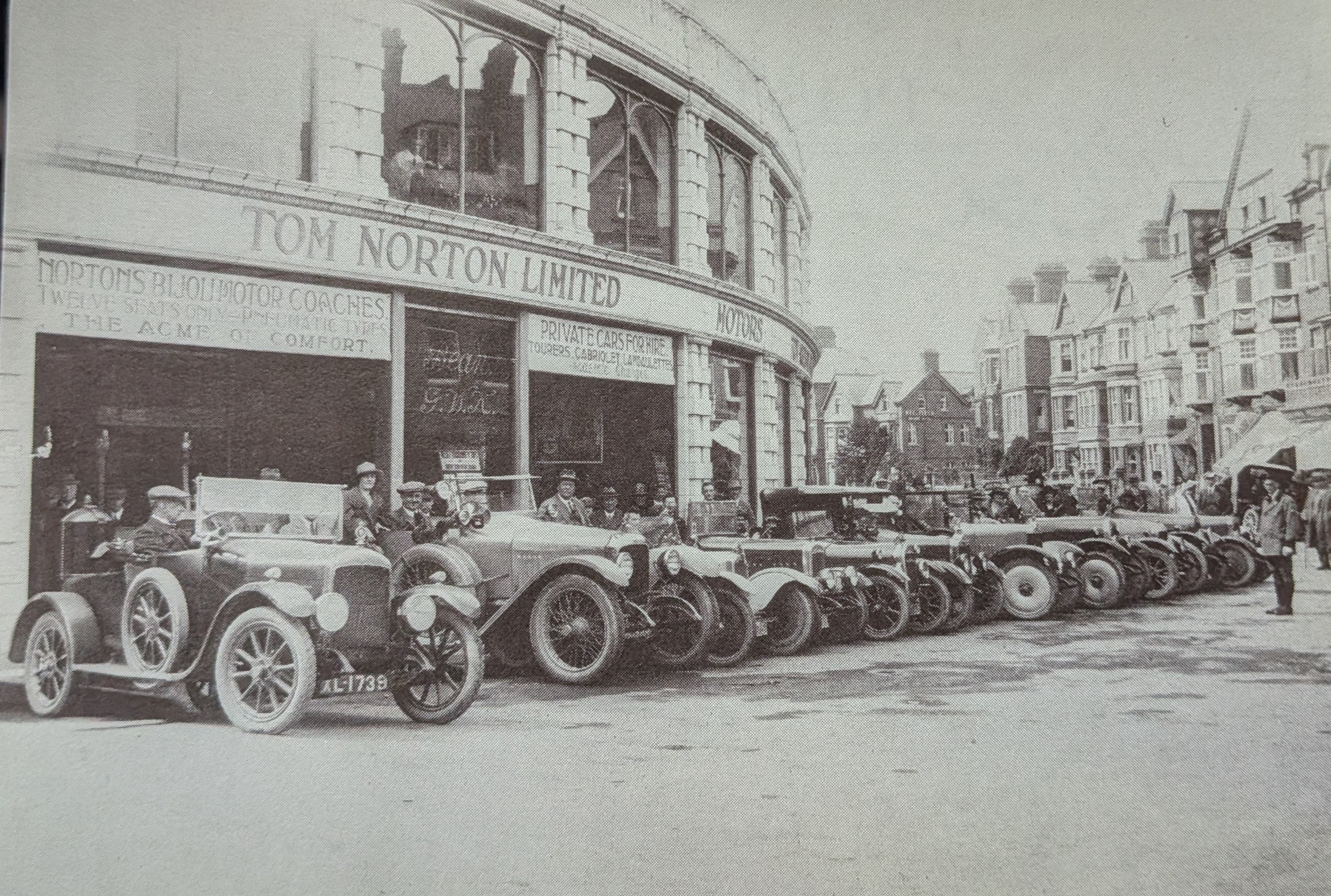
There are some people whose lives become so closely woven into the story of a place that it becomes difficult to separate one from the other. In Llandrindod Wells, Tom Norton was one of those people.
His name survives most visibly on the extraordinary white frontage of the Automobile Palace at Five Ways, where Temple Street, Spa Road and Princes Avenue meet. It is easy, therefore, to remember him simply as the man behind one of the town’s most distinctive buildings. Yet that considerably understates his importance. Norton was a cyclist, businessman and motor pioneer, but he was also a councillor, magistrate, High Sheriff, promoter of golf and bowls, supporter of the spa, advocate of aviation and an important figure in the mechanisation of Welsh agriculture.
More than anything else, Norton understood movement. He understood that people wanted to travel more freely, that visitors wanted to see something of the countryside beyond the railway station, that farmers would increasingly depend upon machinery and that a successful inland resort could not remain tied forever to the railway age which had created it. In a town whose nineteenth-century prosperity had been built around mineral water and the arrival of the railway, Norton helped introduce and normalise some of the technologies which would define the twentieth century.
His achievement was therefore much larger than the creation of a successful garage. He helped Llandrindod Wells adjust from the age of the railway spa to the age of the motorist, and for a time he even tried to carry it into the age of aviation.
From Newtown to Llandrindod
Tom Norton was born at Newtown in Montgomeryshire in early 1871. Later motoring histories repeatedly gave his birth year as 1870, but the contemporary evidence points elsewhere. The 1871 census, taken on 2 April, records him as a one-month-old son of William and Elizabeth Norton, while his obituary in December 1955 gave his age as eighty-four. The primary evidence therefore supports 1871.
He grew up in a large family, later accounts describing him as one of fourteen children, and was associated in youth with Brynhyfryd at Newtown. At about sixteen he was apprenticed to an elder half-brother in the ironmongery trade, reportedly earning only a shilling a week while learning the business.
By 1891 he was already living at Llandrindod Wells. That matters, because Norton did not arrive after the town had reached maturity and simply take advantage of an established resort. He came while the great transformation was still taking place around him. Hotels, boarding houses, villas, shops, churches and public buildings were appearing at extraordinary speed. Llandrindod was still becoming Llandrindod.
He was also an enthusiastic cyclist, and in the late nineteenth century that meant more than simply enjoying a pastime. The bicycle was transforming personal mobility. For people who could not afford a horse and did not wish to organise their lives around railway timetables, it offered a new freedom. Cycling clubs appeared across Britain, touring became fashionable and a substantial trade developed in machines, repairs and accessories.
Norton belonged completely to that world. A later local account credited him with winning a gold medal in 1890 for riding from Newtown to London and back. Contemporary confirmation of that particular feat remains elusive, but his standing as a cyclist is beyond doubt. He became captain of Newtown Cycling Club and, when the club honoured him in 1899, the presentation was accompanied by unusually warm praise for his courtesy, impartiality, energy, zeal and enthusiasm.
That tribute gives us an early glimpse of Norton as a person rather than simply as a name above a shop door. The qualities later associated with his business and civic life were evidently already visible when he was still in his twenties.
Two hundred bicycles
In 1898 Norton opened a cycle and sporting-goods business in rented premises in the Assembly Rooms in High Street. One small newspaper advertisement from June 1899 tells us rather more than its few lines might suggest. Boarding-house keepers were advised to save their wallpaper by encouraging visitors to leave their bicycles at Tom Norton’s depot instead, where he had accommodation for 200 machines.
This was not simply a cycle shop serving local residents. Norton had already understood that cycling formed part of the visitor economy of the spa. People were bringing bicycles with them to Llandrindod and needed somewhere to store them safely.
His methods were strikingly modern. By 1904 he was advertising around 200 bicycles in stock, offering three-year guarantees, repairing punctures without charge during the first season and reimbursing return railway fares to customers travelling considerable distances to buy from him. A surviving photograph of his staff from about 1910 carries the formidable claim that Tom Norton Ltd were Britain’s biggest bicycle buyers. Promotional language should always be treated with some caution, but there is no doubt that the business had already grown far beyond that of an ordinary provincial cycle dealer.
Walter Powell, whose memories of early twentieth-century Llandrindod were later preserved by Bruce Osborne, recalled another market which Norton had identified. He had a branch at Rhayader and sold hundreds of bicycles to men employed on the Elan Valley dam works.
For those workers, the bicycle had an obvious practical value. The reservoir scheme drew around 2,000 men into a comparatively isolated part of Mid Wales. A bicycle gave them access to Rhayader, shops, friends, recreation and, as Powell remembered with characteristic directness, the pubs. Norton was selling machinery, but the machinery was also changing the boundaries of everyday life, a theme which would return throughout his career.
From novelty to infrastructure
Motor transport did not arrive in Llandrindod entirely because of Norton. Visitors were already talking of bringing their “autocars” to the town during the late 1890s, and by 1901 motorists were sufficiently conspicuous to attract prosecutions for speeding in High Street. W. H. Howse later recorded one enthusiast being fined for travelling at an estimated sixteen to twenty miles an hour.
The early motor car was noisy, expensive, unreliable and often viewed with suspicion. Norton’s importance lay not in introducing the first machine, but in helping to make the motor vehicle ordinary.
By the turn of the century he was dealing in cars and motorcycles from firms including Singer, Excelsior, Swift, Ariel, Sunbeam and Daimler. Later recollections associated with the company place private cars in Norton’s hands as early as 1900 and a Daimler wagonette in use for hire by 1902. Then came public transport. In 1906 Norton began a motor service between Llandrindod Wells and Newtown, generally described as one of the earliest motor-bus services in Wales. The early vehicle was remembered as a solid-tyred Commer. Howse later believed that local attitudes towards motoring began to change after Norton’s motor charabanc had been inspected and approved in 1907. This was a revealing development, as Norton was helping to take the motor vehicle from curiosity to infrastructure. By 1911 he was advertising sightseeing tours into the Elan Valley. The railway had delivered visitors to Llandrindod, but the motor vehicle could now take them beyond it, into a landscape which was itself becoming part of the attraction of staying at the spa.
Norton also made motor transport available to visitors who had not arrived with a car of their own. Contemporary guidebooks advertised the Automobile Palace as providing open and closed private cars for hire, together with a fleet of small coaches at moderate charges. A later Motor Sport account described photographs of Norton hire cars from the 1920s, including an Arrol-Johnston tourer, a Model T Ford saloon, a Buick Six and an Oakland landaulette.
This widened the geography of the Llandrindod holiday. A visitor could arrive by train, take the waters and stay at the Metropole, Gwalia, Rock Park or one of the many smaller hotels and boarding houses, yet no longer be confined to the town itself. A hired car or coach opened up Rhayader, the Elan Valley and the wider countryside of Radnorshire. The railway brought visitors to Llandrindod, but Norton helped them move once they were there.
Learning to drive at Norton’s

Walter Powell left one of the most vivid descriptions of what Norton’s business meant in everyday life. In 1914 his father sent him to Norton to learn to drive a left-hand-drive Model T Ford. Powell also remembered helping at the garage by carrying two-gallon petrol cans to the garages attached to the hotels and filling the cars of visitors. Among the makes he recalled were Napier, Wolseley, Rolls-Royce, Lanchester, Daimler and Sunbeam.
It is a small piece of evidence, but an important one. Earlier visitors had arrived by railway and been collected at the station by horse-drawn hotel omnibuses. By the eve of the First World War, wealthy visitors were increasingly bringing their own motor cars. They required petrol, repairs, secure accommodation and people who understood these complicated new machines, all of which Norton provided.
A later Llandrindod visitor guide advertised the Automobile Palace as “The Most Convenient Garage”, under Norton’s personal supervision, with accommodation for more than one hundred cars, private lock-ups and a chauffeurs’ waiting room. The waiting room is particularly revealing. It tells us something about the sort of visitor the business expected to serve. This was not simply a garage for local motorists. The Automobile Palace belonged to the same world as the grand hotels, golf course, bowling greens and mineral springs. It formed part of the infrastructure expected by a fashionable resort adapting itself to a new age of travel.
The Palace of Sport
By 1906 Norton’s High Street premises were no longer adequate. He purchased 1,400 square yards of former Pump House Common at thirty shillings per square yard, paying £2,100 for the site on which his new premises were to rise. A contemporary newspaper used the transaction as an example of the remarkable increase in land values created by the growth of Llandrindod Wells.
The wider argument in that article was fiercely critical of landowners who had benefited from rising values without themselves creating the prosperity which produced them. Norton provided a useful contrast. He bought land at a high price, erected buildings, employed people and paid rates.
The first major phase of the new building was completed in 1911 at a cost of about £11,000. Its architect was Richard Wellings Thomas, already within Norton’s social circle, as the presence of Thomas and his wife at Norton’s wedding demonstrates. The building was originally known as the Palace of Sport. The name suited the ambition behind it. This was never intended to be an anonymous repair shed. It was a commercial showpiece, a building designed to announce that modernity had arrived in Llandrindod.
The detailed historic building survey prepared in 2021 concluded that the Automobile Palace is the earliest known purpose-built car showroom in Wales and one of the earliest surviving examples in Britain. Its first phase used steel framing, while the great 1919 extension made extensive use of reinforced concrete associated with the Hennebique system.
Its glazed elevations allowed vehicles to be displayed prominently, while the white faience frontage gave the whole building a brightness and sophistication unlike almost anything else in the town. Twenty-two sculpted lions punctuate the façade, while raised lettering proclaimed CYCLES, MOTORS, SPORTS, ACCESSORIES and, most arrestingly of all, AIRCRAFT. That frontage was effectively a manifesto. The great Victorian hotels advertised health, refinement and leisure. Norton’s building advertised speed, machinery and technological progress.
A Welsh motor empire
Tom Norton Ltd had been incorporated in 1908, and the scale of the business eventually stretched far beyond Radnorshire. After Ford began producing the Model T at Trafford Park in 1911, Norton became the sole Ford agent for Wales. Later accounts state that Ford cars destined for Welsh customers passed through Llandrindod before distribution. People’s Collection Wales also records that Norton travelled to America and met Henry Ford, while a later local biography dates the journey to 1912 and says the two men subsequently corresponded.
There is even a later motoring anecdote about Edsel Ford visiting the Automobile Palace. According to the story, Ford had looked at a map in Detroit and seen the business represented by a marker almost in the centre of Wales, only to discover on arrival that a central position on a map did not necessarily mean easy access across the roads of Mid Wales.
Whether every detail of that recollection can now be proved is less important than the broader point. Norton had moved from selling bicycles in High Street to dealing directly with some of the most important names in the international motor industry.
His association with Austin became still more substantial. He entered into an agreement with Herbert Austin in 1918, and later company records show the enormous scale the distributorship could reach. At the 1926 Motor Show the business reportedly contracted for hundreds of Austins, Singers and Standards, together with Chryslers. By the early 1930s the Austin allocation alone ran into many hundreds of cars across eight Welsh counties. The Automobile Palace was not a quaint provincial garage, but a serious regional distribution business. Norton understood publicity as well as machinery. Nearly fifty Overland cars were once collected together from their factory, turning their departure through Manchester into a publicity procession. Demonstration vehicles toured Wales and fuel-economy competitions were arranged for owners.
The company also sold motorcycles, commercial vehicles, accessories and agricultural machinery, and at one stage produced accessories under the “Notron” name. Later accounts place Norton among the leading figures in the South Wales and Monmouthshire division of the Motor Trades Association.
Branches and depots appeared at Rhayader, Knighton, Cardiff, Wrexham, Conwy, Llanfairpwll, Rhyl and Penrhyn Bay. Some smaller branches disappeared during the difficult years of the 1920s, and in 1925 the business became the Automobile Palace Ltd, but Llandrindod remained its centre. This is important when assessing Norton’s effect upon the town. A business serving much of Wales might easily have moved its headquarters to Cardiff, Swansea, Newport or another major commercial centre. Norton kept it in Radnorshire, and for a period cars intended for customers across Wales passed through a small spa town because he had chosen to build his business there.
The spa entrepreneur
Norton’s importance cannot be understood through cars alone. He understood the economics of the spa.
He became closely involved with the Llandrindod Wells Springs and mineral-water interests, was associated with Plas Winton Ltd and had an interest in the Rock Park Hotel. His own marriage to Elsie Cummins gives an intriguing glimpse of how completely his private and commercial worlds had begun to overlap.
When they married at Ashperton near Ledbury, Norton and his party travelled from Llandrindod in four motor cars decorated with heather. His premises in Llandrindod and Rhayader were decorated with flags and streamers and a fireworks display took place at the Llandrindod depot. The couple then left for the Continent, and their honeymoon included a tour of leading European spas. It would be easy to make too much of that detail. We cannot know how much professional curiosity accompanied the honeymoon. Yet it is difficult to imagine Norton moving through the great European watering places without making comparisons with the Welsh resort in which so much of his life and fortune were already invested. His involvement in sport was equally significant. Norton was among those who recognised the value to Llandrindod of a first-class eighteen-hole golf course and helped build support for the project which led to the establishment of Llandrindod Wells Golf Club in 1906. Golf was not simply recreation. It attracted exactly the sort of visitor whom an ambitious spa wanted, people able to stay in hotels, spend money and remain for days or weeks.
Norton’s transport business then reinforced the link. The famous golf vehicle known as “Colonel Bogey” carried players between the town and the course, charging more for the journey uphill than for the return. A 1920s advertisement described the golf car leaving the Automobile Palace for the links every half-hour from 9.15 in the morning, demonstrating the close relationship between the garage, hotel visitor and golf course.
Bowls became another part of his life. On 9 May 1912 Norton laid the final turf on the first bowling green in Rock Park and presented the Norton Cup for singles competition. When the club was reorganised as Llandrindod Wells Bowling Club in 1921 he became president, serving until 1924 and then again from 1932 for the remainder of his life.
Bowling eventually became one of the great seasonal attractions of Llandrindod, drawing competitors and spectators from across Britain. Norton was also associated with angling and with the broader promotion of the resort. There was a clear logic to all of this. Transport brought people in, hotels accommodated them, and the waters gave them their traditional reason for coming, while golf, bowls, fishing, excursions and entertainment gave them reasons to stay. Norton’s interests touched almost every part of that chain.
Bringing aviation to Mid Wales
If Norton had stopped at bicycles, buses and cars, his reputation as a transport pioneer would already have been secure. He did not. In 1913 he engaged the celebrated pioneer aviator Gustav Hamel to give a flying display on the Rock Ddole. Another display followed in 1914. Aeroplanes were still novelties, and to many of those watching, powered flight would have seemed barely believable.
The word AIRCRAFT later placed across the Automobile Palace therefore reflected more than decorative bravado. Norton genuinely tried to connect Llandrindod with the new world of flight.
Walter Powell later remembered a small aircraft landing on the Ddole, its wings being folded and the machine then being pushed through the town towards Norton’s premises. It is difficult to imagine a better vindication of the strange word which still survives on the façade.
In the 1930s the Ddole again became a focus for aviation. Sir Alan Cobham’s displays appeared there, while Universal Aircraft Services experimented with operations from Llandrindod. An Avro 504K and a Bristol Fighter were based at the field for a period, sightseeing flights were offered and the possibility of regular services to cities including Cardiff and London was explored.
Norton had an interest in the adjoining Rock Park Hotel, and in 1932 an advertisement referred to the combined management of the “hotel and aerodrome”. The aviation experiment never developed into a permanent commercial airport, but that does not make it insignificant. A town which had been created because the railway made its mineral waters accessible had reached the point where arriving by aeroplane could at least be imagined.
The enthusiasm also entered Norton’s family. His elder daughter Marjorie became a pilot herself and in 1934 married George E. Clair, an aviator and honorary instructor with the Insurance Flying Club. Their wedding cake carried models of the aircraft in which she had made her first flight. For the Nortons, aviation had become more than publicity, it had become part of family life.
Civic Llandrindod and the First World War
Commercial success drew Norton increasingly into public life. His obituary recorded service on Llandrindod Wells Urban District Council from 1910 to 1919, with the chairmanship in 1915–16. Council reports place him in discussions about roads, public health, the Pavilion, seating, billeting and municipal finance, all matters which went directly to the running of a resort town.
During the First World War he chaired the local military tribunal, which heard applications from men seeking exemption from military service. Such tribunals occupied an unenviable position, balancing national military needs against the demands of farms, businesses, dependent families and essential local employment.
The war hit Norton’s own workforce heavily. A contemporary report stated that Tom Norton Ltd had employed around twenty-eight men, of whom twenty-three had already gone to war.
The business was by then large enough to contain clearly defined specialist roles. Surviving reports identify a buyer and stock-keeper, garage manager, accountant, advertising manager and other employees. The Automobile Palace was no longer simply Tom Norton and a few mechanics. It was a substantial employer with an increasingly sophisticated internal structure, and Norton’s knowledge of machinery was soon drawn directly into the national food-production effort.
In March 1917 the Daily Telegraph & Courier reported that Tom Norton JP had been appointed district organiser for Wales and Monmouthshire under the Government scheme for providing farmers with motor tractors for ploughing. His brother Jack was expected to work closely alongside him.
The appointment came at a critical moment. German submarine warfare threatened food imports, agricultural labour had been depleted by military recruitment and increasing the amount of land under cultivation had become a national necessity.
One later local account recalled that only three tractors were initially available in Wales for the scheme. Whatever the exact number at each stage, mechanised agriculture was still in its infancy and the organisational difficulties must have been considerable.
Norton knew engines, rural Wales and distribution, precisely the combination the Government needed. During the same wartime period Tom and Elsie opened a hospital at their home, Fronheulog in Ithon Road, for wounded servicemen. Powys archival material independently records building work for Norton at Fronheulog in 1915, confirming his association with the property immediately before its wartime use. His business, civic office and private life had become thoroughly intertwined with the town.
Tractors and the countryside

Norton’s connection with agricultural machinery did not end with the Armistice. The Automobile Palace later handled Fordson, Ferguson and David Brown tractors and implements. In 1935 it obtained a major Ferguson concession covering Wales and Monmouthshire. Later motoring histories also record a personal friendship between Norton and Harry Ferguson.
A mature Automobile Palace advertisement shows how far the agricultural side of the concern had developed. Alongside cars and motorcycles, the firm was presenting itself as a distributor of David Brown tractors and implements over a large part of Wales.
This part of Norton’s career deserves attention because Llandrindod stood at the centre of an overwhelmingly rural region. Motorisation did not only change the lives of hotel guests and wealthy motorists. The tractor was beginning to change farming itself.
Norton’s business therefore sat at the meeting point of two different twentieth-century revolutions. One involved the visitor driving from Birmingham, Cardiff or London to a spa hotel, while the other involved the farmer replacing horses with machinery. Both could pass through the same Automobile Palace.
Magistrate and High Sheriff
Norton was appointed a Justice of the Peace for Radnorshire in 1916 and eventually became chairman of the Llandrindod bench in 1942. His rise reached its symbolic culmination in 1948, when he was appointed High Sheriff of Radnorshire. The London Gazette identified him simply as Tom Norton of Bryn Morfa, Llandrindod Wells. The social journey represented by that appointment is striking. The office of High Sheriff had historically belonged to the world of landowners, great estates and inherited county influence, whereas Norton had begun as an apprentice in trade. By middle age he had become one of the most prominent businessmen in Mid Wales, and by his seventies he belonged firmly to the Radnorshire establishment. That rise reflects a wider change in provincial British society, where successful businessmen and professionals increasingly entered positions once dominated by inherited land and status.
Yet Norton never became merely ceremonial, and only months before his death he was still contributing to public debate. In February 1955 he wrote to the Western Mail supporting stronger action against drink-driving. He described himself as chairman of a fully licensed hotel company and as a magistrate of long standing, making it clear that his argument did not come from hostility to the licensed trade.
After half a century in the motor world and decades on the bench, he had reached the conclusion that there was no excuse for driving under the influence of drink. There is something particularly revealing in that intervention. The young enthusiast who had helped persuade people that motor cars were useful had lived long enough to see how completely they had transformed society, including the new dangers they had created.
The Norton family
The public story of Tom Norton was one of extraordinary success. His private life, particularly in later years, was marked by considerable loss.
He and Elsie had several children. Their elder daughter Marjorie, born on 24 August 1911, became a pilot. Their younger daughter Joyce trained at Charing Cross Hospital from 1934 to 1937 and qualified as a registered nurse. Their son John Anthony studied for a B.Sc. before joining the Royal Air Force Volunteer Reserve. Another son, Tom Norton junior, eventually entered the Automobile Palace and continued the family business.
Elsie died in April 1938 and was buried at the Old Church following a service at Holy Trinity. Five years later the family suffered another tragedy. In February 1943 Marjorie Clair died aged only thirty-one after her dressing gown caught fire while she was lighting a cigarette at her home in Pinner. Her husband told the inquest that their two children were upstairs and believed that her first instinct had been to get out of the house before the fire itself spread.
The following year brought another loss. Flying Officer John Anthony Norton was serving with 196 Squadron RAF. On the night of 9 November 1944 he was one of the crew of Stirling IV EF234, sent on a supply mission associated with special operations in occupied Europe. The aircraft failed to return and was lost without trace. John Anthony was twenty-two. Within six years Norton had lost his wife, a daughter and a son.
In December 1953 an electrically recorded peal of the Bow Bells of St Mary-le-Bow in London was dedicated at Holy Trinity Church, Llandrindod Wells. Norton had given it in memory of John Anthony, Marjorie and their mother Elsie. It was a deeply personal memorial from a man more commonly remembered through steel, concrete, engines and public office.
A cyclist to the end

For all the motor cars, buses, tractors and aeroplanes, Norton never abandoned the machine with which his story had begun. In later life he became closely associated with a three-wheeled cycle which he used for the short journey between his home and office. Surviving photographs of him riding it are among the most engaging images of his life. Here is the man whose company had handled Rolls-Royces and Daimlers, whose buses had crossed Mid Wales, whose business had distributed cars and tractors across Wales, and whose building carried the word AIRCRAFT, travelling through Llandrindod under his own power on three wheels.
In 1951 he became president of the National Association of Old Time Cyclists. His collection of historic machines, later valued at around £1,500, was kept at the Automobile Palace. There was also an antiquarian side to Norton which is easy to overlook. The National Library of Wales recorded gifts from him in 1949–50 which included a nineteenth-century naval letter, notes on Montgomeryshire pedigrees and proof sheets connected with Lewis Dwnn’s Heraldic Visitations of Wales. The businessman who spent much of his life looking towards the future also had an interest in preserving the past.
Death and succession
Tom Norton died on 29 December 1955. He was eighty-four. Probate was granted the following May on an estate valued at £20,051 15s. 2d., with his son Tom, by then a company director, among those responsible for its administration.
His obituary showed just how many strands of Llandrindod life had become attached to him. It remembered his council service, wartime work, magistracy, chairmanship of the bench and sporting interests. His funeral brought together family, business associates and representatives of the institutions among which he had spent much of his adult life.
Tom Norton junior continued the family concern. He had joined the Automobile Palace in 1939 as a junior salesman earning ten shillings a week, left later that year with the Territorial Army and returned following military service in 1946. By the 1960s he was one of the company’s directors and had taken a leading role in the business. Like his father, he entered county life. In 1966 Tom Norton junior of Fronheulog, Ithon Road, became High Sheriff of Radnorshire. Father and son had now held the same ancient county office eighteen years apart.
Ninety-five years of trade
The business Norton founded survived him by almost four decades. It adapted to the immense changes which overtook the British motor trade after the Second World War, although the age of the independent regional distributor was itself disappearing. By September 1993 the end had come, with contemporary newspaper reporting recording the closure of the car business and the loss of fourteen jobs.
Nearly ninety-five years had passed since Norton had opened his cycle concern in High Street. That longevity matters. Generations of local people had worked for the company, bought vehicles from it, had their cars repaired there or simply regarded the Automobile Palace as part of the permanent landscape of the town. Some employees spent extraordinary lengths of time with the firm. When Motor Sport visited in 1963, one member of staff had been there for forty-three years, while foreman Percy Hughes was in his fifty-fourth year of service. The Automobile Palace was therefore not merely Norton’s business, it had become part of Llandrindod’s working life. When it closed, one of the longest commercial threads in the modern history of the town came to an end. Tom Norton junior lived until 14 June 2005.
The building after Norton
The Automobile Palace survived because its significance was eventually recognised. It was listed Grade II* in 1985, and after the motor business ceased the building passed into new uses while its remarkable frontage was preserved. More recent conservation work has restored and adapted the interior while retaining the great exterior which Norton knew.
In March 1997 a cycle museum opened inside the building, and the later National Cycle Museum developed from it. The circularity is almost too neat. Norton began with bicycles. Cars, motorcycles, buses, tractors and aircraft followed, but the bicycle had been there first and remained important to him throughout his life. A century later, bicycles returned to the building his success had made possible.
Norton’s Llandrindod
Assessing Tom Norton’s importance requires some restraint. He did not create Llandrindod Wells. The mineral springs, railway companies, landowners, hotel builders, doctors and entrepreneurs of the nineteenth century had already transformed a scattered rural landscape into a fashionable spa before Norton’s business reached maturity. Nor did every venture succeed. Llandrindod did not become a permanent aviation centre, the traditional spa economy eventually declined, and the Automobile Palace ultimately ceased selling cars.
His importance lies in the way he repeatedly recognised where society was moving and tried to ensure that Llandrindod moved with it. The early spa had depended upon coaches, and the railway then transformed it into a Victorian resort. Norton belonged to the next transition. He sold bicycles to visitors and dam workers, provided one of the earliest motor-bus services in Wales, hired cars and coaches to visitors who wanted to explore the surrounding countryside, taught people to drive, supplied petrol to the great hotels, distributed vehicles across Wales and helped introduce tractors to the countryside.
At the same time, he understood that visitors needed more than transport. He promoted golf, bowls, angling and excursions because a successful spa needed leisure as well as mineral water. He promoted aviation because he believed Llandrindod should continue looking outward, and he served the town through its council, wartime tribunal and magistrates’ bench because he did not stand apart from the place in which he made his fortune.
The Automobile Palace therefore belongs to the same historical story as the Metropole, Gwalia, Pump House Hotel and railway station. Each represented an attempt to harness a particular stage in the growth of the resort, but Norton’s building looked more insistently towards what might come next. That is why the word AIRCRAFT still matters. It captures not merely a business category, but the forward-looking mentality of the man who placed it there.
Tom Norton deserves to be remembered as Llandrindod Wells’ great entrepreneur. His achievement cannot be reduced to the Automobile Palace, remarkable though the building is, because his influence ran through transport, tourism, agriculture, sport, business and civic life. He connected the spa with its surrounding countryside, Llandrindod with the wider Welsh motor trade, visitors with the Elan Valley and traditional agriculture with mechanisation. For a brief period he even attempted to connect a small Radnorshire spa directly with the emerging world of aviation.
The Llandrindod Norton first knew was still essentially a product of Victorian confidence, railways, great hotels and belief in the medicinal power of its waters. By the time of his death in 1955, that world had changed almost beyond recognition. The motor car had transformed personal travel, tractors were altering agriculture, aviation had become ordinary and the traditional British spa holiday was already beginning its long decline. Norton had lived through that transformation and had participated in almost every part of it.
Perhaps one of the simplest surviving photographs tells the story best. It shows an elderly Tom Norton riding his three-wheeled cycle through Llandrindod Wells, the man who had spent a lifetime selling speed, mobility and modernity having returned to the machine with which his own journey had begun. Tom Norton was not merely a businessman who happened to prosper in Llandrindod Wells. He was one of the people who ensured that, as the world changed around it, Llandrindod changed too.
Explore more Llandrindod Wells history
Continue with the Rock Park Hotel, the Pump House Hotel, or browse the Llandrindod Wells History guide.
Sources and Further Reading
The principal sources used in preparing this essay include contemporary reports in the Radnorshire Standard, Western Mail, Daily Telegraph & Courier, Evening News, Evening Despatch and other British newspapers; census and probate records; Richard Hayman’s The Automobile Palace, Llandrindod Wells: Level 3 Historic Building Record, prepared for Powys County Council in 2021; Cadw and RCAHMW/Coflein records; contemporary and retrospective material in Motor Sport, The Commercial Motor and The Motor; W. H. Howse’s Old-Time Llandrindod; Walter Powell’s eyewitness recollections reproduced by Bruce Osborne; records of Llandrindod Wells Golf Club and Bowling Club; People’s Collection Wales and Radnorshire Museum material; Powys Archives; the National Library of Wales; HistoryPoints; the London Gazette; RAF memorial records; and contemporary family notices relating to Elsie, Marjorie and John Anthony Norton.
Some later secondary accounts give Norton’s birth year as 1870 and describe him as eighty-five when he died. The 1871 census records him as one month old in April 1871, while his contemporary obituary gives his age as eighty-four. The dates used here, 1871–1955, therefore follow the primary evidence.