
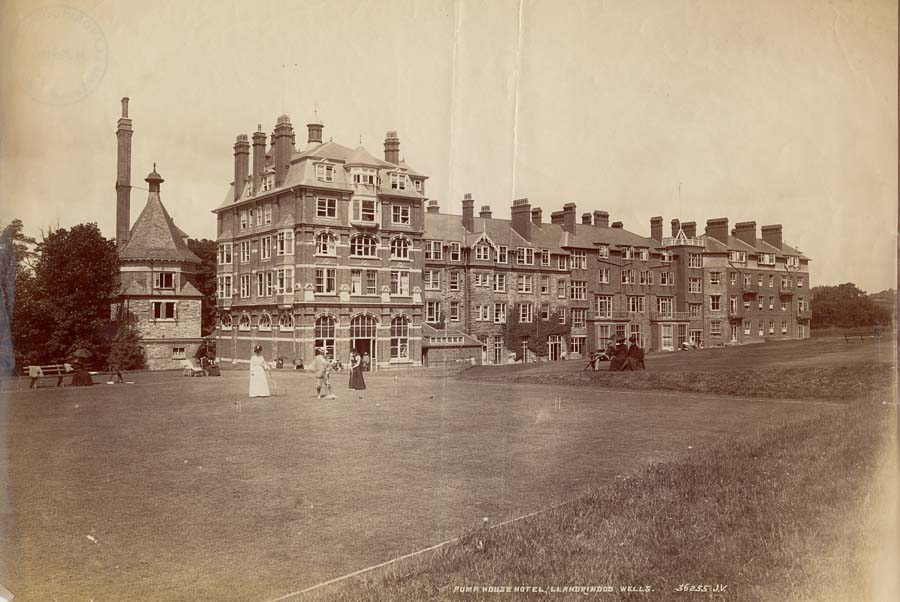
Some hotels belong to the history of a town. The Pump House belonged to the reason the town existed at all.
Long before Llandrindod Wells acquired its railway station, ornamental lake, villas, great red-brick hotels and confident municipal buildings, people were coming to this exposed part of Radnorshire for water. They came because springs rising from the ground were believed to possess medicinal properties. Around one group of those springs stood Bach-y-Graig Farm. From that landscape emerged the Pump House, first as a place where water could be obtained, then as a lodging house, then a hotel, and eventually one of the largest and most ambitious spa establishments in Wales.
Its history is therefore not simply that of a vanished Victorian hotel. It reaches back into the eighteenth-century origins of Llandrindod as a watering place and runs through almost every major stage in the town’s development: the coming of the railway, the enclosure and development of the common, the creation of the lake, the rise of mass tourism, the growth of county government, two world wars, post-war teacher training, residential education and finally the creation of Powys.
The great hotel itself is gone. County Hall stands where it once dominated the landscape. Yet the Pump House remains one of the best ways of understanding how Llandrindod Wells was made.
Before there was Llandrindod Wells
The story begins with the springs. Visitors were coming to the district by the late seventeenth century. Members of the Vaughan family of Herefordshire are recorded as having stayed for several weeks in 1696 to take the waters. At that point there was no town in any modern sense. There were farms, common land, rough roads and scattered places where mineral water emerged from the ground.
The Pump House springs lay on Bach-y-Graig Farm, part of the estate of Thomas Jones of Pencerrig. In the 1730s Mrs Jenkins, the tenant farmer’s wife, became associated with the rediscovery and commercial use of saline and sulphurous springs there. Later accounts said that she had sought a cure for a daughter suffering from a chronic complaint, but an earlier tradition preserved by Catherine Hutton in 1820 told the story differently. Hutton wrote that in 1736 Mrs Jenkins saw a light caused by inflammable vapours around the spring, dug in the hope of finding treasure and instead rediscovered the water. The two traditions cannot both be treated as literal fact. What they show is how quickly the beginnings of the spa acquired the sort of explanatory stories that gathered around successful watering places. The underlying development is clearer. People came. Water was sold. Accommodation followed.
By the 1740s a recognisable Pump House had become a permanent part of the site. An eighteenth-century traveller described a stone house near the springs, while later records refer to repairs and continuing use. Thomas Jones, the Pencerrig artist, noted the repair of an oven at the Pump House in April 1789. Walter Davies referred to it again in 1802. An illustration published in the early nineteenth century shows an established group of buildings beside the wells.
That continuity matters. Llandrindod Hall, opened in 1749 as the district’s first great fashionable spa establishment, enjoyed periods of success and decline. The Pump House was less dramatic, but more persistent. It remained tied to the springs themselves.
The attraction was medicine as contemporaries understood it. In 1756 the German-born physician Diederick Wessel Linden published a substantial account of the Llandrindod waters and the illnesses they were supposed to treat. Modern medicine has long since moved beyond many of those claims, but it is easy to become condescending about people who sought relief at spas. Their illnesses were real. Rheumatism, digestive disease, diabetes, skin complaints, chronic pain and debility could dominate a life at a time when effective treatments were limited. The waters offered something medicine often could not. Hope.
A boarding house grows around the wells

Catherine Hutton’s account of a four-week stay in 1820 gives us the clearest early picture yet found of the Pump House as a place to live. She described it as a boarding house possessing both the saline and sulphurous springs. The original tenant’s house, she wrote, had accommodated only eight or ten people. An adjoining building was then added, containing an eating room with four bedrooms above it, and the Dean of Brecon gave this extension the grand name of the Pavilion.
Hutton also gives us a firm date for another enlargement. In 1805, she said, a second addition was made, increasing the accommodation to twenty-four people, including a two-bed room above the coach house. The rooms themselves retained the improvised character of the early establishment. Some were known as the Den, the Salt-box, the Dungeon and the Post-chaise. The last was supposedly so cramped that a tall guest joked that he could touch all four sides while lying down. This was not yet the great Victorian hotel. It was a successful rural boarding establishment being enlarged piece by piece because visitors continued to come.
By the early nineteenth century the Pump House was also developing the social functions of a resort. A grand ball was advertised there in 1811. In 1817 Richard Williams’s work on the medicinal waters of Llandrindod could be bought at the Pump House itself as well as through a London medical bookseller. The establishment was therefore part of the machinery through which the spa promoted both its treatments and its reputation.
W. H. Howse, writing from earlier local sources, later noted a reference to a new house in 1809, while an advertisement of 1824 described a modern brick, sash-windowed dwelling house and said that the outgoing tenant had made a considerable fortune from selling the waters. Eleven bedrooms were added in 1827. By 1830 the familiar division between first- and second-class visitors was already established.
John Cane was in occupation by 1839. He appears to have been the first proprietor to call the establishment a hotel and advertised that he intended to provide recreations previously unknown at Llandrindod. Cane understood something which became fundamental to the later spa economy: medicinal water alone would not sustain a resort. Visitors expected food, company, comfort and diversion as well as treatment.
A surviving hotel bill from September 1842 reveals something of the commercial world behind the genteel language. Guests were charged for board and bed, individual meals, servants, horses and taking the waters. Even rushlights and feed for horses appeared as extras. The Pump House had become a business in which almost every part of the visitor’s stay could be priced.
The 1841 census catches that business at an unusually useful moment. The address is simply given as Pump House. John Cane, aged about sixty, was recorded as an innkeeper. Around him lived an assistant and a resident staff of young men and women. The household is unmistakably that of an organised hospitality business rather than a farmhouse casually taking lodgers.
By 1853 it could accommodate around forty-five people. There were pump rooms and grounds laid out for visitors, transport supplied by the hotel and medical advice available before beginning a course of the waters. Enlargement continued, but the building remained visibly rooted in the older watering-place landscape and was still partly thatched in the later 1860s.
The most memorable feature was the two-tier tariff, and it was older than later hotel folklore sometimes suggests. In 1827 there had been a uniform weekly charge of two guineas. By 1830 first-class visitors still paid two guineas, while second-class visitors paid less and servants less again. First-class and second-class guests were accommodated under the same roof but at different rates, and the two parts became known as the House of Lords and the House of Commons.
It sounds like a joke, and undoubtedly became part of the hotel’s folklore, but it reveals something important about nineteenth-century tourism. Class was not expected to disappear when people went on holiday or sought treatment. It was built into railway carriages, dining rooms, boarding houses and hotels. At the Pump House, even health could be experienced at different prices.
The railway and the making of the town
For generations the weakness of the Llandrindod springs was not their reputation but their remoteness. The railway changed that.
The Central Wales line reached Llandrindod in 1865. Suddenly a place which had required an awkward journey by road could be reached from the industrial valleys, the English Midlands and the larger cities. At almost the same time, enclosure made systematic development of the common possible.
An advertisement of 1 August 1866 captures the Pump House adapting almost immediately to the railway age. It announced that the hotel, described as a family and commercial boarding house, had undergone extensive alterations and improvements and was again open for visitors. The mineral springs were still in the grounds, but the attractions now included a billiard room and croquet ground. The advertisement made a point of the new railways and told readers that the Central Wales station was only about five minutes’ walk away. It was signed simply by Morgan, proprietor.
The evidence strongly suggests that this was D. D. Morgan. Surviving receipted Pump House bills identify him there in August 1867 and again in July 1873, while Worrall’s directory listed him at the hotel in 1875. One of the surviving bills records £10 1s. 3d. for eleven days’ board in 1867. The exact terms of different stays cannot safely be compared, but the documents provide unusually tangible evidence of the hotel as a commercial concern immediately after the coming of the railway.
When the Woolhope Naturalists’ Field Club visited in 1867, much of the future town was still open land. The Llanerch, Pump House and Rock House were the principal hotels, and the lines of proposed streets could apparently be seen marked across the turf. The club described the Pump House as the chief hotel and observed that between six and nine each morning visitors from across the district converged there to drink the waters and promenade in the shaded walks. Public dining tables were held at one and three, preserving the distinction between House of Lords and House of Commons, while an hourly omnibus connected the hotel with the railway and a four-in-hand coach served visitors. Llandrindod was being planned before it had fully appeared.
The Pump House stood at the centre of that transformation. In 1868 E. Middleton Evans of Llwynbarried Hall inherited the former Jones estate and increased his holdings through the enclosure of Llandrindod Common. He commissioned the Hereford architect Thomas Nicholson to prepare development plans for the grounds. His agent, N. W. Swettenham, worked with the Pump House Hotel Company in the early 1870s on another development which became inseparable from the town’s identity.
The lake is now so familiar that it can appear natural. It was not. Cadw’s registered historic park account places its construction in 1872–73, on boggy ground forming the last part of the old common, and states directly that it was made by the Pump House Hotel. It was intended for boating and quickly became a setting for regattas and recreation. The Pump House was therefore helping to create not only bedrooms and baths but an entire resort landscape. The history of the lake, its regattas and its later boathouse is explored separately in Llandrindod Lake and the Lakeside Boathouse.
The grounds themselves were already substantial. During the severe gale of October 1881 more than twenty trees were blown down in the Pump House Hotel grounds, one of several reports which remind us that the landscaped setting was a managed part of the visitor experience rather than an incidental backdrop.
Elizabeth Duffield
The most important individual in the later history of the Pump House was not an owner, architect or celebrated visitor. She was its manageress.
Elizabeth Maria Priscilla Duffield was baptised at Tregare in Monmouthshire in August 1852, the daughter of William and Mary Ann Duffield of Lower House. Her father was a farmer. Before coming to Llandrindod she built a career in hotel management, holding appointments at the Green Dragon in Hereford, the Royal Gatehouse at Tenby, the Mackworth in Swansea and the Langland Bay Hotel. She also assisted at a hotel in Barmouth kept by one of her sisters.
By about 1883 she had taken over the management of the Pump House. She would remain there for approximately thirty-three years.
That length of service alone is remarkable. More important is what happened during it. Duffield arrived while the old hotel still stood, presided over the transition to the great new Victorian establishment, managed it through its most prosperous decades and remained in charge until her death in 1916.
The Brecon and Radnor Express, looking back on her career after her death, credited much of the hotel’s success and prosperity to her business ability and courteous management. The Pump House Hotel Company repeatedly recorded its appreciation of her services in its minute books.
Her younger sister Agar Duffield also worked closely with her at the hotel. Agar’s death in March 1914 affected Elizabeth deeply, and contemporary reports said that her health was never quite the same afterwards.
The sisters belonged to a generation of women whose commercial authority has too often been hidden behind the language of domestic service. Elizabeth Duffield was not merely supervising bedrooms and dining rooms. She was running one of the largest hospitality businesses in Wales, negotiating the expectations of directors, doctors, guests and a large resident workforce while maintaining the personal tone expected of a fashionable hotel.
Demolition and rebirth, 1887–1888

By the 1880s the old Pump House could no longer match the scale of the resort growing around it. The decision was taken to rebuild completely.
On 10 December 1887 the Weekly Mail reported that demolition of the old Pump House Hotel had begun. The newspaper looked back fondly on the House of Lords and House of Commons, which had accommodated what it called the classes and masses, but described an altogether more ambitious replacement. The new building was to contain more than eighty bedrooms, many with private sitting rooms, magnificent reception rooms, modern sanitation, extensive conveniences and luxuries, and a sulphur bath within the hotel itself. The field behind was to be enclosed and laid out for pleasure and recreation.

The new hotel opened in 1888. It was an extraordinary leap in scale. The old Pump House had evolved piecemeal from a farmhouse and lodging establishment. Its replacement was deliberately monumental. Historic photographs show a complex of tall gables, projecting bays, towers, chimneys and long ranges overlooking the grounds. It was architecture intended to announce that Llandrindod had arrived.
The transformation of the wider estate continued. The first Pump House golf course can now be placed earlier than some later accounts suggest. Evidence from 1889–90 points to a nine-hole course laid out on the common near the lake by Alexander Patrick of Royal Wimbledon, with Thomas Gourlay appointed professional and greenkeeper. Golf therefore joined boating, croquet, walks and other recreations at the moment when the hotel was remaking itself for a larger Victorian clientele.
The hotel and grounds were also exposed to the practical hazards of maintaining a complex of this size. A violent thunderstorm in November 1899 caused considerable damage to one of the Pump House chimneys, just as another enormous round of building work was under way.
The great expansion, 1899–1907
The great building of 1888 was not the finished Pump House. Surviving building-control records show an establishment undergoing almost continuous alteration. New men’s lavatories appeared in 1898, bathrooms followed in January 1899, and in March plans were submitted for a new pump room and further additions. A lounge and porch followed in November.
A contemporary report in the Welsh Gazette on 31 August 1899 makes clear just how ambitious the work had become. Llandrindod had enjoyed an unusually successful season and several of its largest establishments were considering expansion. At the Pump House, however, building was already far advanced. The newspaper reported that many thousands of pounds were being spent, that the old Pump House had given way to a large new hall and that an elegant bath-house adjoining it was approaching completion. Once the directors’ plans were finished, the correspondent expected the Pump House to rank among the most commodious and elegant hotels in the country.
The building programme produced a serious contractual dispute. Hughes, a Birmingham contractor responsible for a new wing, claimed £2,788 for the contract and extras. The legal proceedings reached the Court of Appeal in 1902. Hughes had assigned the money due under the building contract to Lloyd’s Bank, which explains why the bank subsequently appeared as plaintiff. The court held that the assignment was absolute and Lloyd’s Bank was substituted in the action. By November the Pump House Hotel Company had paid £1,450 into court and this was accepted in full settlement. The company’s own counterclaim for £500 in penalties and related matters was abandoned. Contemporary legal reports from the same period also refer to receivership proceedings involving debenture holders.
The episode is revealing, but it should not be mistaken for evidence that the hotel remained commercially weak. By the end of 1906 the business was reporting very different figures. At the third ordinary general meeting of the Pump House Hotel, Llandrindod, Limited, the accounts showed an available balance of profit of £7,021 2s. 3d. The directors recommended a dividend of 10 per cent, absorbing £4,275, while £700 was placed in reserve against depreciation of leases and furniture. A further £2,046 2s. 3d. remained for directors’ remuneration and to carry forward. The Pump House was not simply prestigious. It was capable of producing substantial returns for its shareholders.
The scale of the completed enterprise can be seen equally clearly in the Middleton and Evans estate sale of September 1907. The wider estate extended to about 654 acres and included the Pump House Hotel, the Llanerch Hotel, five farms, a stone quarry and valuable building land. A bid of £80,000 for the estate as a whole was rejected. When the Pump House was offered separately, bidding reached £33,500 and the property was still withdrawn. By comparison, the Llanerch Hotel with thirteen acres sold for £7,600 to its tenant. The figures are not a formal valuation, but they give a striking sense of the Pump House’s place within the Edwardian resort economy.
The wider property remained complex. Southfield was altered and enlarged for the hotel in 1904, a greenhouse followed in 1905, and later work was undertaken on the laundry and bathroom accommodation. A purpose-built garage was planned in 1915. Sale material and later archival records show that Southfield and Lake Cottage belonged to the wider Pump House story. What photographs present as a single great hotel was in reality an operating estate of accommodation, baths, pump rooms, gardens, service buildings, transport, laundry, agriculture and recreation.
Taking the waters

The therapeutic ritual remained central. Visitors rose early. Doctors prescribed quantities of mineral water, sometimes six or seven glasses before breakfast. Earlier accounts recorded even larger amounts. Those unable to walk to the springs could have water delivered in stone jars to their rooms or lodgings.
The Pump House offered saline and sulphur waters, while the baths developed a formidable menu of treatments. By the early twentieth century visitors could encounter sulphur baths, vapour baths, needle or douche showers and cold bathing. Later generations would be offered electrical and heat treatments as spa medicine tried to keep pace with changing medical fashions.
The Pump Room followed its own daily rhythm. Water could be bought by the day, week or gallon. The season generally ran from spring into autumn, with July to September especially busy. Music accompanied the ritual. Bands and orchestras played while visitors drank prescribed quantities of water and then moved out into the grounds.
The springs were also a protected commercial asset. A 1908 conveyance recited a mortgage lease made on 31 October 1892 of the mineral springs known as the Pump Room to the Pump House Hotel Company for nineteen years, together with a covenant preventing mineral water from being sought on specified neighbouring land. In a spa economy, geology itself had become property. The water beneath the ground was as fundamental to the business as the bedrooms, dining rooms and pleasure grounds above it.
Spa life blurred medicine and leisure in a way that now feels unfamiliar. A visitor could begin the day under medical instruction, spend the afternoon boating or playing golf, dine formally, listen to an orchestra and end the evening in a drawing room or billiard room. Health had become a form of tourism.
The working hotel
Grand hotels are designed to make labour disappear. The Pump House depended on a great deal of it.
The 1901 census reveals Elizabeth Duffield at the head of a substantial resident establishment. Around her were bookkeepers, housemaids, waitresses, stillroom and laundry maids, kitchen staff, porters, a coachman, a carver, a page and even a resident golf professional. The occupations read almost like the departments of a small institution. By 1911 the same structure was larger still, with housekeepers, assistant housekeepers, bookkeepers, waitresses, chambermaids, kitchen workers, laundry staff and male hotel employees. Some had travelled considerable distances to work there, including workers born in Germany and Switzerland.
A tragedy in July 1906 gives an unusually vivid glimpse of life behind the public rooms. George Neupert, a German-born carver employed at the Pump House, had returned for his third successive season. After finishing work in the heat of the hotel kitchen around midnight, he and several fellow male servants walked towards the lake to cool down before retiring. Neupert took out a canoe, which capsized. His companions tried to reach him, but he drowned before he could be rescued. He was only about twenty-five or twenty-six.
The report is valuable because it reveals the rhythm of work which the hotel itself preferred to hide. The men were still leaving the kitchen around midnight, and Neupert’s third season shows the recurrent seasonal labour on which the establishment depended. The same archive which preserves directors, leases and sale particulars also contains a photograph of Pump House stablemen, another reminder that the hotel was a community of workers as well as guests.
For many young women, hotel service offered wages and a measure of independence away from the family home, but it came with strict discipline. Staff lived inside the institution they served. Their time was organised around meals, rooms, bells, arrivals and departures. Privacy was limited and the distinction between workplace and home barely existed. The apparent ease of the spa holiday was manufactured through labour.
Some stayed for years. When Elizabeth Duffield died, the funeral report named Mrs Rogers with more than eighteen years’ service, Susan Parkins with nineteen years and Lizzie Dennis with seventeen. Those lengths of service complicate any simple image of hotel work as transient seasonal labour. For some, the Pump House became a career and a community.
The hotel and the town

Duffield’s importance extended well beyond the building she managed. For more than twenty-one years she served as churchwarden of Llandrindod Old Parish Church and was remembered as one of the earliest women to hold such an office in England or Wales. She was instrumental in an enlargement scheme costing more than £600 and helped raise almost all of the money required.
She also served on the governing body and House Committee of Llandrindod Wells Hospital. Visitors at the Pump House were encouraged to support the institution, and she arranged concerts by Thomas’s Royal Ladies’ Choir to raise funds. During the First World War she became honorary treasurer of a comforts fund for convalescent soldiers and supported other wartime causes.
The Pump House was also part of Radnorshire’s political life. When elected county councils were created in 1889, Radnorshire had to decide where its new authority would meet. Presteigne possessed the older administrative tradition, but Llandrindod represented the railway age and the changing geography of the county. By the narrow margin of twelve votes to eleven, councillors chose Llandrindod. For years they generally met at the Pump House Hotel, until the county council acquired purpose-built offices in the High Street in 1909.
The symbolism is almost too perfect. A county authority created by Victorian reform conducted its business inside an institution created by Victorian tourism. The Pump House had helped establish Llandrindod as a place where the county gathered.
The death of Elizabeth Duffield

Elizabeth Duffield died at the Pump House on Sunday, 28 May 1916. She had suffered a serious illness in March but recovered sufficiently to resume work. On the morning of her death she was taken suddenly ill at about a quarter past six and died within half an hour.
Her funeral on 1 June was not merely a private family event. It became a public statement about her place in Llandrindod. The service at the Old Parish Church was fully choral. Local councillors, doctors, businessmen and representatives of the Pump House Hotel Company attended. The bearers were selected from employees of the hotel, Pump Room and baths. Floral tributes came from directors, visitors, individual employees, the kitchen staff, chambermaids, waitresses, stillroom maids, porters and outside staff.
Some tributes referred to Duffield as a friend. Others called her their dear or beloved mistress. Funeral language must always be read with care, but alongside decades of staff service and the testimony of the company, it suggests a woman who commanded substantial loyalty as well as authority. Probate valued her estate at £4,550 16s. 8d.
Between the wars

The Pump House survived the First World War, but the world of the spa was changing. The motor car altered travel. Medical science altered treatment. Domestic service became harder to recruit. Seaside resorts and new forms of holiday competed for visitors. Yet the Pump House was far from finished.
In October 1923 representatives of the Central Wales spas were invited to meet officials of the newly formed London, Midland and Scottish Railway at the Pump House Hotel. The local press welcomed the company’s interest while reminding readers that its predecessor, the London and North Western Railway, had promoted the spas for many years through rail services, posters, illustrated guides and persistent advertising. The choice of the Pump House for the conference was significant. More than half a century after the railway had transformed Llandrindod, the hotel was still being used as a place where the future of the spa economy was discussed.
Motoring did not simply replace the railway. The two overlapped for years. The Pump House had submitted plans for its own garage in 1915, and by the 1930s Tom Norton’s garage adjoining the hotel was being advertised to motorists. The resort was trying to reach visitors by whichever means they travelled.
Then came the crisis of 1929. On 24 August the Western Mail advertised the Pump House for auction the following month. It was described as the principal hotel in what the advertisement called the premier inland spa of Wales, with about 200 rooms, its own grounds, a model farm of approximately fifty acres, electric lighting and mains drainage. The saline and sulphur springs, Pump Room and baths were integral to the sale. RCAHMW preserves annotated sale particulars for the auction of 24 September, encompassing not only the hotel but Southfield, described as an annexe, and Lake Cottage.
The proposed sale did not lead to a simple transfer. In November Llandrindod Wells Urban District Council agreed to open negotiations to buy the hotel, baths, Pump Room and grounds. The idea went no further. By the end of that month newspapers reported that the Pump House had been sold privately and that the new proprietors intended to spend heavily on modernisation.
In January 1930 the contents of the old establishment were sold under instructions from the Receiver for the Debenture Stock Holders. The disposal included furnishings from the Pump Room, smoke room, lounge, billiard room, drawing room, dining room, reception areas and kitchens, together with 120 bed and sitting rooms, the equipment of the medicinal baths, trade fixtures, glass, china, linen, plate, outside effects and the furnishings of Southfield House. This was not simply an old owner handing over the keys to a new one. One commercial era had ended.
The Honywood revival

The Pump House reopened in 1930 as part of the Honywood Hotels group. It was a deliberate commercial reinvention under Lady Constance Mary Honywood, née Pixell, wife of Sir Courtenay John Honywood, 9th Baronet of Evington. After the First World War she had moved into hotel management and built a substantial business. By the 1920s and 1930s she was repeatedly identified in advertising as managing director of The Honywood Hotels Ltd.
The Honywood portfolio included hotels in London, Cheltenham, Shrewsbury, Cardiff, Malvern, Weymouth, the New Forest and Llandrindod Wells. The Pump House fitted the group unusually well because its value could not be detached from the springs, lake, landscape and long spa tradition. The organisation was modern in management but conservative in atmosphere. Historic hotels were to retain their individual character while being updated in the things inter-war guests increasingly expected.
The reopening in June 1930 was treated as a major event. Sir William Arbuthnot Lane formally reopened the hotel and baths before a large crowd, the band of the Welsh Guards provided music, visitors toured the building and grounds, and the evening ended with dinner, dancing and fireworks.
The new owners were not trying to recreate 1888. They were trying to make the Pump House modern again. The baths were equipped for diathermy, ultra-violet ray and radiant heat treatment. Experienced male and female nurses were employed and a resident matron was available. Central heating, telephones, improved bathrooms and hot and cold water increasingly sat alongside the older saline and sulphur waters.
A full-page advertisement in The Tatler on 6 May 1931 shows that repositioning especially clearly. It promoted fifty acres of grounds adjoining the golf course, special terms for salmon and trout fishing, suites of rooms, bedrooms with private bathrooms and central heating. The Pump Room and baths remained central, with saline and sulphur waters and what the advertisement called the latest electrical treatment. The hotel was also said to have been entirely reconstructed, redecorated and refurnished. That last phrase should be read as advertising language rather than literal proof that the whole building had been structurally rebuilt, but it leaves no doubt about the scale of the modernisation being claimed.
The Tatler advertisement also placed the Pump House beside other Honywood establishments in London, Brockenhurst, Dover, Weymouth, Cheltenham, Shrewsbury, Cardiff and Malvern. This was national marketing to an affluent readership. The inter-war Pump House was being sold not merely as a surviving Victorian spa hotel but as a modern country hotel combining treatment, golf, fishing, landscape and comfort.
The estate remained extensive. Tennis, bowls, putting, croquet and walks were offered. The hotel had its own farm and kitchen garden. Inter-war recollections describe eight gardeners working under a head gardener. Music remained part of the experience, with a Pump House band and an Austrian orchestra performing for visitors. In that coexistence of mineral water, nurses, cars, telephones, orchestras and formal dining, the Honywood Pump House belonged to a Britain suspended between Victorian habit and modern leisure.
September 1939 and wartime use

The 1939 Register preserves a remarkable final snapshot of the old hotel world. It was compiled on 29 September, less than four weeks after Britain declared war on Germany, and the Pump House was still functioning as a hotel. More than a hundred residents, guests and employees appear across its pages. The staff included chambermaids, waitresses, a head waiter, cooks, kitchen workers, porters, a page boy, clerical workers, a bookkeeper-receptionist and a garage attendant. Frederick Turner was recorded as hotel manager.
The guests included retired professionals, company directors, people of private means, a solicitor and a surgeon. On 29 September people were still making beds, serving meals, handling luggage, keeping accounts and receiving guests. The old residential hotel was still functioning on the eve of a very different future.
During the war the Pump House was taken into military use. It served as a military hospital and was also used for officer-cadet training. Lieutenant Geoffrey Berkeley Turnock, born in 1911 and serving with the Royal Artillery, was an instructor with the Officer Cadet Training Unit at the Pump House. On 6 October 1942, aged thirty, he was accidentally killed by a rifle grenade during a training exercise with officer cadets. Independent archival evidence also places 124 Officer Cadet Training Unit at Llandrindod in 1940. That is a strong lead towards identifying the wartime unit more precisely, although the surviving evidence should not yet be stretched to say that every element of 124 OCTU was based inside the hotel.
The building created for seasonal leisure had become useful to the wartime state for exactly the same practical reasons that later made so many hotels adaptable: bedrooms, kitchens, baths, large communal rooms and the ability to accommodate many people under one roof.
From hotel to emergency college

The Pump House found another purpose after the war, but the change did not happen overnight. During 1946 the proposed emergency teacher-training college was repeatedly delayed while alterations to the building were carried out. In May the Minister of Education told Parliament that work had not progressed far enough for the college to open and that an autumn start was then hoped for. By December the government was finally able to give an intended opening date of 20 January 1947.
Coleg Llandrindod operated from 1947 until 1950 as one of the emergency teacher-training colleges created to address the severe post-war shortage of teachers. The delays themselves are revealing. Converting an immense former hotel into an educational institution required labour and materials at a time when both were in short supply.
Powys Archives preserves an unusually human record of this short-lived institution through the papers of Cecilia Williams, who trained there. Photographs show college plays, a production of Twelfth Night, carnival groups by the lake and the final intake of 1950. A college magazine for 1949–50 also survives. Rooms once occupied by spa guests had become part of a residential training community whose students were preparing for careers in the classrooms of the new welfare state.
A school and a home, 1950–1973
On 17 October 1950 another community arrived. The Royal Cambrian and Llandrindod Wells Residential School for the Deaf opened in Llandrindod with 157 pupils. The former Pump House and Ye Wells became part of the residential school complex, its costs shared by the participating Welsh local education authorities.
For the children who lived there, the Pump House was not an interesting relic of spa history. It was part of home. They slept there, ate there, studied there and built friendships there. The same broad corridors and large rooms which had once supported seasonal tourism were absorbed into the routines of residential education.
The old building still demanded constant maintenance. In May 1956 fire broke out in the upper storeys while holiday crowds watched firefighters tackle the blaze. Several living apartments were severely damaged. The report is a reminder that the Pump House remained a heavily occupied building long after its hotel days had ended.
In July 1965 the building briefly appeared to be approaching another change of use. Radnorshire Education Authority agreed to take the first step towards establishing a teachers’ training college in Llandrindod after being told that there was an almost definite prospect of the Pump House closing as a residential school for the deaf. T. O. Nicholls pointed out that the premises had already been used shortly after the war as an emergency training college. The proposed closure did not happen then. The residential school remained until 1973, when changes in provision for deaf and hearing-impaired children brought the institution to an end.
This period should not be sentimentalised. Mid-twentieth-century deaf education was shaped largely by hearing authorities and by assumptions about speech, lip-reading and institutional care which deaf people themselves have subsequently challenged. The children who lived at Llandrindod were individuals, not simply beneficiaries of an institution.
Local government comes back

In 1974 Powys County Council acquired the former Pump House Hotel for use as County Headquarters. There was an extraordinary historical circularity to the decision. Radnorshire County Council had met at the Pump House after its creation in 1889. Eighty-five years later, the successor authority for Montgomeryshire, Radnorshire and Brecknockshire came to occupy the same place.
A newspaper looking back during the demolition in 1989 explained why the building had proved so useful: when the new county council was created, the old Pump House was effectively the only building in Llandrindod capable of housing most of its departments. Bedrooms became offices and public rooms became administrative spaces. The scale built for hundreds of seasonal visitors now accommodated a county bureaucracy.
Eventually the building could adapt no further. By November 1989 demolition was under way as the new £6.25 million County Hall neared completion. Contemporary plans proposed using part of the old Pump House basement in a lake or water feature in front of the new headquarters, so that the new building would be reflected over the footprint of the old. The report describes a proposal rather than proving exactly how much of the basement was ultimately incorporated, but the intention was strikingly symbolic.
The replacement County Hall was officially opened in 1990, not 1991 as some later summaries have stated.
Demolition did not entirely erase the Pump House landscape. In December 1990 Powys County Council announced a programme of tree management and replanting in the old hotel grounds. Some dangerous trees were to be felled and replaced in what was described as the first new planting there since Victorian times. Timber from the site was to be reused in a pergola-style information centre intended to house what the newspaper called the original pump from the old hotel, together with local history and wildlife displays.
Other fragments survived too. By 1992 a canopy salvaged from the former Pump House Hotel had been reused at Llandrindod Wells railway station. Later conservation accounts record roof tiles from the old building being reused in the new amenity structure, timber from a large Douglas fir in the grounds, and the restoration of a Victorian gate. Substantial elements of the old pump-house and bath complex also survived beside County Hall, while the springs themselves remain capped in the grounds.
There is a pleasing circularity in that survival. The railway helped transform the Pump House from a rural watering place into a Victorian resort hotel. After the hotel had gone, a fragment of its architecture found a new life at the station which had helped make its greatness possible.
What the Pump House tells us

The temptation with lost hotels is to remember grandeur. The Pump House deserves more than that.
Its history begins before Llandrindod Wells existed as a recognisable town. The eighteenth-century traditions surrounding Mrs Jenkins belong to a rural landscape in which visitors came with difficulty and lodged where they could. Catherine Hutton’s description of the Pavilion and the documented 1805 enlargement shows the early Pump House expanding long before the railway. John Cane’s nineteenth-century establishment belonged to the first organised spa economy, while D. D. Morgan’s tenure coincided with the railway transformation that pulled the older watering place into the new Victorian town.
The hotel then helped reshape the landscape around it. The lake was created in 1872–73. Golf followed by about 1889–90. The rebuilding of 1888 and the enormous expansion of 1899 created the monumental hotel remembered in postcards, but the surviving legal and financial records show the effort required to sustain it. The Hughes litigation reveals the risks of construction, the 1906 accounts reveal the profits which could follow, and the rejected £33,500 bid of 1907 shows the value attached to the finished establishment.
The census returns and George Neupert’s death expose the institution beneath the architecture. Chambermaids, cooks, porters, bookkeepers, gardeners, stablemen, carvers and waiters made the great hotel work. Some came for a season. Others remained for decades. Their labour created the ease that visitors believed they were paying to enjoy.
The inter-war years were not simply a story of decline. Railway officials were still discussing the promotion of the Central Wales spas at the Pump House in 1923. The crisis of 1929 was followed by the Honywood revival, and the 1931 Tatler advertisement shows a hotel deliberately broadening its appeal through fishing, golf, central heating, private bathrooms and modern treatments while still trading on the mineral waters.
Then the building crossed into entirely different worlds. Soldiers replaced spa guests. Teacher trainees replaced soldiers. Deaf children made a home in rooms designed for paying visitors. Local government eventually took possession of the site. Each generation inherited the same place and asked a different question of it.
The other great hotels help place the Pump House in context. The Gwalia tells us about the confidence of the mature Victorian resort and the family who made one hotel into an institution, while Ye Wells shows how a great Edwardian building could survive by becoming something entirely different. The Hotel Metropole offers another contrast, a hotel which survived the collapse of the old spa economy by repeatedly adapting its market, facilities and purpose while remaining in hospitality.
Llandrindod did not build the Pump House because it had become a spa town. The town grew because places like the Pump House had already made the wells worth travelling to.
The settlement grew towards it, then around it, and finally over it. Today County Hall occupies the landscape where mineral water was sold, where Elizabeth Duffield ran one of the great hotels of Wales, where visitors queued for sulphur and saline waters, where servants carried trays and made beds, where soldiers trained, where teachers studied and where deaf children lived. The hotel is gone. The history is not.
For the wider institutional story, see Llandrindod Wells Hospital: From Cottage Hospital to County War Memorial, which traces the hospital from its Victorian foundation through the war memorial rebuilding, the NHS and its modern role in rural Powys.
Related Essays
- Llandrindod Wells Hospital: From Cottage Hospital to County War Memorial
- Board and Lodging: The Boarding Houses of Llandrindod Wells
- Bowling in Llandrindod Wells: From the Spa Greens to Rock Park and the Indoor Game
- From the Pump House Links to Death or Glory: A History of Golf in Llandrindod Wells
- From Spa Town to Administrative Capital: Civic Government and the Making of Llandrindod Wells
Explore more Llandrindod Wells history
Continue with the Llandrindod Wells History guide, or follow the related essays above to explore the people, buildings and institutions that shaped the town.
Sources and Further Reading
Catherine Hutton, letters and reminiscences relating to her stay at Llandrindod in 1820, for the early Pump House, the Pavilion, the 1805 enlargement and contemporary traditions surrounding Mrs Jenkins.
Richard Williams, account of the mineral waters of Llandrindod, 1817, advertised for sale at the Pump House and through London medical booksellers.
W. H. Howse, Old-Time Llandrindod, Radnorshire Society, for the nineteenth-century development of the Pump House, tariffs and John Cane’s occupation.
Oswestry Advertiser, 1 August 1866, advertisement for the reopened and improved Pump House Hotel under Morgan, including railway access, billiards and croquet.
Woolhope Naturalists’ Field Club, Transactions, 1867, account of Llandrindod and the Pump House, including the morning drinking of the waters, dining arrangements, railway omnibus and four-in-hand.
Gwynedd Archives, receipted Pump House Hotel bills in the name of D. D. Morgan, 3 August 1867 and 28 July 1873; Worrall’s Directory of South Wales, 1875.
Cadw, registered historic park and garden report for Llandrindod Wells, for the construction of the lake in 1872–73 and its relationship with the Pump House Hotel.
Wellington Journal, 22 October 1881, report of the gale which brought down more than twenty trees in the Pump House Hotel grounds.
Weekly Mail, 10 December 1887, report on the demolition of the old Pump House Hotel and plans for its replacement.
Contemporary golf reporting and later club historical material, 1889–90, for Alexander Patrick’s nine-hole Pump House course and Thomas Gourlay’s appointment as professional and greenkeeper.
Welsh Gazette, 31 August 1899, report on the extensive Pump House alterations, new hall and bath-house and the expenditure of many thousands of pounds. Radnor Express, 16 November 1899, report of thunderstorm damage to a Pump House Hotel chimney.
Hughes v. The Pump House Hotel Company Ltd, [1902] 2 K.B. 190 and [1902] 2 K.B. 485; Hereford Times, 8 November 1902, for the building dispute, Lloyd’s Bank assignment and settlement.
Brecon and Radnor Express and Carmarthen Gazette, 12 July 1906, report of the death of George Neupert, Pump House Hotel carver, at Llandrindod Lake.
Radnorshire Standard, 6 February 1907, report and balance sheet of the Pump House Hotel, Llandrindod, Limited, for the year ended 31 December 1906.
Montgomeryshire Echo, 7 September 1907, report of the Middleton and Evans estate sale, including the rejected £33,500 bid for the Pump House Hotel.
Powys Archives, Llandrindod Wells Urban District Council records, including building-plan registers, leases, Southfield, laundry, bathrooms, garage and property agreements, 1888–1915; J. G. Williams solicitor’s papers relating to the Pump Room mineral springs.
Census of England and Wales, 1841, 1901 and 1911, Pump House and Pump House Hotel, Llandrindod Wells; National Probate Calendar, 1916; Tregare parish register, baptism of Elizabeth Maria Priscilla Duffield.
Brecon and Radnor Express, 1 and 8 June 1916, obituary, career account and funeral of Elizabeth Maria Priscilla Duffield.
Wellington Journal, 13 October 1923, report of the proposed conference between representatives of the Central Wales spas and the LMS Railway at the Pump House Hotel.
Western Mail, 24 August and 28 December 1929; Wellington Journal, 16 November 1929; Daily News and Western Mail, 30 November 1929, for the sale, council negotiations, private purchase and receivership disposal.
Royal Commission on the Ancient and Historical Monuments of Wales, annotated sale particulars for the Pump House Hotel, Southfield and Lake Cottage, 24 September 1929, and associated photographic collections.
Shrewsbury Chronicle, 6 June 1930, report of the reopening of the Pump House under Honywood Hotels; contemporary Honywood Hotels advertising and company material.
The Tatler, 6 May 1931, full-page advertisement for the Pump House Hotel, fishing, golf, fifty acres of grounds, private bathrooms, central heating, Pump Room and baths.
1939 Register, Pump House Hotel, Llandrindod Wells. Ormskirk Heritage Hub, biographical account of Lieutenant Geoffrey Berkeley Turnock and his death during officer-cadet training at the Pump House Hotel, 6 October 1942; Trinity College Cambridge archives, correspondence identifying 124 Officer Cadet Training Unit at Llandrindod in 1940.
Hansard, 1946, parliamentary statements on delays to the Llandrindod emergency teacher-training college and the intended opening date of 20 January 1947; Powys Archives, Cecilia Williams papers relating to Coleg Llandrindod, 1947–50.
National Library of Wales, records of the Royal Cambrian and Llandrindod Wells Residential School for the Deaf, opened 17 October 1950 and closed 1973.
Western Mail, 22 May 1956, report of the fire in the upper storeys of the former Pump House during its use as a residential school.
Liverpool Daily Post (Welsh Edition), 24 July 1965, report of the proposal to establish a teachers’ training college at the Pump House if the residential school closed.
South Shropshire Journal, 3 November 1989, report on demolition of the old Pump House and the proposed use of part of its basement within the new County Hall landscape.
Liverpool Daily Post (Welsh Edition), 10 December 1990, report on tree management, replanting and the proposed information centre housing the historic Pump House pump.
South Shropshire Journal, 20 March 1992, report noting the reuse of a Pump House Hotel canopy at Llandrindod Wells railway station.
Powys Archives, records of the construction and opening of the new County Hall, 1989–90; Tony Haskell, Caring for Our Built Heritage: Conservation in Practice, 1993, for the post-demolition landscaping and reuse of material from the former Pump House site.
Bruce Osborne, Llandrindod Wells, New Millennium Spa Heritage Series, especially the chapter on the Pump House Estate; C. W. Newman, “The Pump House Hotel, Llandrindod Wells”, Transactions of the Radnorshire Society, vol. 52, 1982; J. Clark, The South Wales Itinerary, 1853.