
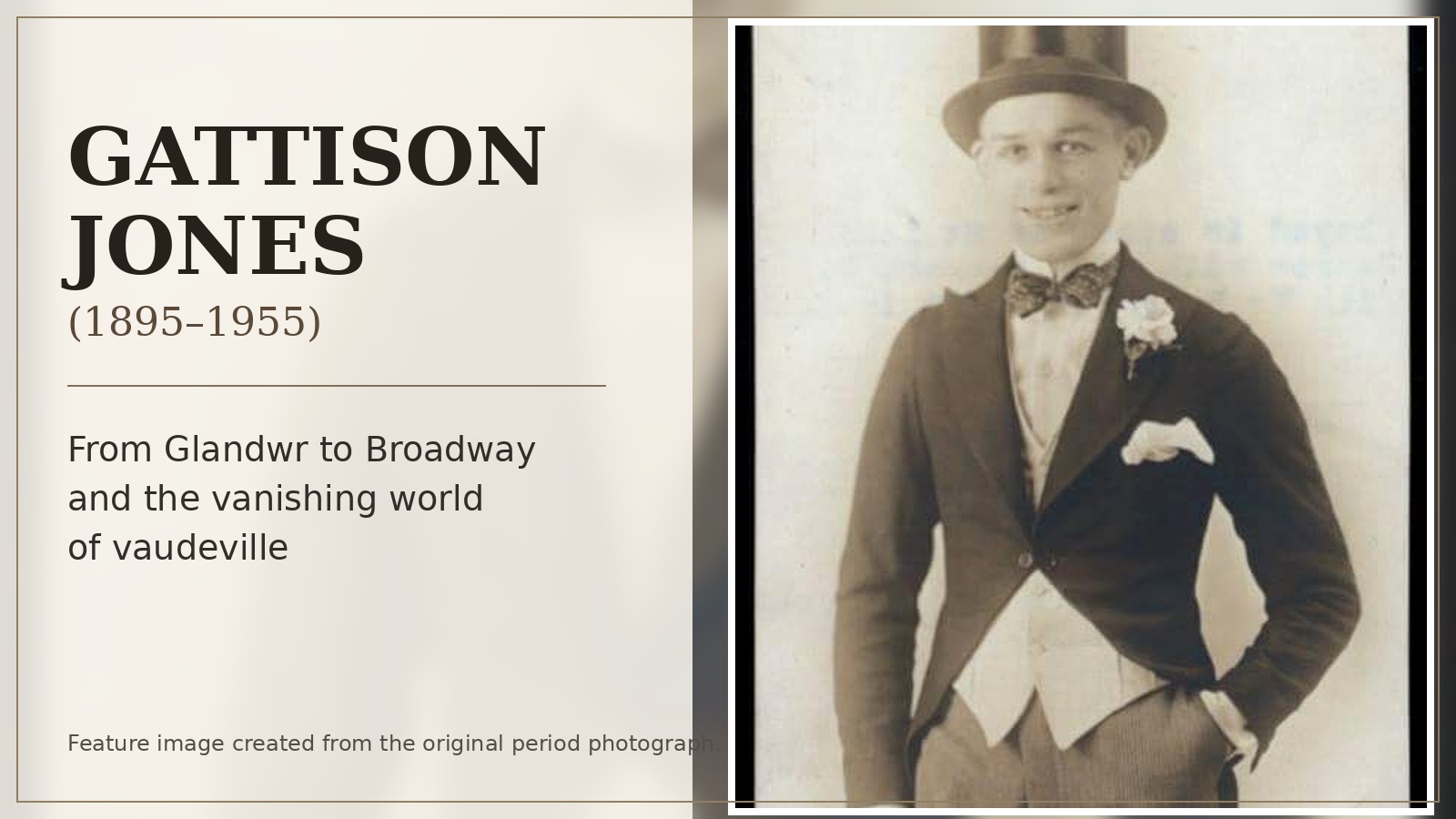
There is something striking about the distance travelled by the descendants of William Jones of Glandwr. Within little more than a century, a family whose fortunes had been built between Dolgellau, London and a country house overlooking the Mawddach had produced lawyers, clergymen, soldiers, sportsmen and musicians on several continents. Among the more unusual descendants was a man who became known not by his full name, Gatty Wynne Jones, but by the more theatrical name of Gattison Jones.
Today Gattison is almost entirely forgotten. He made no famous film, left behind no great recording and never achieved the enduring celebrity of some of the people with whom he shared a stage. Yet that rather obscures what he actually achieved. For more than a decade he earned his living in one of the most competitive branches of American entertainment. He toured the major vaudeville circuits, developed a recognised dancing act with his wife, appeared in four Broadway productions and performed alongside men and women who would become familiar names in American cinema. At his height he was being advertised by theatres as one of their principal attractions.
His story is also one of transition. Gattison belonged to the last great generation of American vaudeville performers. During his working life the entertainment industry changed around him. The variety theatre that had supported thousands of professional performers was progressively displaced by the cinema, then transformed again by talking pictures. Some vaudeville performers successfully crossed into Hollywood. Gattison Jones apparently did not. His life therefore tells us something wider about the thousands of respectable professional entertainers who flourished in the 1910s and 1920s, only to find that the world in which they had built their careers was disappearing.
From Glandwr to America
Gatty Wynne Jones was born at Jacksonville, Illinois, on 3 December 1895. He was the eldest son of Gatty Wynne Jones and May Blanche Taylor, and through his father belonged to the American branch of the Jones family of Glandwr. His grandfather was William Halse Gatty Jones, eldest son of William Jones of Glandwr Hall near Barmouth. He was therefore the great-grandson of the man who had established the Glandwr family among the substantial landowning families of nineteenth-century Merionethshire.
By the time Gattison was born, however, his immediate family had travelled a very long way from the world of Glandwr. His father had become a professional musician in the United States and was particularly associated with the banjo. Eventually settling in Salt Lake City, he founded the Jones College of Music. The 1910 United States census found the family together in Salt Lake City, with Gatty Wynne Jones recorded as a musician, the fifteen-year-old Gattison, then still known as Gatty W., attending school, and his younger brother Gordon L. Jones also in the household. The atmosphere in which Gattison grew up was therefore very different from that of his Welsh ancestors. Music was not merely a genteel accomplishment within the household, it was a profession.
The younger Gatty initially showed considerable promise in another direction. He was a talented swimmer and athlete and won local recognition for his swimming. Yet his ambition was already moving towards entertainment. Growing up in a household centred upon music must have made the stage a considerably less improbable career than it might have appeared to most young men of his generation. His father’s profession had already broken with the conventional careers followed by many of the earlier Glandwr descendants. The son went one stage further.
He adopted the professional name Gattison Jones. It was a clever choice. It retained enough of his unusual given name to remain distinctive, while sounding suitably theatrical on a programme or billboard. Under that name he began to establish himself as a dancer and musical comedy performer.
The first professional stages
Gattison had entered the theatrical profession remarkably young. When he registered for the American military draft in Salt Lake City on 5 June 1917, only months after his marriage to Elsie, he gave his occupation simply as “Vaudeville”. At twenty-one he was therefore already identifying himself officially by the profession that would dominate the next thirteen years of his life. His statement that he was “not employed at present” also hints at the precarious rhythm of theatrical employment, performers moving between engagements rather than holding continuous salaried positions. The same card recorded two years of earlier service as a high-school cadet in Utah and described him as six feet tall, slender, with blue eyes and light hair.
By 1919 Jones was appearing with the dancer Sheila Terry and fellow performer Ben Bard in William B. Friedlander’s Three’s a Crowd, a compact twenty-two-minute “tabloid musical romance” in three scenes. The premise was simple but theatrical: Jones and Bard played old friends who discovered that both were courting Terry, then proposed to her simultaneously, leaving the audience to choose between them by applause. The rejected suitor was sent towards a painted recruiting office while the successful man and Terry headed towards an “Apartments to Let” sign, a neat comic shorthand for marriage and domestic life. Contemporary Variety reporting regarded both men as competent and the act as sufficiently effective to make an impression on the bill. The production continued to tour. In April 1920 the Davis Theatre in Pittsburgh advertised Sheila Terry with Harry Peterson and Gattison Jones in Three’s a Crowd, describing it as a three-scene operetta mounted with the care of a much larger musical comedy, complete with its own conductor and stage technicians.
Not every critic was enthusiastic. A Billboard review published at the beginning of 1920 found the production slow and undistinguished, although it acknowledged the dancing of one of the male performers. Such criticism is useful. It reminds us that Gattison’s career was not a simple progress from success to success. Vaudeville was intensely competitive. Acts were judged night after night, audiences could be unforgiving, and performers constantly altered material in response to reviews, theatre managers and changing public tastes.
More importantly, Gattison was working. By his early twenties he had entered the professional American theatre and had begun appearing on bills far removed from his Salt Lake City upbringing.
Elsie Elliott
The most important professional partnership of Gattison’s life was also his first marriage. Elsie Mae Elliott, whose original surname was Rockenfield, became both his wife and his dancing partner. They married in Iowa on 23 September 1916. The marriage would eventually end unhappily, but for much of the next fifteen years Gattison and Elsie functioned as a professional team.
Their partnership mattered because vaudeville depended heavily upon distinctive acts. A performer did not simply need talent. He needed something that could be advertised in a few words, fitted into a theatre programme and transported from one city to another. Jones and Elliott developed precisely such an identity. They danced together, performed individual speciality numbers and, during their most successful period, appeared with their own musical accompaniment.
Their first major Broadway opportunity came in 1920 with Jim Jam Jems.
Broadway
Jim Jam Jems opened at the Cort Theatre in New York on 4 October 1920. Gattison played the role of Murphy, while Elsie Elliott was also among the company. He had been attached to the production before its Broadway opening. A July 1920 Billboard report announced that rehearsals would begin at the Cort Theatre on 2 August ahead of an Atlantic City premiere on 20 August, and Gattison Jones was already named among the intended company. His Broadway appearance was therefore not a late addition, but part of the show’s development and pre-Broadway life. The production ultimately ran until 1 January 1921, giving 105 performances.
That was no insignificant achievement. Broadway was already the centre of the American commercial theatre, and the cast around Gattison contained several performers whose reputations would subsequently grow far beyond the stage. Joe E. Brown, Frank Fay, Ned Sparks and Harry Langdon were all associated with the production. Langdon in particular would become one of the notable screen comedians of the silent era.
Gattison therefore worked within precisely the theatrical environment from which early Hollywood was drawing much of its talent. In retrospect it is easy to divide performers into those who became film stars and those who did not. The distinction would have been far less obvious in 1920. They were all part of the same entertainment world, moving between musical comedy, vaudeville, revues and, increasingly, the motion picture industry.
Gattison’s next years show how readily he moved between Broadway, vaudeville and the wider variety world. In June 1922 Variety reported that producer Rube Bernstein had engaged Gattison Jones as the “juvenile” and Elsie Elliott as the “ingenue” for the Columbia Circuit attraction The Broadway Flappers. In theatrical usage the juvenile was not a child performer, but the youthful male romantic or leading type, which tells us something about the way Gattison was being cast. The engagement also places husband and wife firmly within the professional burlesque and variety circuits of the period. Only weeks later Gattison joined the enormous company of Spice of 1922 at the Winter Garden Theatre. The revue opened on 6 July and continued until 9 September, its large cast of comedians, dancers, singers and speciality performers reflecting the lavish revue format then fashionable in New York.
Yet Broadway was only one part of Gattison’s career. Indeed, the surviving evidence increasingly suggests that the more important part of his professional life was spent on the road.
Vaudeville across America
During the 1920s Gattison Jones and Elsie Elliott became established performers on the American vaudeville circuit. This meant constant movement. An act could spend one week in Chicago, the next in Milwaukee, then travel hundreds or thousands of miles for another engagement. Railway timetables, hotel rooms, rehearsals and twice daily performances formed the practical background to what audiences experienced as effortless glamour.
In April 1923 Billboard listed “Jones, Gattison, & Band” at the Orpheum Theatre in Oakland, California. Later that year Gattison’s company was appearing at the Orpheum in Oklahoma City. By March 1924 he could be found in Portland, Oregon, before moving on to San Francisco. The scale of his standing on the circuit becomes clearer in the following year. In May 1925 Bakersfield advertising promoted “Gattison Jones and Band” as the “Big Orpheum Headline Act”, describing the presentation as a song-and-dance revue. By April 1926 Billboard was listing “Jones, Gattison, Co.” at the Palace Theatre in Cincinnati. The wording matters: during the middle 1920s he was not merely appearing on bills, but increasingly fronting an identifiable company under his own name.
These scattered notices are more revealing than they first appear. Oakland, Oklahoma City, Portland and San Francisco were not neighbouring engagements. They demonstrate that Gattison was travelling through a national theatrical network.
The Orpheum circuit was an important part of American vaudeville. To be repeatedly engaged within such a system required an act capable of satisfying theatre managers and audiences in very different cities. Gattison was no longer merely trying to establish himself. He was earning a sustained professional living from entertainment.
A particularly evocative piece of evidence survives from December 1923. An advertisement for the Orpheum Palace Theatre in South Bend, Indiana, announced “Gattison Jones and Elsie Elliott” among its star acts. Their names appeared prominently enough to sell tickets on their own recognition.
By the following year their act had developed further.
Gattison Jones, Elsie Elliott and the Jazz Age
In November 1924 the Adams Theatre in Newark advertised “Gattison Jones and Elsie Elliott”, assisted by Hal Fisher’s Collegiate Orchestra, as one of vaudeville’s particularly polished attractions.
The detail is important. Gattison and Elsie were no longer appearing simply as two dancers. Their presentation had grown into a staged musical act with orchestral backing, suited perfectly to the Jazz Age. A United States passport application completed in Los Angeles in November 1924 makes the transition even clearer. The document names him as “Gatty Wynne Jones, professionally known as Gattison Jones” and gives his occupation simply as “Actor”. Living at 1519 Hazelwood Avenue, Los Angeles, he intended to travel to England, France, Italy, Holland, Switzerland and Belgium for travel and professional work, with departure from New York planned for December. The application also preserves a contemporary photograph of Gattison and Elsie and describes him as six feet tall, with blue eyes, blond hair, a fair complexion and a long face. Harold Fisher, a musician who swore the supporting identification affidavit, stated that he had known Gattison personally for two years. This places the Hal Fisher association on firmer ground, showing that the orchestral collaboration reflected an established personal as well as professional connection.

The strength of the act’s position on the circuit can also be seen in Variety‘s September 1924 coverage of forthcoming Orpheum tours, where “Gattison Jones, Elsie Elliott and Band” appeared among the nationally promoted attractions. A few months later Billboard reported that Gattison Jones and Elsie Elliott, accompanied by Hal Fisher’s Orchestra, had begun an Orpheum Circuit tour at the Palace Theatre in Chicago, presented on the prestigious twice-daily schedule under the direction of theatrical agent Harry Weber. Surviving contemporary publicity now makes the hierarchy of the act especially clear. A printed music-publisher image carries Gattison’s portrait above the musicians and bills the presentation as “Gattison Jones, assisted by Hal Fishers Orchestra”. Gattison, not the orchestra, was therefore being marketed as the principal attraction. The same publicity was issued by Ager, Yellen & Bornstein Inc., Music Publishers, 745 Seventh Avenue, New York, and complements the surviving sheet-music material for Hard-to-get Gertie, which likewise promoted Gattison with Fisher’s orchestra.

A few weeks later the Gattison Jones Company was listed at the Palace in Milwaukee before moving to the State Lake Theatre in Chicago. By late 1925 another Billboard report described an entertainment company of twenty-four people that included Gattison Jones and Elsie Elliott with their Hollywood Club Orchestra.
There is a temptation, because Gattison ultimately became obscure, to imagine that he had never been particularly successful. The contemporary evidence argues otherwise. Success in vaudeville did not necessarily mean becoming a household name for generations afterwards. It meant remaining booked, moving from theatre to theatre and developing an act that managers believed audiences would pay to see.
Gattison and Elsie were doing precisely that.
Their career should therefore be understood within the vanished professional class of American vaudeville. Thousands of performers once occupied this world. Some became famous enough to survive in cultural memory. Others were enormously familiar to audiences for a few years and then disappeared almost completely when the theatres, newspapers and circuits that sustained their reputations vanished.
Gattison Jones belonged somewhere between the two.
Back to Broadway
The partnership with Elsie continued into the later 1920s and eventually brought the couple back to Broadway.
On 1 October 1928 Sunny Days opened at the Century Theatre. Gattison played Paul Morel, while Elsie appeared as Babette. This was a substantially more identifiable part than his anonymous appearance in Spice of 1922. Paul Morel participated in several of the production’s musical numbers, including I’ll Be Smiling, Hang Your Hat on the Moon, Girls’ Brigade and Trample Your Troubles.
It demonstrates that Gattison had developed beyond being merely a speciality dancer placed between larger acts. He was capable of working as a musical comedy performer within a Broadway production, combining acting, movement and musical presentation.
Only weeks after Sunny Days closed, another Broadway engagement followed.
Angela opened at the Ambassador Theatre on 3 December 1928. Produced by Lee and J. J. Shubert, it gave Gattison the role of the Duke of Berascon. The production ran for forty performances, closing on 7 January 1929.
Its cast gives Gattison’s career a particularly interesting historical perspective. The Princess Angela was played by Jeanette MacDonald. Eric Blore and Alison Skipworth were also among the company. All three would subsequently become familiar figures in motion pictures.
MacDonald was on the very edge of the transition that would transform American entertainment. Within a short time she would become one of Hollywood’s best-known musical stars. Gattison had stood on the same Broadway stage with her just before that transformation occurred.
The contrast is revealing. One career was about to be magnified by the cinema. The other was approaching its end.
The end of vaudeville
The late 1920s were difficult years for traditional vaudeville. Cinema had been drawing audiences away for some time, but the arrival of synchronised sound accelerated the change dramatically. The theatrical world upon which performers such as Gattison and Elsie depended began to contract.
The change did not happen overnight. Gattison was still performing professionally in 1930.
The end of Broadway did not mean the end of Gattison’s theatrical life. Variety listings show Gattison Jones and Elsie Elliott still on the road in late 1929, including an Orpheum engagement in Portland, and they continued to appear on major bills into February 1930. On 8 March that year they were at Loew’s Lincoln Square in New York in Hit Bits of 1930. The company included Douglas Leavitt, Ruth Lockwood, Bobs McIntyre, Ted Eddy and his nine-piece orchestra, and the Hayden Girls Chorus. Billboard recorded Gattison and Elsie among the entertainers surrounding the principal comedy performers. The surviving evidence therefore shows a career that continued through the final contraction of traditional vaudeville rather than one that simply ended with Angela.
This pushes Gattison’s documented professional theatrical career across thirteen years, from his own declaration of “Vaudeville” in 1917 through to the surviving stage notices of 1930.
After that the evidence becomes markedly thinner.
Family research records that Gattison and Elsie moved to Los Angeles in the early 1930s, where he became sales manager for Los Angeles Buick.
It is difficult not to wonder whether the move west was connected with the motion picture industry. Gattison had spent years working alongside performers who were moving into films, and Los Angeles was the obvious destination for anyone hoping to make the same transition. Yet no convincing film credit has so far been found for him.
We should therefore resist turning possibility into fact. Perhaps he attempted to enter films and failed. Perhaps he had already decided that a regular commercial career offered greater security than the increasingly uncertain theatre. The evidence presently supports neither conclusion.
What can be said is that by the early 1930s Gattison Jones, once a nationally travelling vaudeville performer and Broadway actor, was earning his living in the motor trade.
It was a dramatic occupational change, but probably not an unusual one. The decline of vaudeville displaced an enormous professional workforce. Singers, dancers, comedians, musicians, speciality acts and theatrical technicians all had to adapt to an entertainment economy that suddenly needed far fewer of them.
The Betty Compson affair
The quieter life did not prevent Gattison from briefly returning to national attention.
His marriage to Elsie had deteriorated badly. They had no children and separated in October 1933. The following year an acrimonious divorce action began. Gattison alleged that Elsie had subjected him to mental cruelty. Elsie responded with allegations of her own and named the Hollywood actress Betty Compson.
The story was sufficiently colourful to be carried by the Associated Press. In November 1934 newspapers described Gattison as the sales manager of a Los Angeles automobile concern and reported that Elsie had named Compson as his alleged former sweetheart.
There was already a connection between them. Betty Compson had grown up in Salt Lake City and had moved through vaudeville into motion pictures, eventually becoming a recognised star of the silent screen. Family research indicates that she had known Gattison during their school years and had received violin tuition from his mother through the Jones College of Music. Newspapers covering the divorce claimed that Gattison and Compson had once been youthful sweethearts.

Elsie alleged that she had discovered letters from Compson to her husband and that Gattison had threatened her if she revealed them. The allegation should remain exactly that, an allegation made during an exceptionally hostile divorce. No evidence presently allows us to state as fact that Gattison and Betty Compson conducted an affair.
Nevertheless, the episode provides a curious final connection between Gattison and Hollywood. Betty had successfully made the transition from vaudeville to the screen that Gattison apparently did not. By 1934, however, her own greatest period of fame was behind her. The arrival of talking films that had helped destroy traditional vaudeville had also altered the fortunes of many silent stars.
Their stories, in different ways, were shaped by the same revolution.
A second marriage
Gattison did not remain single for long. On 20 December 1935 he married Lynnivere Paddock. She represented a very different world from that of the touring performer Elsie Elliott. Lynnivere was a graduate of Whittier College and had distinguished herself as an able student and debater. Among her contemporaries at Whittier was another young Californian whose life would take a very different course, the future President Richard Nixon. The connection is independently corroborated in material preserved by the Nixon Presidential Library, where a Whittier-related list identifies “(Lynnivere Paddock) Mrs. G. W. Jones” at 3810 Olmsted, Los Angeles, the same address later recorded for Gattison on his Second World War registration card.
The marriage endured. Gattison and Lynnivere eventually had one son, Gatty Wynne Jones III, born in 1948. By the 1940s Gattison’s professional life had moved even further away from Broadway. His Second World War registration card places him at 3810 Olmsted Street, Los Angeles, and records his employer as the Dr Pepper Bottling Company at 5950 Avalon Boulevard. The person he named as someone who would always know his address was his mother, Mrs May Blanche Jones of 262 Seventh Avenue, San Francisco, a small but revealing indication that mother and son remained in contact. The former Broadway performer was by then working in the commercial world as a Dr Pepper salesman.
It is an apparently ordinary ending to a remarkably unusual career.
The young man who had grown up in a Salt Lake City music school had danced his way through vaudeville, toured the United States, played Broadway, worked alongside future film stars, led an act bearing his own name and briefly found himself entangled in Hollywood newspaper scandal. By middle age he had settled into commercial employment.
Gattison Jones died at 1.15 a.m. on 1 June 1955 at the City of Hope Medical Center in Duarte, Los Angeles County. His death certificate records acute cardiac failure, resulting from cor pulmonale, itself associated with pulmonary emphysema and fibrosis. The underlying lung disease was said to have been present for about five years. The certificate described his usual occupation as “Salesman” in the automotive industry, independently reinforcing the evidence that his post-theatrical life had included substantial work in motor sales. His wife was recorded simply as “Lynne Jones”, evidently Lynnivere. Gattison was buried at Rose Hills Memorial Park on 4 June 1955. The certificate gives his birth date as 3 December 1897 and his father’s birthplace as England, but these entries were supplied from hospital records and conflict with stronger records completed by Gattison himself. His 1917 draft registration and 1924 passport application support 3 December 1895 as his birth date, while the passport identifies his father as Australian-born. Lynnivere survived him by half a century, working as a schoolteacher and dying in November 2005.
The forgotten performer
Gattison Jones never became a Jeanette MacDonald, Joe E. Brown or Harry Langdon. There is no reason to pretend otherwise. Yet measuring his life only against those who became enduring celebrities produces a distorted picture of his achievement.
He worked professionally in American entertainment for at least thirteen years. He appeared repeatedly on one of the country’s principal vaudeville circuits. His name was used to advertise theatre bills. He maintained a long-running dancing partnership, at times supported by jazz orchestras and his own company. He secured four Broadway credits between 1920 and 1928, including named roles in Jim Jam Jems, Sunny Days and Angela.
That was a genuine theatrical career.
His obscurity today probably tells us less about the quality of that career than about the disappearance of the world in which it existed. Film preserved faces and voices. Vaudeville often preserved little more than advertisements, reviews, programmes and names buried deep in entertainment newspapers. A successful act could perform before tens of thousands of people across America and yet leave almost nothing by which later generations might remember it.
Gattison’s survival in the historical record is therefore unusually dependent upon fragments. A theatre advertisement in Indiana, a Billboard route listing in California, a Broadway cast list in New York, an old passport photograph and newspaper accounts of an unhappy divorce gradually reconstruct a man whose working life otherwise almost disappeared.
There is an additional irony when his story is returned to its Welsh origins.
Gattison was born in Illinois, grew up in Utah and apparently had little direct connection with Wales. Yet by descent he belonged to the family of Glandwr Hall. His great-grandfather William Jones had established the family’s position in Merionethshire during the nineteenth century. His grandfather William Halse Gatty Jones had crossed the world between Britain and Australia. His father had remade himself as an American musician. Gattison continued that movement until the Jones family had travelled, socially as well as geographically, from a Welsh country house to the stages of Broadway.
He was perhaps one of the least Welsh of William Jones’s descendants in everyday experience, but his life illustrates better than almost any other how widely the family dispersed and how thoroughly later generations entered the modern world.
Gattison Jones belonged to an entertainment industry caught between two ages. He reached Broadway, toured the great vaudeville circuits and lived through the exuberance of the Jazz Age. Then the theatres changed, cinema took command, and a career that had once carried his name across American newspapers quietly disappeared.
Almost a century later, the fragments are enough to put him back on the stage.
Explore the wider family: The Jones Family of Glandwr Hall, Barmouth places Gattison Jones within the wider story of the family’s dispersal from Merionethshire into Australia and the United States.
Sources and Further Reading
Antony David Davies, Old Llyfnant Valley Farming Families: Including the Jones Glandwr and Davies Caeadda Families, particularly the chapter “Gatty Wynne Jones”, pp. 122–125.
Internet Broadway Database, Gattison Jones performer record, confirming four Broadway productions, Jim Jam Jems (1920–21), Spice of 1922 (1922), Sunny Days (1928) and Angela (1928–29).
Internet Broadway Database, Jim Jam Jems, original production and cast record.
United States Federal Census, 1910, Salt Lake City, Utah, household of Gatty Wynne Jones; United States World War I Draft Registration Card for Gatty Wynne Jones, 5 June 1917, Salt Lake City; United States Passport Application No. 494593, Gatty Wynne Jones, professionally known as Gattison Jones, November 1924, including the supporting affidavit of Harold Fisher and contemporary photograph of Gattison and Elsie; United States World War II Draft Registration Card for Gatty Wynne Jones, Los Angeles, recording his residence at 3810 Olmsted Street and employment with the Dr Pepper Bottling Company; County of Los Angeles Certificate of Death for Gatty Wynne Jones, 1 June 1955, recording his death at the City of Hope Medical Center, Duarte, his usual occupation as an automotive salesman, the medical cause of death and burial at Rose Hills Memorial Park.
Variety, March 1919, contemporary review and description of William B. Friedlander’s Three’s a Crowd, including its three-scene structure, audience participation and the roles played by Gattison Jones, Sheila Terry and Ben Bard; Davis Theatre, Pittsburgh, April 1920 advertising for Three’s a Crowd; The Billboard, July 1920, advance reporting on rehearsals and the Atlantic City opening of Jim Jam Jems.
Labor Clarion, June 1919, contemporary notice for Sheila Terry, Harry Peterson and Gattison Jones in Three’s a Crowd.
Variety, June 1922, reporting Gattison Jones as the “juvenile” and Elsie Elliott as the “ingenue” in Rube Bernstein’s The Broadway Flappers; Variety, September 1924, Orpheum Circuit coverage listing “Gattison Jones, Elsie Elliott and Band”; Bakersfield theatre advertising, May 1925, billing “Gattison Jones and Band” as the “Big Orpheum Headline Act”; The Billboard, 24 April 1926, listing “Jones, Gattison, Co.” at the Palace Theatre, Cincinnati.
University of Notre Dame Archives, The Daily, December 1923, theatre advertisements prominently billing Gattison Jones and Elsie Elliott at the Orpheum Palace Theatre.
The Westfield Leader, November 1924, advertisement for Gattison Jones and Elsie Elliott with Hal Fisher’s Collegiate Orchestra at the Adams Theatre, Newark.
The Billboard, 15 March 1930, review of Hit Bits of 1930 at Loew’s Lincoln Square, New York, providing evidence that Gattison and Elsie were still performing professionally in March 1930.
Variety, December 1929 and February 1930, route and theatre listings documenting Gattison Jones and Elsie Elliott’s continued touring after their final Broadway engagement; The Billboard, 15 March 1930, review of Hit Bits of 1930 at Loew’s Lincoln Square, New York; Ager, Yellen & Bornstein Inc., contemporary publicity image, “Gattison Jones assisted by Hal Fishers Orchestra”, 745 Seventh Avenue, New York; Baylor University, Frances G. Spencer Collection of American Popular Sheet Music, Hard-to-get Gertie, promotional material naming “Gattison Jones with Hal Fisher’s Orchestra”; Richard Nixon Presidential Library, Whittier-related correspondence and address material identifying “(Lynnivere Paddock) Mrs. G. W. Jones” at 3810 Olmsted, Los Angeles; Associated Press reporting reproduced in the Daily Iowan, 1 December 1934, concerning the Jones divorce proceedings and the allegations involving actress Betty Compson.