
As a boy in the 1990s, I loved reading about mysteries, unexplained events and unsolved crime. Somewhere among those books was the story of a boy called Oliver Thomas. I have long since forgotten the title of the volume in which I first encountered it, but I have never forgotten the story itself. What made it different from many of the other mysteries I read was the supposed local connection. Rhayader was familiar ground to me, part of the landscape in which I grew up, and the idea that such an extraordinary disappearance had taken place there gave the story an immediacy which tales from distant places did not have.
As a child I accepted the account largely as it was presented, an unexplained local mystery. An eleven-year-old boy had supposedly walked out into the snow on Christmas Eve 1909, his family had heard him crying for help, his footprints had ended abruptly and he had never been seen again. It was memorable enough to remain with me for more than thirty years. Returning to it now, however, raises a rather different question. Before asking how Oliver Thomas disappeared, it is necessary to ask whether the disappearance happened at all.
The story of Oliver Thomas
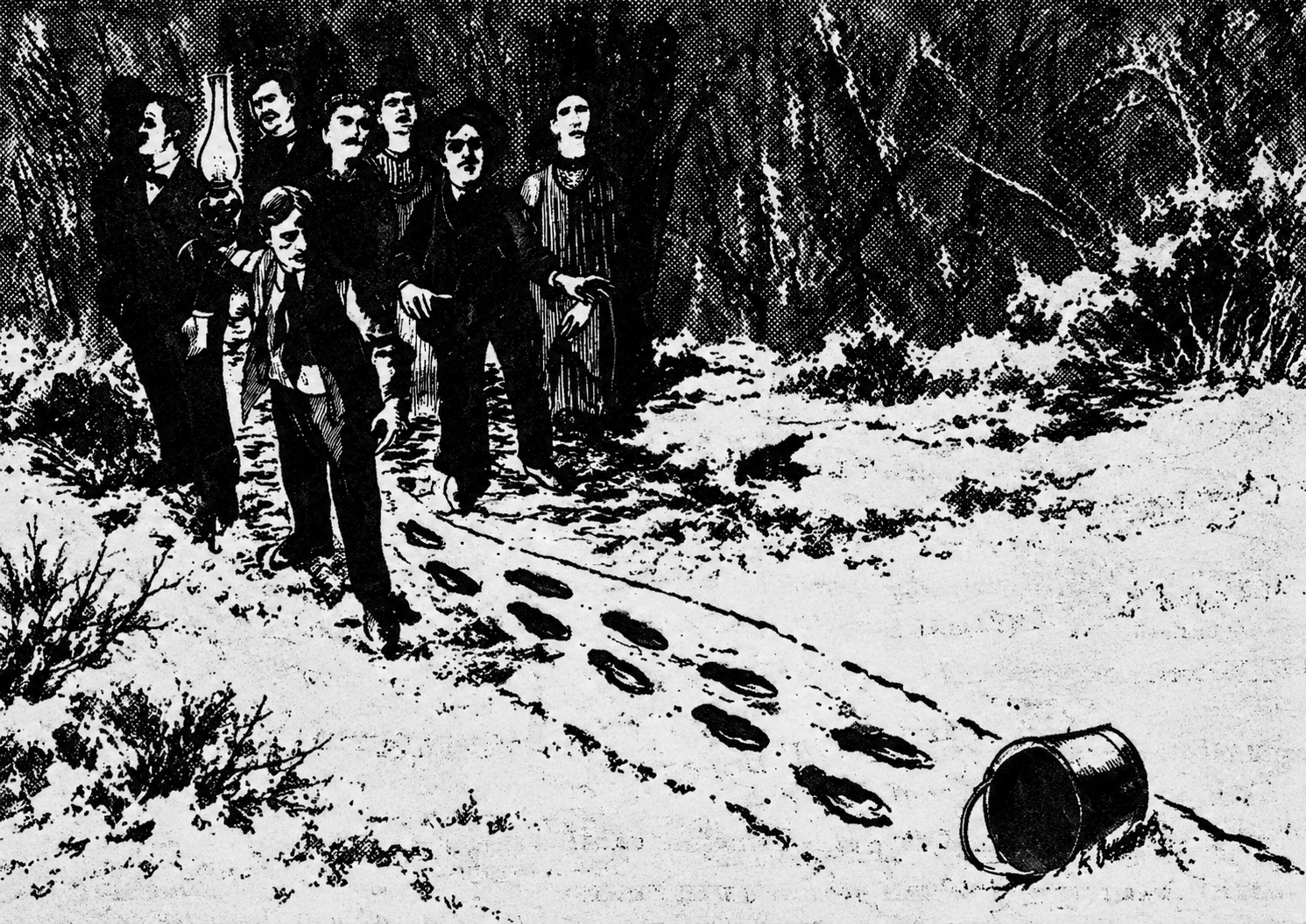
The familiar version is set on Christmas Eve 1909. Snow lay across the Welsh hills and a family party had gathered at a farmhouse, with chestnuts roasting, carols being sung and relatives and friends preparing to welcome Christmas Day. The farmer was Owen Thomas and his eleven-year-old son was Oliver. Shortly before eleven o’clock, Owen noticed that more water was needed and sent the boy outside with a bucket to draw some from the well.
Only a few moments later those inside heard Oliver scream. They hurried into the yard with a paraffin lantern, but although they could hear the boy they could not see him. His voice appeared to come from somewhere above them. According to the later accounts he shouted that something had got him. His footprints were visible in the snow leading towards the well, but then they stopped. There were no marks showing that he had turned aside and no second set of footprints beside his own. The bucket was found farther on, beyond the point where the trail ended. Oliver himself had vanished.
It is an extraordinarily effective story because the details are simple and visual. A farmhouse, a winter night, a child sent for water, fresh snow and a trail of footprints which ends where no person should be able to disappear. The setting sounds plausible enough for rural mid-Wales in the early twentieth century, while the supposed presence of numerous witnesses gives the account an appearance of substance. Later versions added police searches, an inquest and the claim that official enquiries could find no explanation.
A story in print
An important early British version survives in the Belfast News Letter of Tuesday 19 May 1964. Under the heading When a boy vanished into the night, John Macklin presented the case as part of his Stranger Than Fiction series. This matters because it shows that the Welsh version of the story was already circulating before Brad Steiger included a very similar account in his 1966 book Strangers from the Skies.
Macklin’s account contains most of the elements which later became standard. Christmas Eve 1909 brought snow across the mountains of Wales. In a farmhouse on what he described as a Brecon hillside, about a dozen people were gathered around the kitchen range. Owen Thomas was the farmer and Oliver his eleven-year-old son. Among the guests were said to be a minister and his wife, a veterinary surgeon and an auctioneer. Shortly before eleven Oliver was sent outside for water. Within seconds he screamed. The minister seized a paraffin lantern and the party rushed out, only to hear the boy’s voice apparently coming from overhead while his footprints ended on the way towards the well.
Macklin then moved the story beyond family recollection and into supposedly official territory. Police were summoned, the well was grappled, the surrounding countryside searched and those present questioned. He claimed that an inquest was held and that no ordinary explanation could be found. He also referred to official records which supposedly ruled out balloons and aircraft. These are precisely the sort of details which make a story sound historical, because they imply that somewhere there must be files, names, reports and evidence which can be checked.
There is, however, one small but important point in Macklin’s wording. He did not describe Oliver as a boy from Rhayader. The police, he wrote, were summoned from the nearby town of Rhayader. The distinction is easily overlooked, but it helps explain how the story may have changed in later retellings. A farmhouse somewhere in the Welsh hills, with police arriving from Rhayader, gradually became a disappearance at Rhayader itself. Once that happened, Oliver Thomas could be remembered simply as the boy who vanished from Rhayader.
The geography in Macklin’s version is itself rather loose. Rhayader was in Radnorshire, while his reference to a Brecon hillside sounds more like a generalised idea of mid-Wales than a description rooted in close local knowledge. That does not disprove the story, but it is exactly the sort of imprecision which deserves attention when a supposedly factual account first appears many decades after the event.
An American story before 1909
The greater difficulty for the Oliver Thomas story is that its central features were already in print before 1909. In October 1888 the American writer Ambrose Bierce published a group of mysterious disappearance stories in the San Francisco Examiner. Among them was the piece later known as Charles Ashmore’s Trail.
Bierce’s Charles Ashmore was sixteen and lived with his family near Quincy, Illinois. One winter evening he left the house carrying a tin bucket to fetch water from a nearby spring. When he failed to return, his father went looking for him with a lantern. Snow lay on the ground and Charles’s footprints could be followed easily. Then, after a short distance, the trail simply stopped. Beyond the final print the snow was undisturbed. Several days later his mother believed that she heard her son’s voice near the place where the footprints had ended, and other members of the family were said to have heard it afterwards. The voice gradually became fainter until it disappeared altogether.
The similarities are too substantial to ignore. There is the isolated family home, the journey for water, the bucket, the snow, the disappearing trail and the disembodied voice. The essential structure of the supposed Welsh mystery was therefore present in American literature more than twenty years before Oliver Thomas was said to have vanished.
The story then changed again. By the beginning of the twentieth century an American version concerning a young man called Oliver Lerch, or in some accounts Oliver Larch, was circulating in print. Researchers have traced an early form of this story to the New York Sunday Telegraph on Christmas Day 1904, while another version appeared in The Scrap Book in 1906. The setting was moved to a farmhouse near South Bend, Indiana, the date became Christmas Eve and the missing person was now Oliver rather than Charles. Once again he went outside to fetch water, snow covered the ground, his cries were heard and his footprints ended inexplicably.
The story continued to circulate through newspapers, magazines and books. Details changed from one telling to another. Oliver’s age varied, as did the year, the distance travelled and the exact words supposedly shouted. What remained constant was the recognisable core of the tale. In the post-war period it entered the literature of paranormal events and unidentified flying objects, where the voice coming from above could be interpreted as evidence that the missing person had somehow been taken into the sky.
From Oliver Lerch to Oliver Thomas
At some point the American Oliver Lerch crossed the Atlantic and became Oliver Thomas. By May 1964, when Macklin’s article appeared, the transformation was already complete. The farmhouse was now in Wales, Oliver was eleven, his father was Owen Thomas, respectable witnesses had been added and Rhayader had entered the account as the nearby town from which the police came.
Two years later Brad Steiger published a closely corresponding version in Strangers from the Skies. The similarities extend well beyond the broad idea of a missing boy. The Christmas gathering, chestnuts and carols, the named father, the minister, veterinary surgeon and auctioneer, the paraffin lantern, the well, the bucket, the footprints and the cries from overhead all belong to the same developing tradition. It would be tempting to assume that Steiger took the story directly from Macklin, but without a documentary link that would go further than the evidence allows. Both may have been drawing on another version which had already begun to circulate.
The more interesting point is that the story appears to have accumulated local authority only after it had already been substantially reshaped. Rhayader was not necessarily the original setting of the Welsh version, yet repeated retelling seems to have pulled the town steadily towards the centre of the account. The nearby police town became the place of disappearance, and the boy eventually became local in memory even when the earliest British version located him only vaguely in the surrounding Welsh hills.
Testing the story against the record
This is where the difference between a good mystery and good history becomes important. Macklin did not describe a private family legend which might easily have escaped the record. He described a major disappearance involving numerous witnesses, a police investigation, a search of the well and surrounding countryside, and an inquest. An eleven-year-old child who disappeared in such circumstances ought to have left traces beyond a newspaper feature published more than half a century later.
There should be a family which can be identified, a farmhouse which can be located, police activity which can be followed, an inquest which can be traced, or contemporary newspaper reports describing the disappearance and search. At present no convincing body of contemporary Welsh evidence has emerged to support the story as told. That is not the same as proving that no child called Oliver Thomas ever lived in the wider district, and it would be unwise to turn the absence of one online search result into absolute proof. Historical records can be incomplete, newspapers can omit events and digitised searches can fail.
The difficulty is cumulative. The claimed disappearance is not merely hard to find in Welsh records, its central plot can be demonstrated in print before 1909 and in another country. The name, date and geography move over time, while the narrative remains strikingly stable. When that is placed beside the lack of a firmly identified Thomas family or contemporary inquest, the balance of evidence points away from a genuine unexplained disappearance and towards a story which was repeatedly adapted.
There remains value in checking the surviving local records wherever possible. Rhayader’s police and petty sessions records survive for the relevant period in Powys Archives, and they offer one of the most useful remaining avenues for testing the alleged event directly. If an official investigation on the scale described by Macklin really took place, some trace might reasonably be expected. Equally, if nothing appears, that absence would need to be weighed alongside the wider documentary history rather than treated as a dramatic proof in itself.
How a legend becomes local history
The story of Oliver Thomas is more interesting because of this uncertainty, not less. It provides an unusually clear example of how folklore can become attached to a real place. The process does not require one person to invent an entire false history. A writer changes a name. Another changes a date. A location is simplified. A secondary account is repeated without returning to its source. A detail is added because it improves the story. Over time, repetition begins to look like corroboration.
Rhayader also suited the tale. The surrounding country could still seem remote to outside readers in the 1960s, and a farmhouse, well, winter darkness and snow-covered hills fitted a familiar image of rural Wales. The setting felt plausible. Once the name Rhayader appeared in print, later writers had little reason to question whether the town was actually the scene of the event or merely a nearby place mentioned in one version of the story.
That local connection is also the reason the story remained with me. As a boy, I did not remember Oliver Thomas because his was necessarily the strangest mystery in the book. I remembered him because I knew Rhayader. The landscape was familiar and the story seemed to belong to somewhere I understood. It crossed from the world of mystery books into my own sense of place.
Looking at it now as an historian, the most revealing part of the story is not the supposed moment when the footprints stopped. It is the much longer process by which Charles Ashmore of Illinois became Oliver Lerch of Indiana and then Oliver Thomas of Wales. By the time the story had settled around Rhayader, much of its structure had already travelled for decades.
The boy who never vanished?
There is no persuasive evidence at present that an eleven-year-old Oliver Thomas disappeared in the Rhayader district on Christmas Eve 1909 in the circumstances described by John Macklin and later writers. That conclusion should remain carefully phrased, because the absence of evidence is not the same as proof that no child of that name ever existed. What can be said with much greater confidence is that the disappearance story itself has a demonstrable ancestry which predates 1909.
Ambrose Bierce had already written of a young man leaving home to fetch water, disappearing where his footprints ended in the snow and later being heard as a mysterious voice. The Oliver Lerch version transferred much of that structure into an allegedly factual American case. Twentieth-century paranormal writers repeated and altered it, and by 1964 the story had emerged in Britain as the disappearance of Oliver Thomas somewhere in the Welsh hills, with Rhayader supplying the police.
The question which fascinated me as a boy was what had happened to Oliver Thomas. The more interesting question now is how he came to be in Rhayader at all.
That is why the story still belongs in the history of Radnorshire, but in a different way from that suggested by the mystery books. It is not reliable evidence of an unexplained disappearance. It is evidence of the way stories travel, change and become local. What began as a literary mystery in nineteenth-century America eventually settled into the folklore of mid-Wales.
Oliver Thomas may never have vanished from a snowy Radnorshire farm.
He appears instead to have been gradually written into it.
Related Essays
Explore more Radnorshire history
Continue with the Radnorshire History guide, or browse the related essays above.
Receive new historical essays by email
For new essays on Welsh history, biography, genealogy and rural community life, subscribe on the homepage.
Sources and Further Reading
The principal early British source for the Welsh version examined here is John Macklin, “When a boy vanished into the night”, News Letter, Belfast, 19 May 1964, p. 4. Macklin’s account is especially valuable because it predates Brad Steiger’s better-known retelling and because it describes Rhayader as the nearby town from which police were summoned rather than clearly identifying it as Oliver’s home.
The principal literary antecedent is Ambrose Bierce’s Charles Ashmore’s Trail, first published with his mysterious disappearance stories in the San Francisco Examiner on 14 October 1888. Early twentieth-century versions concerning Oliver Lerch or Larch appeared in American print before the supposed Welsh disappearance of 1909 and were later repeated in paranormal and UFO literature.
Later investigations by writers including Kevin Randle, together with research tracing the early Oliver Lerch tradition, are useful in showing how the names, dates and locations changed while the basic narrative remained. The surviving Rhayader police and petty sessions material at Powys Archives provides a useful local avenue for further checking against the official record.