
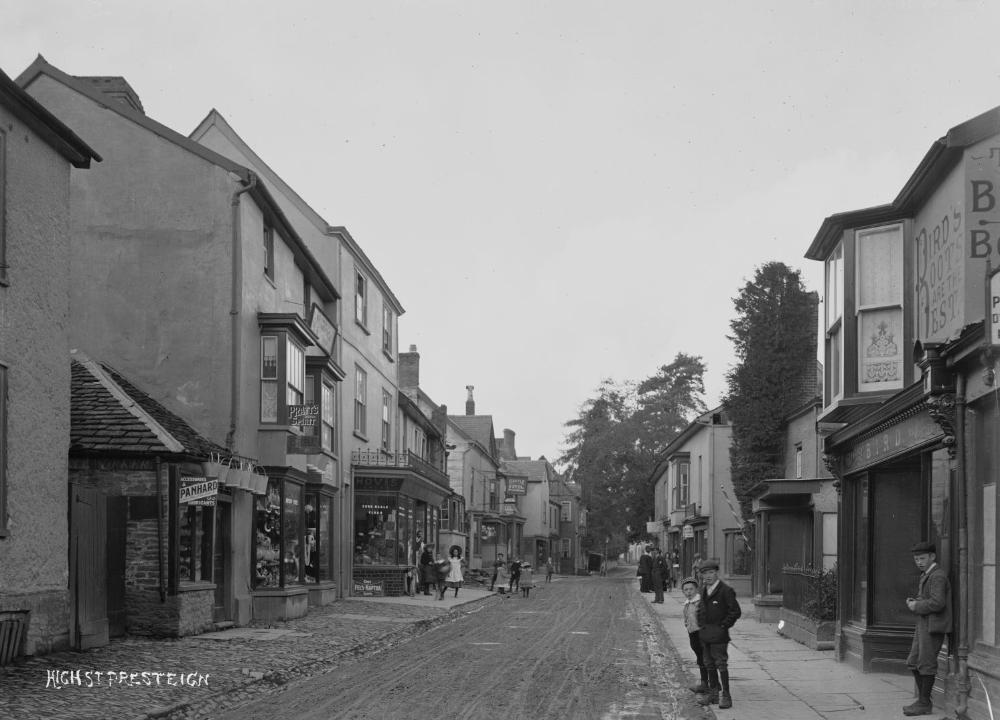
Presteigne is one of those towns whose historical importance is not immediately explained by its size. Standing beside the River Lugg, almost touching the English border, it has the quiet appearance of a small country town shaped chiefly by the Georgian and Victorian periods. High Street, Broad Street and St David’s Street contain old shopfronts, substantial houses, timber-framed buildings hidden behind later façades and civic buildings on a scale that suggests a rather larger story. For centuries this was one of the principal places from which Radnorshire was governed. Judges lodged here, prisoners were confined here, jurors and witnesses came in from across the county, and attorneys, magistrates and officials filled its inns and public buildings. Markets drew the surrounding countryside into the town, while coaches and carriers connected it with a much wider border economy. Before Llandrindod Wells rose to prominence, Presteigne was the place where much of Radnorshire’s judicial and administrative life was concentrated.
That long public role is only part of the story. Presteigne was repeatedly altered by events that might easily have broken the continuity of a smaller settlement. War, plague and fire all left their mark. Industries changed, roads improved, the railway arrived late and disappeared again, and the machinery of county government gradually shifted elsewhere. Yet the basic framework of the town endured. Medieval property lines survived behind later buildings, old institutions found new uses and successive generations tended to adapt what was already there rather than sweep it away. The Presteigne of today is the result of that long accumulation, not the creation of any one period.
Llanandras and the medieval town
The Welsh name Llanandras points towards St Andrew’s Church and to origins much older than Presteigne’s later fame as a market and county town. St Andrew’s contains unusually early masonry, including work regarded as pre-Norman, alongside Norman and later medieval fabric. It is now Grade I listed and stands among the most important medieval churches in Powys. The building is particularly appropriate to Presteigne because it contains several periods at once. Medieval stonework sits alongside later alterations and furnishings, among them an early sixteenth-century Flemish tapestry and Georgian additions. Nothing about the church suggests that the town stood still. Both were changed repeatedly, but enough of the earlier fabric survived for their long development to remain visible.
By the early thirteenth century Presteigne was taking on the characteristics of a small commercial town. Henry III granted William Fitz Warin the right to hold a weekly market and annual fair in 1225, although that grant cannot simply be treated as the foundation of the market. Only a few years later Fitz Warin was pardoned the payment due because he apparently did not actually possess the manor, and later medieval records show market rights in other hands. Even so, the evidence points to a settlement whose urban functions were becoming established. Long, narrow burgage plots developed behind the principal street frontages, and archaeological work has shown medieval occupation extending along Scottleton Street. Houses were replaced, divided and refronted over the centuries, but many of those earlier property boundaries survived beneath the later town.
Nor is Presteigne’s medieval character confined to the plan of its streets. Timber dating has identified fifteenth-century fabric within surviving buildings, including timbers at Tan House dating from the 1430s. Parts of the domestic town known to people in the later Middle Ages therefore remain within the modern one. Above it all lies the Warden, now a peaceful public space but once part of a more defensive landscape. A castle was probably established there around the end of the twelfth century and occupied a commanding position over the settlement. It was attacked during the campaigns of Llywelyn ap Gruffudd in 1262 and thereafter largely disappears from the documentary record. Few places in Presteigne show the change in the town’s character more clearly, a site associated with military power eventually becoming one of its favourite places of recreation.
Destruction and recovery
Presteigne did not grow steadily from medieval market settlement to county town. The later Middle Ages brought periods of economic difficulty, disease and political upheaval, and the town suffered during the years of the Glyndŵr rising in the early fifteenth century. Settlement and trade across the border country were badly disrupted. Presteigne nevertheless recovered, and by the later fifteenth century its market and commercial life had revived sufficiently for a charter of 1482 to confirm renewed privileges. At roughly the same time, New Radnor, once the more obvious centre of the county, was losing some of its former importance.
Geography helped Presteigne. Although firmly part of Radnorshire, the town looked eastwards as naturally as it looked west. Herefordshire lay close at hand, and the everyday economy of the border paid little attention to the neat county boundaries shown on maps. Farmers, merchants and craftsmen crossed them constantly. During the Tudor period wool and cloth became important to Presteigne, giving employment to local households and helping to create a more prosperous commercial community. John Beddoes, a successful merchant associated with the cloth trade, belonged to that world. In 1565 he founded a grammar school in the town, leaving an educational legacy which survived for centuries and became closely associated with one of Presteigne’s most familiar customs, the evening ringing of the curfew bell at St Andrew’s.
By the sixteenth century, however, commerce and education were no longer the only sources of the town’s importance. Presteigne was beginning to acquire a judicial role that would outlast almost every other institution discussed in this essay. It was that role, more than any single industry, which eventually set the town apart from its Radnorshire neighbours.
The making of Radnorshire’s judicial centre
Important judicial functions were transferred to Presteigne in the 1540s following serious disorder at Rhayader. Later generations gave the episode a dramatic edge, with one tradition speaking of the murder of a judge and other accounts referring instead to a sheriff killed while carrying out his duties. The detail is less certain than the outcome. Presteigne became one of the places in which the Court of Great Sessions met, and from that point the administration of justice became woven into the life and economy of the town.
The arrival of a court meant much more than the appearance of a judge for a few days. Clerks, barristers, attorneys, jurors, witnesses, constables, sheriffs, servants and prisoners all had to be accommodated. Inns filled, horses required stabling and traders supplied visitors who might stay in town for the duration of a session. Legal business created its own local economy. Quarter Sessions also dealt with matters extending well beyond criminal trials, including roads, bridges, county expenditure, policing and other public responsibilities. Long before elected county government existed, Presteigne was therefore one of the places where the practical business of Radnorshire was carried out.
The intimacy of a small county made this especially visible. Judges and magistrates walked the same streets as shopkeepers and labourers, while prisoners were held only a short distance from ordinary houses and businesses. On court days, landowners and professional men mixed with witnesses, defendants and families who had travelled in from remote parishes. The authority of the county was not an abstract thing. In Presteigne it could be seen arriving, lodging, dining, arguing cases and passing sentence.
Plague and isolation
The prosperity of sixteenth-century Presteigne was repeatedly interrupted by disease. The outbreak of plague in 1593 was on a scale that must have overwhelmed a community of this size. In an ordinary year the parish might record about fifty deaths. In 1593 there were more than 380, and at the height of the epidemic twelve plague victims were buried on a single day. Such figures are more than a dramatic statistic. In a town where people lived and worked in close proximity, few households can have remained untouched. Families lost parents and children, businesses lost workers and the churchyard received the dead at a rate far beyond ordinary experience.
Plague returned in the following century. An outbreak beginning in 1636 lasted for an unusually long period, and attempts to contain it interfered directly with the normal workings of the town. Movement was restricted and the market suspended to reduce contact between Presteigne and the countryside around it. That was a severe measure in a place whose economy depended upon precisely such movement. Farmers needed to bring produce in, customers travelled from nearby villages and traders carried goods onwards. Closing the town to protect its neighbours also deprived it of much of the commerce on which it relied.
The repeated epidemics appear to have hastened the decline of the local cloth trade. They were certainly not the only cause, but deaths among skilled workers, disruption to production and understandable reluctance to buy goods from an infected town all worked against it. Presteigne survived, as it had survived earlier disruption, but its economy gradually came to rest on a broader mixture of trades, markets, professional services and the continuing presence of the courts.
The great fire of 1681
Fire brought another severe interruption on the night of 12 September 1681. Older histories sometimes stated that more than sixty, or even seventy, houses were destroyed, but the evidence is not quite so simple. A surviving list records seventy-two people affected by the disaster, a figure which seems later to have been treated as though it represented seventy-two separate properties. Archaeological work suggests that perhaps a fifth to a quarter of the town’s housing stock was lost. Even on that more cautious estimate, the effect on a community the size of Presteigne was considerable.
High Street and St David’s Street were among the areas affected, and the grammar school and schoolhouse founded through the Beddoes benefaction were also destroyed. A closely built town containing large amounts of timber was particularly vulnerable once fire took hold. News of the disaster travelled well beyond Radnorshire, and church collections were made for the inhabitants of Presteigne in places as distant as Cheshire and Devon. The scale of those appeals gives some indication of how serious the loss was considered at the time.
The fire also explains part of the apparent contradiction in modern Presteigne, where an ancient street pattern often survives behind buildings that look much later. Property boundaries endured even when houses did not. Excavation at Scottleton Street has identified a late-medieval building apparently rebuilt on a larger scale after the fire, a small piece of archaeological evidence for a process that must have occurred across much of the damaged town. Presteigne did not cease to be medieval in plan simply because its buildings were replaced. The old town was rebuilt upon itself.
Roads, markets and the eighteenth-century town
By the eighteenth century Presteigne had acquired a different sort of prosperity. Cloth no longer occupied the place it once had, but the courts, markets and professional life of the town continued to draw people in. Malting became important, supported by the barley-growing countryside, while timber, coal, groceries, drapery, iron goods and numerous smaller trades served both local residents and a much larger rural hinterland. Presteigne was where farmers sold produce, families sought legal or medical advice, servants looked for positions and country households bought goods unavailable in their own villages. Its importance rested as much on serving the surrounding countryside as on anything made within the town itself.
Improved roads strengthened that relationship. The Radnorshire Turnpike Trust conducted much of its business at Presteigne, and from the 1760s the county’s main routes were increasingly improved and regulated through the turnpike system. One of the most significant, known as the Great Road, ran west from Presteigne through New Radnor and Penybont towards Rhayader. Before railways altered the pattern of travel, roads such as this were the county’s main arteries. Magistrates, carriers, coaches, farmers and private travellers all depended upon them. The line of the road from Presteigne towards New Radnor and Rhayader also reveals something of an older Radnorshire, one whose administrative and commercial pull remained firmly towards the east.
Poverty, relief and mutual aid
Respectable houses, county officials and prosperous tradesmen were only one side of Georgian Presteigne. An investigation in 1795 recorded nineteen people in the parish poorhouse and about sixty-five families receiving relief while remaining in their own homes. The poorhouse itself was described without much admiration. Residents slept on basic bedding filled with chaff and flock, although the recorded diet included meat on some days as well as bread, cheese, potatoes and milk. Most hardship never entered such accounts in detail. It remained behind the doors of cottages and rented rooms, among elderly people without support, labourers unable to work and families whose income had suddenly disappeared through sickness or death.
The Poor Law Amendment Act of 1834 was intended to replace this local system with larger unions and central workhouses. Presteigne Poor Law Union was formed in 1836 and included parishes on both sides of the Radnorshire and Herefordshire border, a reminder that social as well as commercial life ignored the county line. Presteigne never acquired the large purpose-built union workhouse that became such a feature of many Victorian towns. The guardians resisted that model, and the union continued without one until it was dissolved in 1877.
Working people also created their own forms of protection. The Presteigne Friendly Society, known as the New Club, was founded in 1805. Members contributed towards assistance in sickness and other periods of hardship, reducing the risk that misfortune would immediately force a household onto parish relief. Friendly societies were practical institutions, but they also created fellowship and identity. In Presteigne the New Club became particularly visible through the annual celebrations associated with the Warden’s Wake.
The Warden’s Wake
By the early nineteenth century the Warden had changed beyond recognition from the defensive site of the medieval period. Walks had been laid out, and a bowling green and pavilion made it a place where the more prosperous inhabitants could take exercise and enjoy the view over the town and surrounding countryside. It would be misleading, however, to imagine the Warden simply as a polite promenade. On particular days it belonged to a much broader section of Presteigne society.
An older fair developed into the Warden’s Wake, also known as the Cherry Wake, held in June. Stalls, entertainments, drinking and large crowds filled the hill and spread into the streets below, while the New Club held its annual procession in connection with the event. The Wake could be exuberant and, at times, disorderly. In 1857 trouble broke out between revellers and members of the recently established Radnorshire Constabulary. Such incidents reveal a rather different town from the world of judges, county dinners and orderly promenades. Both existed side by side.
As the nineteenth century progressed, stronger policing and changing ideas about public behaviour altered the character of occasions such as the Wake. Nonconformist criticism of heavy drinking also formed part of that shift towards more restrained recreation. Yet the older celebrations remained important because they brought together parts of the community that rarely appear in official records. For a day at least, the Warden became a crowded public stage on which Presteigne displayed itself.
Crime, punishment and Mary Morgan
The judicial history of Presteigne cannot be told only through buildings and institutions. For defendants brought before the courts, the town could mark a decisive and sometimes final moment in their lives. One of the best-known cases was that of Mary Morgan, a seventeen-year-old servant employed as an undercook at Maesllwch Castle. In 1805 she was tried at Presteigne before Justice George Hardinge for killing her newborn child. She was convicted, sentenced to death and executed only days later.
Seen simply as a criminal case, the story is bleak enough, but its wider setting matters. An unmarried servant who became pregnant could face dismissal, social disgrace and serious uncertainty over how either she or her child would be supported. Modern work on infanticide and the Georgian courts has shown how closely such cases were bound up with poverty, illegitimacy and attitudes towards poor relief. Mary Morgan’s story should not be reduced to a gruesome local anecdote. It shows what Presteigne’s position as a centre of justice meant in practice. Within its courtroom decisions were made that could lead to imprisonment, transportation or death.
The Shire Hall
By the early nineteenth century the buildings used for county justice were no longer equal to the dignity that Radnorshire’s magistrates expected of them. The old Shire Hall had deteriorated so badly that it had to be propped up for a parliamentary election in 1828, while the gaol had acquired a reputation for insecurity. Edward Haycock of Shrewsbury was commissioned to design a replacement complex, bringing together a new Shire Hall, Court of Justice and Judge’s Lodging. Completed in 1829, it contained the courtroom, jury rooms, county offices and accommodation for visiting judges. Its appearance was deliberately imposing. Justice was not merely to be administered, it was meant to look authoritative.
Inside the building, social differences were difficult to miss. Visiting judges were accommodated in considerable comfort and dined according to the conventions of their office, while prisoners waited nearby under guard. The same institution offered refinement to those administering the law and confinement to those subject to it. Sentences could be severe. Transportation removed men and women from Britain, sometimes for life, and death sentences remained available for offences that would later be treated very differently.
Radnorshire juries developed a reputation of their own. In a small county, jurors could easily know the accused, their family or the community from which they came. The old joke that only a Radnorshire jury could save a hare already being pursued by greyhounds played upon the supposed reluctance of local men to convict their neighbours. In 1834 one jury went considerably further and was fined after settling its verdict by tossing a coin. The affair was made still worse by the discovery that one of the jurors was related to the accused.
There were dramas outside the courtroom as well. In 1848 Edward Wilding, Thomas Wilding and Edward Cooke, awaiting trial in connection with robberies and burglaries, attempted to escape from Presteigne Gaol by making a hole through the boundary wall. They were discovered before they could complete the attempt, placed in irons and kept under close supervision. All three were subsequently convicted and sentenced to transportation for life. For prisoners such as these, Presteigne could be the last town in Britain they knew before exile.
A town of shops, professionals and chapels
The courts gave Presteigne status, but most days were shaped by more ordinary business. Nineteenth-century directories show how many occupations could be crowded into a small town. Cabinet makers, booksellers, ironmongers, tailors, publicans, solicitors, doctors, officials and shopkeepers all served a population extending far beyond Presteigne itself. Broad Street in particular contained the sort of businesses on which rural households depended.
The Newell family’s ironmongery provides an unusually vivid example. Over time it became much more than a shop selling iron goods, extending into tinsmithing, clocks and watches, bicycles and a wide range of other services. Thousands of items from the business later passed into the collection at St Fagans. Their survival is valuable because it restores something that directories cannot convey, the physical clutter and variety of a country-town shop and the range of practical needs that brought customers through its door.
Religious life also broadened during the nineteenth century. St Andrew’s remained central to the established church, but Baptists, Primitive Methodists and Wesleyans created congregations, chapels and Sunday schools of their own. These were not simply places of worship. They formed networks of families and shaped views on education, temperance, recreation and acceptable public behaviour. Victorian Presteigne was therefore becoming more diverse even as many of its older civic institutions remained firmly in place.
A town without a proper market hall
For all Presteigne’s county status, civic improvement was not always straightforward. When the old Shire Hall was sold in 1831, the covered market arcade projecting into Broad Street was demolished because it was considered an obstruction to the highway. The town was left without the sort of covered market accommodation that an important local trading centre increasingly expected to possess. A proposal in 1840 for a new market hall with a schoolroom above came to nothing, and the problem remained unresolved for more than thirty years.
A more ambitious scheme emerged in 1862 with the formation of the Presteigne Market Hall and Public Room Company. Sir Richard Green Price was among its leading supporters, and the intention was to create a building that combined practical market space with rooms for meetings and entertainment. Lady Jones Brydges laid the foundation stone in October 1863. The project proved harder to finance than its promoters had hoped. Shares were not all taken up, borrowing became necessary and a mortgage was required before the work could be completed. The first market finally opened there on 1 November 1865.
The later history of the building is revealing. The company struggled and eventually failed, ownership changed, and the urban district council acquired the property in the early twentieth century, by which time the traditional market was itself losing ground. The Market Hall remains a good expression of Victorian Presteigne, ambitious enough to build for commerce and public life, but operating within the narrow financial limits of a small rural town.
The railway reaches Presteigne
Presteigne entered the railway age late. For years passengers and goods still had to travel by road to reach the nearest station, with carriers providing the connection. That became an increasing disadvantage as neighbouring towns gained easier access to the national rail network. The Kington and Presteigne Railway was authorised in 1871, and construction began soon afterwards.
The branch was only about five miles long, but it was no trivial undertaking. Around three hundred navvies were employed, twenty bridges were required and the engineers had to deal with cuttings, embankments and culverts. Flooding brought down a bridge over the Arrow during construction, while costs eventually ran beyond the original estimate. For Presteigne and the villages nearby, the railway was already affecting everyday life before a train had run, simply through the presence of hundreds of labourers working along the route.
The line opened on 9 September 1875 after inspection earlier that month. Presteigne treated the occasion as a major civic event. Streets were decorated, triumphal arches erected, illuminations and fireworks added to the celebrations, and a large public meal was held near the Castle Hotel. By the following year six trains a day were running between Presteigne and Kington, the journey taking about twenty minutes.
For many households, the most useful consequence was less picturesque. The price of coal in Presteigne reportedly fell by five shillings a ton once it could be carried by rail rather than hauled over the road and through turnpike gates. The benefit of the railway was therefore felt not only by travellers but in ordinary domestic expenditure. Even so, the line did not produce the great industrial expansion some of its supporters had imagined. Proposed new enterprises failed to transform the local economy, and Presteigne did not spread out around its station in the manner of a newly created railway town.
That difference matters when Presteigne is compared with Llandrindod Wells. At Llandrindod the railway helped to create the conditions for rapid urban expansion, large hotels and a visitor economy. At Presteigne it improved communications for a town whose basic form and functions were already centuries old. Passenger services ended in 1951, and goods traffic followed on 24 September 1964. The railway had lasted for less than ninety years. The streets and roads it was once expected to supersede proved far more enduring.
The vote that changed Radnorshire
The creation of elected county councils posed a more serious challenge to Presteigne’s traditional status, a transition explored more fully in the history of civic government in Llandrindod Wells. Under the Local Government Act of 1888, Radnorshire had to decide where its new council should meet. History plainly favoured Presteigne. The town possessed the Shire Hall, the courts and centuries of association with county administration. Llandrindod Wells could offer something else, a more central position, good railway connections, substantial hotels and the confidence of a place that had grown rapidly in the Victorian period.
The provisional Radnorshire County Council met in Presteigne on 29 March 1889. Alderman William Bowen Davies proposed that future meetings should be held at Llandrindod Wells. The division could hardly have been closer. Twelve members supported Llandrindod and eleven opposed. A single vote was enough to direct the new council towards the spa town.
That did not mean that Presteigne suddenly ceased to be a county centre. The courts remained, local institutions continued and the old town retained considerable importance. Nor did everyone accept that Llandrindod should become the permanent home of county administration. When proposals were later made for purpose-built county offices there, supporters of Presteigne questioned why expensive new accommodation was needed when county buildings already existed in the old county town. The argument continued into the twentieth century, but by the completion of the new County Buildings at Llandrindod in 1909 the administrative shift was becoming difficult to reverse.
The movement from Presteigne to Llandrindod is best understood as a process rather than a single decision. It took roughly twenty years for the new arrangement to settle. Behind it lay a broader change in the geography of Radnorshire. Presteigne had flourished in a world of market roads, assizes and county magistrates. Llandrindod was better suited to the age of rail travel, elected government and the expanding administrative machinery of the late nineteenth and twentieth centuries.
Government at home
Presteigne’s loss of county council meetings coincided with the growth of a different form of local government. The later nineteenth century brought greater official involvement in sanitation, water, streets, lighting and public health, and the town eventually acquired an urban district authority dealing with many of those everyday matters. This was government on a smaller geographical scale, but its effect on daily life was often more immediate than decisions taken at county level.
The contrast with the Presteigne described earlier in the century was considerable. That town had relied on pumps and wells and possessed no street lighting. Gas, organised water supply and a more formal municipal administration belonged to a new idea of what even a small town should provide for its inhabitants. There is a certain irony in the timing. While Presteigne was losing part of its historic county role to Llandrindod, local government was becoming more visible in the streets of Presteigne itself.
Presteigne at war
The twentieth century brought experiences that had little connection with Presteigne’s traditional county-town functions. During the First World War Corton House was converted into a Red Cross hospital, opening in October 1914 with twenty beds. Its capacity later increased, and from 1917 it developed a particular role in the care of amputees. By the time the hospital closed in 1919, about 760 patients had passed through it.
For a town the size of Presteigne, the presence of wounded servicemen must have made the war unusually immediate. Local people became involved in nursing, voluntary work, fundraising and the many practical tasks required to maintain a hospital. The fighting itself remained overseas, but some of its consequences were now being treated in a substantial house at the edge of town.
The Second World War brought another temporary population. Camp 48 at Clatterbrune was established in 1942 and initially housed Italian prisoners of war, followed later by Germans. Prisoners worked on surrounding farms and inevitably came into contact with local families. Work, music and ordinary social contact sometimes softened the distinction between camp and community, and some former prisoners remained in Britain after the war. There is an unusual echo here of Presteigne’s older history. A town long associated with a county gaol again found prisoners within its bounds, though this time their presence arose from a European war rather than the decisions of the local courts.
The long ending of the courts
Presteigne’s judicial role survived the transfer of county administration by many decades. Assizes continued to meet in the Shire Hall into the twentieth century, carrying forward ceremonies whose local roots reached back to the sixteenth. The last Assizes were held there in October 1970. By then the circumstances that had once made Presteigne a natural centre of justice had largely disappeared. Communications were different, the courts were being reorganised and small county towns no longer occupied the same place in the legal system.
Even 1970 was not quite the end. Magistrates continued to use the building for another twenty years, with the final magistrates’ court hearing taking place in 1990. From the transfer of important judicial business to Presteigne in the sixteenth century to the final court sitting, the town had remained associated with working justice for roughly four and a half centuries.
The former Judge’s Lodging subsequently found a different purpose. Preserved as a museum and heritage site, it retains not only the courtroom but the domestic world in which visiting judges lived while on circuit. Their rooms, furnishings and the servants’ areas make the hierarchy surrounding Victorian justice unusually tangible. The building no longer exercises legal authority, but it remains one of the best places in which to understand what that authority looked and felt like.
An old town that survived change
By the later twentieth century many of the institutions that had once defined Presteigne were gone. The railway had closed, the Assizes had ended, and Radnorshire itself disappeared as an administrative county in 1974 when it became part of Powys. Motor transport had widened the area in which people shopped and worked, while larger centres increasingly supplied services once concentrated in small market towns. The old Shire Hall no longer stood at the centre of county life.
Yet Presteigne escaped much of the large-scale rebuilding that altered other towns. Medieval burgage boundaries can still be traced, timber-framed structures survive behind later fronts, and Georgian and Victorian public buildings remain within streets whose origins are much older. St Andrew’s still anchors one side of the historic centre, while the Warden remains open ground above it.
For that reason Presteigne should not be thought of as a medieval town preserved intact. Its interest lies in the opposite fact, that it changed repeatedly without entirely losing what came before. A fifteenth-century structure can survive behind a later façade, a Victorian market building stands within a medieval commercial centre, and a place once occupied by a castle became a public walk. The Judge’s Lodging, built for the administration of law, now survives to interpret it. The town has been altered by almost every period of its history, but comparatively little of that history has been completely erased.
The old county town
Calling Presteigne the old county town of Radnorshire is convenient, but it does not quite convey what the role meant. For centuries the county repeatedly came to Presteigne. Jurors travelled in from rural parishes, magistrates assembled for sessions, farmers attended market, prisoners arrived under guard and attorneys prepared their cases. Servants waited upon visiting judges, shopkeepers supplied families from the countryside, friendly societies processed through the streets and crowds gathered on the Warden. Later came railway passengers, wounded servicemen and prisoners of war. Government, trade, poverty, punishment, leisure and religion were all compressed into a remarkably small urban space.
Presteigne also forms part of a larger Radnorshire story. New Radnor had been an earlier centre of authority before Presteigne emerged as the principal judicial and administrative town. Llandrindod Wells later became the place best suited to the railway and local-government age. The contrast between the three should not be made too neat, because their periods of importance overlapped, but together they show how the centre of gravity within the county shifted over time. New Radnor belonged most clearly to the medieval order, Presteigne to the world of markets, assizes, turnpike roads and county magistrates, and Llandrindod to the period of railways, elected councils and modern administration.
What is striking about Presteigne is how long its own period at the centre lasted. The town endured medieval disruption, plague and a major fire, then adjusted to the decline of the cloth trade and the changing economy of the eighteenth century. The railway arrived late but made everyday goods cheaper and travel easier. County government moved towards Llandrindod, while Presteigne developed its own urban administration. The Assizes ended, but the building associated with them survived. Again and again, an older function disappeared without taking the town itself with it.
Modern Presteigne looks old not because history passed it by, but because so much history accumulated there. The judges have gone, trains no longer arrive at the station and the county whose affairs once filled the Shire Hall has vanished from the administrative map. Even so, the older town remains remarkably legible. High Street, Broad Street and St David’s Street still follow its historic pattern, St Andrew’s carries the fabric of many centuries, the Warden rises above the roofs and the old Shire Hall continues to dominate its corner of the town. For a very long period this small settlement beside the Lugg stood at the centre of Radnorshire life, and much of Presteigne still bears the marks of that history.
Related Essays
- Knighton: A Border Town on the Dyke
- Rhayader: The Making of a Radnorshire Market Town
- The Town That Became a Village: The Rise and Decline of New Radnor
- From Spa Town to Administrative Capital: Civic Government and the Making of Llandrindod Wells
- A Town Marked Out on the Common: The Making of Llandrindod Wells
- The Mid-Wales Railway: The Lost Route Through the Heart of Wales
- Norton Manor: The Rise and Changing Fortunes of a Radnorshire Country Estate
Explore more Radnorshire history
Continue with the Radnorshire History guide, or browse the related essays above.
Sources and Further Reading
The medieval and archaeological development of Presteigne is particularly well documented in the historic settlement work of the former Clwyd-Powys Archaeological Trust, now Heneb, together with the regional Historic Environment Record. These sources are especially important for the medieval street plan, burgage plots, the castle and Warden, surviving timber-framed buildings, Scottleton Street and the archaeological evidence for rebuilding after the fire of 1681.
The history of the courts, Shire Hall and Judge’s Lodging is preserved by The Judge’s Lodging, Presteigne. Its collections and historical material provide evidence for the Court of Great Sessions, Assizes, visiting judges, the 1829 Shire Hall, the county gaol and the long continuation of judicial life in Presteigne.
Powys Archives holds extensive Quarter Sessions and county records, together with material relating to Presteigne’s friendly societies and local administration. These records are particularly valuable for understanding the town not simply as a place of trials, but as a centre for the wider business of county government.
For the history of the Kington and Presteigne Railway, including construction, the opening celebrations and the effect of rail transport upon the local coal trade, see Herefordshire Through Time. Specialist railway histories confirm the withdrawal of passenger services in 1951 and the final freight service on 24 September 1964.
The history of poor relief and the unusual Presteigne Poor Law Union, which never constructed a large central union workhouse, is summarised by The Workhouse. Cadw’s listed-building record for St Andrew’s Church provides the principal architectural assessment of the Grade I church and its exceptional medieval fabric.
Contemporary newspapers, parish records, local directories and later historical studies provide much of the social detail used here, including accounts of plague, the Warden’s Wake, court proceedings, railway celebrations and the continuing rivalry between Presteigne and Llandrindod over the location of county administration. Read alongside the history of New Radnor and the civic history of Llandrindod Wells, Presteigne forms the central part of a wider story about the changing geography of power within Radnorshire.