
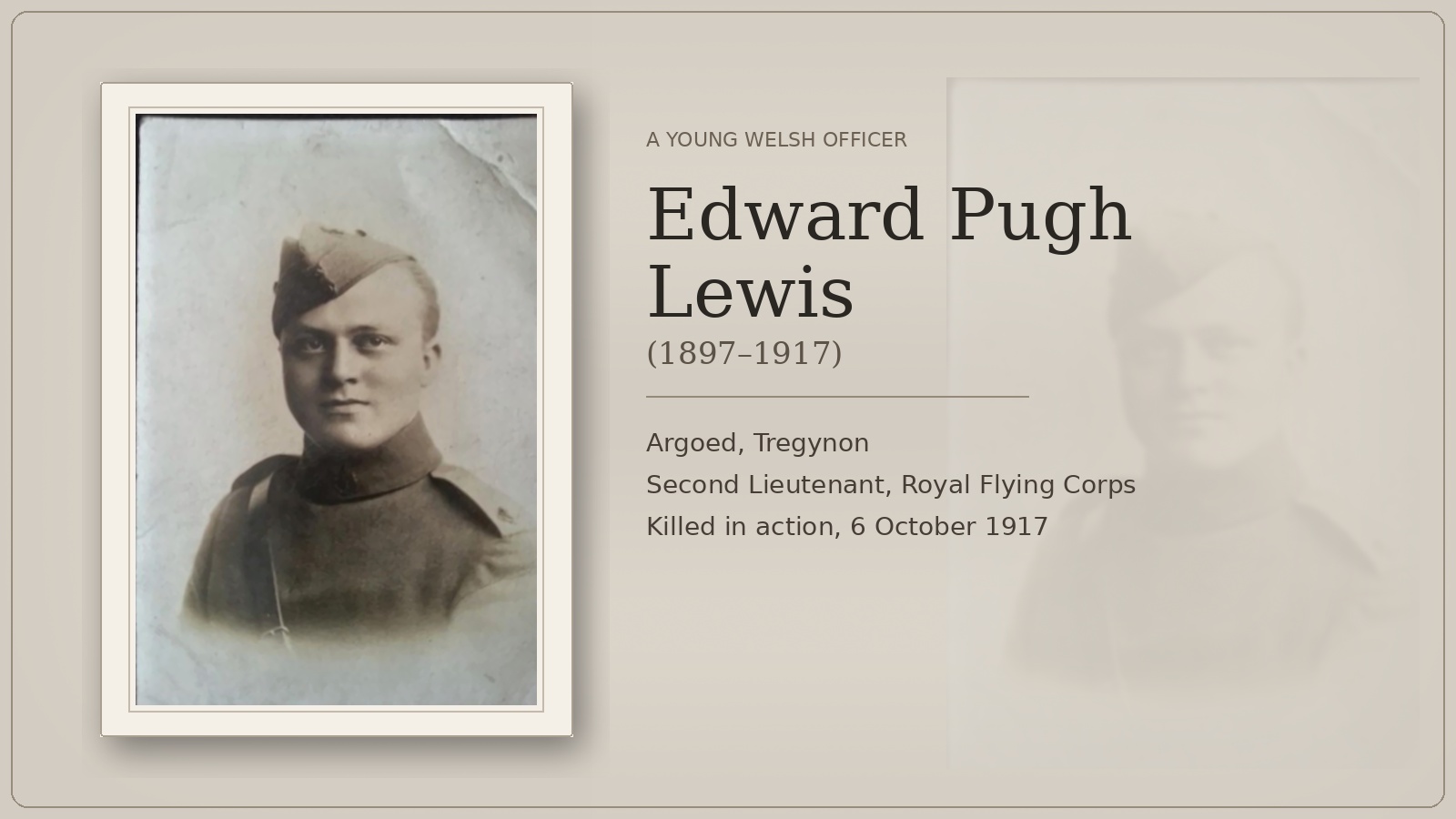
On 6 October 1917, an R.E.8 reconnaissance aircraft of No. 9 Squadron, Royal Flying Corps, was lost during operations around Ypres. Its two occupants were killed. One was Second Lieutenant Edward Pugh Lewis of Argoed, Tregynon, Montgomeryshire, who had turned twenty only seven months earlier.
There was little in Edward’s upbringing to suggest that he would die in an aircraft over Belgium. His family was well established in the farming society of Montgomeryshire, and his education took him from Newtown County School to the University College of Wales at Aberystwyth. He then entered military training and, in the spring of 1917, received his commission. The surviving papers make it possible to follow these changes with unusual precision.
What interests me particularly is the evidence beyond the official record of his death: his father’s letters, the signatures on his application and the list of possessions recovered afterwards. They return Edward to the family and community from which he came.
The Lewis family of Argoed
Edward Pugh Lewis was born on 10 March 1897 at Argoed, Tregynon, near Newtown, Montgomeryshire. He was the son of Evan Lewis (1855–1929) and Jane Lewis, née Pugh (1865–1955).
Evan Lewis was an established farmer who also served as a Montgomeryshire County Councillor and a Justice of the Peace. These were not minor distinctions in rural society. As a councillor and magistrate, Evan Lewis occupied a position of local responsibility and was evidently regarded as a man of sufficient standing to take part in the government of his county.
We should not assume that Argoed was a great estate or that the family enjoyed the wealth of the traditional landed gentry. The available evidence does, however, point to a comfortable and respected farming household, one able to provide Edward with a secondary and university education.
His mother’s ancestry was rooted in the farming communities around Machynlleth. Jane Pugh had been born at Tymawr, Aberangell, on 2 August 1865, a daughter of John Pugh (1834–1912) and Ann Elizabeth Jones (1840–1911). John Pugh had begun his working life in agricultural employment and subsequently developed substantial farming interests, including Glyncaerig at Llanwrin and Alltddu in the Llyfnant Valley. John’s rise from agricultural employment to the ownership of farms was a considerable achievement in a countryside where landownership carried both practical and social weight.
Other marriages bound the Pughs to neighbouring farming families. Jane’s younger sister Catherine Harriet Pugh (1880–1972) married David Davies (1870–1960) of Caeadda, Llanwrin, in 1923. Through Catherine Harriet and David Davies, Edward’s story connects with my own Davies family history. It is another example of how the farming families of the district were linked through marriage, land and generations of shared local experience.
Schooling and university education
Edward attended Newtown County School. A further trace of his education survives in the University of London’s matriculation examination lists: a candidate named Edward Pugh Lewis of Newtown County School appears in the January 1915 list, while Edward Pugh-Lewis, associated with the same school, appears in the June 1915 list. The matching names and institution make identification highly probable, although the lists record candidacy rather than results and do not imply that he studied in London.
He subsequently attended the University College of Wales, Aberystwyth. The Welsh university colleges had opened opportunities to students from families beyond the older university-going classes. What Edward intended to do after college remains unknown. His military papers describe him as a student but give no clear account of his academic subjects or professional ambitions.
Whatever his original plans, by January 1916 he had chosen military training.
Military training and commission
On 31 January 1916, Edward enlisted in the Inns of Court Officers’ Training Corps. He was eighteen years old. Although long associated with the legal profession, the corps provided training to prospective officers from a wider range of educated backgrounds during the First World War.
His enlistment papers gave his occupation as student and an address at Rose Hill, Powell Street, Aberystwyth. Argoed remained his family home. After more than a year of military preparation, he applied on 13 March 1917 for a temporary commission in the Royal Flying Corps. His father, Evan Lewis, also signed the application because Edward had not yet reached the age of twenty-one.
The application survives in the War Office file alongside references and a medical examination conducted at Berkhamsted on 8 March 1917. The medical certificate describes Edward as five feet eight inches tall and weighing 156 pounds, approximately eleven stone two pounds. His eyesight was recorded as 6/6 in each eye, and he was pronounced fit under the special standards applicable to the Royal Flying Corps. His signature survives on the application, something of more personal value to the family than the formal description of his medical fitness.
Edward’s appointment as a temporary Second Lieutenant took effect on 20 April 1917 and was recorded in the London Gazette on 6 June. He was entering a service that scarcely existed when he was a schoolboy.
No. 9 Squadron and the new aerial war
The Royal Flying Corps had been established in 1912. At the outbreak of war in 1914, military aircraft remained relatively primitive machines, but reconnaissance quickly became essential to the armies fighting on the Western Front. Aircraft observed enemy movements, photographed defensive positions and helped artillery batteries locate their targets and correct the fall of shells.
No. 9 Squadron’s history reached back to the earliest attempts to use wireless communication in the air. Its original formation at Saint-Omer in December 1914, as No. 9 (Wireless) Squadron, reflected the developing use of airborne wireless communication. The unit was disbanded in March 1915 and re-formed at Brooklands the following month before undertaking operational service in France. By 1917, the squadron’s duties centred upon reconnaissance and artillery observation.
Edward served with No. 9 Squadron, which operated the Royal Aircraft Factory R.E.8, a two-seat reconnaissance biplane. The aircraft’s crew normally consisted of a pilot and an observer, whose tasks required close coordination. Their work attracted less attention than that of the fighter pilots, but without accurate aerial observation artillery batteries could waste large quantities of ammunition or fail to locate their targets.
Their duties were dangerous. Observation aircraft could encounter enemy fighters and anti-aircraft fire, while the need to watch and report on a particular part of the battlefield could limit their freedom to evade threats. Edward’s duties belonged to this difficult and often overlooked part of the aerial war.
The final flight, 6 October 1917
Edward died during the Third Battle of Ypres, later closely associated with Passchendaele. On 4 October British and Commonwealth troops had fought the Battle of Broodseinde; the Battle of Poelcappelle followed on 9 October. Edward’s death on Saturday, 6 October therefore occurred between two major attacks, during a period in which reconnaissance and artillery observation remained central to operations.
On that day, Edward was aboard an R.E.8, serial number B5039, with Lieutenant Hubert Granville Holt, MC, an officer associated with Manchester University. The aircraft was lost, and both men were killed. Memorial accounts place the incident within the Ypres sector; one describes the aircraft as struck by a shell, while another refers to a crash near Poperinghe.
There is a difficulty in the evidence which ought not to be concealed. One memorial account identifies Holt as the pilot; Manchester University’s material identifies Edward as the pilot and Holt as the observer. Without an original aircraft casualty report or a sufficiently detailed squadron record, I cannot decide between them. The claim that the aircraft was struck by a shell likewise remains unverified. It is better to leave these questions open than to give a misleadingly precise account of Edward’s last moments.
What is certain is that Edward Pugh Lewis was killed in action on 6 October 1917, aged twenty, less than six months after receiving his commission.
The official report and a family’s loss
Edward’s officer service file, preserved at The National Archives under reference WO 339/99886, includes a field service report of death dated 8 October 1917. It records his rank, No. 9 Squadron, the date of his death and the official classification of killed in action. The report was produced only two days after his death, when the authorities were still establishing the administrative circumstances.
The papers then take us away from the air war and back to Argoed. In January 1918 his father wrote to military officials concerning money believed to be due and enquired about Edward’s pay book. Further correspondence in April explained that Evan had searched unsuccessfully for an earlier form requested by the War Office.
There is no dramatic language in these letters. Evan was asking about forms, money and a pay book, matters which had to be settled even after the death of his son. It would be wrong to read an absence of grief into the formality of his words. What the correspondence shows is the work that bereavement imposed upon families, sometimes many months after the casualty had been reported.
A further declaration records that Edward had left no will. Once again, his father’s signature appears in the file.
The belongings he left behind
Perhaps the most revealing document in the file is the inventory of Edward’s personal effects, dated 31 October 1917. The listed possessions included a cigarette case, matchbox case, cheque books, an identity disc and chain, tie pin, keys, wallet, knife, fountain pen, letters, stamps and a wristwatch whose glass was missing. The inventory also records a log book and two notebooks.
It is tempting to link the damaged objects with the accident that killed him, but the list alone cannot establish when or how that damage occurred. The log book is of particular interest. If it was a flying log book, it might once have recorded training and operational flights, although its contents and present whereabouts remain unknown.
These are ordinary possessions, but they tell us something that his service record cannot. Edward carried letters, writing materials, keys and a watch. He was an officer, but he was also a young man with personal concerns and connections beyond the squadron.
Burial and commemoration
Edward is buried in Mendinghem Military Cemetery, near Proven in Belgium, in Plot VII, Row B, Grave 51. Immediately beside him, in Grave 50, lies Lieutenant Hubert Granville Holt, MC, who died with him aboard B5039.
The two men had different backgrounds. Edward came from a Montgomeryshire farming family and had studied at Aberystwyth. Holt was associated with Manchester University and had been awarded the Military Cross. They served together, died together and were buried in consecutive graves. The cemetery register records that fact without elaboration, and it needs none.
Edward was also commemorated in his home community at Tregynon, in the University of Wales at Aberystwyth’s memorial tradition and in the Montgomeryshire County Memorial. His name thus appears in the records of the village from which he came, the university he attended and the county to which his family belonged.
The Royal Air Force did not formally come into being until 1 April 1918, through the amalgamation of the Royal Flying Corps and Royal Naval Air Service. Edward was therefore an officer of the RFC, not the RAF. His service nevertheless belongs to the formative history from which the new air force emerged.
A life interrupted
Edward Pugh Lewis was not a famous airman. He did not live long enough to establish a distinguished military career. His short life is nevertheless worth examining, not least because it shows how a young man from a prosperous Welsh farming household passed from education into a new and dangerous form of warfare.
His family had invested in his education, and he had reached university. We do not know what profession he might have entered or whether he intended to return to Montgomeryshire. We do know that he joined officer training before his nineteenth birthday and was killed before reaching twenty-one.
The survival of the War Office file is especially valuable. It gives us his handwriting, a physical description, dates of training and commission, and the letters written by his father. The list of belongings and the position of his grave provide further evidence which would otherwise have disappeared from family knowledge.
When I look at Edward’s photograph, I am conscious of how little the official phrase ‘killed in action’ can tell us about a life. The records do not allow me to know his thoughts or character in any intimate sense, and I have no wish to invent them. They do allow me to restore his place within a family, a particular Welsh community and the early history of military flying. That, more than any claim to fame, is why his story deserves to be preserved.
Related studies on this website
Edward’s life can be read alongside John Pugh of Glyncaerig (1834–1912), the history of his maternal grandfather; Caeadda, Llanwrin: Three Centuries of Farming, examining his extended family’s agricultural background; and Llanwrin: A Montgomeryshire Village, Its People and My Family’s History. Readers may also explore the wider Montgomeryshire History and Family History & Genealogy guides.
Sources and research notes
- The National Archives, WO 339/99886, Edward Pugh Lewis, officer service file, digitised copies in the author’s family archive: enlistment, commission application, medical examination, field service death report, estate correspondence and inventory of effects.
- London Gazette, Supplement to Issue 30117, 6 June 1917, p. 5604, temporary commission effective 20 April 1917.
- University of London, matriculation examination records, 1914–1916, candidate lists for January and June 1915.
- Pugh Family, unpublished genealogical compilation, author’s private family archive.
- West Wales War Memorial Project, Tregynon War Memorial, Edward Pugh Lewis entry.
- Manchester University First World War Roll of Honour, Hubert Granville Holt entry, for the aircraft and differing crew identification.
- Commonwealth War Graves burial information for Mendinghem Military Cemetery, Edward Pugh Lewis and Hubert Granville Holt.
- Royal Air Force Museum, Royal Aircraft Factory R.E.8, aircraft type and history.
- Peter Dye, ‘Nine Squadron RFC–RAF: An Analysis’, Cross & Cockade International, vol. 28, pp. 73–109, identified for further consultation; full article not examined.
Research note: the pilot/observer identification and the exact cause of B5039’s loss remain unresolved in the examined evidence. The London matriculation lists establish examination candidacy, not a pass or attendance at the University of London. Descriptions of family standing are historical interpretations, not verified valuations of personal wealth.
Researched and written by Antony David Davies. The author is related to Edward Pugh Lewis through the Pugh and Davies families of Montgomeryshire.